

Welcome to this latest edition of Workbench and all the news, updates and exclusive announcements from the fascinating world of Airfix modelling. On 3rd July 2015, the Airfix website published the first edition of a new blog entitled ‘Workbench’, which was intended to bring Airfix enthusiasts all over the world the very latest product development and new project information much earlier than had previously been the case. Since that date, the blog has gone on to become something of a hobby phenomenon, increasing its readership with each new edition and allowing us to bring our loyal readers new model development information from initial announcement, right through to eventual kit release.
This latest edition of our blog marks three fantastic years of Workbench and whilst we are obviously extremely proud of this this achievement and are keen to mark it in some style, we have decided to defer our celebratory edition until the next blog for one specifically seasonal reason – holidays. We have something very special planned for our next edition, but rather than forego our usual blog publication slot entirely, we decided to produce a condensed version of Workbench this time, whilst still featuring a significant addition to the current Airfix model range. Although slightly shorter in length, we can still promise you a Workbench exclusive and a closer look at a handsome new model which marks an important Royal Air Force type, in this significant centenary year for the force. We will be keeping the celebratory Workbench champagne (or should that be poly cement) on ice until the next edition of our blog.
As we currently find ourselves in the centenary year of the Royal Air Force, many modellers will be planning projects featuring some of the most significant aircraft to wear the famous roundel of the RAF and we will all undoubtedly have our own opinions on which types are most deserving of inclusion in this illustrious group. From the early fighters of the Great War to the latest Eurofighter Typhoons protecting Britain’s airspace, there are a number of aircraft which are likely to be popular choices amongst modelling enthusiasts, whilst others which could claim to be equally deserving of consideration are likely to slip through the net. One such aircraft is the Douglas Dakota, an aircraft which performed some of the essential support tasks during the Second World War and beyond, without which it would have been difficult for the Allies to secure a hard fought victory. An aircraft which was not initially designed for war, but adapted from the world’s first great airliner, it went on to serve in every theatre of war and prove decisive in keeping the machinery of war moving in the right direction for the Allies. From transporting men and equipment, to evacuating casualties and leading D-Day, the Dakota not only has a strong claim to be considered in our RAF centenary lists, but also as one of the most significant aircraft in the entire history of flight.
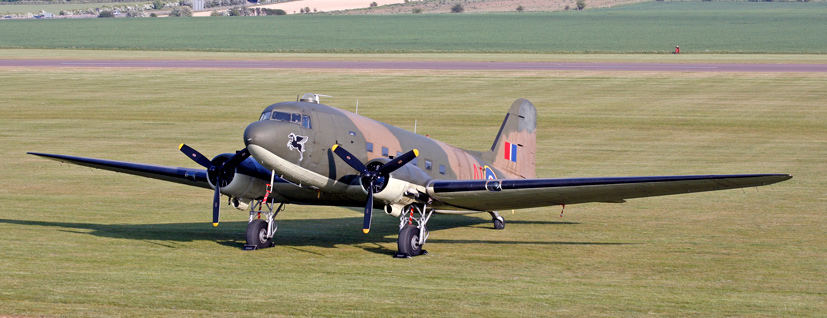
The famous Dakota operated by the Battle of Britain Memorial Flight is one of the most popular display aircraft on the UK Airshow scene
There are few aircraft in the history of aviation able to boast the significant reputation enjoyed by that of the Douglas DC-3/C-47/Dakota. This revolutionary aircraft was responsible for establishing comfortable and reliable passenger air travel throughout the United States in the 1930s, as well as attracting significant military interest from the US Army. As America watched Europe and the Far East descend into conflict in 1939, they quickly realised that they needed an effective aircraft to potentially transport troops into combat areas and resupply their forces wherever they may be operating - a military version of the rugged and reliable DC-3 was identified as the ideal solution. As these aircraft began to roll off the production lines, they were also proving to be of great interest to the British and following the Japanese attack at Pearl Harbor and America’s entry into the war, the C-47 was supplied to British and Commonwealth air forces under the Lend-Lease programme in some numbers.
The first C-47s in British service arrived in India during 1942 and were given the name Dakota – there are several theories as to the source of this name, with some stating it was an acronym derived from Douglas Aircraft Company Transport Aircraft ‘DACoTA’, although it is much more likely to have simply been a randomly selected US state/place name as used with previous US aircraft types in British service, such as the Buffalo, Maryland, Boston and Baltimore. Over 1900 Dakotas were eventually produced for British and Commonwealth air forces, from a total production run of over 10,000 aircraft and like all C-47/Dakotas, they were to perform a vital role in keeping the Allied forces on the move and their enemies on the back foot. British Dakotas were to see extensive service during the Burma campaign, the D-Day landings and operations at Arnhem and it is interesting to note that Dakotas were operated by both the RAF and BOAC during WWII. With many of these aircraft going on to see military service long after the end of the Second World War and the C-47/Dakota still being a regular performer at Airshows all over the world, there is no doubt that it has to be considered as one of the most significant aircraft in the history of aviation and one of the most important types to see Royal Air Force service.
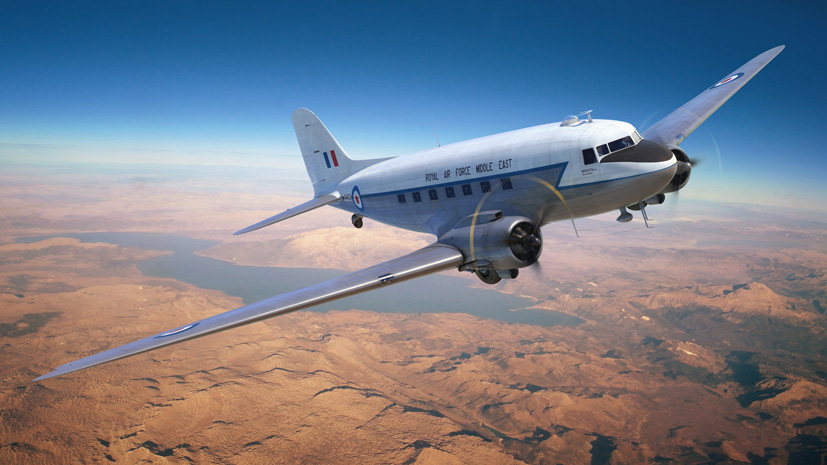
The latest exclusive artwork reveal for Workbench readers features this beautiful RAF Dakota operating over the barren terrain of the Middle East
Tracing its lineage back to the first flight of the Douglas DC-3 passenger airliner in December 1935, the RAF operated the Dakota from 1942 until retiring their last example in 1970. With an enviable safety record and a reputation for being as reliable as it is rugged, this attractive aircraft is still a regular performer at Airshows and as it gracefully sweeps across the sky, it is difficult to accept that you are admiring an aircraft design which is now over 80 years old. The latest Airfix model range included the announcement of two attractive new scheme options for the popular Douglas Dakota Mk.III tooling and as this kit is scheduled for an August release, it seems appropriate to take a look at these now, particularly as they represent two totally contrasting representations of the Dakota in RAF service.
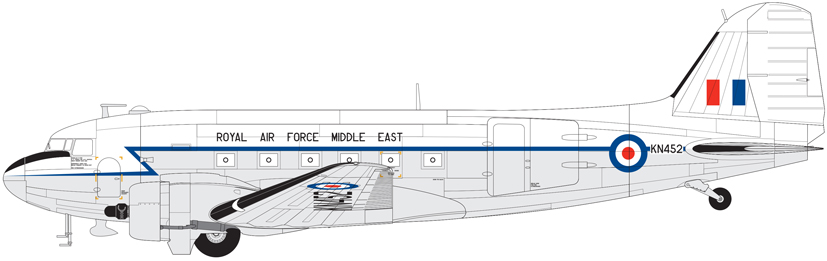
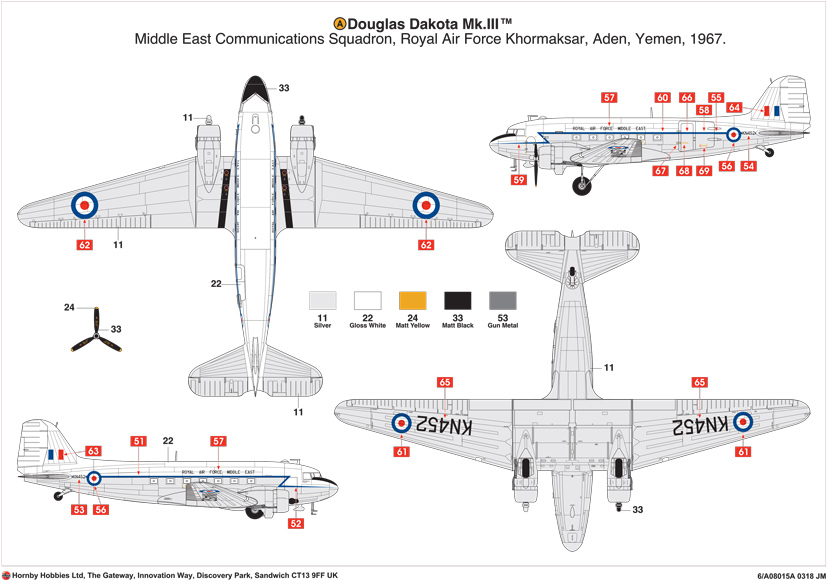
Full scheme and decal placement guide for the RAF Middle East Communications Squadron Dakota
Of all the many schemes worn by the famous Douglas DC-3/C-47/Dakota during its long service career, surely the aircraft of Royal Air Force Transport Command were the most attractive. Wearing this striking silver and white scheme, with blue cheat line and black anti-glare panel on the nose, it is as if the Dakota was built for these colours and makes the already attractive lines of the aircraft seem even more appealing. Operating with the Middle East Air Force Communications Flight, out of Khormaksar airfield in Yemen, Dakota Mk.III KN452 was the oldest aircraft in their fleet and one of two Dakotas they operated, both of which were maintained by civilian DC3 engineers employed by Aden Airways and usually parked on the civilian side of the airfield. As the main base operated by RAF Middle East Command, Khormaksar was a busy place and home to three quarters of the RAF and Fleet Air Arm aircraft in the region, as well as being a civilian airport. Its main military responsibilities revolved around providing tactical and transport support in the region, protecting the area from potential attack and supporting the movement and deployment of troops and supplies.
This particular aircraft was constructed as C-47B-30 by Douglas at their Oklahoma City plant. It was taken on charge with the USAAF (s/n 44-76591), before being transferred to the Royal Air Force in March 1945 – given the serial number KN452, it entered RAF service at Montreal, in Canada. In a long and distinguished RAF career, this Dakota spent much of its time in the Far and Middle East, serving notably with the Coastal Command Communications Flight at RAF Gibraltar in the 1950s and as the oldest of the MEAF Communications Flight aircraft flying out of Aden in the mid 1960s. Following the end of its military service, it was bought by Shackleton Aviation and given the civilian registration G-AXJU, only to be sold to the Kenyan Police the following year, who operated it until October 1974. Having spent much of its service life in the Far and Middle East, it would once again find itself back in the region with Airfast Freight Services in Singapore, before eventually having its civil registration cancelled and being broken up for spares at Seletar airfield, with the remaining hulk scrapped – such an ignominious end for a hard working and well travelled aircraft.
With this being such an attractive scheme for a Dakota to wear, it will be difficult to look past this option when building this magnificent kit. With 2019 marking the 75th anniversary of D-Day and WWII Dakotas destined to receive plenty of attention, this will make a welcome and slightly more colourful way in which to present this important and extremely attractive aircraft.
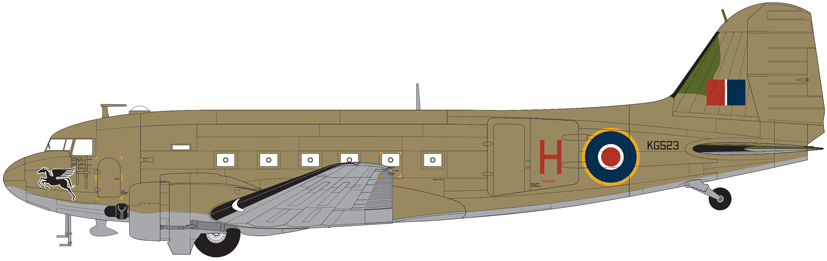
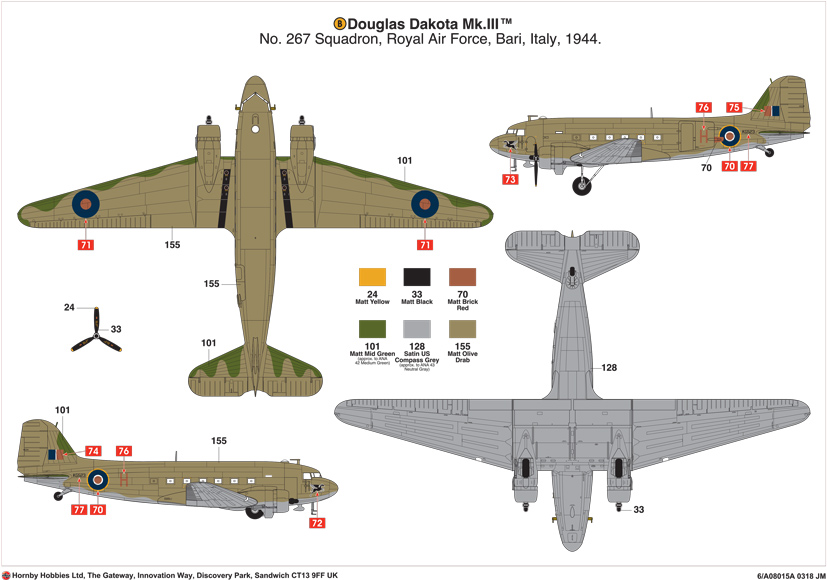
This wartime RAF Dakota Mk.III features the famous Pegasus emblem of RAF No.267 Squadron
One of the most distinctive features of the Douglas C-47 was the large double cargo door positioned on the rear port side of the fuselage, which allowed this magnificent aircraft to prove such a useful asset during its military service. Not only was it used for the transportation of troops and supplies across war zones, but also for clandestine supply drops aiding partisan forces around Europe and the evacuation of sick and wounded troops and civilians. This particular Dakota was the subject of a famous wartime photograph as it prepared to transport sick partisans and civilians from Bari airfield in Italy. Large numbers of people fighting and supporting the Yugoslav National Liberation Army had been evacuated to Italy by the Balkan Air Force Casualty Evacuation Section and it was feared that many may be suffering from disease, specifically typhus, dysentery and tuberculosis. Officials were so worried about the prospect of a sickness epidemic that they deployed specialist teams to meet the evacuees on their arrival at Bari and immediately transport suspected cases to specially equipped typhus treatment centres – yet another important job performed by the Dakotas of the Royal Air Force.
RAF No.267 Squadron was formed in September 1918 in Malta and was initially charged with performing maritime patrols and anti-submarine support around this strategically important island. During the Second World War, the squadron reformed as a communications unit in Egypt and later went on to extend its operations across the Mediterranean, Italy and the Balkans, not only undertaking transport and supply duties, but also working closely with partisan forces in the region. One particularly noteworthy mission carried out by a 267 Squadron Dakota was 'Operation Wildhorn', which was a highly secret and extremely dangerous mission to pick up agents and parts of a recovered V-2 rocket from Poland. The squadron moved to bases in Italy from 1943 and India in early 1945, as their Dakotas continued to support Allied offensives in driving back the enemy on all fronts. The Dakota presented in this scheme option carries the squadron’s Pegasus winged horse emblem on both sides of the nose of the aircraft.
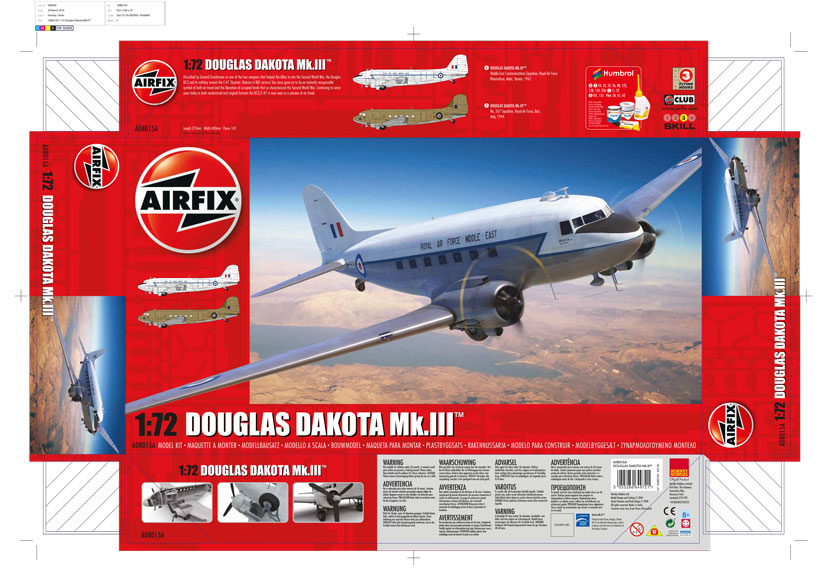
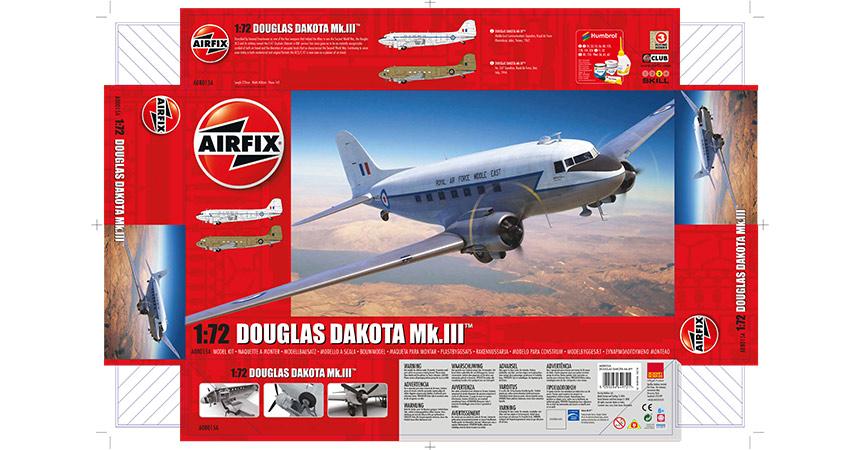
This box artwork will be a familiar sight in model shops following the release of A08015A in August
Douglas Dakota Mk.III A08015A is scheduled for an August 2018 release and will mark one of the most important aircraft to serve with the Royal Air Force in this, their significant centenary year. With two distinctly different RAF schemes to choose from, it will be interesting to see which one proves to be the most popular amongst the build pictures uploaded to the Customer Images section of the Airfix website, in the months following its release.
We are afraid that is all we have for you in this slightly shorter holiday edition of Workbench, however, we will be back in two weeks’ time with our very special third anniversary edition. In the meantime, if you have any suggestions for subjects you would like to see covered in a future edition of the blog, or ways in which we could enhance your enjoyment of Workbench, please do not hesitate in contacting us. We can be reached via our usual e-mail address at workbench@airfix.com or by contributing to our Workbench thread over on the Airfix Forum. If social media is more your style, you could access either the Airfix Facebook page or our Twitter channel, using #airfixworkbench where you will find plenty of modelling news, views and discussion. Whichever medium you decide to use, please do get in touch, as it is always interesting to hear from fellow modelling enthusiasts and the projects you have on the go at the moment.
As always, the Airfix website is the place to go for all the latest model release information, with our New Arrivals, Coming Soon and Last Chance to Buy sections all accessed by clicking on the above links. As updating the website is a constant process, a quick search through each section of the Airfix web pages will reveal new information and updated images in many of the product sections and this is always an enjoyable and rewarding way to spend a few minutes.
The next edition of Workbench is due to be published on Friday 20th July, when we look forward to bringing you all the latest news, updates and exclusives from the fascinating world of Airfix modelling.
Thank you for your continued support.
The Airfix Workbench Team
© Hornby Hobbies Ltd. All rights reserved.

