

Welcome to this latest edition of Workbench and all the news, updates and exclusive announcements from the fascinating world of Airfix modelling. This latest blog marks a change to our usual blog format, as the holiday season has dictated that this will be a slightly abridged version of Workbench, but rather than miss our usual fortnightly production slot altogether, we wanted to bring you the latest update from one of the most anticipated new tooling releases of 2019 – our new 1/72nd scale Blackburn Buccaneer S.2 kit. As this project continues towards its release date, we take a closer look at the two scheme detail options which will be included with the kit, both of which will encourage modellers to consider British airpower of the Senior Service and marking the strong naval heritage of the mighty Buccaneer. We also celebrate the launch of our new 1/24th scale Grumman F6F-5 Hellcat by bringing you a picture of our recent Centenary edition competition winner, as he proudly holds his Hellcat box, the first person in the world to own this magnificent new kit – it is available now, so you will need to act quickly if you want one from this initial production run.
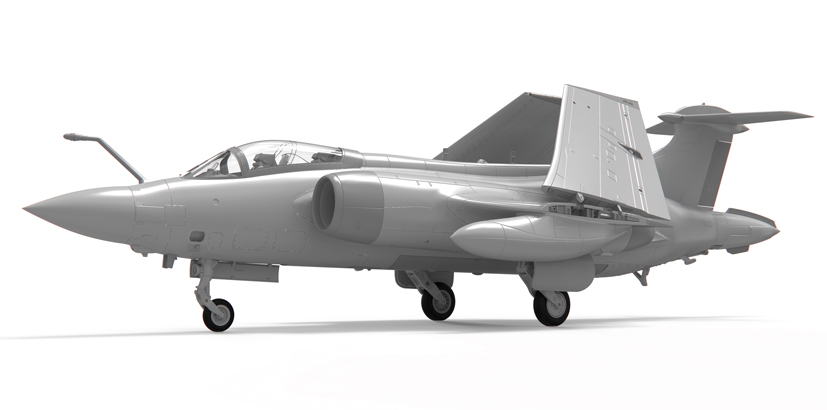
Even though the Buccaneer ended its flying days wearing the colours of the Royal Air Force, its naval heritage was always clearly evident, from its folding wings, to the powerful arrester hook under its rear fuselage
Although many enthusiasts will undoubtedly associate the Blackburn Buccaneer with the camouflage of the Royal Air Force, as these were the colours the aircraft wore for the final sixteen years of its service life, it was originally conceived as a high performance naval strike jet and its Fleet Air Arm heritage always remained easily identifiable. The Blackburn Buccaneer can trace its development history back to the 1950’s and a massive naval expansion programme undertaken by the Soviet Navy. With their intention to introduce large numbers of their new Sverdlov Class Cruisers into service, the Royal Navy were concerned that they would not be in a position to mount an effective defence against this new threat with their existing force alone. Simple economics dictated that Britain would not be in a position to undertake a similar expansion programme of their own, so it was quickly decided that a capable new naval strike aircraft would be the answer, one able to operate from existing carriers, but possessing the ability to detect and destroy the new Soviet vessels. The aircraft would be the first of its type to be developed from the outset as an ‘under radar’ design and would need to provide excellent performance at low altitudes, as well as the capability to deliver nuclear munitions on their target, if required. Clearly, these parameters would place extreme demands on any aircraft, however, the new jet would need to achieve all this whilst operating from one of Britain’s diminutive aircraft carriers – this would have to be a very special aeroplane indeed.
The operating environment for Fleet Air Arm Buccaneers could hardly have been more demanding and not only called for a highly capable strike jet, but one which could be operated from the relatively small decks of Britain’s aircraft carriers. Even though most Navy Buccaneer squadrons would spend the majority of their time operating from shore based stations, they were also regularly required to be deployed on carriers, as part of an air group which also included fighters, helicopters and airborne early warning aircraft. As these carriers were small by international standards, this meant that the decks of these vessels were extremely busy environments and the effective operation of these large and powerful jets required not only the very best aircrews, but also a highly trained team of deck handlers who were well versed in launching and recovering fast jets at sea. With the aircraft having to conform to the size constraints of Britain’s existing carriers, Blackburn design engineers not only had to produce the world’s finest naval attack jet, but also make it small enough to fit on the existing deck lifts equipping British aircraft carriers and at a height low enough to allow it to be safely stowed below deck, should the aircraft require maintenance. Sharing a common design feature with many other naval aircraft, the wings of the Buccaneer folded upwards for stowage and due to the overall length of the aircraft, both the nose (radar housing) and the split rear speed break ingeniously folded back and split open respectively – these features allowed a Buccaneer to use the deck lifts on HMS Ark Royal, HMS Hermes and HMS Eagle, without compromising the aerodynamic integrity of this highly advanced aircraft. As for its performance, although this was not a supersonic aircraft, the Buccaneer was capable of high subsonic speeds at extremely low level and significantly, was a stable weapons platform. When the only thing that mattered was effectively carrying out its mission, the Buccaneer excelled where its contemporaries could not compete and when added to the flexibility of a floating naval task force, the Fleet Air Arm had an aircraft which they could be proud of.
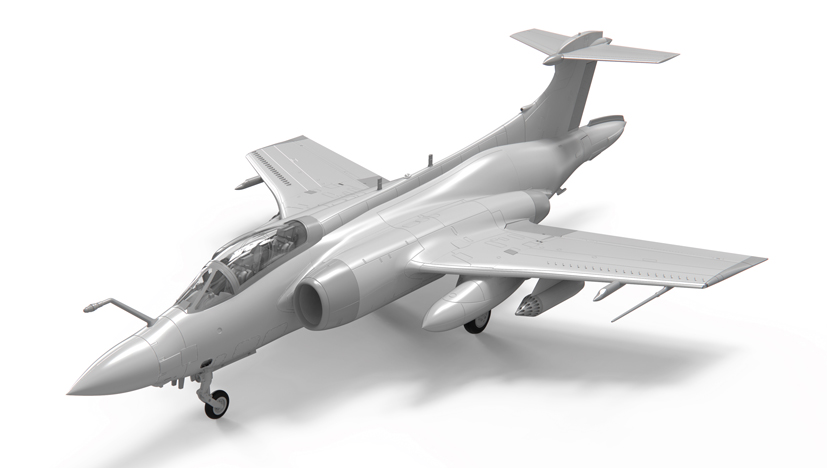
A computer rendered 3D image of the new 1/72nd scale Buccaneer S.2, showing the distinctive lines of this capable Cold War strike jet
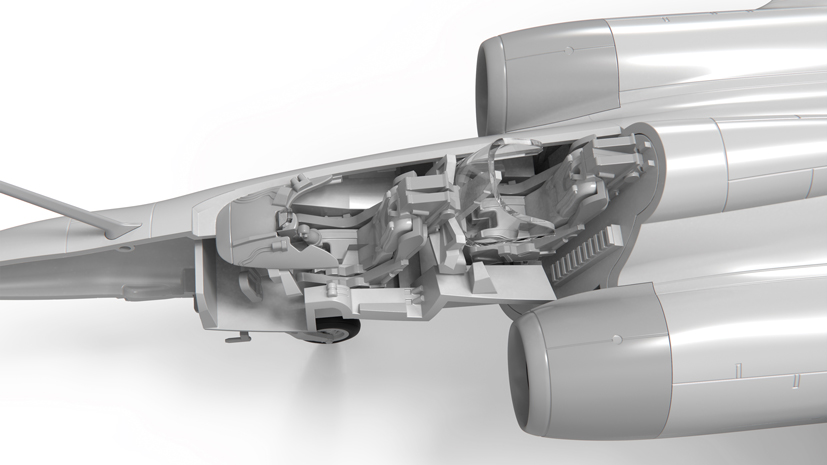
Detail in scale. One of the project images produced by the development team to highlight some of the detail which has been incorporated into this new kit
The first Buccaneer’s entered Royal Navy service in 1962 as the S.1 variant, powered by a pair of De Havilland Gyron Junior engines, which proved to be something of a disappointment and held the operational effectiveness of the aircraft back somewhat. The introduction of the Buccaneer S.2 from 1965 saw the aircraft equipped with the much more powerful Rolls Royce Spey engines and a further upgrade of its already impressive strike capabilities. Providing the aircraft with 40% more thrust, increased range and greater efficiency, the Buccaneer S.2 was now an even more capable fighting aircraft and one which must have struck fear into the hearts of Soviet naval captains. With its increased power, the S.2 variant was more than capable of landing back on a carrier with one engine shut down, possessing enough thrust to safely go around again, should the aircraft fail to catch the arrestor hook. The adoption of the S.2 was not without its incidents, however, and two rather high profile accidents would result in the temporary grounding of Britain’s Buccaneer force. In 1979 and 1980, two different aircraft lost their starboard wings whilst on flight operations and immediately brought about the grounding of the entire Buccaneer fleet. Investigations revealed fatigue cracks in the wing spars and new components had to be manufactured and fitted, before the aircraft could return to normal duties – during this time, Buccaneer crews were required to maintain their currency by flying other aircraft, such as the Hawker Hunter.
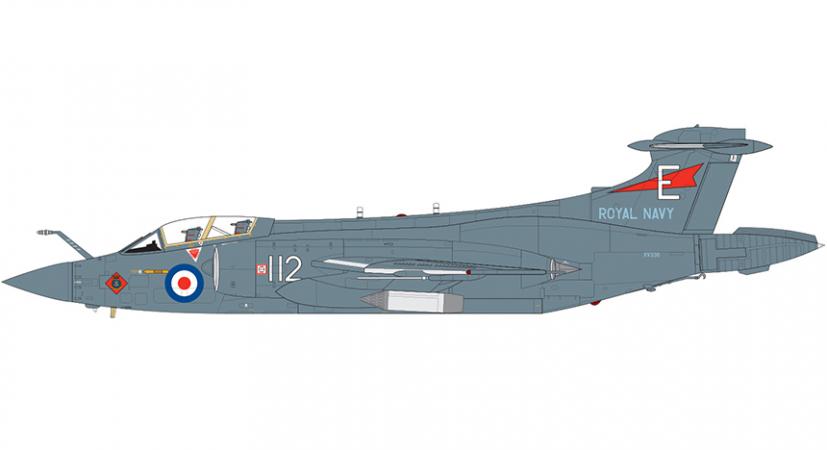
With its rich naval heritage, it is somehow fitting that the first release from our new 1/72nd scale Blackburn Buccaneer S.2 includes scheme and decal options to complete the kit in one of two attractive Fleet Air Arm liveries, both featuring the distinctive all-over extra dark sea grey colour scheme. Let’s take a closer look at each of these finish options.
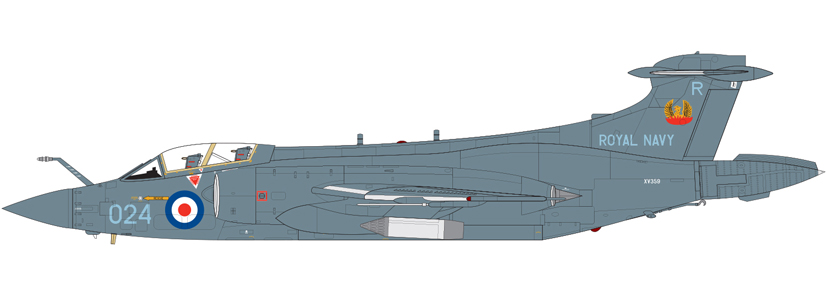
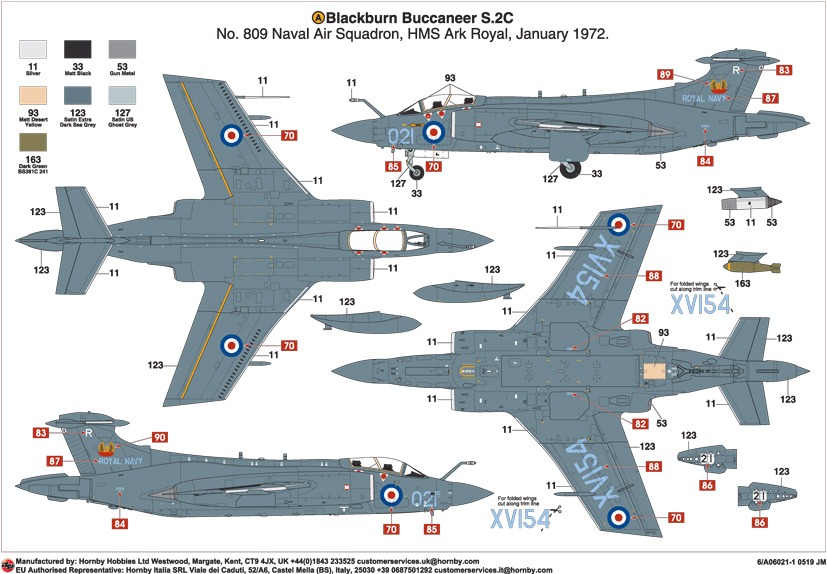
These appealing lead scheme details present one of the two Buccaneers which ‘buzzed’ Belize City in January 1972
The Buccaneer was a very large aeroplane, which served onboard Britain’s relatively small aircraft carriers with other large and powerful aeroplanes. Initially, these would have been De Havilland Sea Vixens, but this twin boom naval fighter was replaced in 1970 by the even larger McDonnell Douglas Phantom. The sight of these mighty aircraft operating from the decks of HMS Ark Royal must have been truly magnificent, if a little terrifying for those involved – there would certainly have been no room for error. During the final eight years of her service life, the strike component of Ark Royal’s air wing comprised 14 Buccaneer S.2s of No.809 Naval Air Squadron, along with Phantom FG.1s, Fairey Gannets, along with Sea King and Wessex helicopters, usually around forty aircraft in total.
No.809 Naval Air Squadron’s association with the Buccaneer began back in early 1963, when they re-formed as the second FAA Buccaneer squadron, at that time operating the original S.1 variant aircraft. They received the much improved S.2 in 1966, aircraft which replaced the half white-half dark sea grey scheme of their predecessors for a smart all-over extra dark sea grey livery, whilst still retaining the units famous ‘Phoenix’ emblem on their tails. With six aircraft embarking on the deck of HMS Hermes for the first time in 1966, the squadron’s longest shipborne association would prove to be the almost eight years spent on HMS Ark Royal, where from 1972 onwards, No.809 Naval Air Squadron became the last Fleet Air Arm squadron to operate the Buccaneer.
During their time on Ark Royal, navy Buccaneers were involved in many exercises and international deployments, but perhaps non as interesting as a situation which arose in 1972. Following a breakdown in negotiations between Britain and the Guatemalan Government over the disputed sovereignty of British Honduras, there was the very real threat of a hostile invasion and Britain were keen to show their intentions to repel such an incursion. Ordered to steam for the region with some haste, the crew of HMS Ark Royal immediately began to draw up a plan, whereby their air wing could display a show of their awesome striking potential, in an attempt to prevent this disagreement from escalating into conflict. As soon as the ship was within range, she launched four of her Buccaneer strike jets on what turned out to be a momentous 2600 mile, six hour sortie to reassure the people of British Honduras and to strike fear into the hearts of Guatemalan forces who may have been preparing for invasion. With two of the Buccaneers acting as ‘buddy tankers’, the remaining two Buccaneers announced their presence over Belize City with two noisy and attention grabbing orbits, underlining the fact that should it come to it, HMS Ark Royal possessed greater destructive potential than anything the Guatemalan forces possessed. Thankfully, crisis was averted and the reputation of the Buccaneer’s striking capabilities (and long sea legs) saved the day.
This particular Atlantic deployment proved to be one of Ark Royal’s most eventful cruises and actually resulted in the loss of one of her Buccaneer S.2s. During deck handling manoeuvres at night, Buccaneer XT269 fell off the deck of the ship and into a watery grave, a rather expensive mistake which must have seen at least one person reporting to the Captain first thing in the morning.
The lead Buccaneer scheme details to be included with the release of our new 1/72nd scale kit allows the modeller to finish their model as one of the two Buccaneers which performed the invasion preventing ‘Buzz job’ over Belize City in January 1972, which at that time, was one of the longest missions of its kind ever to be undertaken – an interesting episode in the illustrious history of the Blackburn Buccaneer. Interestingly, No.809 NAS and their ‘Immortal Phoenix’ will re-commission in April 2023 as Britain’s second Lockheed Martin F-35B Lightning II squadron, carrying the naval standard of this unit into the future, as they once again operate one of the world’s premier fighting aeroplanes.
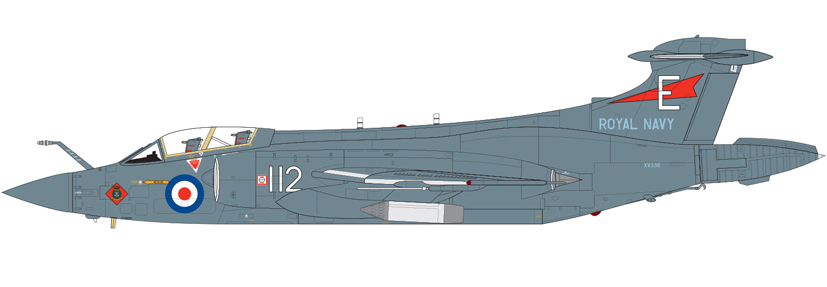
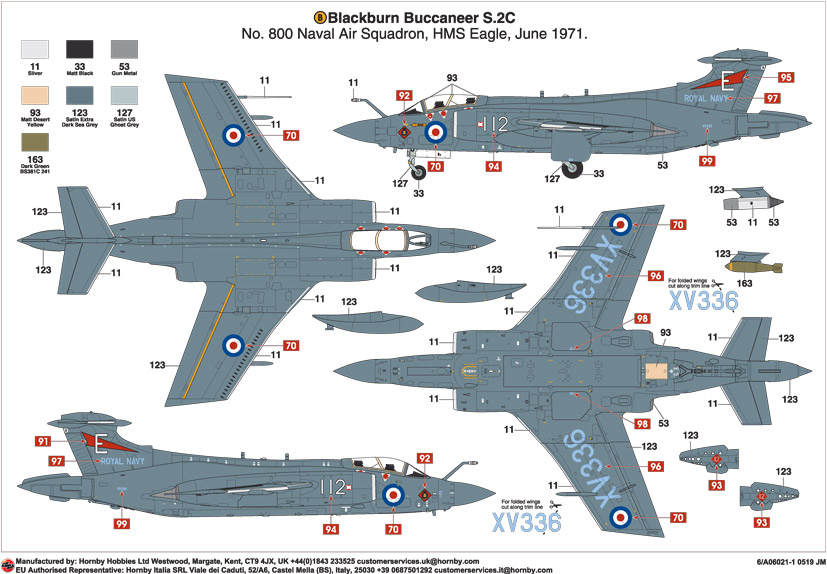
Again sporting a rather colourful tail, this scheme option marks one of HMS Eagle’s Buccaneer S.2s during her final year of service and only months before this aircraft was transferred to Royal Air Force service
Equipped with the Buccaneer S.1 from March 1964 and operating from the decks of HMS Eagle, No.800 NAS would launch their aircraft with a full weapons load, but only limited fuel, as the size of the carriers deck and the relatively low power of the aircraft’s Gyron Junior engines would not allow the aircraft to do both. Following launch, these early Buccaneers would take on more fuel from waiting Supermarine Scimitar tankers, before embarking on their latest mission. This complex scenario was eradicated with the arrival of the Rolls Royce Spey powered Buccaneer S.2 in 1966, as its improved performance allowed the aircraft to be operated with both fuel and weapons, making this the ultimate fleet strike aircraft. With its exceptional low altitude performance and ability to carry a wide weapons load, the Buccaneer was a feared adversary and one which maintained the Royal Navy as one of the world’s elite fighting units. The Buccaneers of No.800 NAS were famously involved in the destruction of the stricken oil tanker Torrey Canyon off Lands End in March 1967, as the government attempted to avert an environmental catastrophe by breaking open the vessel and burning its flammable cargo. Operating from RAF Brawdy, eight Buccaneers from No.800 NAS dropped 42,000 lbs of high explosive bombs on the tanker, achieving an impressive 75% success rate.
After their involvement in this historic event, the squadron’s Buccaneers would be associated with HMS Eagle for the remainder of its service life, mainly operating with Sea Vixen and Gannet aircraft, but also used to trial the Navy’s adoption of the mighty McDonnell Douglas Phantom. The normal operating configuration of the carrier’s Buccaneers would be ten aircraft maintained in their usual strike configuration, two configured for reconnaissance duties and the remaining two as buddy tankers – in this way, the squadron were ready to face any potential mission scenario, allowing the carrier to be at her most effective. Although thought to be in better cosmetic condition than her sister ship HMS Ark Royal, the decision not to refit Eagle for Phantom operation saw the transferral of 20 Fleet Air Arm Phantoms to Royal Air Force service and ultimately, the withdrawal from service of this famous ship. As she docked at Devonport in early 1972, she was stripped of all useable components and her Buccaneers flew to Lossiemouth, where they effectively came under the control of the RAF. With the disbandment of the squadron in the same month, the Fleet Air Arm were left with just one operational Buccaneer squadron, the flying Phoenix of No.809 NAS.
Blackburn Buccaneer S.2 XV336 was constructed at Brough during 1966, making her maiden flight from Holme-on-Spalding Moor on 31st January the following year. She entered Fleet Air Arm service on 28th February 1967 and would spend much of the next four years operating from the decks of HMS Eagle, providing the Navy with a capable strike force. Like most of the former Fleet Air Arm Buccaneer S.2 airframes, XV336 was passed to the Royal Air Force in 1972, where she would spend the majority of her service life wearing the camouflage of a land based strike jet, though still retaining her naval heritage. She was scrapped at Shawbury in October 1991, an ignominious end for one of the Cold War’s most effective naval strike jets.
As we all look forward to the scheduled late summer release of the new Buccaneer, we now only have two further project updates to bring our readers – built model images and the unveiling of the box artwork. Hopefully, we will be in a position to bring you these details in the very near future, as many people are very much looking forward to building this magnificent kit.
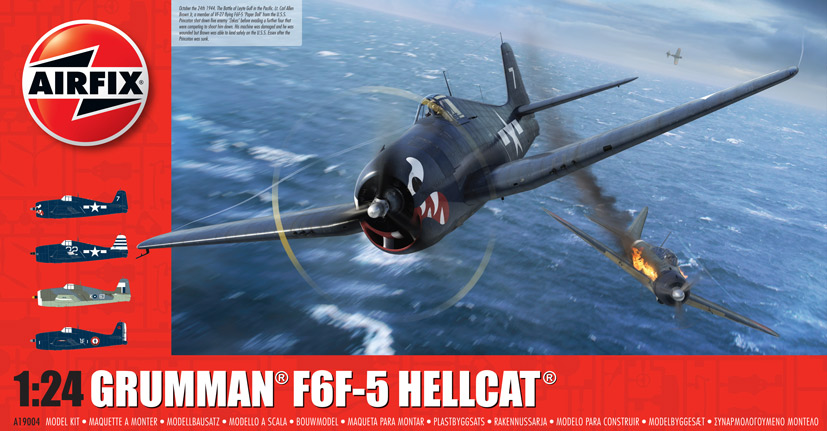
We are delighted to announce that our long wait for the new 1/24th scale Grumman F6F-5 Hellcat is over and this magnificent model is now available. After months of bringing our readers exclusive updates from this latest addition to our large scale aviation kit range and increasing everyone’s excitement levels, pre-ordered models are already in the process of being dispatched and model stores all over the world will be receiving their allocation of these magnificent models. At this moment in time, the Airfix website still has limited numbers of these kits available, but please be aware that this situation could change very quickly, as ordering activity over the past couple of days has been brisk to say the least. We are very much looking forward to featuring all your build images in future editions of our blog, although with the amount of detail included with this kit, we do not expect to see the first completed examples until nearer the end of the year – who will be the first to have their Hellcat featured in Workbench?
We would like to end this holiday edition of our blog by including this picture of a rather pleased looking Tim Crockett, with his recent Airfix competition win. Tim was the lucky winner of our Workbench Centenary Edition blog and therefore the first modeller in the world to receive an example of our new 1/24th scale Hellcat – judging by the impressive model display on his cabinet, the Hellcat will be in good 1/24th scale company and Tim has promised to keep us updated on his build progress. We hope Tim enjoys building his prize kit and we look forward to sharing his endeavours in future editions of the blog.
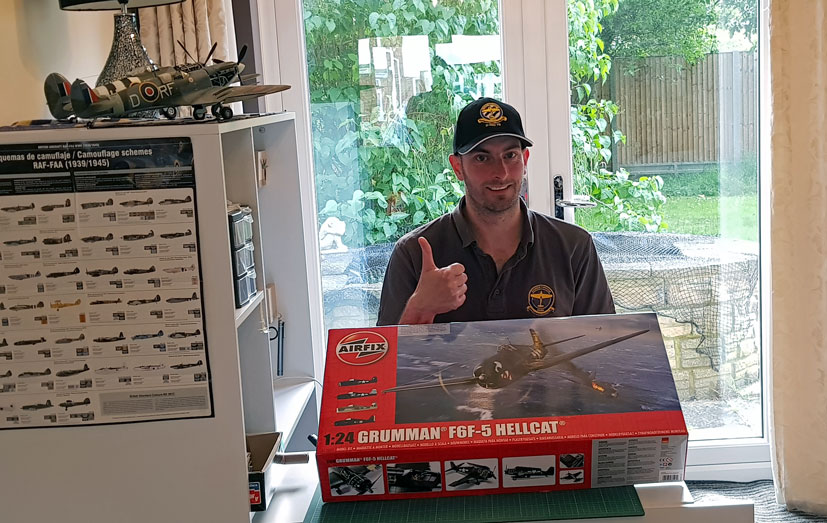
Tim Crockett looking rather pleased with his Centenary blog competition win. He was the first modeller in the world to get his hands on this impressive new kit
That’s all we have for you in this holiday edition of Workbench, however, we will be back as usual in two weeks’ time with a further selection of Airfix modelling delights for your enjoyment. In the meantime, if you have any suggestions for subjects you would like to see covered in a future edition of the blog, or ways in which we could enhance your enjoyment of Workbench, please do not hesitate in contacting us. We can be reached via our usual e-mail address workbench@airfix.com or by contributing to our Workbench thread over on the Airfix Forum. If social media is more your style, you could access either our Airfix Facebook page or Twitter channel, (using #airfixworkbench), where you will find plenty of modelling news, views and discussion taking place. Whichever medium is your preference, please do get in touch, as it is always interesting to hear from fellow modelling enthusiasts and the projects you have on the go at the moment.
As always, the Airfix website is the place to go for all the latest model release information, with our New Arrivals and Coming Soon sections both quickly accessed by clicking either of the links above. As updating the website is an ongoing process, a quick search through each section of the Airfix web pages will often reveal new information and updated images in many of the product sections and this is always an enjoyable way in which to spend a few spare minutes.
The next edition of Workbench is due to be published on Friday 5th July, when we will have more news and modelling features from the fascinating world of Airfix.
On behalf of the entire Workbench team, thank you for your continued support our Airfix blog.
The Airfix Workbench Team
© Hornby Hobbies Ltd. All rights reserved.

