

We would like to wish our readers a warm welcome to the latest fortnightly edition of Airfix Workbench and your update on everything from the world of Airfix. In our previous blog, we included a feature build of the 1/72nd scale Supermarine Spitfire Mk.IIa, which was finished in rather unusual Belgian Air Force markings for presentation to visiting Belgian F-16 pilots at RAF Valley, in August 2015. This feature appears to have been particularly well received and we are pleased to tell you that we have another feature build for you in this latest edition – a larger aircraft than the Spitfire from edition 15, but still finished in slightly unusual markings for the aircraft in question. We will also give you an update on some of the current Airfix projects, including some spectacular box artwork for an eagerly anticipated new model tooling, which signifies the model is almost due for release. We have plenty to show you in this edition, so let’s dive straight in.

Box artwork of the recently released SEAC RAF Dakota Mk.III
Although perhaps not quite as glamorous as the Boeing B-17 Flying Fortress or North American P-51 Mustang there can be no doubting the aviation pedigree of the superb Douglas C-47 Skytrain/Dakota and the impact this aircraft had on World War II. Described by General Dwight D Eisenhower as one of the ‘Four Tools of Victory’ that helped the Allied forces prevail during WWII, the C-47 proved to be essential in the deployment of troops and keeping them supplied throughout the war. This rugged and flexible aeroplane would also serve as a casualty evacuation aircraft, paratroop transport and glider towing aircraft, in the years following America’s entry into the conflict.
A military development of the successful Douglas DC-3 civilian airliner, the C-47 adopted a number of design differences from its passenger carrying predecessor. Perhaps the most visible of these were the large cargo doors on the rear port side of the aircraft, which were equipped with a hoist attachment point, to make the loading of cargo much easier. Another visible addition to the military version of the aircraft was the placement of a transparent ‘Plexiglas’ astrodome on the upper spine of the C-47, just aft of the cockpit, which assisted the navigator in plotting his route and potentially ensuring the correct drop zone for his cargo of paratroopers.
Not quite so visible, but clearly essential to the success of this aircraft, the C-47 incorporated a strengthened fuselage floor, which made the Skytrain ideal for transporting a wide variety of stores, munitions and men.
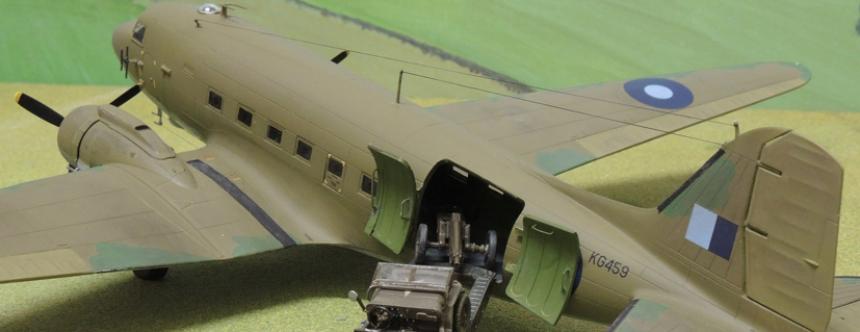
The subject of this feature build is the recently released A09008 RAF Douglas Dakota Mk.III which comes complete with a British Army Willys Jeep, trailer and 75mm Pack Howitzer – wearing unusual and highly appealing RAF South East Asia Command colours, this was certainly one model I was looking forward to seeing finished. The Dakota has long been a popular subject with the modeller and this latest Airfix kit is an absolute beauty – if nothing else, it makes a welcome change from the Spitfires and Hurricanes that have been receiving so much exposure over the past few months, with the 75th Anniversary commemorations of the Battle of Britain.
For this RAF Dakota build, we are indebted to Lancashire modeller Colin Duckworth and his sterling efforts over the past few weeks. Colin has been a keen modeller since the late 1970s and has been entering various modelling competitions since the early 1990s – a modest man, he would not tell you himself, but he has emerged victorious with many of his competition entries. Colin happily describes himself as a recycler (his long suffering wife would say scavenger) who is always on the lookout for any implement, material or packaging that might come in useful with a future modelling project. He loves a challenge and will often scratch build parts to ensure that his models are as authentic as possible. For him, researching the project thoroughly is as enjoyable as building the model itself and he is never afraid of deviating from the instruction sheet, if he feels it would benefit the finished aircraft and produce an even more accurate representation of the real aircraft.
With regard to subject matter, Colin will certainly turn his hand to anything and has successfully built competition standard models of ships, tanks, cars and railway accessories in the past, but would certainly class aircraft as his favoured subject matter. He described how he will happily tackle all kinds of aviation subjects, but would probably say that WWII aircraft were his favourite – there is a caveat here … no Axis allowed! He does not like working on German aviation subjects so much, but not for reasons of patriotism, he just finds Allied aircraft more appealing. With this in mind, Colin was obviously excited when we asked him to have a go at building the new SEAC Dakota.

One of Colin’s favourite Airfix kits – 1/72nd scale Nimrod MR.2
Describing his long association with Airfix, Colin recalls how his very first model builds were Airfix kits, as will probably be the case for many UK modellers. Over the years, he has made hundreds of Airfix models, but has certainly seen a change in fortunes over recent years. From around the time of the release of the 1/72nd scale BAe Nimrod MR.2 and the Fairey Swordfish, there were some huge improvements in the quality of the models produced by Airfix and the associated enjoyment for the modeller. Current Airfix model tooling releases are absolutely superb and will stand up against any of the world’s kit manufacturers - with some fantastic new model announcements this really is a great time to build Airfix models. More than happy to build the current Airfix model releases straight from the box, Colin will often delve into his loft stash and attempt an older ‘classic kit’ from the Airfix back catalogue and whilst this may pose slightly more of a challenge, it is still an enjoyable modelling experience and one which allows him to practice all of his skills.

Sprue check – parts are washed and allowed to dry thoroughly
Having already spent some time researching details on the internet and in his impressive reference library, Colin started the Dakota project with a look through the extensive instruction sheet and an inspection of the part frames. Although this is just to confirm that there are no missing or damaged parts and this process rarely highlights any issues, old habits die hard and Colin will begin every project with a kit inspection. Once happy that everything is accounted for, the kit frames are given a clean in soapy water, to make sure that any residual mould lubricant is removed from the plastic and following a thorough drying and a check to make sure that no small parts have become detached during the cleaning process, it is time to start the build.

Dry fit parts and begin painting internally located items
Right from the very beginning of the build process, Colin will already have planned where he will need to incorporate all the additional features he intends to add to the model – these will include aerials and antenna, radio wires, door handles and landing light lenses. Adding these details is certainly not necessary to complete an accurate model build, but they are all things that make modelling more pleasurable for Colin and it is just the way he likes to approach his modelling. With many components being scratch built specifically for individual models, or coming from Colin’s extensive spare parts collection, this is where prior research is essential and many parts will need to be incorporated quite early on in the build.

Interior lighting strip is added to the roof of the Dakota

More detail in the undercarriage bay of the model
One thing that Colin mentioned about the current crop of Airfix models is the incredible level of detail that now comes as standard with these impressive models. Much of this detail is applied to internal areas of the model and require attention quite early in the build – this means that the paint comes out early, as these parts will be difficult to access once the model starts to be assembled. Colin felt that as someone at Airfix has gone to great lengths to incorporate increased fine detail into these kits, it would be rather rude not to make a feature of it.
Although Colin invited me to his home to take pictures of the completed Dakota model, he kindly offered to take pictures of the build at various stages during its construction and we have used a number of these images throughout this feature. Although Workbench readers will all have their own particular building styles and preferences, it is always interesting for modellers to see how other people like to work and I am sure that these images will be of interest to many.

Everything starts to come together and an egg carton comes in handy
For most readers, the look of the finished model will be all important and Colin had some specific ideas about how he wanted to complete the model. Although the C-47 was very much an American aircraft, it proved to be so successful and offered armed forces such airborne flexibility, that it was clearly going to be of interest to overseas operators. The RAF were heavy users of the C-47 and many modellers with an interest in British aircraft which took part in WWII will have been pleased to hear about the release of this latest kit and the South East Asia Command scheme decals that are supplied with it. The RAF gave the C-47 the name Dakota, which is commonly thought to have come about as an acronym of Douglas Aircraft Company Transport Aircraft and the aircraft proved to be an essential addition to their aerial inventory, particularly in the inhospitable terrain in the Far East. The rugged and highly adaptable Dakota was well liked by both aircrew and the troops it transported and in this challenging terrain, many units will have received their essential supplies courtesy of the Dakota.

The paint finish on the Dakota reflected Colin’s research of the aircraft
The subject of painting models of WWII aircraft is one that is very much open to discussion and it is easy to provide convincing arguments for quite a variation in colour representations. Remembering that the world was at war and paint would have to be applied to aircraft on a what stocks were available basis, there is quite some latitude with regard to paint interpretation – indeed, the more detailed your research, the less convinced on definitive colour shades you become. This situation is even more challenging when looking at aircraft that operated in the Far East, as supply lines were often extremely stretched and using the right paint shade on a particular aircraft would not be high on the list of operational priorities. Indeed, the climate in this theatre would have dictated that aircraft would have been subjected to some pretty extreme conditions and any paint applied to aircraft would have faded due to the effects of weather quite considerably.

Decal application of the RAF SEAC markings
Having researched SEAC Dakota operations quite extensively, Colin had a clear idea on how he wanted his finished model to look and this was definitely not ‘straight from the paint shop’. He wanted the model to look as if it had been flying on operations in the Far East and for the paint to appear faded by the effects of sun and rain – looking even deeper into this subject, it was clear that any paint applied to fabric areas of the aircraft would have faded more significantly than other areas of the aircraft. This was the look that Colin wanted for the model, along with some general light weathering, to make this look like it was a working aircraft and not a museum piece.


Looking good - the RAF Dakota Mk.III in all its glory!
For many of us who do not possess Colin’s modelling prowess, the huge appeal of the hobby is to actually see finished models that have been produced by someone else and to see how realistic their aircraft looks compared to the real thing. Modelling will mean different things to different people – for some, it will be the challenge of the build process itself, whilst others look forward to the overall appeal of the finished model and adding it to their growing collection. Whichever camp you may be in yourself, you cannot fail to be impressed by the magnificent RAF Dakota that Colin managed to produce and he can definitely chalk this one down to another job well done.
The actual aircraft that has been modelled is Douglas Dakota Mk.III KG459, which operated with No.194 Squadron, Imphal Garrison, Burma, between March and June 1944. Prior to arriving in theatre, the aircraft had served with the Balkan Air Force on operations over Poland, Yugoslavia and Greece, which will have tested the flexibility and reliability of the aircraft to the full. Originally constructed as a Douglas C-47A-10 and given the USAAF serial number 42-92668, this Skytrain was transferred to the Royal Air Force, where it was referred to as a Dakota Mk.III and given the code KG459. Like so many WWII Dakotas and C-47s, the aircraft continued to provide sterling service long after the war had ended and it is reported that this particular aircraft was sold to the Indian Air Force and given the registration BJ496. Despite later details of its history being a little uncertain, it appears that it is now preserved at an aviation museum in Bangalore.


The finished model looks magnificent and makes a fine addition to the collection
Hopefully, these images of the finished models will do Colin’s efforts justice as he really has done a magnificent job with this Dakota. It has been finished with the supplied Willys Jeep and 75mm Howitzer and it is clear to see that the Airfix engineers have managed to capture the classic lines of the Dakota/Skytrain perfectly – with the diorama extras, this really does build into an extremely handsome model. SEAC Dakota A09008 is available now on the Airfix website and at all good models shops throughout the country. We would like to sincerely thank Colin for his magnificent work on this build project and for allowing us to use his work on this latest edition of Workbench.

We are proud to exclusively reveal the box artwork for the 1/48th scale Meteor release A09182
There is nothing like ending a Workbench blog on a high note and there can be no finer way to do this than to announce the latest spectacular box artwork project, to support an impending release. As our blog can now chart the progress of a model release from exclusive new tooling announcement, right through to model availability, the revealing of new box artwork for a project is an indication that a model is just about to be released. In Workbench edition fourteen, we were proud to bring you confirmation of the decal options for the forthcoming new tooling release of the 1/48th scale Gloster Meteor F.8 (A09182) tooling. As we are now in a position to bring you the spectacular artwork that will adorn the box of this much anticipated new kit, this signifies that the model is now very close to its release date.
Without doubt, the box artwork used on many of the current Airfix releases needs no introduction and serves to inspire modellers to create beautiful examples of the kit they have just bought. Featuring a pair of RAF No.111 Squadron Meteor F.8 fighters on their latest training sortie, this stunning artwork alerts us that Gloster Meteor A09182 is due for release towards the end of March/early April. This new kit has been very heavily pre-ordered and if you have not already done so, it may be a good idea to head for the Airfix website and secure your example – there is nothing worse than waiting for an exciting new model and struggling to pick one up in the days following its release.

A50177 Fokker E.II & RAF BE2c Dogfight Double set features two of the latest 1/72nd scale Airfix toolings
Our regular review of the imminent new model releases and popular kit re-stocks includes two of the fantastic models we have featured in this week’s blog - to keep up to date with all the impending Airfix New Tooling releases, please keep checking the Coming Soon and New Arrivals sections of the Airfix website, which will be regularly updated with all the latest availability information.
Models due for imminent release:
The Airfix website also benefits from a Back in Stock section, where new supplies of popular kits can be checked in one area. Back in stock soon is 1/48th scale Hawker Hurricane Mk.I A05127, which definitely proved to be one of the most popular kits of 2015. This superb kit is due back in stock later this month and will be high on the wants list of many a modeller - if you have been waiting to get your hands on one of these beauties, don’t miss out this time. To add to the expectation, here is another look at the impressive Hurricane box artwork – just beautiful!

1/48th scale Hurricane Mk.I (A05127) is an eagerly anticipated re-stock
Some particularly noteworthy re-stocks include:
Model re-stocks - available now:
For the latest information on the release of new and re-stocked model kits, please keep checking the Coming Soon and Back in Stock areas of the Airfix website, which will have all the latest availability details for you. We will have more release information for you in our next Workbench.
I am afraid that is all we have for you in this latest edition, but we look forward to bringing you more news from the fascinating world of Airfix in the next edition of Workbench. Please continue sending us your ideas, pictures and stories for future editions, as we are always pleased to receive your contributions and you may just feature on the Airfix website for all to see!
As usual, you can get involved in all the latest Airfix modelling chat via our dedicated Workbench thread on the Airfix Forum, or if you prefer, by logging onto our Facebook or Twitter social media channels and using the #airfixworkbench.
Until next time, enjoy your modelling.
The Airfix Workbench Team
© Hornby Hobbies Ltd. All rights reserved.

