
Welcome to this latest edition of Workbench and all the news, updates and exclusive announcements from the fascinating world of Airfix modelling.
For anyone with even the slightest interest in modelling and the history of the plastic kit market in the UK, working to produce the fortnightly Workbench blog could be described as something of a dream come true. With so much fascinating information to share with fellow enthusiasts, there is never a shortage of subject matter for each new publication, whether that be new product development details, or the joys of delving back into the plentiful Airfix archives. When you add reader supplied features into the mix, it really is no wonder that this hobby which appeals to so many people is in such rude health at present.
In this latest edition of Workbench, we are going to be discussing ‘Classic Airfix’ and details of a forthcoming release in the popular Vintage Classics range, one which caused real excitement amongst modellers when its reintroduction was announced back at the beginning of 2019. We will also be seeing how our knowledgeable readership can sometimes shed new light on research details linked to the latest scale model releases, even though they are representations of aircraft and vehicles which were in service almost 80 years ago. We continue the vintage theme by featuring TWO classic builds undertaken by Workbench reader and regular article contributor Andreas Fey and we announce the lucky winner of our recent 1/24th scale Hellcat competition. It’s Airfix time again and as usual, we have much to talk about.
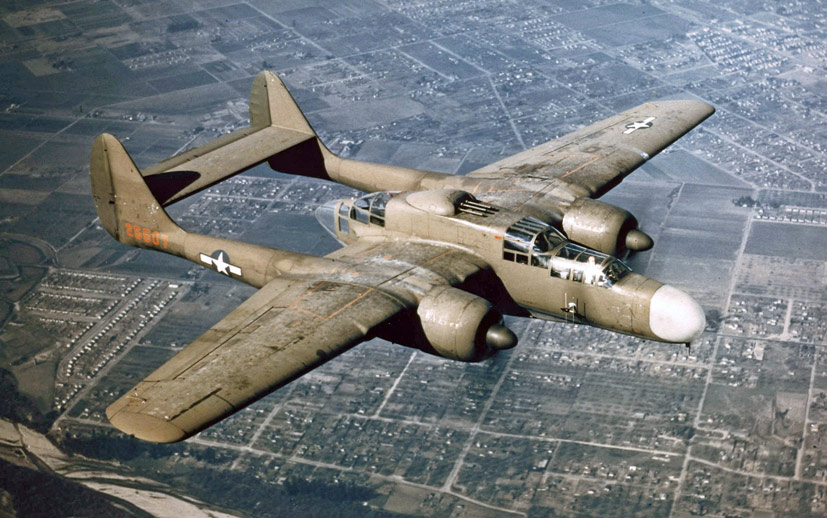
One of the most interesting aircraft of the Second World War, the Northrop P-61 Black Widow was the first US aircraft designed specifically for combat at night and in poor weather – it is also a particularly good looking aeroplane
One of the most potent and visually striking aircraft of the Second World War, the Northrop P-61 Black Widow was the first US aircraft designed from the outset for combat use as a nightfighter and in poor weather. Equipped with a powerful nose mounted radar unit, the aircraft was capable of autonomously detecting potential targets during long ranging night sorties, before destroying them with its powerful array of offensive armament. Powered by two huge Pratt & Whitney Double Wasp engines, the P-61 was a real beast of an aeroplane and has the distinction of being the largest Allied aircraft of WWII to be designated a fighter – indeed, with a loaded combat weight of over 16 tonnes and a wingspan of 66 ft, the Black Widow was more like a medium bomber than a fighter.
One of the benefits of America’s late entry into WWII was their ability to view modern warfare from a distance and make re-armament decisions accordingly. As they watched the RAF eventually prevail during the Battle of Britain in the summer of 1940, they noticed with some interest how the Luftwaffe moved to night bombing raids following their failure to secure air superiority over Britain and how the RAF did not have a coherent force with which to combat this new threat. They were keen to equip their own air force with an aircraft which could mount long standing night patrols, whilst also possessing the ability to detect targets without the need of ground vectored guidance. They were looking for the perfect nocturnal hunter, one which would go on to dominate the night skies.
The contract for developing this new aircraft was awarded to Northrop at the beginning of 1941 and it was clear from the outset that the new aircraft would be bristling with the latest technology and an extremely advanced design. Central to its development would be the installation of an effective airborne interception radar set, with the development of this unit proceeding simultaneously with that of the aircraft. Once an enemy aircraft had been detected, the ability to quickly and effectively destroy it was essential, and the Black Widow would pack a real punch – four forward firing 20mm cannons in the aircraft’s belly were supplemented by a further four .50 cal machine guns housed in a powered, remote-control ventral turret positioned behind the cockpit.
The tremendous weight of all this equipment dictated that Northrop’s new nightfighter was going to be a very large aeroplane indeed and when combined with the weight of fuel needed to mount long standing night patrols, it is no wonder this turned out to be one of the most impressive fighters of WWII. Adopting a rugged twin-boom design and strong tricycle undercarriage, the P-61 did have the appearance of being a much larger variant of the Lockheed P-38 Lightning, but these were actually two very different aeroplanes.
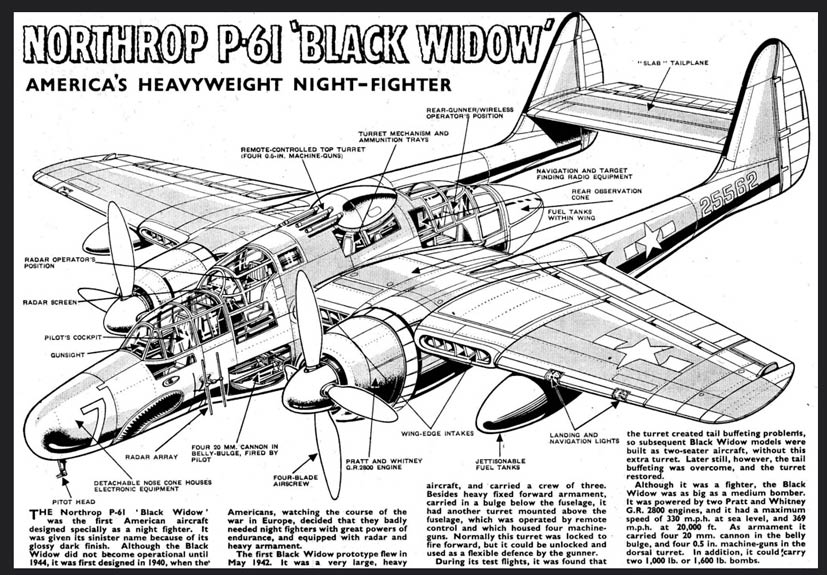
The P-61 Black Widow was a complex and highly advanced aircraft and even though it could have made a significant contribution to the Allied war effort, a protracted development dictated that the first examples did not engage in combat operations until the summer of 1944
Unfortunately, the development of the Black Widow was beset with delays, as the advanced design and associated technology it utilised took some time to perfect. Despite making its first flight in May 1942, it would be two years before the P-61 Black Widow would make its combat introduction in the European Theatre and even this would be made under something of a cloud. Convinced this massive aeroplane was too large to be effective against the latest battle hardened Luftwaffe intruder aircraft, US officials put in a request to have British Mosquitos for the role rather than Northrop’s new monster. A later fly-off competition between the Mosquito and the P-61 proved relatively inconclusive, although some at the time believed the British had purposely ‘manufactured’ the closeness of the results, as they were desperate to avoid any of their superb Mosquitos being diverted to the Americans.
The first US Squadron to train exclusively on the P-61 Black Widow was the 422nd and they arrived in the UK during March 1944 to undertake training in the art of flying and fighting at night. Their aircraft would not arrive at Charmy Down airfield in Somerset until sometime later. Their role was to provide night defence for US airfields in the UK and forward operating bases on the continent following D-Day. The unit’s first aerial victory in a P-61 came on the night of 15th July 1944, when a Black Widow named ‘Borrowed Time’ brought down a V-1 flying bomb over the English Channel, opening the combat account of this fascinating aeroplane. It is also interesting to note that the first P-61 operations in the Pacific took place at around the same time the aircraft were being introduced in Europe.
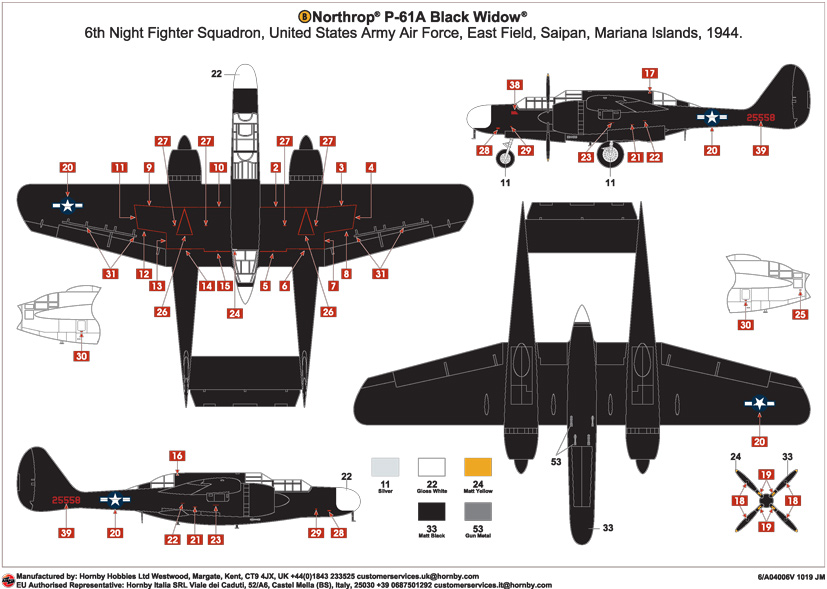
As such an interesting aeroplane, the P-61 Black Widow has always been a popular subject with the modeller and as such, news of its introduction in the Vintage Classics range was met with overwhelming approval, not only for those looking for a nostalgic trip down modelling memory lane, but also for anyone looking for a project which took one of the Second World War’s most interesting aeroplanes as its inspiration. The two scheme options which will be included with this soon to be released kit are:
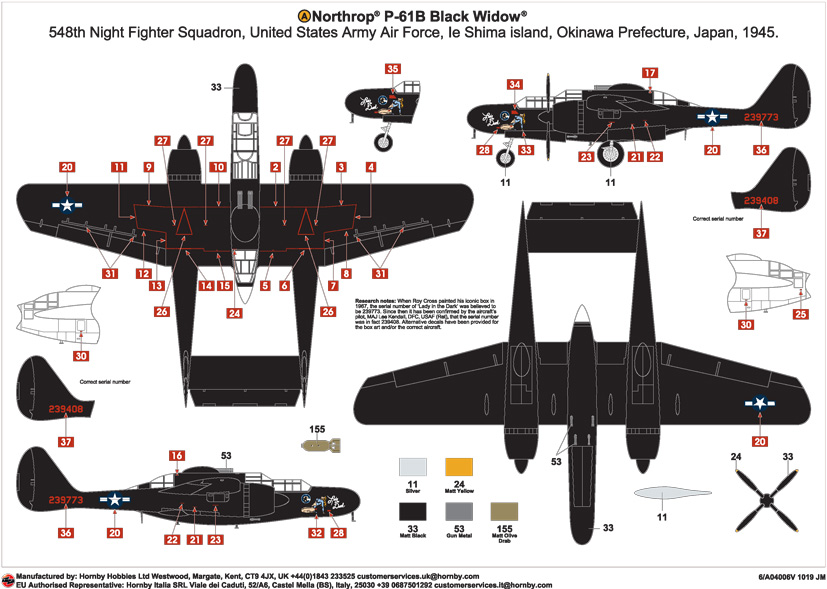
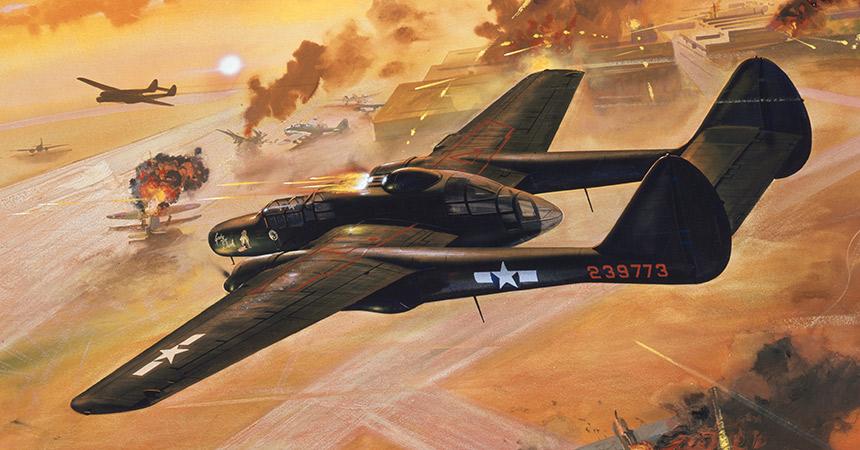
This magnificent scheme not only presents one of the most significant aircraft in the history of the Second World War, but also one which enjoys a prominent role in the history of Airfix. First introduced in 1967, this new kit benefitted from spectacular Roy Cross artwork which showed P-61B ‘Lady in the Dark’ going on the offensive and bringing her eight gun package to bear on Japanese aircraft parked at their home airfield. At the time this painting was produced, research information indicated that the serial number of this particular aircraft was 42-39773, with the decal sheet being produced accordingly. Subsequent information gleaned from the actual pilot of this aircraft during its final victory confirmed that the correct serial should have been 42-39408, so for this re-issue, both serial number options will be included on the sheet.
Once again underlining just how difficult it can be when attempting to obtain definitive information regarding aircraft which were used during WWII, the pilot of ‘Lady in the Dark’ who confirmed the correct code for the aircraft, was at the time of the incident in question, was called 1st Lt. Solie Solomon USAAF. He would change his name to Lee Kendall in 1962, so it is quite common to find reports of the incident with both his names used and whilst either are technically correct, you can see how confusion can occur in such instances.
One thing which is certainly not in question is the operational use of the P-61 once the aircraft arrived in the Pacific Theatre. Whilst the Japanese had been mounting single aircraft night raids against US targets across the Pacific, the effectiveness of US Navy and Marine fighter units meant that enemy aircraft could be difficult to locate for Black Widow crews hoping to open their victory accounts. Indeed, it has since been reported that some crews could have successfully completed over thirty missions before they even caught sight of an enemy aircraft, such was the overwhelming superiority of the Americans in the Pacific at that time. This forced P-61 crews to go on the offensive, taking targets of opportunity wherever they presented themselves.
Despite only arriving in theatre towards the end of 1944, Northrop P-61B Black Widow 42-39408 ‘Lady in the Dark’ would certainly make a name for herself with regard to the history of the Second World War. It is thought that this aircraft scored the final two victories of WWII whilst operating from le Shima airfield, both on consecutive nights and both flown by different crews. What makes this all the more astonishing is that both victories were claimed without a single shot being fired.
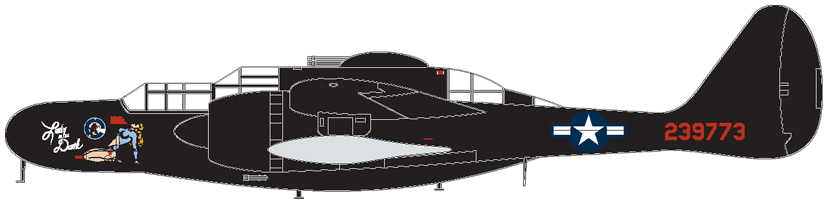
On the evening of 14th/15th August 1945, ‘Lady in the Dark’ was flown from her base at le Shima by pilot Robert W Clyde and his crew when during a routine patrol, they intercepted a Japanese Nakajima Ki-44 Shoki fighter. When they were spotted by the fighter, it immediately took evasive action, diving for the ocean and flying erratically at wave-top height. The crew reported seeing the aircraft hitting the sea and disintegrating before they had the opportunity to bring their guns to bear and on returning to base, they reported the incident to officials. The war had officially ended at 2400 that night and the victory was therefore not attributed to the crew.
With the American’s worried about how remaining Japanese forces would take the order to surrender and still being fearful of Kamikaze attacks, the 548th Night Fighter Squadron mounted a further patrol the following evening (the first official night of peace) and the ‘Lady in the Dark’ was in the air once more. This time in the hands of 1st Lt. Solomon (who later changed his name to Lee Kendall) and his crew, the airmen were once again expecting an uneventful sortie when ground controllers informed them of a possible bogie approaching the island. Vectoring to the general vicinity and activating their radar, they intercepted another Ki-44 which once again began taking evasive action. Moving in close on four separate occasions to try and obtain a positive identification, the Nakajima was clearly up to no good and whilst continuing to take violent evasive action, it slammed into the ground, scattering wreckage over a wide area. Ground forces later confirmed that it was indeed a Japanese Ki-44 fighter.
Northrop P-61 Black Widow ‘Lady in the Dark’ had prevented two enemy aircraft from potentially carrying out devastating raids against American forces, with the reputation of the nightfighter forcing what were probably two novice airmen into taking disorientating evasive action. The aircraft had the distinction of claiming the last two aerial victories (of sorts) of the Second World War, all without firing a shot. As the war was officially over, there was no real desire to corroborate the claims of the two crews, so neither were credited with their unusual victories – post war research has since attributed the last two aerial victories of WWII to the ‘Lady in the Dark’, a rather unusual and historic claim to fame for this Northrop P-61B Black Widow nightfighter.
Although much was expected of Northrop’s new dedicated nightfighter, the protracted development of the aircraft, along with the advanced nature of much of the technology incorporated within its design would lead to the project suffering some supply restrictions – these proved so problematic that construction modifications became necessary. Although installation of the ever improving interception radar equipment would lead to many less visible design alterations, perhaps the most obvious and problematic supply issue related to the powered dorsal turret. This advanced unit was operated by remote control and could be fired by any of the three man crew – only the pilot could fire the belly mounted cannon.
Unfortunately for the design team at Northrop, the advanced dorsal turret was the same type as that fitted to the Boeing B-29 Superfortress and as this heavy bomber had production priority over the Black Widow, the units were simply not available in the required numbers. As a consequence of this, more than half of the entire P-61 production run would be constructed without the dorsal turret being fitted, which did reduce the overall weight of the aircraft and allowed it to be operated by just the pilot and his radar observer. All 80 of the first P-61s and the first 37 P-61As would feature the remote controlled dorsal turret, but this unit would not re-appear until after the first 200 P-61Bs had been constructed, some 283 machines later.
The colours applied to Black Widow fighters during WWII is a further source of interest, as well as a potential research headache. At this period of the war, US aircraft destined for daylight operations were painted in olive drab and grey as they left the manufacturing plants, but as the P-61 was destined for nocturnal activities, the first aircraft produced were painted flat black. Incredibly, this scheme was found to be unsuitable for night operations, as it made the aircraft too visible on a moonlit night, so the vast majority of the A-1 and A-5 model P-61s would actually leave the factory reverting back to the olive drab and grey scheme.
It was subsequently found that a gloss black finish was most effective for night operations, so all subsequent aircraft left the factory in this colour, whilst many of those already in service would receive the new paint finish in the squadron paint shop. From a modellers perspective, although aircraft painted gloss black would have undoubtedly looked resplendent the moment they emerged from the paint shop, it would not take long before the sheen of the paint began to wear off in uneven patches, with the underside of the wings and tailplane retaining the shinier appearance for a longer period. As these were hard working aircraft, there would have been no priority to keep these aircraft looking good for the enemy, so most would have been operated in a less than pristine condition, with the overall appearance of the finish more closely resembling a flat black paint.

Black Widow crews loved the dark of night, lurking unseen in the blackness and waiting to strike at their unsuspecting prey. Although a clear, moonlit night would certainly make missions both safer to undertake and easier to spot enemy aircraft in, it also alerted enemy pilots to the presence of this large aeroplane, so a cloudy night was always referred by crews who had the added benefit of excellent onboard radar. Strict rules of engagement dictated that crews had to ascertain the identity of a target before opening fire, specifically to prevent friendly fire incidents in the crowded night skies. The uncertainty of night operations also saw US crews hampered by circumstance when actually claiming kills and unless they had definitive corroborative evidence (which was unlikely during night operations), they would only be awarded one kill after claiming three ‘probables’.
Of most concern to P-61 crews was the seemingly indiscriminate anti-aircraft fire which filled the night sky and in many cases, may have been coming from Allied batteries. When hunting an enemy aircraft, if they lost contact with their quarry and feared the aircraft had exceeded a 10 mile target radius, it was better to leave the aircraft to the flak batteries, as anything illuminated by searchlights was in danger of being targeted – better to live and fight another day than to be the unfortunate victim of an Allied shell yourself.
There is no doubt that the P-61 Black Widow is an impressive looking aeroplane and when considering its aviation pedigree and the technology it incorporated into its design, it will come as absolutely no surprise to hear that this was a very expensive aeroplane to manufacture. At around $180,000 each, the USAAF could have two Douglas C-47 Skytrains, or three P-38 Lightning fighters for the same price, but it has to be said that neither of these aircraft looked anything like as impressive as the sinister Black Widow.
The 6th (Pursuit) Squadron began WWII equipped with Curtiss P-36A fighters at Wheeler Field, Hawaii, however all 18 were neatly lined up on the airfield throughout the Japanese attack on Pearl Harbor and were all destroyed. Later re-equipping with P-40 Warhawks, the unit was re-designated the 6th Night Fighter Squadron in 1943 and was shipped out to Guadalcanal to combat Japanese night raids with their new Douglas P-70 Nighthawks. The 6th received their first P-61 Black Widows in May 1944 and once the aircraft had been re-assembled and checked, an intense period of training for air and ground crews began. The first combat operations took place the following month and it would not be long before the first enemy aircraft started to fall to the guns of the Black Widow.
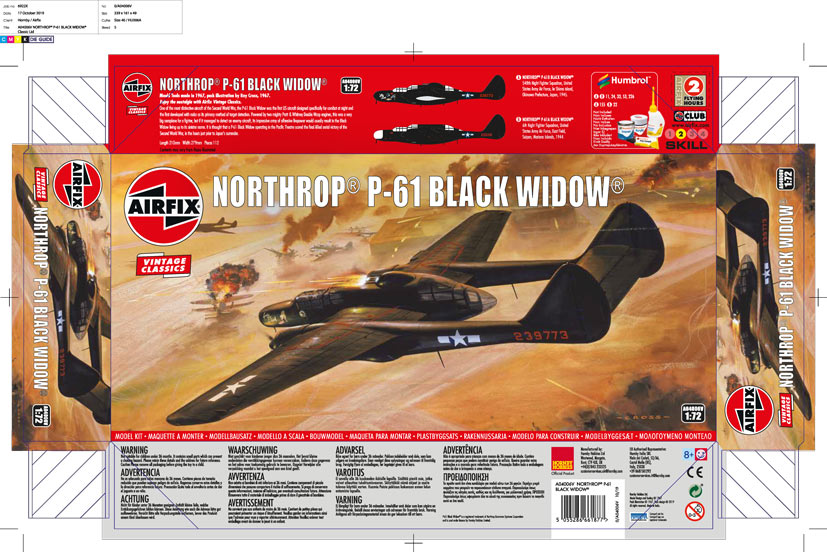
Classic Roy Cross artwork on the latest Airfix box presentation – is it any wonder why our Vintage Classics range has proved such a resounding success with the world’s modellers
A detachment of aircraft were sent to Saipan, one of the Mariana Islands, where they would be tasked with performing one of the most crucial tasks of the entire war. The Japanese knew that if the Americans were allowed to build suitable airfields on Saipan, their mighty B-29 bombers would have the range to strike at the Japanese home islands and this had to be stopped at all costs. Mounting heavy initial raids, the powerful P-61 must have proved a fearsome adversary for outclassed Japanese bombers operating at the very edge of their range, and it was quickly discovered that if the American fighters attacked and destroyed the lead bomber, the rest would immediately jettison their bombs and head for home. The effectiveness of Black Widow operations during this period allowed the war to move to a devastating new phase in the Pacific.
Northrop P-61 Black Widow A04006V will be taking its place in the Vintage Classics range in the next few weeks and we are very much looking forward to seeing all your completed models in the Customer Images section of the Airfix website later in the year – the P-61 really is a spectacular looking aircraft.
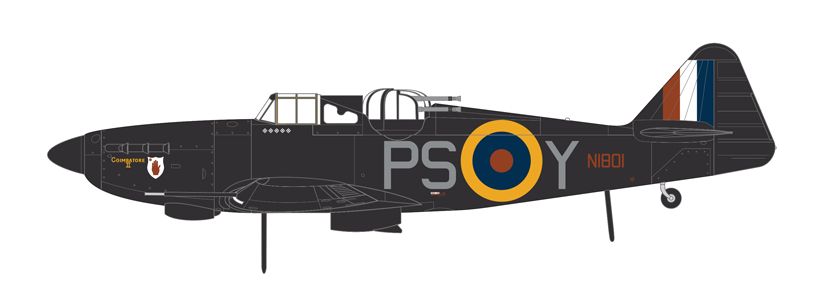
In the previous edition of our blog, you will recall that we took a detailed look at the Boulton Paul Defiant Mk.I and the two scheme options which will be featured with the impending release of A05128A. Since this edition was published, we have been fortunate enough to receive additional supporting information regarding the second scheme option, Defiant Mk.I N1801, the mount of pilot Desmond Hughes and his gunner Fred Gash. With this aircraft flying operationally almost 80 years ago, there has been quite an amount of conflicting information published about this aircraft and the men who flew it, but thanks to two Workbench readers, we are now in receipt of new and definitive information. Thankfully, the scheme details we have included in the kit are correct, we just have a little more clarification about the information behind the aircraft’s history.
We are extremely fortunate that within the ranks of our huge Workbench readership, there are some extremely knowledgeable people who have access to information that benefits the entire hobby and are only too happy to share it with us. Adding even more interest to this magnificent release and possibly making this B scheme an irresistible build option choice for many, we are indebted to readers Gareth Walls and Tony Osborne for sending in new information regarding this scheme. Tony in particular (being an Ulsterman himself) provided us with some fascinating reference material.
The main area of concern with this particular aircraft was the white shield and hand motif which was carried under the engine exhausts on the port side of Defiant N1801. Many sources state that this artwork related to No.264 Squadron’s association with India and the Madras Presidency and has nothing to do with the hand of Ulster, whilst others claim the opposite, however, thanks to information received from Tony, we now have conclusive evidence of its origins, from the memoirs of the pilot himself.
Born in the small coastal town of Donaghadee in County Down, Northern Ireland, Frederick Desmond ‘Hawkeye’ Hughes could already fly by the time WWII began and was offered a Direct Entry Commission in the RAF in early October 1939. Having successfully negotiated his training, he was posted to No.264 Squadron at Duxford, where he would begin his operational association with the Boulton Paul Defiant turret fighter, eventually becoming one of the few airmen to attain ‘Ace’ status in this much maligned aeroplane.
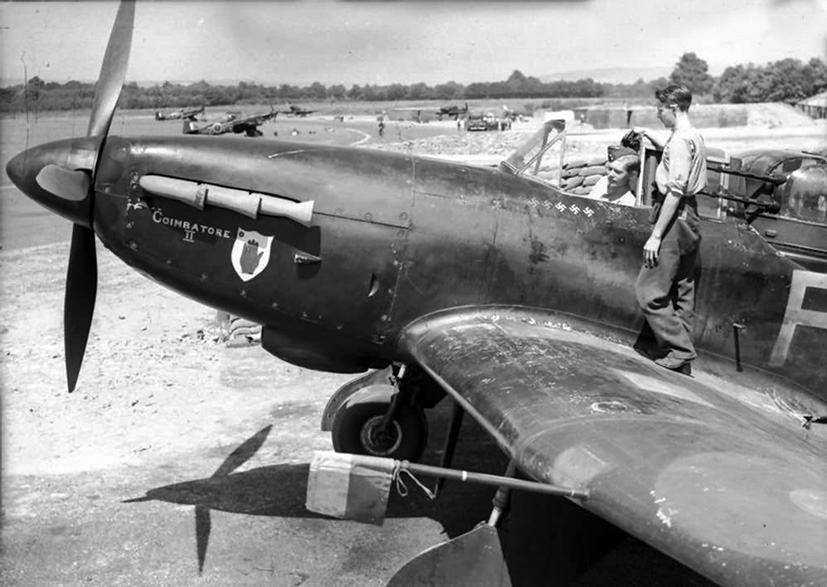
A famous wartime shot showing the personal Defiant Mk.I N1801 of Frederick Desmond ‘Hawkeye’ Hughes, complete with his ‘Hand of Ulster’ emblem, Coimbatore II name and five victory markings
Here is where things get interesting from our point of view – his personal memoirs include the following information. The first aircraft he was allocated as his own was Defiant N1801 and he was allowed to embellish it with his own personal markings, the Red Hand of Ulster on a white shield, painted on the port-side engine cowling. Moreover, he states that he continued to use this emblem on all his aircraft throughout the rest of the war. As for Defiant N1801, he states that he retained this aircraft until the squadron re-equipped with the more powerful Defiant Mk.II and he remembered it with fondness as a reliable aircraft whose engine never so much as coughed at him. Well, that certainly puts the Red Hand issue to bed.
Frederick Hughes would go on to post further success in the night air war flying Beaufighters and Mosquitos, eventually ending the war as one of the RAF’s most decorated airmen and posting a victory tally of 18.5 enemy aircraft destroyed. As if the prospect of building Hawkeye Hughes’ Defiant was not already enticing enough, another interesting story also associated with this pilot is that he was one of the first WWII airmen to take his pet dog on an operational sortie with him. His mongrel ‘Scruffy’ was dressed in flying overalls for warmth and had at least one RAF Beaufighter night sortie to his furry name.
We are grateful to Gareth and especially Tony for providing this fascinating information update on Frederick Desmond Hughes and his Defiant Nightfighter and we are pleased to confirm that our 1/48th scale representation of this magnificent aeroplane is now two weeks closer to its release date.
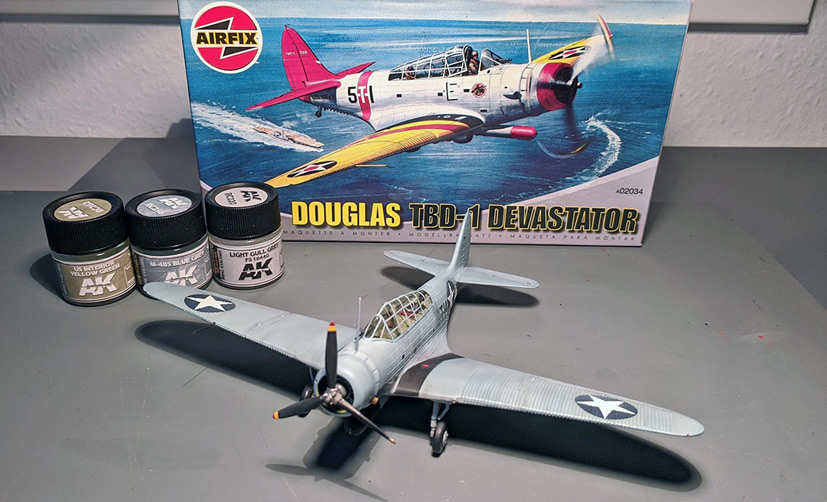
For many Workbench readers, the sight of classic Airfix box artwork no doubt immediately conjures up happy modelling memories from our formative years and may even tempt us to have another go at building kits which were so important to us as kids. As we seem to be enjoying something of a Classic Airfix edition, we thought you might like to see two recent build projects sent in to us by regular Workbench contributor Andreas Fey, both of which feature Airfix model tooling which herald from the late 1960s.
Over the past five years of our blog, Andreas and his model building talents have featured on several previous occasions, as he has sent us interesting build details of such kits as the Messerschmitt Bf 109E, Focke Wulf FW190, Me 262 and most recently the Grumman F4F-4 Wildcat. Two things all these builds had in common were that they featured relatively new model toolings, in addition to showcasing Andreas’ talent for incorporating the models in appealing diorama settings. With a clear vision of the scene he was attempting to convey at the outset of the project, the resultant images are truly fascinating and have no doubt served as inspiration for many a model build amongst fellow Workbench readers over the years.
We are pleased to say that Andreas has been at it again, but this time, his model kits of choice were two classic 1960s US Navy aircraft types and unusually, one of them was already built! We are grateful that he sent us pictures of both builds, including a selection of his evocative finished diorama images. Let’s take a closer look at each build in turn.
A kit which was first introduced back in 1969, the Douglas TBD-1 Devastator was a US Navy torpedo bomber which at the time of its service entry in 1937 was arguably the most advanced aircraft of its kind in the world. Unfortunately, by the time of the Pearl Harbor raid, the pace of aviation technology had caught up with the Devastator and it was beginning to show vulnerabilities. With its replacement some way off, the Devastator would be heavily involved in the first naval engagements of the Pacific War, following America’s entry into the conflict. The Battle of Midway would prove to be the operational swan-song for the Devastator, despite the actions of their heroic crews – they simply could not defend themselves against attacking Zero fighters.
Two things really stand out for the Airfix modeller who remembers tackling this model kit in their youth – the attractive inter-war scheme which featured on the box artwork and the corrugated appearance of the wings and horizontal stabilizers. Even though this could never be described as one of the most successful aircraft types of WWII, it is such a fascinating subject.
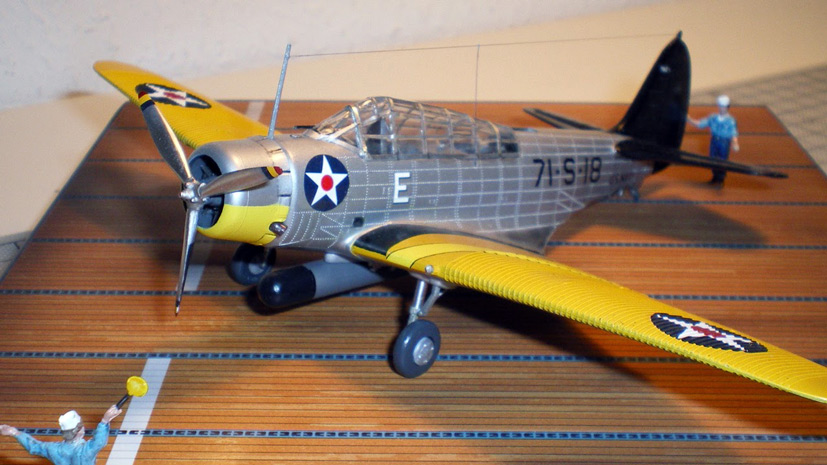
This fantastic series of images show how Andreas took his already built Airfix Douglas TBD-1 Devastator and used it as the basis of his latest build project. The build started with a disassembly and immersing the parts in oven cleaner

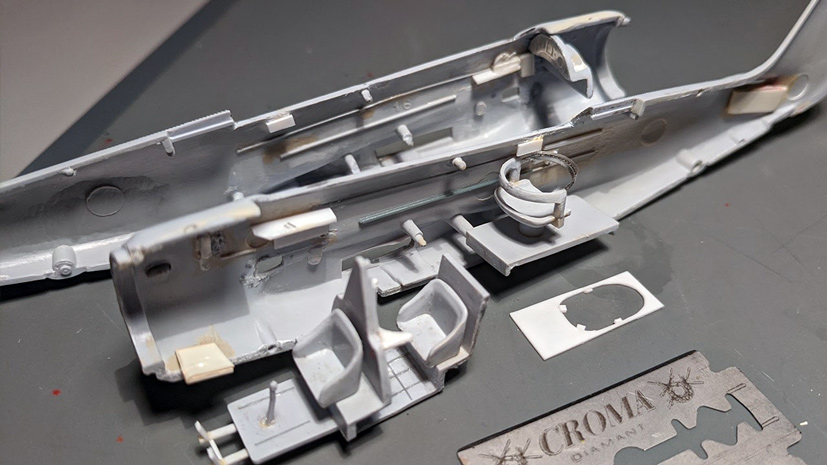
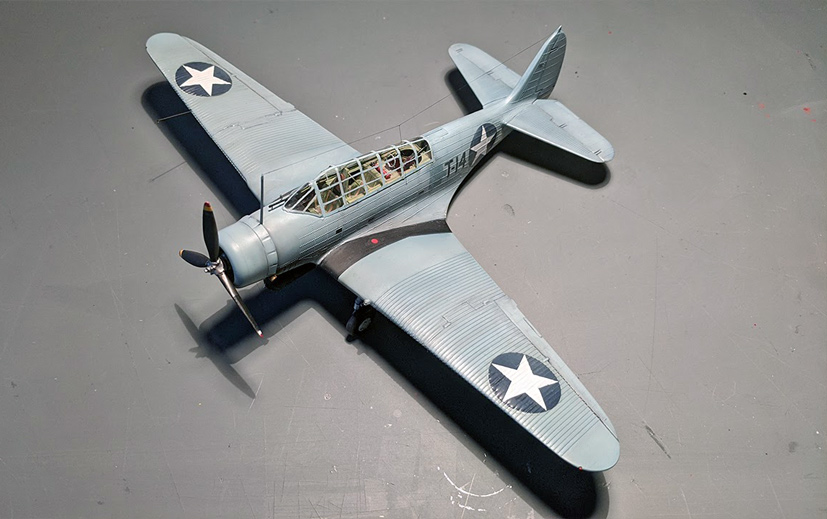
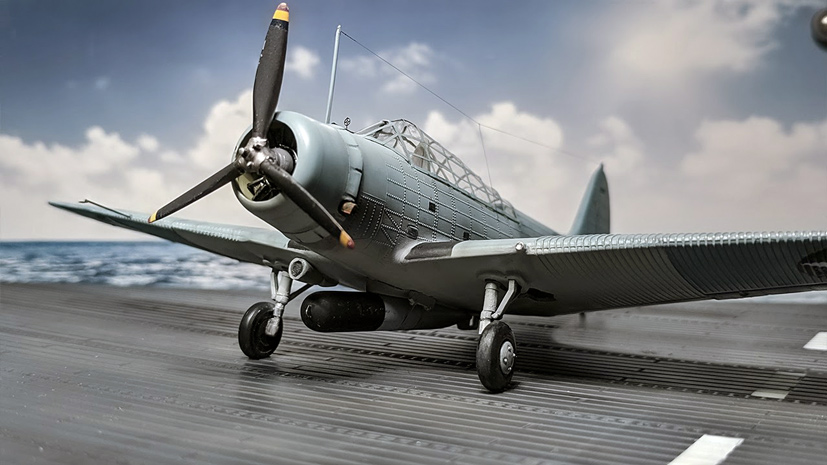
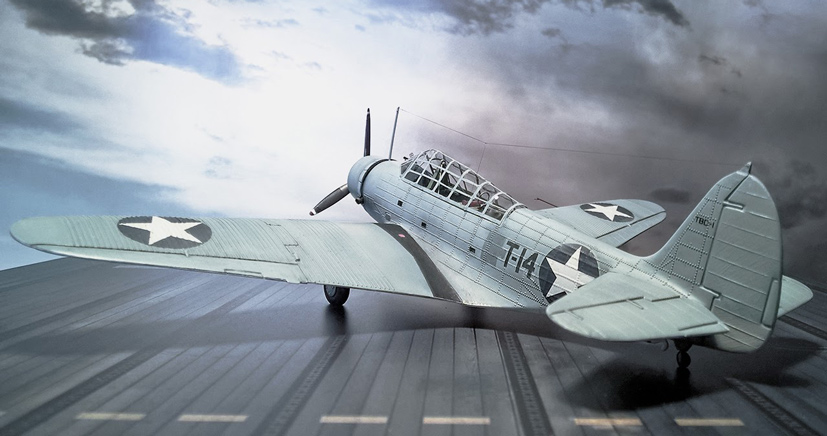
For this Build, Andreas did not have a new kit available to build, so he tried something altogether more creative – he started by taking his existing model apart. Feeling he could do much better than the built kit he had in his display cabinet, he took the razor blade to the model and carefully prized the pieces apart. Here is how he described the build.
I represent a plane of VT-8 from USS HORNET. Note: The overpainted “8 –“ on the fuselage is intentional. The special thing about the kit: This time I took apart an old, already built kit from Airfix, to build it a second time. I did this because I am an Airfix fan and this old kit is hard to find or very expensive. I decided to make an experiment just to see if I can do a job better than the first try.
I carefully disassembled the kit and put it in oven cleaner. After about 2 hours I was able to carefully wash off the old paint with a dish brush. Since the old kit is over 50 years old, it has typical features of that time: rows of rivets that are much too large, a rudimentary cockpit and canopy parts that are too thick.
I decided to leave most of this vintage kit parts as it is, except the canopy. I heated transparent plastic film over a candle flame and pulled it over the old canopy, but I did not managed to make this in one piece. I upgraded the cockpit with some scratch build parts to bring a little more life in it (i.e. the fire extinguisher).
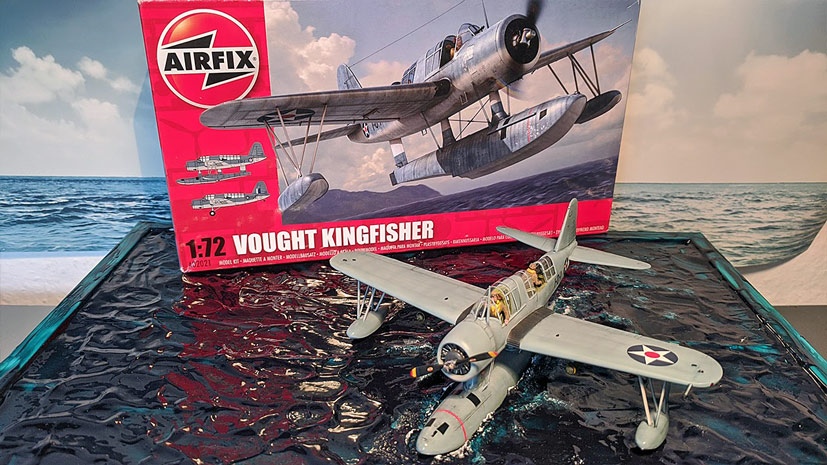
Undoubtedly one of the more interesting aeroplanes of the Second World War, the Vought Kingfisher was a catapult launched spotter/general observation float plane which was the main aircraft of its type used by the US Navy throughout WWII. The main task of this aircraft was to act as ‘the eyes’ of its parent ship, sending back strategic information from beyond visual range and especially when attempting to locate enemy ships. They would also serve as gunnery spotters, when navy vessels were pounding shore positions, helping to ensure the range and direction accuracy of their salvoes.
The Kingfisher would also be used extensively in a search and rescue role, however, it was not blessed with an abundance of power from its Pratt & Whitney Wasp Junior engine, so if the rescue involved several downed airmen, they would simply have to cling to the airframe and wait for a passing ship to come to their aid. If land was not too far away, the Kingfisher could always chug towards the shore under its own steam, but this would very much be a last resort – it would most certainly not have the power to take off.
The Airfix kit of this unusual aeroplane first appeared in 1967 and as the Kingfisher served with both the Fleet Air Arm and RAAF, it has always been a popular kit in any range it appeared. We think you will agree that Andreas’ model looks fantastic on his diorama base.
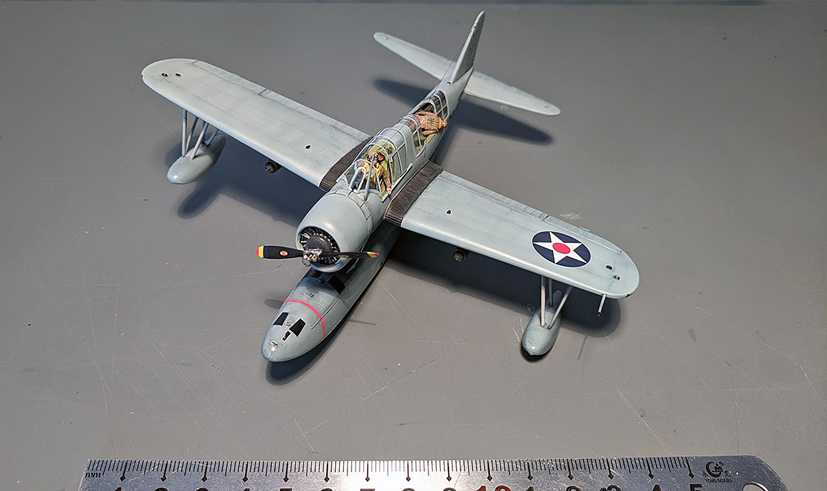
Another one of WWII’s more interesting aircraft types, this particular model build has been made all the more appealing by the imaginative production of an impressive ‘water based’ diorama display
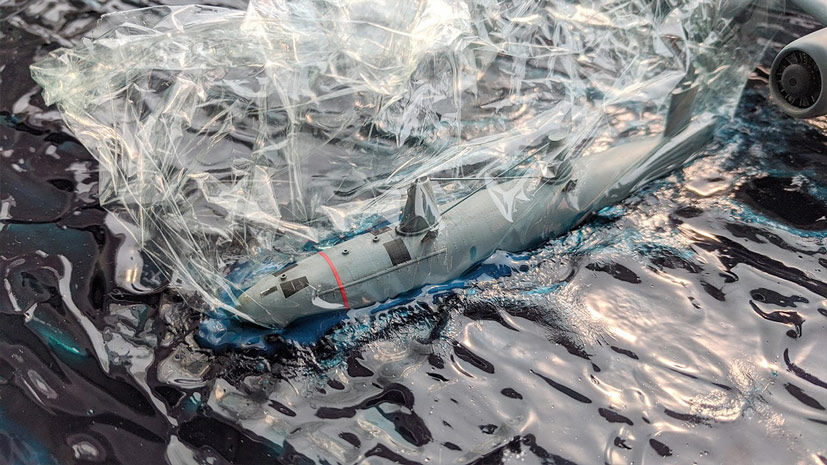
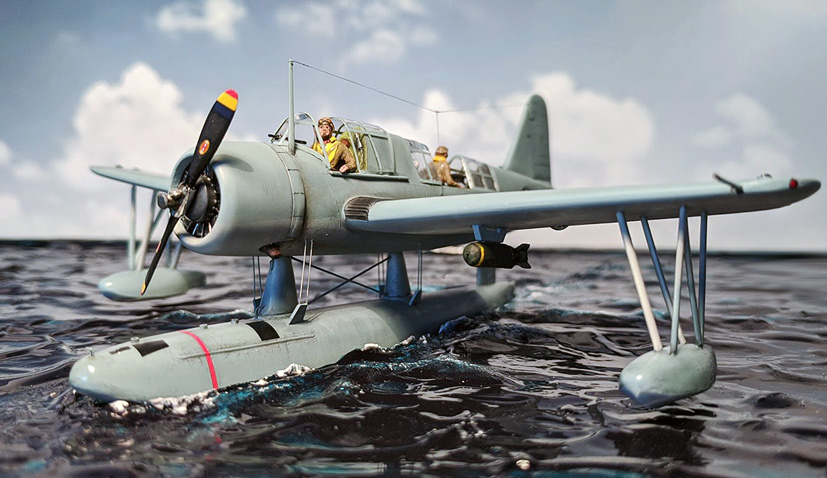
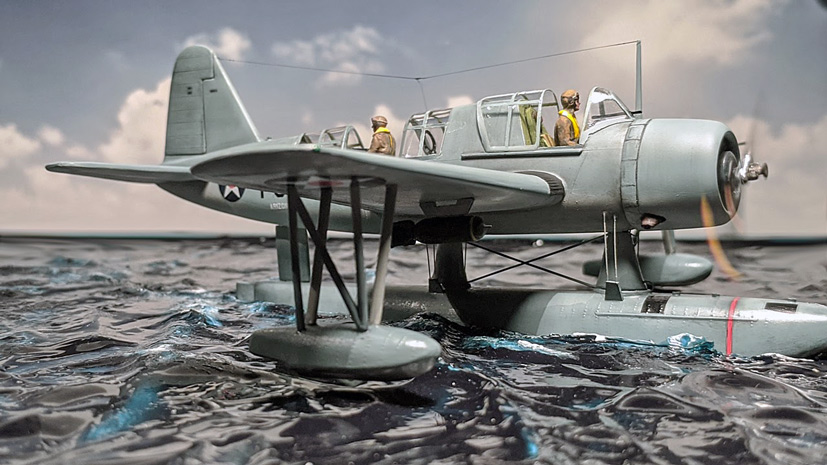
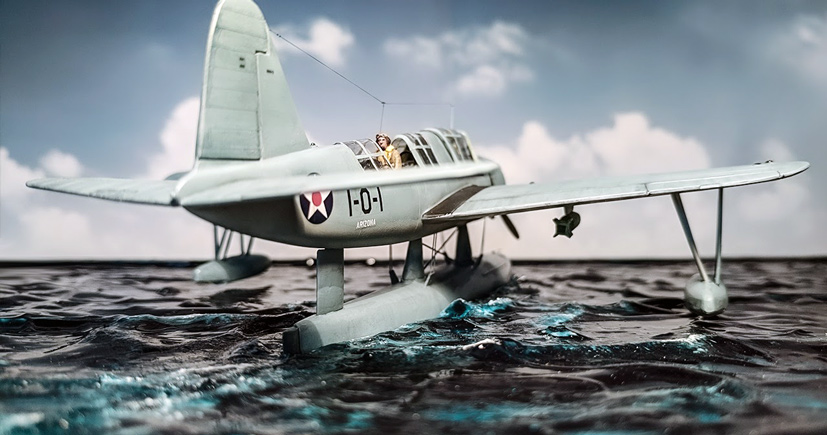
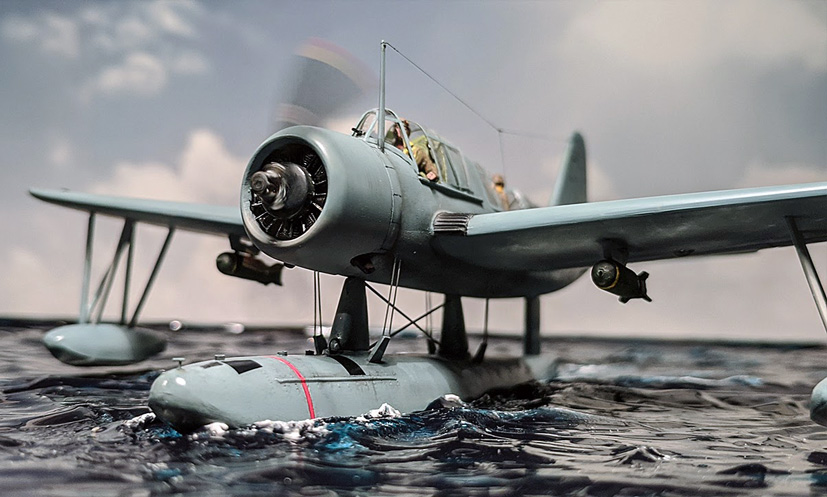
Andreas describes how he approached this Kingfisher build.
The kit is a very old one from the 1960s by Airfix. It was reissued a few years ago in new packaging and with new decals. The kit itself is therefore low budget and I also didn’t buy any aftermarket parts. All comes from the left-over box (except for the barrel of the M2 Browning machine gun, which comes from CMK). I scratch build the area of the canopy over the pilot’s seat, since the original part is not intended to be arranged in the open position.
The fit of the kit’s parts is not too bad and I had no problems during the build. I recommend to shorten the inner struts for the outer floats, because they are just a little bit too long. The decals are very good and the colour profile is correct as far as I could say.
The water base is made from 6 mm foam (I recommend to use 10mm or more) covered with paper and then painted with acrylics and a big layer of AK water gel. I have added a few white spots with acrylic paint to simulate the foaming wave tops. Next time I will add more water effects on the plane itself. Because this is the first time I attempted to simulate water, I didn’t dare. I borrowed my wife’s hair dryer to generate the wind for the rotating propeller.
Both builds look absolutely fantastic and highlight what can be achieved with classic Airfix kits and a little modelling talent. What with the earlier Black Widow and now the Devastator and Kingfisher, there is definitely life in these older classic kits and we hope the sight of these build features will inspire a little more classic Airfix building action over the coming months. If you do take the plunge, please let us see the fruits of your modelling labours.
We would like to thank Andreas for kindly sending in these details and allowing us to share them with fellow Workbench readers. He is also on the lookout for another Devastator or a Grumman Duck, so if anyone can help locating one or both, please do drop us a line.

As one of the most successful fighter aircraft of the Second World War, the Grumman Hellcat made ‘aces’ of at least 305 US Navy pilots, in addition to being responsible for an astonishing 75% of all aerial combat victories claimed by US Navy pilots during WWII. As such, the title of this particular section might be a little spurious, however, we are not talking about attributing another victory to the long list of the Hellcat’s combat successes, we are talking about a victory for one lucky Workbench reader.
In the previous edition of our blog, we included a feature where we looked at two more 1/24th scale Hellcat builds completed by one of our Product Designers Paramjit Sembhi and how he used this opportunity to incorporate some ‘display innovation’ into the builds. As we were talking about one of most impressive model kits in the Airfix range, we also thought it only right to offer one of these beautiful Hellcat kits as a competition prize for one lucky Workbench reader. We are pleased to report that we now have our winner.
Having received over 4000 entries, it was obvious that many readers were keen to get their hands on one of our Hellcats, but on occasions such as this, we are afraid that there can only be one winner and that lucky person who was selected at random from the list of correct entries is Malcolm Wright. Malcolm has already been notified of his success and has supplied us with his address details, so he will hopefully be getting stuck in to a little Hellcat action in the next couple of weeks.
Congratulations to Malcolm and thank you to each and every one of you who took the time to make this latest competition such a resounding success.
We are afraid that’s all we have for you in this latest edition of Workbench, however, we will be back as usual in two weeks’ time with a further selection of Airfix modelling delights for your enjoyment. If you have any suggestions for subjects you would like to see covered in a future edition, please use this workbench@airfix.com link to contact us.
In between new editions of our blog, the Airfix conversation continues over on our Airfix Forum Worbench thread, with further discussions taking place on both the official Airfix Facebook page and the Airfix Twitter channel - please do get involved in the discussions and let us know what you think about Workbench.
Whenever you decide to visit, the Airfix website is always the place to be for all the latest model availability information, previous editions of our blog, a selection of modelling tips and much more.
The next edition of Workbench is due to be published on Friday 12th June, when we will have more interesting features from the world of modelling.
On behalf of the entire Workbench team, thank you for your continued support our Airfix blog.
The Airfix Workbench Team
© Hornby Hobbies Ltd. All rights reserved.

