

It’s Airfix Workbench time again and can you believe that we are already at edition number ten! As we have spent the previous nine blogs telling you about the large number of fantastic new model toolings that Airfix have in development, we are going to use this latest edition to catch up with some of these earlier announcements and pay a little more attention to how they are progressing. Over the past few months there has been so much new model activity that many Workbench readers have requested some more robust updates on the projects that have already been announced, and we intend to do just that. There is a lot to update you on so we had better get started.
When the Boeing Model 299 prototype took off on its maiden flight from Boeing Field, Seattle on 28th July 1935, it must have made for an incredibly impressive sight. At that time, Boeing’s new aircraft was the largest landplane in the US and this vision in polished metal weighed around 15 tons and was bristling with defensive armament. The aircraft had already been given its nickname of ‘Flying Fortress’ by a journalist who was present at the aircraft’s roll-out ceremony and had noted the significant defensive armament included on the new bomber.
The Boeing Model 299 developed into one of the most famous aircraft of WWII and arguably more than any other aircraft of the conflict symbolised the awesome industrial prowess of the United States. During an impressive ten year production run, no fewer than 12,732 Flying Fortresses were produced, which went on to serve in every theatre of operation during the Second World War. Tragically, out of this number, 4,735 bombers were lost in combat, which clearly illustrates the perilous nature of the missions B-17 crews were forced to endure. Perhaps for this very reason, the Flying Fortress is viewed as something of an American icon and it remains a popular subject for modellers and aviation enthusiasts all over the world.

The Boeing Model 299 prototype aircraft at Boeing Field
In the fourth edition of our Workbench blog, we announced that Airfix would be producing a totally new 1/72nd scale tooling of the Boeing B-17G Flying Fortress and from the feedback and forum comments received since then, it appears that a great many modellers are very much looking forward to its release. Produced as a late model ‘G’ variant of this famous US bomber, the new kit will faithfully reproduce the improvements and modifications incorporated in the design of this particular version of the B-17, which were developed as a direct result of the combat experiences of Flying Fortress crews over Europe. Even though the US airmen were forced to endure the savage aerial battles in the skies above Germany and occupied Europe, this version of the aircraft was introduced to build on the many impressive qualities of the earlier B-17 designs and improve on both mission effectiveness and crew survivability.
The new Airfix kit presents the modeller with a late model ‘G’ variant of the Flying Fortress, which is generally regarded as the definitive version of this famous bomber. Many of the improvements on the ‘G’ were around the defensive capabilities of the aircraft, including the new remotely operated ‘Bendix’ chin turret, altered side mounted gun positions in the nose of the aircraft and the distinctive ‘Cheyenne Tail’ gun unit. Other significant changes included staggered waist gun positions, which were now fully glazed and featured an effective coiled spring gun support system, which performed like something of a gimbal and made the operation of these heavy guns much less labour intensive for the crew. By staggering the waist windows, B-17 gunners would no longer bang into each other, during combat situations, which could be both annoying and potentially life threatening. The dorsal gunner’s turret was also modified to remove much of the framing associated with the previous version, allowing a much clearer view for the gunner.

Exclusive image of the built up test model on the Airfix desk
Obviously of great interest to the modeller, the new B-17G Flying Fortress model project is progressing towards release in late 2016 and the Airfix team have kindly sent us an update for inclusion in our latest edition of Workbench. As with many of the new model projects announced this year, they have been brought to the attention of modellers much earlier than was previously the case, with the subsequent release dates usually being many months in the future. The huge benefit for us is that we can keep an eye on the project as it progresses through the various stages as it heads towards release, which gives us a fascinating insight into how much work is involved in bringing a new model tooling to market.
The latest images from the B-17G project include some fascinating pictures of the test frame model components, which must be an exciting time for the designers who have put so much effort into producing this model. They clearly show the impressive levels of detail that have been incorporated into this new model. As the first plastic frames to be produced from the new tooling, this is a critical stage of the process. Taking a complete set of the components, the Airfix designers will have to construct the kit, assessing every aspect of the fit and construction at each stage. The constructed model will then be sprayed with grey primer, as this how we finish test builds.
This single colour will allow designers to assess the fit of all the major parts, before they compile a report on any issues raised during the process. This will then be sent to the manufacturing facility, so that alterations and modifications can be actioned where necessary, before the model can be released for full production.

Exclusive kit frame images of the newly arrived B-17G test model

The new Boeing B-17G built up test model, with test frame components
This is currently the stage at which the Airfix Boeing B-17G project is at and these exclusive images are the very latest updates from this exciting new kit. They are being included in Workbench on the understanding that readers accept that these are the latest development images and there could be some significant modification required before the model is released for production. They do allow us a very interesting insight into the processes involved in the development of a high quality plastic model tooling and will certainly leave many modellers looking forward to getting their hands on this extremely impressive new model. As the new B-17G tooling progresses and the model moves closer to production, we will include further updates in future editions of Workbench – there are more details and you can pre-order your new Airfix Boeing B-17G (A08017) here.

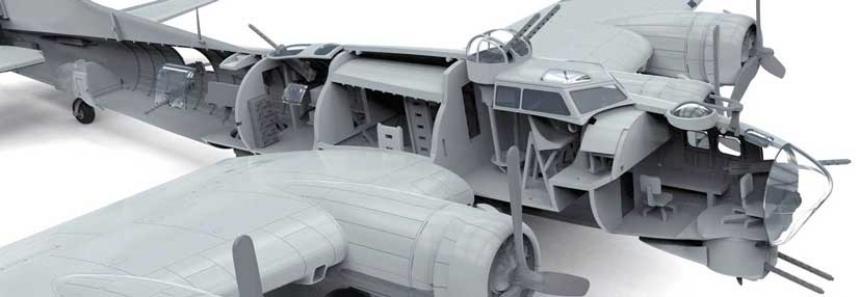
Computer rendered cut-away image of the new Airfix B-17G
Bristol Blenheim Mk.IF Long Range Fighter
One of the few new Airfix 1/72nd scale models to escape the attention of our earlier Workbench blogs is the new Bristol Blenheim Mk.IF (A04059) – this long-range fighter version of the famous Blenheim benefits from newly tooled additional parts to the already released A04016 Mk.I Blenheim Bomber kit, which has been produced using the impressive manufacturing techniques in place at Airfix. This beautiful new model is due for release in early 2016 and we can now bring you details of the decal options that will be supplied with this impressive kit.
As was the case with many of the aircraft developed during the mid 1930’s, the Blenheim was one of the most advanced aircraft in the world at that time and was faster than all of the fighter aircraft in service with the RAF, at the time of its first flight. This was obviously of great interest to the RAF, who felt they would now have a light bomber that was capable of out-running any fighter sent to attack it and making it a devastatingly effective deterrent threat. Unfortunately, on the eve of the Second World War, fighter technology had developed so much that the Blenheim had transformed from a fast and highly capable light bomber, to an extremely vulnerable aircraft that would not be able to operate effectively without the benefit of defensive fighter support.

Restored Bristol Blenheim Mk.IF displaying at Old Warden
As RAF military planners came to terms with the vulnerability of the Blenheim as a bomber, some 200 Mk.I airframes were converted to perform a long-range heavy fighter role and as the RAF prepared to fight the Battle of Britain, no fewer than nine Blenheim fighter Squadrons were in service. With the concept of the heavy fighter appealing to both the RAF and the Luftwaffe at this time, much was expected of the Blenheim Mk.IF fighters, but just as the Germans experienced with their Messerschmitt Bf 110 Destroyers, the size and relative lack of manoeuvrability of the twin engined aircraft made them extremely vulnerable to fighter attacks. Even though the idea of heavy fighters seemed to be a valid one on paper, they proved to be a disappointment and actually just turned out to be light bombers with more guns on them. The disappointing performance of the Blenheim day fighters led Fighter Command to withdraw the aircraft from daytime fighter operations and converted them to a nocturnal role, where the aircraft enjoyed much greater success.
With the designation Blenheim Mk.IF, the fighter version of the aircraft differed from the light bomber configuration in a number of ways. Perhaps the most significant difference was the addition of a ventral gun pack, which housed four .303 machine guns and packed a real punch if all were brought to bear on a concentrated area of an enemy aircraft. These gun packs and their mounting frames were actually manufactured at the Southern Railway workshops at Ashford, in Kent, which is just a short distance from the new Hornby offices. The aircraft also retained the single wing mounted Browning machine gun and the Vickers ‘K’ gun, mounted in a semi-retractable, hydraulically operated dorsal turret.
This impressive new kit will be supplied with the following decal options:

Livery and decal details for the new Airfix Blenheim Mk.IF
Bristol Blenheim Mk. IF
K7159 / YX-N
RAF No. 54 Squadron Operational Training Unit
Church Fenton
North Yorkshire
December 1940
Equipped with the Airborne Intercept radar unit to aide night detection of enemy aircraft, this particular Blenheim was employed in training nightfighter crews in interception techniques, before they went on to fly either Mosquito, or Beaufighter nightfighters. Flying from RAF Church Fenton, the northern situation of the airfield meant that training could take place with only a limited threat of attack by Luftwaffe bombers.

Livery and decal details for the new Airfix Blenheim Mk.IF
Bristol Blenheim Mk. IF
L8679 / BQ-O
RAF No. 600 (City of London) Squadron
Royal Auxiliary Air Force
Manston Airfield
Kent
August 1940
During a night patrol off the coast of Ramsgate on the night of 9th August 1940, this Blenheim suffered engine failure, with the crew bailing out into the North Sea. There is some conjecture as to the cause of the incident, with some reports stating that the aircraft was shot down by a Bf 109E flown by Oblt. Karl-Heinz Metz of 8./JG.2, with others stating it was the victim of friendly fire, from a shore based AA unit. Thankfully, both RAF airmen survived the incident.
This fantastic new model, which marks one of the important fighter types available to Fighter Command at the start of the Battle of Britain, is due for release during February 2016 and you can keep updated with its progress by checking the A04059 page on the Airfix website.
You may recall that in the very first edition of Airfix Workbench, we announced that the 2016 catalogue would benefit from the addition of two brand new 1/72nd scale tooling releases. These models marked two of the most important aircraft types of the First World War and news of their development was certainly well received by the modelling community. As we are still commemorating the Centenary of the Great War, the addition of two new WW1 aircraft model toolings was obviously seen as big news, particularly as the new models have been developed using the techniques that have won Airfix so many modelling plaudits over the past few years. The Airfix catalogue really did need some new Great War aviation subject matter and these two new models will delight many modellers – we can now give you the latest update on these models, which are due for release at the end of January 2016.

The magnificent box artwork adorning the Airfix BE2c release
Since this magnificent new model was announced in June this year, we have produced a number of articles featuring this interesting aircraft, which was the product of a nationalised aviation manufacturer. Workbench Edition 1 features the development of the BE2c, whilst Aerodrome 12 looks specifically at the VC winning aircraft, which was flown by William Leefe Robinson, in the home defence role, against the hated Zeppelin. The new Airfix catalogue includes both a Dogfight Double set, featuring the BE2c and the Eindecker, as well as the individual releases of both models. The decal options included with the Royal Aircraft Factory BE2c (A02101) are:

Livery and decal details for the new Airfix BE2c (Option 1)
Royal Aircraft Factory BE2c
2693
Lt. William Leefe Robinson
No.39 (Home Defence) Squadron
Royal Flying Corps
Sutton’s Farm Airfield
Essex
2nd/3rd September 1916
This was the aircraft that Robinson used to famously destroy the German Schutte-Lanz SL.11 Airship on the evening of 2nd-3rd September 1916, which was the first British victory over the hated Airships. The feat earned Robinson the Victoria Cross and the admiration of the entire nation, elevating him to celebrity status overnight.

Livery and decal details for the new Airfix BE2c (Option 1)
Royal Aircraft Factory BE2c
8407
Royal Naval Air Service
East Fortune Airfield
East Lothian
December 1916
This particular BE2c was fitted with ten Le Prieur rockets, which were attached to the outer wing struts of the aeroplane – these rockets were designed for use in the battle against the hated Zeppelin balloon menace. Unfortunately, the rockets proved to be rather ineffective against these silent night raiders, with the firing of them being much more visually impressive than operationally effective. They do help to tell the story of how Britain began to use aeroplanes as an effective home defence weapon and the first nightfighter operations.

As the aeroplane began to play a significant role in military operations over the Western Front, the German Air Service introduced an aircraft that was to change the course of aviation history. The Fokker Eindecker series were the first true fighter aircraft of the Great War and saw the introduction of a gun synchronisation mechanism, which allowed German pilots to fire their guns through the arc of the propeller, but crucially, in the pilot’s line of sight.
Light and manoeuvrable, the combat introduction of the Fokker Eindecker proved to be devastatingly effective and it was responsible for allowing the Luftstreitkrafte to enjoy a period of air superiority. In a phase of the air war known as the ‘Fokker Scourge’, the Eindecker proved to be the nemesis of the RFC BE2c reconnaissance aircraft, with many falling to the guns of the German fighter. There can be no doubting that the Fokker Eindecker series of aircraft are extremely significant in the history of WWI aviation and indeed of aerial warfare. The decal options supplied with this kit (A01086) are:

Livery and decal details for the new Airfix Fokker E.II Eindecker
Fokker E.II (Late) Eindecker
69/15
Lt. Baron Kurt von Crailsheim
Feldflieger Abteilung 53
Monthois Airfield
France
October 1915
The Airfix designers are rightly proud of these two new Great War models, which are both due to be released at the end of January 2016. The Official Airfix YouTube channel now features a superb construction video of the Fokker Eindecker, which really does illustrate the impressive level of detail that has been incorporated into this kit.

Box artwork of the Airfix Korean War F-51D Mustang A02047
What could be a better way to end the latest edition of Workbench than with a spectacular model build, featuring one of the Airfix models from the current 2015 catalogue? The recent 40th Anniversary Celebration evening of the Rossendale Aviation Society included an impressive display of models, which were produced by the Society’s rather accomplished modellers. One model that particularly caught the eye was this magnificent North American F-51D Mustang, wearing spectacular Korean War livery, which was built by Society member Colin Duckworth. Colin described how the model was built straight from the box and was a joy to construct – I suspect there may have been a little bit of skill involved as well. It looks absolutely magnificent and is a fine tribute to one of the most famous fighter aircraft of WWII, which was still fighting in the jet age. Korean War Mustang A02047 is currently available on the Airfix website.

Beautifully finished Airfix Korean War USAF F-51D Mustang

Beautifully finished Airfix Korean War USAF F-51D Mustang
That’s it for Workbench Edition 10, which we hope you found interesting. When we posted the first edition at the beginning of July, we really wanted to produce something that would be an interesting read for Airfix modellers and particularly to give readers a greater insight into everything that goes on behind the scenes at Airfix. We have been delighted with the reader response to Workbench and we are extremely grateful for the support you have given us during 2015. We will be working hard to ensure that 2016 builds on this success and that we continue to bring you interesting news and features from the world of Airfix.
On behalf of the entire Airfix team, we would like to wish you a very happy Christmas and a prosperous New Year. We look forward to seeing you again in 2016.
If you have any spare time during the Christmas festivities, you can get involved with all the Airfix chat on our dedicated Workbench thread on the Airfix Forum, or alternatively, you could use either our Facebook or Twitter social media channels, using #airfixworkbench.
We look forward to bringing you more Airfix news in the next edition of Workbench!
The Airfix Workbench Team
© Hornby Hobbies Ltd. All rights reserved.

