

Welcome to this latest edition of our Workbench blog and all the news, updates and modelling exclusives from the fascinating world of Airfix.
This latest blog is going to be something a little different from our usual format and whilst we don’t think it will take readers that long to work it out, we are not going to be giving you any clues at this stage. As we have now reached the halfway point of the year, it is interesting to note that the new tooling projects we have been following all year are now fast approaching their initial production releases, with the de Havilland Chipmunk T.10 still at the head of this particular release pack. Whilst we are getting a little excited about adding these new kits to our build schedules a little later this year, our designers have all ‘moved on’ and have already spent months working on their next designs, projects we will not be able to tell you about until we announce the next range at the beginning of 2022. When we are allowed to let you know what we have planned, you are not going to be disappointed!
So what do we have for you in this latest edition? We begin by featuring a sextuple of fantastic 1/32nd scale figure sets, products which can trace their history back to the 1960s, but are now just about to take their places in our ever popular Vintage Classics range. We follow this up with another impending Vintage Classics arrival and a kit which is a scale representation of a vehicle which is the epitome of cool, but really does need cloudless blue skies to bring out the best in it. Finally, we bring things right up to date with exclusive imagery from the latest new tooling project to join our Quickbuild range, a beautiful representation of a true American muscle car. As you can see, we have much to tell you about, so let’s get started.
The ‘Eagle has Landed’ - the Vintage Classics range is about to benefit from the addition of six sets of 1/32nd scale military figures … let battle commence
For millions of Airfix enthusiasts all over the world, the sight of our iconic box artwork immediately conjures up memories of our youth and the carefree days when the most important thing in our lives at that time was either making, or playing with built models and scale soldier packs. Indeed, it would be fascinating to know just how many Workbench readers share the same memory of having their plastic soldier collection spread out across the front room carpet, with things like coffee tables and magazine racks making for rather effective cover props for our miniature sharp shooters.
Back in those days, it wasn’t the fact that these figures were beautifully finished in accurate representations of the correct military uniforms for the opposing scale forces, but more that they fed the fertile imaginations of young people acting out scenes they had read about in their action comics or had been told about by their parents and grandparents, which resulted in many happy hours of autonomous creative entertainment. Whilst these scale military manoeuvres were taking place, mums and dads were definitely banned from the room, because they simply wouldn’t be able to comprehend the complexities of these vital modelling engagements.
A range of scale figure sets which also benefitted from the commissioning of stunning box artwork, an impressive selection of 1/32nd scale figures are just about to join the growing collection of products in our Vintage Classics range and whilst the contemporary nature of childhood entertainment may have changed dramatically since the 60s, 70s and 80s many of us remember so fondly, these figure sets will surely still have appeal for both young and old, particularly when military anniversaries are currently commemorated so widely. The decision to produce these figures in 1/32nd scale goes back to the halcyon days of Airfix and a time when this famous hobby brand could hardly do a thing wrong - although made out of plastic, almost everything Airfix touched back then turned to hobby gold. With the intention being to launch a new range of cars, tanks and ultimately figures, company officials at that time assessed the existing market, whilst at the same time being conscious of the imperial scaling system they traditionally worked to.
As many existing larger scale figures were produced in 1/32nd scale (in between 1/24th and 1/48th from a sizing perspective), it was decided that this would be the right scale for these new products. With a range which was expected to grow exponentially over the coming years, this constant scale would allow for a level of connectivity between these new figure sets and tanks and cars which would be produced in the same scale, although having said that, what a WWII German Paratrooper would be doing in a brightly coloured Beach Buggy might require an explanation only a child at play could give. In truth, to them, such matters were of little concern and if it made for a few hours of happy entertainment, then so be it.
From this original scaling decision, an impressive range of cars, military vehicles, field guns, buildings and of course figures would be introduced in the years which followed, all of which would be at the correct relative size to one another and all which would support many hours of playing entertainment for the huge Airfix audience.
With such a comprehensive and ever expanding tooling bank to its name, it soon became obvious that not all of the kits in the Airfix range could be in production at any one time and how some may prove more popular than others. As collector tastes naturally ebbed and flowed over the years, from time to time, some kits were rested and fell from subsequent ranges, with some actually finding it difficult to make a reappearance, for a number of perfectly valid reasons. When models do go into production once more after something of a hiatus, their re-appearance is often extremely successful, if for no other reason than the priceless nostalgia value they possess for incredible numbers of hobbyists. For those who still remember conducting large scale military campaigns in their gardens or on the front room carpets of their childhood homes, they will be interested to hear that the Vintage Classics range is about to welcome the re-issue of no fewer than six 1/32nd scale figure sets, which includes the first WWII German Infantry set which was tooled in 1969, to the WWII British Infantry set first tooled in 1980.
Produced using a material called K-resin, these figures have been manufactured to make the application of paint more effective, should that be required and includes full painting details for each set
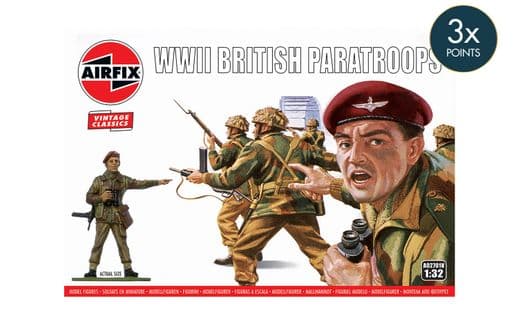
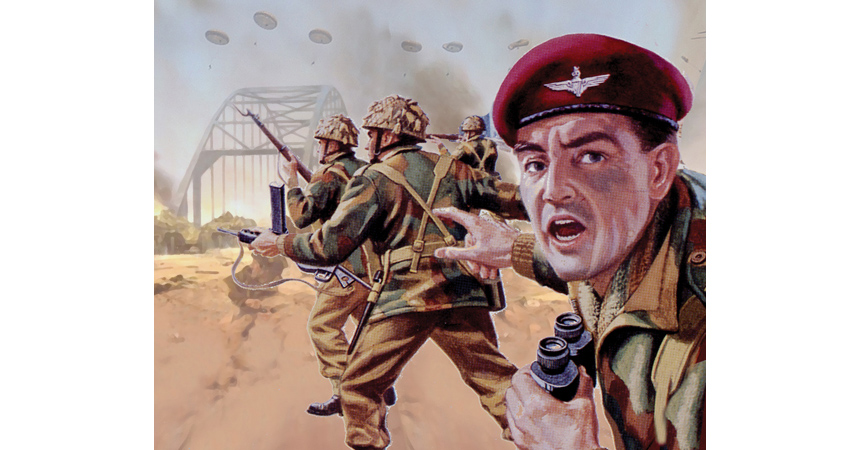
Featuring the box artwork created by William Stallion, these evocative images were similar to those found on the front of combat comics such as Commando and The Victor and were to stimulate many hours of play and carpet combat the world over
Each set features the evocative artwork created by the extremely talented William Stallion and it has been quoted in a number of enthusiasts sites that Mr Stallion would pose holding wooden guns and ask his wife to take pictures of him, in advance of the illustration process. Using a selection of poses, he would then use these pictures to lay out his artwork, before later adding authentic uniforms, combat backgrounds and of course weapons to complete his dynamic images. What he created were artworks of real impact, ones which would become familiar to millions of people, whilst at the same time, helping to ensure that many hundreds of thousands of these figure sets would find new homes with youngsters desperate to start their scale battles.
Although clearly accessing military subject matter for their source inspiration, the intended use for these products was definitely play, giving youngsters the plastic tools with which to unlock their fertile imaginations. Knowing the heavy usage these figures would be subjected to and how accurately painted uniforms would not necessarily be the order of the day, these initial releases were manufactured in a rather forgiving soft plastic, which was intended to be quite flexible so they could survive many hours of play and the rigors of simulated explosions and withering machine gun fire. Some time later, it became apparent that more committed enthusiasts were keen to paint the figures in authentic uniforms, but how due to the flexible nature of the plastic, the paint would flake off with annoying regularity, no matter how much care was taken during the painting process.
In order to address this situation, Airfix later completely changed the material used to make these figures, selecting a more rigid, resin like compound which was less flexible and much more accommodating to the application of paint. This latest production run uses a material called K-resin and again supports the painting of these figures, although it still has to be said that enamel paints are much more effective than acrylics when it comes to these particular products. As we touched on earlier, the Vintage Classics range is about to welcome SIX of these quintessential figure sets, which will include WWII British Paratroopers, WWII German Infantry, WWII US Infantry, WWII US Paratroopers, WWII German Paratroopers and WWII British Infantry, with each set also utilising the original impressive artwork created by William Stallion. Each set also includes detailed painting instructions for each respective combat force modelled, clearly marking the fact that these figures are intended to be painted and fully support that requirement. If your intended use of the figures is to enhance a 1/32nd scale military diorama, or something much less time consuming, these soldier figures will be ready for action and reporting for duty in just a few short weeks’ time.
With all six of the sets listed above due for release at the same time, these figure sets and their historic artwork will be gracing model displays in stores the length and breadth of the country in the coming few weeks, tempting many of us to re-create those household military campaigns of years past. We would like to thank Airfix expert Jeremy Brook and the Airfix Collectors Club Constant Scale Journal for his invaluable help in detailing the history behind these figure sets and helping us to prepare for their impending range inclusion.
A range of model kits which have become an established part of the Airfix range over recent years, QUICKBUILD is a combination of Airfix quality with construction simplicity, models which can be built without the need for paint and glue many hundreds of times if desired, but equally, don’t look out of place if left assembled and given a spot on your display case. These impressive little kits may be quite a divergence from the kits most would regard as ‘traditional’ Airfix models, but they now have a huge part to play in both the future of the brand and in attracting potential new, younger modellers to a hobby which has brought to much pleasure to so many people over the years. If nothing else, they allow for some quality family time, as everyone vies for the title of ‘House Champion’ in the crucial QUICKBUILD Challenge stakes.
The impressive design brief behind every QUICKBUILD model tooling is to produce a brick based model which whilst intended as an introduction to modelling for youngsters, can be enjoyed by people of all ages, whether they have previous modelling experience or not. Construction is a simple, push together exercise and does not require the use of either glue of paint, with the finished model being decorated with a selection of high quality self-adhesive stickers, but once finished, there is little or no evidence of the model’s brick based construction. This means that after construction and some serious playing time, the model is accurate and appealing enough to take its place on your shelf as a display model, or taken apart and returned to its box, to be constructed again when the mood takes you.
In many ways, the design of a QUICKBUILD kit can be more challenging for our designers than working on a traditional Airfix model kit. The moulds themselves can be extremely complicated and incorporate additional ‘side actions’ to create the unique parts for a QUICKBUILD kit – this also which means that tooling costs associated with these models can actually be much higher than with other Airfix kits, just heaping a little more pressure on our designers. This is mainly due to the fact that each QUICKBUILD kit may require four or five separate moulds when creating the parts, as different coloured selection of brick components will all require separate tooling moulds.
The brief facing a QUICKBUILD designer is to produce an accurate and attractive representation of the vehicle on which it is based, but one which can be assembled and taken apart many times, all without the need to use glue and paint.
A thing of beauty, once assembled, this latest addition to the QUICKBUILD range is an eye-catching representation of this American muscle car.
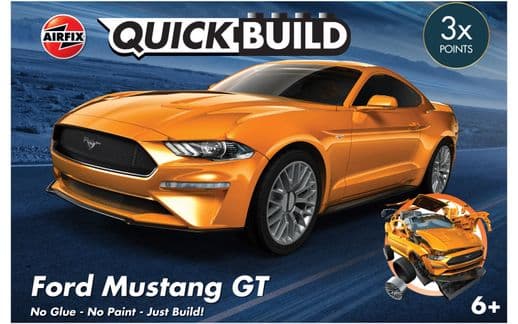
Our expanding range of QUICKBUILD kits can now boast an impressive selection of cars, utility vehicles, aircraft and tanks, enough to create a colourful model display in its own right. It is also just about to increase further with the addition of a stunning new model, an American muscle car which for many people is the epitome of motoring style, one which pays homage to its illustrious predecessor, the latest incarnation of a motoring classic, the Ford Mustang GT.
The subject chosen for this latest addition to the QUICKBUILD range is one of the most famous car models to wear the Ford badge, a stunning vehicle which has been in continuous production since 1964, the mighty Mustang. A real American muscle car, the Mustang is one of the most instantly recognisable cars to be found on any of the world’s roads and one which actually proved to be something of an unexpected success for the company. A car which immediately became an aspirational purchase for anyone who was a style conscious driver, the Mustang had a distinctive long front bonnet (hood if you want to stay American) and a relatively compact cabin, attributes which gave it a really purposeful, almost aggressive appearance, making this it a car to be reckoned with. In actual fact, this distinctive styling would prove so popular that it would inspire a generation of new vehicles from several rival motor manufacturers, including such US classics as the Chevrolet Camaro, Pontiac Firebird and Dodge Challenger. A little closer to home, European markets would see the introduction of the Toyota Celica and the Ford Capri, both types which were thought to have taken design inspiration from the Ford Mustang.
The original Ford Mustang underlines its star billing within the Ford line-up by its appearance in several high-profile movies of the period, such as James Bond’s ‘Goldfinger’ and the classic fast-paced action thriller Bullitt, big screen appearances which would only serve to further enhance the reputation of this powerful new car. The name chosen for the car is thought to have been suggested by a senior designer and stylist working at Ford’s at the time, a man who was a huge admirer of the famous WWII Mustang fighter aircraft - as the Mustang proved to be a real war winner and something the American people were rightly proud of, it seemed a fitting name for this new muscle car, one which would have to fight for its position within Ford’s range.
More exclusive imagery, these pictures show a production sample of the new QUICKBUILD Ford Mustang GT, the latest addition to this popular range of models.
Over the years, the classic styling of the original Mark I Mustang has been ‘tinkered with’ in order to maintain sales numbers which have always been strong, providing the model with regular facelifts. It does have to be said that some of these styling decisions weren’t always a roaring success and when compared with the original, are much less pleasing to the eye, however, they say that beauty is in the eye of the beholder and someone at Ford must have thought they were a good idea. The second iteration of the Mustang was quite appealing, as it gave the car an even more aggressive appearance, making this a car whose owner was definitely not to be messed with, but it does have to be said that the 3rd and 4th generation styling was much less impressive, making this motoring classic almost resemble that of an anonymous family car, which is something the Mustang never really was.
By 2005, Ford’s Mustang was back, as the 5th generation styling clearly went back to the drawing board, taking plenty of inspiration from the winning formula which made the original Mustang such a motoring phenomenon. Once again demanding the attention of anyone who clapped eyes on it, it appeared that Ford designers were now completely aware of how their Mustang was viewed by its adoring public and indeed, how they expected it to look. From now on, this motoring classic would be styled sympathetically to its iconic origins, staying faithful to the attributes which made it so popular in the first place, whilst also incorporating all the latest technological innovations to maintain its position as a true aspirational prestige/sports design. The latest iteration of the Ford Mustang was unveiled in December 2013 and is another stunner, a car anyone would love to own and one which stays faithful to the car’s muscular origins. Although you should never generalise on such matters, would you describe the Ford Mustang as being a car which would appeal to men and a certain type of man at that? Perhaps a style conscious sports star or an actor/stuntman who works on action movies, or are we making too many assumptions here? Whatever the target audience, there is no doubting that the latest version of this American classic is one which Steve McQueen, the ‘King of Cool’, would have looked right at home in and is therefore a car many millions of people would therefore love to own.
Even though these models are designed to be built without the need to use either glue or paint, this latest addition to the QUICKBUILD range builds into an attractive representation of this stunning car and one which wouldn’t look out of place in any model display case.
When looking at this picture, it is difficult to believe that our new Ford Mustang GT model employs the brick based construction method our QUICKBUILD kits are famous for.
This latest stunning addition to the QUICKBUILD model range has just been released and means that modellers can now have an example of both the flying and motoring versions of this American classic within their collections. Adding a real touch of motoring prestige and style to the Quickbuild line-up, this new model is a representation of the latest Mustang GT and is moulded in striking orange plastic, ensuring it is going to be getting plenty of attention in the future. The model looks spectacular as a display piece, but owners of the kit will also know that it will allow hours of future fun as a construction project, as it can be taken apart and re-assembled as many times as you wish, one of the major benefits of our QUICKBUILD models. A representation of this modern motoring classic, this new model is surely destined to become a range favourite with anyone looking for a more traditional look to their model supercar and it will be interesting to see if the Mustang will demand as much attention as something like our Bugatti Chiron - if we could only choose one to own (we are talking real cars here), which one would emerge as the most popular? Even if money was no object, we think the Mustang GT will be capable of holding its own in the desirability stakes.
For most of us, or at least until our lottery win finally materialises, we can keep this dream alive by owning one of these fabulous new kits and charting the latest model development in the Airfix QUICKBUILD range. A really enjoyable way to spend a little time modelling without the need to use either glue or paint, once constructed, this new model makes for a stunning display model and a really attractive scale representation of an American motoring icon. Why not road test one of our new Ford Mustang GT models now!
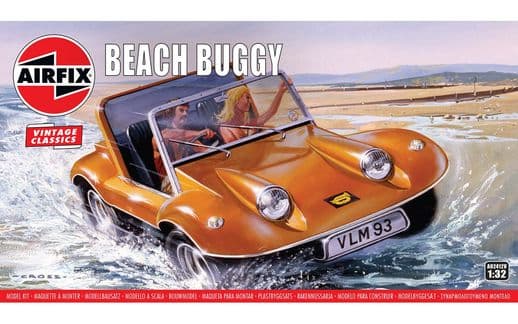
Coming from the hand of famous Airfix artwork creator Roy Cross, the Beach Buggy box could always be relied upon to raise a smile. This was one model kit nobody minded receiving as an unexpected gift, even if your kits of choice were aircraft or tanks. This kit, which is the epitome of fun, is about to take its place in the current Airfix range, as the latest release in our Vintage Classics range.
For modellers of a few years standing, our association with the Airfix brand probably started many years ago and whilst we all love to admire the technological advances incorporated into all the latest model tooling designs, for us, the nostalgia of the brand can often be just as powerful. The sight of the box artwork we admired in our youth can still produce a heady mix of emotions and can immediately take us back to those days when the only thing that seemed to matter was our hobby, even though a lack of available funds dictated that we were forced to be a little more patient with kit acquisitions than we are today. As new kits were difficult for us to come by back then, there were some model kits which readily made it to our ‘must get’ list, whilst others had to reside in the ‘it would be nice to have’ section of the same list, ones which we would possibly not ask for as a birthday or Christmas gift, but if they turned up unexpectedly, we wouldn’t be too disappointed. For many modellers, one kit which definitely falls into this category was the 1/32nd scale Beach Buggy, modelling subject matter which could hardly be more different from the Spitfire fighters and Panther tanks which appealed to us so much, but one which represented the very embodiment of what our hobby is all about - fun and enjoyment.
For all those modellers who wished they had built the Beach Buggy during their formative years, but never had the opportunity to scratch that particular modelling itch, your time may well have come, as this iconic model is about to take its place in our Vintage Classics range and be unleashed on the modelling world once more.
Unashamedly a lifestyle and recreational vehicle, the Beach Buggy will always be associated with somewhere like California, where young people had nothing more on their minds than surfing and relaxing on long, sandy beaches, before taking a dip in the clear blue waters of the Pacific, or at least that was how most people saw it. The Dune/Beach Buggy can trace its origins back to the early 60s and the desire to produce a simple, yet rugged and effective light off-road vehicle, one which could either be a new build, or utilise the major components of an existing vehicle. Centred around a rather flamboyant and distinctive fibreglass body shell, the Buggy’s design incorporated wide tyres for traction on soft ground, a rear mounted air cooled engine for simplicity and an open cabin, which really did suggest that it was intended for use in countries known for having a warm climate.
A capable off-road and hill-climbing performer, the vehicle was designed to be a no frills, go anywhere recreational vehicle, but as it appeared to be adopted by the young and sporty in America, a group of people many looked at with no little admiration, these cars became to represent the surfing community and as such, soon took on an iconic status. Not a vehicle you would choose to travel long distances in on a motorway or highway, the Beach Buggy was all about getting you from your home to the seaside and the place you would be spending your day recreationally. The thinking was, if you were going to be making this journey anyway, why not do it in a fun and stylish way - if you wanted to get noticed, get yourself a Beach Buggy.
Although this vehicle was clearly associated with America’s young beach goers, it also attracted plenty of admirers on this side of the Atlantic and whilst we can rarely count on a Californian type of climate here in the UK, there’s no reason why we shouldn’t aspire to owning our own little Buggy. In fact, whenever you see one of these fun little cars, you are immediately drawn to it and the people sat inside it are either envied or admired, but always seen as being incredibly cool. If you see a Beach Buggy at one of the Motor shows around the country which attract so many visitors in each normal year, you can be sure that there will always be a healthy crowd around the display, with everyone attracted to their colourful paint finishes and iconic body shape. Their appeal also seems to traverse age and gender boundaries, as a Beach Buggy has an almost universal appeal and whilst they may not be the most expensive cars on display, the appeal of their fun factor make them amongst the most desirable. As soon as you clap eyes on one of these cars, you can almost imagine yourself sat in one whilst speeding down some deserted beach, without a care in the world.
An exclusive first look at the Vintage Classics box layout which will welcome the Beach Buggy into this popular and nostalgic range of model kits.
A kit which appealed to many more people than just the enthusiast modeller, the Airfix 1/32nd scale Beach Buggy tooling was produced in 1972, a time when the range was growing at quite a rate. Expanding the range away from the more usual military subject matter Airfix were famous for, this new model was a welcome development for the ever expanding Airfix range and its impact was only further enhanced by its association with a true Airfix legend, Mr Roy Cross. Creating box artwork which positively screamed ‘buy me’, the sight of this Beach Buggy splashing through the sea at the water’s edge on a bright summers day just makes you smile and looking at the people who are inside the vehicle and clearly enjoying their drive, who wouldn’t want to be doing that? The really clever thing about the artwork is the fact that the background is stunningly anonymous and could be a beach scene somewhere in California, or similarly on sands a little closer to home in Devon. The only thing we know is that it is a drive by the seaside.
Taking its place in the Vintage Classics range, the Beach Buggy tooling has been prepared for production once more over the past few months and the fruits of these labours are just about to grace the displays of model stores the world over. For a kit which has proved quite difficult to find over recent years, many more modellers will soon have the opportunity to have a go at building this Airfix classic in the near future and we can’t wait to see which weird and wonderful body colour combinations you all come up with when finishing your builds. Perhaps someone will even produce a Union flag inspired design which seems to be all the rage at the moment, something we might expect to see our Prime Minister using whilst on his summer holiday this year. Our Vintage Classics Beach Buggy is scheduled to be available by the beginning of next month and will surely prove to be an incredibly popular addition to the range.
We are afraid that’s all we have for you in this latest edition of Workbench, which we hope you found enjoyable. As always, if you have any suggestions for particular subjects you would like to see covered in a future edition, please do drop us a quick line, using this workbench@airfix.com link to contact us.
In between new editions of our blog, the Airfix conversation continues over on our Airfix Forum Workbench thread, with further discussions taking place on our official social media platforms - Airfix Facebook, Airfix Twitter and Airfix Instagram – please do get involved in the discussions and let us know what you think about Workbench.
Whenever you decide to visit, the Airfix website is always the place where you will find all the latest model availability information, previous editions of our blog, a selection of modelling tips and much more.
The next edition of Workbench is scheduled to be published on Friday 25th June.
Thanks as always for continuing to support the Airfix blog.

