

Hello again and welcome to the latest edition of Airfix Workbench, where we have a feature packed update on everything that is happening in the world of Airfix modelling. Once again, there is much to tell you about in this latest edition, including an update on some information we brought you in our previous Workbench blog, scheme updates on two exciting upcoming kit projects, some fantastic reader pictures sent in response to our feature on some classic Airfix Luftwaffe kits and one of our ever-popular exclusive box artwork reveals. From a feedback perspective, we are extremely grateful for the reader e-mails we have received over the past two weeks and whilst we may not be able to feature all of them within our blog, we read every e-mail you send and are always interested to hear your views – please do keep them coming, because our growing readership is clearly full of passionate modellers and it is always great when we can share some interesting Airfix stories. Right, let’s get on with our latest blog.

Beautiful computer rendered CAD image of the Whitley GR.MK.VII
It is clear that since the release of the 1/72nd scale Airfix Armstrong Whitworth Whitley Mk.V kit last year, this important British bomber has come to the attention of many more modellers, who have found themselves become quite attached to the aircraft. The unusual and rather imposing shape of the Whitley has already become an extremely popular addition to model collections all over the world and this beautiful kit continues to be amongst our top selling models. Although perhaps not enjoying the enthusiast popularity of the more famous RAF four-engined bombers of the Second World War, the Armstrong Whitworth Whitley was nevertheless an extremely important aircraft to the RAF and the release of this kit has seen a resurgence of interest in this early twin-engined bomber and the significant contribution it made during WWII.
In our previous blog, we brought you an update on the stunning future release of Whitley GR.Mk.VII in Coastal Command colours and the unusual Mk.V BOAC freighter configured aircraft, which already look like being incredibly popular additions to the 1/72nd scale range (A09009). As part of this update, we included a frontal computer rendered CAD image of the GR.Mk.VII Whitley to illustrate this section of the article and we would just like to point out that the image we used was an early version of our CAD and has since been updated. Following the original release of this image, a number of our knowledgeable enthusiasts highlighted an issue with the glazing on the chin of the aircraft, which was immediately rectified on the model tooling. We feel that it is important to confirm that the model will come with the correct nose glazing section once released, just to avoid any confusion with modellers who are looking forward to building this kit when it is released later in the year. It is also gives us another excuse to include additional images from this project and to further enhance the appeal of this beautiful aircraft – with two such strong schemes included in the kit, it will be interesting to see which proves to be the most popular build project with modellers, as both schemes are equally appealing. As they are so different, perhaps some will even consider a ‘dual build’ and complete both versions of the aircraft – whatever you decide, please do share your finished models with fellow modellers by sending pictures to us at Workbench and on the Airfix forum, for us all to admire.

Profile artwork of BOAC Armstrong Whitworth Whitley Mk.V BD386

Computer rendered CAD image of the Whitley Mk.V nose fairing
In the previous edition of Workbench, our ‘First Flights’ feature looked at a pair of unusual Luftwaffe reconnaissance aircraft from WWII, which certainly qualify for classic Airfix status and are remembered fondly by many modellers. This feature was read by South African modeller Mr Peter G Stevens, who kindly sent us some pictures of his model collection and a short history of his modelling exploits, which we have included below.
Hi Airfix,
I have one of each of the Airfix kits built up, see attached. I built the BV 141 as per the kit and it was an old second hand kit from Kingkit - you will notice the decals were rather yellowed.
The Airfix Fw 189 I built as the future release, at that time, of the Italeri night fighter version because I had already built the Italeri kit in the standard recon colours. I used the box art, from the Hannants website as a guide and fitted decals left over from the Italeri kit built previously and fitted the radar aerials from a Messerschmitt Me 262 night fighter. The crew members, which I enjoy so much, were missing from the Airfix Fw 189 kit.

Peter’s modified Airfix Focke Wulf Fw 189 Uhu ‘Eagle Owl’
I was an avid builder of Airfix models of all types from about 9 years of age back in 1956, living in Kitwe, Zambia, eventually settling on only Second World War planes, military models and ships including some modern warships like HMS Daring, Tiger, Victorious and Devonshire and USS Forrestal, Franklin D. Roosevelt and Forrest Sherman. I also built the Patton tank and 8inch self-propelled gun (turreted version). Many of the models I built were from a number of different manufacturers at the time, but with planes I tended to stick to 1/72 scale and aircraft such as the Frog Blenheim Mk.I. I initially stopped modelling in 1965.
I brought my model collection down to Durban South Africa in 1967, where now I live, but sold them to a collector in 1971, as I was moving away from home to a flat in Durban with much less space. I was working at the Dunlop factory then but moved to Motor Assemblies in 1975 which eventually became Toyota SA Manufacturing in the 80’s and was taken over by Toyota Motor Corporation, Japan in 2006, from where I retired in 2010.
I started building models again in 1998 while trying to settle my son in to a hobby. We started with the Airfix set of Spitfire, Hurricane, Zero and Mustang including paints and brushes. The paints were matt colours which I had not experienced before and the kit really got me going again. Initially I settled on only 1/72 warplanes from the WWII, Korean, Vietnam and Gulf wars of all participants and soon had over 400 built models in my collection with many still to build. These include a collection of kits for Israeli Air Force planes with after-market decals for other kits which did not include an IDF option.

The unusual Blohm & Voss BV 141 is now highly prized amongst Airfix kit collectors
I sold all the models of the Korean, Vietnam and Gulf war planes, except for those of the RAF and SAAF, to a collector in Namibia and I have been collecting and building all the SAAF planes up to the present time with decals obtained from a local guy.
I have over 100 kits still to build of mainly IDF planes but also WWII RAF, USAAF, US Navy, Russia, and the Luftwaffe, having already finished a number of Italian, French and Japanese Second World War models. I also have a few SAAF models still to build.
Of course Airfix “new tool” kits are also being added to replace the old Airfix models. I buy most of my kits from Kingkit as the cost of second hand kits and the low postage costs make them affordable to a retiree like me. Postage from the UK can be very expensive and most model stores in South Africa have closed down but I can still buy my paint, glue and accessories from one of only two suppliers left in the Durban area. Kits from them are very expensive due to the Rand value and import duty.
Kind regards,
Peter G Stevens.
We would like to thank Peter for taking the time to send us his modelling story and for the two pictures of his classic Airfix Luftwaffe models. It really is great to think that Workbench is reaching modellers all over the world.

Computer rendered CAD image of the forthcoming Spitfire Mk.Va
We begin our future release decal scheme update by looking at the much loved Airfix Supermarine Spitfire. As one of the most famous aircraft ever to take to the skies, the Spitfire has always been amongst the most popular models in any Airfix catalogue, since the first 1/72nd scale model was released back in 1955. Since this rather basic model captivated huge numbers of youngsters and basically established the plastic kit building hobby in the UK, the range has benefitted from a large number of new and updated Spitfires in a number of different scales, as the modelling world’s appetite for scale Spitfire kits shows absolutely no sign of abating. The current catalogue includes details of a future Spitfire release in 1/72nd scale (A02102), which is a re-issue of the successful Mk.I/IIa kit, but this time including decal options for a Mk.II and a Mk.Va Spitfire.
Following the end of the Battle of Britain, military officials grew fearful of an impending high altitude Luftwaffe bombing campaign against British cities and requested a new version of the Spitfire to combat the threat. As this would take some time to develop, an interim fighter was proposed, to maintain the operational effectiveness of the Spitfire, following the arrival of the latest Messerschmitt Bf 109F in France. Using the more powerful Merlin 45 engine, the new Spitfire possessed greater combat performance, which kept it at least on par with the latest German fighter and allowed the RAF to continue their offensive against occupied Europe. Importantly, the new engine could be fitted into existing Mk.I/II airframes, meaning that the production line could continue without disruption, simply exchanging power-plants for the latest unit. The first mark V Spitfires retained the standard eight .303 Browning machine gun armament of the early machines, but as more powerful gun configurations became available, the wings were modified to accept these weapons.
Despite the fact that the Spitfire Mk.V was originally considered as an interim development of Britain’s premier fighter, the combination proved so successful that this version of Spitfire was produced in greater numbers than any other single mark, with some 6,480 aircraft built. In fact, the Mark V Spitfire proved to be so closely matched in performance to the proposed Mk.III, that the additional construction complexities posed by this re-designed version led to it being dropped in favour of the already in production Mk.V. With no production delay and Spitfires rolling off the Castle Bromwich production lines in large numbers, the RAF were able to gain a fragile air superiority in the skies above Northern France during the summer of 1941. With many Spitfire Mk.Vs seeing service in many theatres across the world, it could be argued that this version of the famous Spitfire was the most important of the entire war.
The re-issue of this Airfix Spitfire Mk.II/Va in 1/72nd scale will be of huge interest to many modellers and we are pleased to be able to bring you confirmation of the two decal schemes that will be included in A02102 when it is released later in the year:
Scheme Option 1

Supermarine Spitfire Mk.Va scheme option A profile artwork

Full decoration layout for the first A02102 Spitfire Va scheme option
Supermarine Spitfire Mk.Va, R7127/FJ-A, RAF No.164 Argentine (British) Squadron, Peterhead, Aberdeenshire, Scotland, April – September 1942
This interesting Squadron within the RAF was composed of volunteer pilots from families living in the UK who were of Argentine descent. Around 600 Argentine volunteers joined the British and Canadian Air Forces, determined to do their bit for the war effort. Many were incorporated into No.164 Squadron at Peterhead, which initially became operational in May 1942, flying their Spitfire Mk.Va aircraft. A number of the pilots decorated their aircraft with a popular Argentine cartoon character of the day, who was called ‘Patoruzu’ – similar to our Popeye, he was an inconspicuous indigenous man who possessed incredible strength, which he generally used for good. Although this does make for an interesting story about this unusual RAF unit, most of the Spitfires flown did not carry the ‘Patoruzu’ artwork and our artwork depicts one of the more common aircraft to fly with No.164 Squadron.
Scheme Option 2

Supermarine Spitfire Mk.II scheme option B profile artwork

The full decoration layout for Spitfire Mk.II P7666 / EB-Z
Supermarine Spitfire Mk.II, P7666/EB-Z, Squadron Leader Donald ‘Don’ Osborne Finlay, RAF No.41 Squadron, ‘Observer Corps’, Hornchurch, Essex, September 1940
Squadron Leader D.O Finlay was not only an exceptional fighter pilot, but also an accomplished international athlete. Representing Great Britain at no fewer than three Olympic Games, he was chosen as the British team captain for the 1948 summer games in London.
This particular Spitfire scheme is interesting as it marks one of the famous ‘Presentation Spitfires’ of the Second World War – the Commandant of the Royal Observer Corps began a fund raising campaign to raise £5,000 to purchase a Spitfire for the RAF. An incredible sum of money in those days, the appeal managed to raise almost double this figure and Spitfire P7666 was duly purchased. Carrying the name ‘Observer Corps’ and the ROC badge on the side of the fuselage, this particular machine will have made everyone who contributed proud, as it was to claim three enemy aircraft destroyed and a number of other shared, or probable victories.
This fantastic Spitfire re-issue will clearly be of great interest to WWII modellers and is currently scheduled for a mid-September release date. As with all future releases, we advise readers to check the Airfix website for the latest release information, as published release dates can often be subject to alteration.

Computer rendered CAD image showing the unmistakable nose profile of the Curtiss P-40B
If you were to ask most aviation enthusiasts to list their top five fighter aircraft of the Second World War, most would include the Spitfire, Messerschmitt Bf 109 and Mustang amongst their selections. Although deserving much more respect than it usually receives, the Curtiss P-40 Warhawk is unlikely to be included on many lists, but it could be argued that this robust American fighter deserves to be held in at least the same regard as both the Spitfire and Messerschmitt that were its contemporaries. The P-40 was the latest in a long line of successful Curtiss fighters and by the beginning of the Second World War, was one of the most advanced fighter types available to the US Army Air Corps. The aircraft was a very capable and extremely well built fighter, which was easy to maintain and relatively cheap to produce. Historically, the Curtiss P-40 has to be viewed as one of the most important fighters of the Second World War as it was one of the few modern US fighters in full scale production at the start of WWII and was made available to the RAF in large numbers. With Spitfires and Hurricanes still needed for home defence, the US supplied P-40s (known as Tomahawks in RAF service) allowed the RAF to continue challenging the Luftwaffe, particularly in the desert skies of North Africa. It was essential that British forces remained fighting until America could be persuaded to join the fight.
Having seen the gathering clouds of war and the sleek, modern fighters being developed by many of the European air forces, the US Army Air Corps placed their largest ever order for 524 Curtiss P-40 fighters, not knowing that this decision was arguably one of the most significant of the entire war. As America allowed the European Allies to access all their latest military hardware, large orders for Curtiss P-40 fighters came from France and Britain, at the same time as their own Army Air Corps began to re-equip with the new fighter. Not only would the P-40 bolster depleted RAF fighter forces in Europe and North Africa, but it would also go on to allow America to challenge Japanese dominance in the Pacific theatre, holding the line until more effective fighter aircraft could be developed.

The new Curtiss P-40 will feature impressive levels of detail
Announced in the sixth edition of Workbench, the newly tooled 1/48th Scale Curtiss P-40B from Airfix has already attracted plenty of positive comments from modellers who are very much looking forward to getting stuck into this kit. In this larger 1/48th scale, the distinctive lines of this early P-40 look all the more impressive and with some of the most iconic schemes seen on WWII fighters available to the modeller, this really does look like being a stunning addition to the Airfix range. We are now pleased to be able to show you the scheme options that will be included in this much anticipated new kit:
Scheme Option 1

Magnificent Pearl Harbor Curtiss P-40B scheme profile image

Full scheme layout for the magnificent Pearl Harbor P-40B defender
Curtiss P-40B Warhawk, 160/15P, 2nd Lt. George Welch, 47th Pursuit Squadron, 15th Pursuit Group, US Army Air Corps, Wheeler Field, Oahu, Hawaii, December 7th 1941
Following an extremely late night at the Squadron Christmas party the day previously, USAAF pilots George Welch and Kenneth Taylor woke to the sound of explosions and low flying aircraft. The date was 7th December 1941 and the United States naval base at Pearl Harbor was under attack. Still wearing their mess dress from the previous night, the men rang ahead to Wheeler Field, where their Squadron had been deployed for gunnery practice and instructed ground crews to prepare two P40 fighters for flight. Driving their Buick at high speed and coming under fire from Japanese aircraft, the men arrived at Wheeler and immediately made for their aircraft – taking off beneath waves of attacking enemy aircraft, the two pilots fought valiantly against overwhelming odds, even landing to re-fuel and re-arm, only to take off and fight again. During a frantic few minutes, Welch destroyed four enemy aircraft, with Taylor accounting for at least a further two. For their heroic actions during the Pearl Harbor attack, George Welch and Kenneth Taylor were both awarded the Distinguished Service Cross.
As this coming December will mark the 75th Anniversary of the Pearl Harbor raid, it is difficult to imagine a more iconic aircraft to commemorate this historic attack and America’s entry into the Second World War.
Scheme Option 2

Iconic side profile of a ‘Flying Tigers’ Curtiss Hawk 81-A-2 fighter

Complete scheme layout for the R.T Smith P-40 Hawk
Curtiss Hawk 81-A-2, ‘White 47’, P-8127, Flight Leader Robert ‘R.T’ Smith, 3rd Squadron ‘Hell’s Angels’, American Volunteer Group, Nationalist Chinese Air Force, Kunming, China, June 1942
Clearly illustrating the importance of the Curtiss P-40 Warhawk series of fighters during the early stages of WWII, this magnificent machine operated with the first American Volunteer Group (AVG), the famous ‘Flying Tigers’ against Japanese forces at war with China. These volunteer pilots are revered amongst American historians for their valour and fortitude in heading overseas to wage war against the Japanese during the Sino-Japanese War. Although the Flying Tigers did not see combat until after the Japanese attack on Pearl Harbor, the infrastructure behind recruiting, training and equipping the unit began in early 1941. Divided into three Pursuit Squadrons of around 30 aircraft each, the group of volunteer pilots were officially members of the Chinese Air Force and were equipped with Hawk 81-A-2, which were roughly equivalent to the Tomahawk IIA and IIB fighters of the British Desert Air Force. One of the more appealing aspects of their time in China was the salary they were earning – for their commitment, they were paid more than three times the amount they would be receiving, had they remained in the US military. Any study of the Flying Tigers P-40s will reveal that their aircraft wore various incarnations of the famous sharkmouth artwork, which are still regarded as some of the most distinctive WWII aircraft to ever see combat.
It is already clear that many modellers are looking forward to securing their example of this kit and with initial supplies certain to sell out quickly, this is one model that should be considered for placing on pre-order. Currently scheduled for an early August release, we look forward to bringing you further updates from this fantastic new tooling in due course.

Simply stunning - artwork reveal for the forthcoming ‘Operation Firedog’ Bristol Beaufighter TF.10
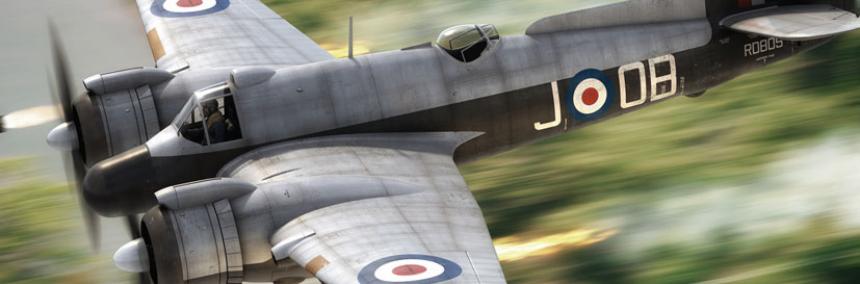
One of the most popular features of our Workbench blogs is when we have the opportunity to exclusively reveal the new model box artwork, which will adorn the front of highly anticipated future model releases. In this latest edition, we have an absolute cracker for you, in the form of this magnificent ‘Operation Firedog’ Bristol Beaufighter TF.10 (A05043) and by way of an extra special treat for the coming weekend, we have not one, but two new pieces of artwork for this fantastic new model. There is no doubting that Airfix box artwork has long been one of the most appealing features associated with modelling, with the classic artwork of Roy Cross really helping to put Airfix on the modelling map. Even though many modellers will have extremely fond memories of this magnificent artwork from years past, the standard of the current digital work really does have to be described as superb and has become one of the major talking points of contemporary Airfix model releases. The quality of the latest Airfix model tooling is first class and the artwork that accompanies the latest releases is equally impressive.
Capturing the hard-hitting striking power of the late mark Bristol Beaufighter, these latest pieces of artwork are quite breath-taking and will certainly inspire many a modeller to attempt this particular version of the Beaufighter. The Malayan Emergency between 1948 and 1960 saw combined Commonwealth forces facing a guerrilla war with the Malayan National Liberation Army. With the unforgiving terrain of the country being a significant factor, air power was to play an important role in bringing about a successful conclusion to the conflict – ‘Operation Firedog’ saw the use of no fewer than 31 aircraft types, in 36 versions during the twelve years of fighting, including this extremely capable looking RAF Beaufighter TF.10, which wears the attractive two-tone black and grey livery applied during its service in Malaya. With many modellers already looking forward to including this new kit in their 2016 build programme, this stunning artwork will only serve to further enhance the appeal of this extremely interesting aircraft. Bristol Beaufighter TF.10 (and Mk.X - Late) A05043 is currently scheduled for an early August release – we hope you enjoy seeing these fantastic box artwork images.

Double Trouble – this striking Beaufighter box artwork will inspire many a modeler to attempt this version of the aircraft
We are afraid that is all we have for you in this latest edition of Airfix Workbench. Don’t forget that you can find out all the latest model release information by heading to the New Arrivals and Back in Stock sections of the Airfix website, although spending a little time searching through all the various sections of the website is certainly time well spent. Please do support our Airfix ‘First Flight’ feature, as it would be really interesting to see which Airfix kits played an important part in your formative years, or helped encourage you back to modelling after a period of kit building inactivity. Thanks again to Peter Stevens for kindly sending us his Luftwaffe reconnaissance aircraft model images, which linked in perfectly with the ‘First Flights’ feature we included in our previous edition of Workbench – we are sorry it can be such a challenge to get the models you want over in South Africa, but keep up the good work. If you would like to send us your own build pictures or Airfix modelling memoirs, please use our usual workbench@airfix.com e-mail address and you may find yourself immortalised within the modelling annuls of our Airfix blog.
As usual, you can also get involved in all the latest Airfix modelling chat via our dedicated Workbench thread on the Airfix Forum, or if you prefer, by logging onto our Facebook or Twitter social media channels and using #airfixworkbench. Whichever medium you choose to use, please do get in touch with us, as it is always great to hear from fellow modellers.
Until next time, we wish you success with your latest modelling project.
The Airfix Workbench Team
© Hornby Hobbies Ltd. All rights reserved.

