

We are very pleased to be bringing you your latest fortnightly instalment of Airfix modelling news, information and updates, as we post Workbench edition fourteen for your delectation. In yet another feature packed edition, we think that we have something for everyone, including a new section at the end of the blog, which we intend to include on all future publications. Let’s get right into it!
Although we do have some mouth-watering new tooling information to tell you about in the very near future, we are not quite in a position to begin making announcements just yet, but as they say, all good things come to s/he who waits! That being said, there is absolutely no shortage of news to bring you this week and we are excited to be able to address some of the reader requests that we have received since posting our New Year blog on 1st January, and look at some of the classic Airfix models that have inspired modellers over recent years.

Following on from a series of successful events held during 2015, Airfix lead researcher Simon Owen will be giving two talks during February at the RAF Museum sites at Cosford (1.30pm Wednesday 17th February) and Hendon (1.00pm Friday 19th February). Entitled ‘Airfix, scaling down reality’, Simon will be giving attendees an insight into the world of Airfix and how they research and gather information to enable them to produce the models we all love to build. These lectures are extremely popular and whilst both of the events are free, places are limited and are available on a first come, first served basis.
If you are able to make either event, please go along and support Simon, who will definitely regale you with interesting information about Airfix – don’t forget to mention that you are a Workbench reader!
 The incredible digital artwork of Adam Tooby
Arguably, one of the most important kits in the recent history of Airfix has to be the magnificent 1/24th scale De Havilland Mosquito. Released to coincide with the 70th anniversary of the company in 2009, this model was quite possibly the most eagerly anticipated kit in the history of plastic modelling and was something of an obsession for the then Airfix product manager, Mr Trevor Snowdon. The 1/24th scale range from Airfix was already famous for producing detailed models of aircraft such as the Supermarine Spitfire Mk.I, the P-51D Mustang and the Ju-57B Stuka – these kits certainly challenged the modeller, but built into some of the most detailed models on the market and definite centrepiece items for any collection of aircraft models. The new 1/24th scale Mosquito took this detail to new levels and allowed modellers the opportunity to produce a model that was the most accurate representation of a De Havilland Mosquito that had ever been produced.
With an instruction booklet that is like a manufacturing blueprint and no fewer than 617 parts to the kit, the 1/24th scale Airfix Mosquito is certainly not for the faint hearted, but all this modelling effort is well worth it, as the completed model is something very special indeed. Possessing incredible levels of detail and a host of construction options for the modeller, this magnificent Mosquito demands closer inspection, where you will not be disappointed with what you see. The model can be constructed with panels either open, or removed, which reveals some of the detailed workings of the aircraft, such as engine and machine gun detail, not to mention a fully detailed cockpit.
There is something very special about the De Havilland Mosquito and its enviable service record during the Second World War. Described as ‘The Wooden Wonder’, the Mosquito made use of laminated wood construction methods and de Havilland’s expertise in producing hi-speed racing aircraft. Possessing great speed and manoeuvrability, the Mosquito proved to be an excellent bombing platform, but was soon developed into a hard-hitting heavy fighter/strike aircraft – indeed, it is fair to say that the Mosquito was probably Britain’s first successful multi-role aircraft. As one of the most successful products of the British Aviation industry, the Mosquito enjoys huge popularity amongst aviation enthusiasts and as such, the Airfix 1/24th scale kit of the Wooden Wonder proved to be one of the most successful and certainly one of the most eye catching models in the history of the company.

 Airfix 1/24th scale Mosquito expertly finished by Alan Bottoms, Chairman of the Harrow Modelling Society
Taking its place in the Airfix kit range in 2009, the 1/24th scale Mosquito proved to be a hugely successful release and was used by many modellers and modelling societies to showcase their modelling talents. As you may imagine, a kit of this stature required a rather large box, but this box featured some magnificent artwork, which will have definitely served to inspire hundreds of modellers. Featuring a pair of Amiens Raiders, the artwork commemorated the daring low level precision bombing raid to free Allied prisoners during ‘Operation Jericho’ in February 1944, with this scheme also featuring amongst the model decal options. Although the production run of this spectacular model was judged to be large enough to satisfy the significant demand that would surely follow the release of this kit, it proved to be so popular that it has not been available since 2012 and there have been many requests for it to be made available again.
Fortunately, A25001A is available once more and modellers desperate to challenge themselves with one of the most famous kits in the history of the hobby now have their opportunity. The model has been released with spectacular new box artwork, featuring a Coastal Command Mosquito FB Mk.VI of the Banff Strike Wing, plus three new decal options, which are definitely worthy of closer inspection.
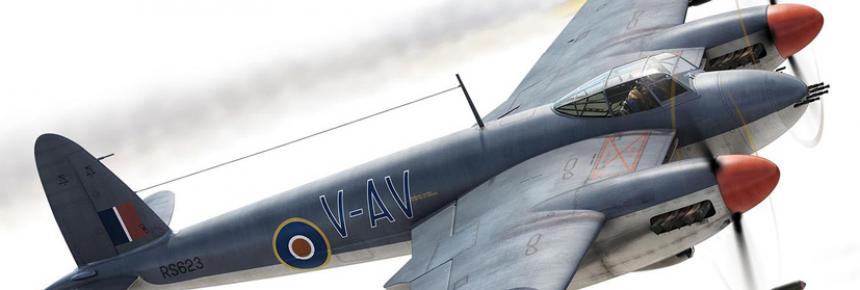
 Mosquito RS623 of the famous Banff Strike Wing
Decal option A
De Havilland Mosquito FB Mk.VI, RS623 / VV-A, Flying Officer William Moffatt (DFC) &, Flt. Lt. Colin Hardy (Navigator), RAF No.235 Squadron, Banff Strike Wing, Coastal Command, Banff, Aberdeenshire, May 4th 1945
This scheme is synonymous with the maritime strike missions of the Banff Strike Wing and helps to mark the important and dangerous work undertaken by these airmen. On 4th May 1945, this aircraft was one of forty-one Mosquitos sent to attack Axis shipping in the Kiel and the Kattegat Strait, before ending their sweep over Denmark. Supported by eighteen Mustangs and three Air Sea Rescue Vickers Warwicks, the Mosquitos found a number of enemy vessels to attack, most of which were either sunk, or left burning in the wake of their onslaught. The defensive flak barrage put up by the ships proved to be particularly intense and a number of aircraft were hit – four of the Mustangs failed to return and two Mosquitos also suffered damage, including RS623. Whilst attacking shipping in the Kattegat Strait, one of the Mosquito’s Merlin engines sustained damaged and abruptly cut – pilot F.O William Moffatt steered a course for neutral Sweden, where the aircraft crash landed. Both crew members survived the ordeal, but with the end of the war in Europe only days away, this was to be their last contribution to the war effort.
 Royal Canadian Air Force Mosquito RF838 also operated from Banff
Decal option B
De Havilland Mosquito FB Mk.VI, RF838 / EO-A, F/L J. R. Hughes (DFC & Bar) & P/O Wade, RCAF No.404 ‘Buffalo’ Squadron, Banff Strike Wing, Coastal Command, Banff, Aberdeenshire, April – May 1945
Wearing a much more traditional RAF medium sea grey and dark green camouflage scheme, Mosquito RF838 was built by the Standard Motor Company at Coventry – it was also to be the first Mosquito delivered to No.404 Squadron. The Canadian pilots of No.404 Squadron had converted to the Mosquito having previously flown Bristol Beaufighters on shipping strike operations as part of the Dallachy Strike Wing. Once converted to Mosquitos, the Squadron moved to Banff for one final push towards victory over the beleaguered Axis maritime targets they regularly hunted.
This particular aircraft is interesting as it is one of the few aircraft at Banff that carried any sort of artwork on the forward fuselage – the name ‘Annygumchum’ is thought to be a reference to the most regularly asked question by the local children around the area of the base. With their Canadian (but to British kids, American sounding) accents, air and ground crews would always be asked this question, as they presumably thought that anyone from North America was always in possession of copious amounts of chewing gum. A rather nice human story from the latter stages of WWII which, really does make an interesting subject for any modeller's latest Mosquito project.
 Smart post war scheme for Mosquito RS679
Decal option C
De Havilland Mosquito FB Mk.VI, RS679 / AU-P, RAF No.4 Squadron, Royal Air Force Germany, RAF Celle airfield, West Germany, September 1949
The final decal option available with this kit is a little more unusual, but no less appealing to the modeller. Despite the advent of the jet age and the disposal of many WWII aircraft following the end of hostilities, an aircraft as useful as the Mosquito was to continue in RAF service until 1962. This attractive post war scheme was applied to Mosquito RS679, as it served through the potentially disastrous Berlin Airlift crisis, whilst stationed in Germany. Following the end of this crisis, the Mosquitos of No.4 Squadron moved to Celle airfield, in Lower Saxony, as the RAF continued to maintain a significant presence in Germany. A number of official photographs from this time seem to confirm that the Mosquitos at Celle displayed a number of different camouflage styles, which seems to be quite unusual for this period – nonetheless, this extremely appealing scheme helps to tell the story of the post war RAF Mosquito.
The spectacular 1/24th scale Airfix de Havilland Mosquito FB.VI (A25001A) is available now on the Airfix website and in all good model stores – make sure you grab your example, before it disappears once more!
 The spectacular artwork featured on 1/48th scale Lightning A09179
If the Mosquito is one of the most revered British piston engined aircraft, then a direct jet powered equivalent has to the awesome English Electric Lightning – Britain’s first and only indigenous supersonic fighter aircraft. Possessing spectacular acceleration and climb performance, the Mach 2+ Lightning was way ahead of its time when it first entered RAF service in 1960 and instantly became an icon of the British aviation industry. The Lightning was designed to quickly get airborne and race to any encroaching hostile aircraft, shoot it down and return to base, with maximum speed and minimum fuss. Described by many as something of a rocket with a pilot strapped to it, the Lightning was always in need of additional fuel, as the hungry engines and extremely high performance demanded heavy fuel usage and although the Lightning went on to provide Britain’s air defence for well over twenty years, the need for more fuel would always be an issue.
The last RAF Lightning flew from Binbrook to a private owner in June 1988, although a number of aircraft were used by British Aerospace in high speed target trials in support of the Tornado ADV project – by 1992, these had also been withdrawn from service. Despite the lack of a Lightning on the UK Airshow circuit, the first and only all British supersonic fighter continues to fascinate enthusiasts and modellers alike and if you were lucky enough to actually see a Lightning fly, you will hold those memories dear.
The Airfix kit range benefits from a number of RAF Lightning models in both 1/72nd and 1/48th scale, but for the purposes of this week’s Workbench, we are going to focus on the re-issue of an absolute classic – A09179 the 1/48th scale English Electric Lightning F1/F1A/F3. This much loved kit was originally released back in 1998, but the quality of the tooling immediately elevated it to something of a modelling cult status and it became one of the most popular kits in the Airfix range. As is the case with the Mosquito we looked at earlier, this kit has been unavailable for some time, but following numerous requests to re-issue the early 1/48th scale Lightning, it has again been made available to the modelling community. Benefitting from the latest decal printing techniques, this absolutely classic Airfix kit comes with the following scheme options.
 The classic English Electric Lightning F.1A ‘Firebirds’ scheme
Decal option A
English Electric Lightning F.1A, XM174/D, RAF No.56 Squadron, ‘The Firebirds’ Aerobatic Display Team, RAF Wattisham, Suffolk, 1963
This stunning scheme is one of the more flamboyant to be applied to an RAF Lightning, but certainly helped to ensure that Britain’s Cold War interceptor continues to enjoy an unrivalled level of enthusiast interest. With its red detailing and the distinctive ‘Firebird’ emblem on the tail, this scheme will be difficult for the modeller to ignore and will inspire many to attempt this fantastic kit. This particular aircraft also served with No.226 Operational Conversion Unit at Coltishall and the Leuchars based Target Facilities Flight. On 29th November 1968, the pilot reported an in-flight engine fire on taking off from RAF Leuchars – he ejected safely from the stricken aircraft, which crashed in Balmullo Quarry, close to the airfield.
 This RAF No.74 Squadron livery will be difficult to refuse
Decal option B
English Electric Lightning F.1, XM143/A, RAF No.74 Squadron, ‘The Tigers’, RAF Coltishall, Norfolk, 1962
Replacing red for black, Lightning XM143 wears the iconic colours of No.74 Squadron and their distinctive tiger stripes. The famous Squadrons who operated the Lightning were keen to celebrate their RAF heritage and their association with Britain’s premier supersonic jet fighter. This particular aircraft was one of the Lightnings from the first production batch of 20 F.1 fighters built at Salmesbury and as well as serving with No.74 Squadron, this aircraft served with No.226 Operational Conversion Unit at Coltishall. It was reduced to spares at No.33 Maintenance Unit, Lyneham, following Cat 5 damage, with the remaining fuselage being scrapped in December 1966 – quite a short service life for this stunning fighter.
 The Lightning looks equally impressive wearing an RAF camouflage scheme
Decal option C
English Electric Lightning F.3, XR751/A, Lightning Training Flight, RAF Binbrook, Lincolnshire, 1980
This particular Lightning was built and first flown in 1965 as the final F.3 off the production line. It saw service with Nos 5 and 29 Squadrons, along with No.226 Operational Conversion Unit and the Lightning Training Flight at Binbrook. It ultimately ended up on the fire dump at Binbrook, but the cockpit section has now been saved and is currently undergoing restoration. This profile also shows how different the Lightning looked when wearing an RAF camouflage scheme.
The attractive 1/48th scale Airfix Lightning F.1/F.1A/F.3 kit (A09179) is available now on the Airfix website and at all good model retail outlets.
Staying with the popular 1/48th scale, we are pleased to be in a position to bring you updates on two new tooling releases in this larger scale, which are due for release later in the year. An integral part of any kit release, the decal and paint scheme selections are always of interest to the modeller, particularly as a great many people will build their kits straight from the box. The decal scheme selection is a very important aspect of any new model’s development and the Airfix team go to great lengths to ensure that they research interesting and accurate schemes for their models. There will always be a trade off with modellers who want a popular, recognised scheme for their latest project, as opposed to others who prefer to finish their models in more obscure, or esoteric schemes – Airfix will research their schemes exhaustively and try to produce decal sheets that appeal to as many modellers as possible.
 Computer rendered 3D image of the new Gloster Meteor F.8
Workbench edition 3 included the exclusive information that Airfix were already at the advanced stages of producing a 1/48th scale Gloster Meteor F.8, which was news that delighted a great many modellers. As we speed headlong towards a proposed May 2016 release, we can now bring you an update on the decal schemes that will be included in this much anticipated kit.
 The Gloster Meteor is already proving to be a popular addition to the range
Decal Option A
Gloster Meteor F.8, WL123/H, RAF No.111 Squadron, North Weald, Essex, 1954
As Britain’s first jet powered fighter and the only one to see service during the Second World War, the Gloster Meteor is not only an extremely important aircraft in the history of British aviation, but also one of the most attractive jets to see RAF service. The importance of the Meteor has been reflected in the level of interest that has been shown in this new model following its announcement, with a great many modellers confirming that this will be their first 1/48th scale modelling project. This first scheme marks a Meteor which served with No.111 Squadron and wears standard RAF day fighter camouflage, with the addition of a distinctive yellow tail. WL123 was to end its RAF service at No.5 Maintenance Unit at Kemble, where it was sold for scrap in July 1959.
 Meteor WH364 is preserved at the Jet Age Museum, Gloucestershire
Decal option B
Gloster Meteor F.8, WH364/U, RAF No.85 Squadron, Binbrook, Lincolnshire, 1968
Wearing an attractive silver scheme, this Meteor served with RAF No.601 Squadron between 1952 and 1957, with the station flights at Safi, Takali and Idris. It went on to serve with No.85 Squadron at Binbrook, before being retired in 1971 – it then went on to serve as the gate guardian at RAF Kemble. Twenty years later, the aircraft was bought by Eddie and Paul Brown of Meteor Flight Ltd, but when their plans to return the aircraft to flight were abandoned, WH364 was bought by former Gloster test pilot and Jet Age Museum patron Peter Cadbury. The aircraft was restored and is now on display at the Jet Age Museum, Gloucestershire Airport, wearing its former RAF No.601 Squadron markings.
The new 1/48th scale Gloster Meteor F.8 (A09182) is due to be released in May 2016, but is available to be pre-ordered on the Airfix website now.
 Computer rendered 3D image of the new 1/48th scale Tropical Hurricane Mk.I
One of the impending new tooling releases not previously covered by Workbench is the 1/48th scale Hawker Hurricane Mk.I. Although a Battle of Britain version of this new kit was released during 2015, a modified tooling version is about to be released during May this year, which will introduce the tropicalized version of the Hurricane Mk.I to the range. Utilising all the latest design and production technologies available to the Airfix team, A05129 will allow modellers to build this very specific version of the ubiquitous Hawker Hurricane, in some rather unusual and highly appealing schemes. The decal options that will accompany the release of this kit are:
 The highly distinctive appearance of desert Hurricane P2638
Decal option A
Hawker Hurricane Mk.I (Tropical), P2638, Sgt. Plt. F. H. Dean, RAF No.274 Squadron, Sidi Barrani, Egypt, 1941
This first scheme is an absolute beauty and will surely form the basis of many construction projects through 2016. Featuring the already attractive desert camouflage of the RAF, this aircraft sports a rather striking lightning flash on the fuselage, in place of the Squadron codes. It also has the unusual ‘spaghetti scheme’ applied to the nose, chin and wing leading edges of the fighter. After serving with No.274 Squadron in Egypt, P2638 went on to serve with No.208 Squadron at Heliopolis in early July 1942, where it was converted to a tropicalized photographic reconnaissance aircraft. It was shot down by a gaggle of Messerschmitt Bf 109Fs on 27th July 1942.
 This unusual silver Hurricane scheme will appeal to many modellers
Decal option B
Hawker Hurricane Mk.I (Tropical), T9531, Rhodesian Air Training Group, Empire Air Training Scheme, Rhodesia, 1941
This really is an interesting and unusual scheme for the Hawker Hurricane and marks an aircraft which was involved in the extensive Empire Air Training Scheme to provide large numbers of qualified pilots to the Royal Air Force. Established during May 1940 and continuing until the end of March 1954, the Empire Air Training Scheme took student pilots from many Commonwealth countries and gave them the opportunity to receive high quality flight training, in the relative safety of South African skies. The scheme successfully provided the RAF with badly needed pilots throughout the war and was testament to the foresight of the British military.
 Magnificent Hurricane build by Airfix forum member Spencer Pollard
This beautiful Hurricane has a natural metal and doped aluminium finish, with a distinctive black anti-glare panel forward of the cockpit canopy. We are extremely grateful to Workbench reader and accomplished modeller Spencer Pollard for allowing us to include this picture of an Airfix Hurricane he modified to represent a Rhodesian Air Training Group aircraft – thanks Spencer! Tropical Hurricane A05129 is available to pre-order on the Airfix website now and is scheduled for a May 2016 release.
 The Short Sunderland Mk.III (A06001) is a classic Airfix kit and one of many kits back in stock very soon!
In this new section for our Workbench blog, we intend to provide modellers with an update on which models they can expect to be receiving at their doors (if the model had been pre-ordered), or collecting from their local model shop in the coming few weeks. Although most of the models listed below should be available imminently, we are making this information available on the understanding that this is the info that we currently have.
Due for release by mid February:
A07002 - Short Stirling B. Mk.I - 1/72nd Scale
A50069 - HMS Belfast Gift Set - 1/600th Scale
A09008 - Dakota Mk.III with Jeep - 1/72nd Scale
A16001A - Focke Wulf FW 190A-5 - 1/24th Scale
A04017 - Bristol Blenheim Mk.IV Fighter - 1/72nd Scale
A02070 - Grumman F4F-4 Wildcat - 1/72nd Scale
A04059 - Bristol Blenheim Mk.1F - 1/72nd Scale
A05128 - B.P. Defiant Mk.I - 1/48th Scale
A05126 - Spitfire Mk.I - 1/48th Scale
Although there may be more models arriving than are displayed on this list, it does contain some of the model releases we have been looking at over the past few weeks and represents a nice selection of Airfix kits, including both those new out and those coming back into stock. We will have a further update for you in the next edition of Workbench.
I am afraid that is all we have for you in this latest edition, but we look forward to bringing you more news from the fascinating world of Airfix in the next edition of Workbench. Please continue sending us your ideas, pictures and stories for future editions of Workbench, as we are always pleased to receive your contributions and you may just feature on the Airfix website for all to see!
As usual, you can get involved in all the latest Airfix modelling chat via our dedicated Workbench thread on the Airfix Forum, or if you prefer, by logging onto our Facebook or Twitter social media channels and using the #airfixworkbench.
Until next time, enjoy your modelling.
The Airfix Workbench Team
© Hornby Hobbies Ltd. All rights reserved.

