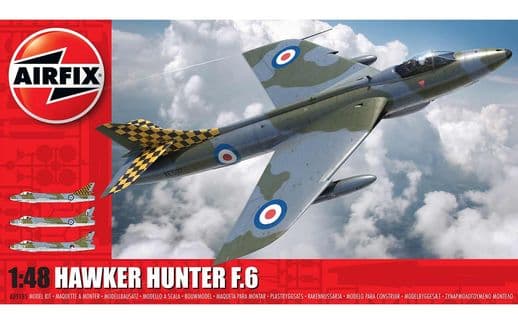


Following the news of our CEO, Lyndon Davies, purchasing the iconic Hawker Hunter which rose to hobby infamy whilst mounted on a pole outside of the Humbrol factory in Hull for many years, we have decided to start a Hawker series! Within the series, we will be looking back over the history of the Hawkers, building up to the point in which our very own Hawker Hunter will arrive at the Hornby offices in Margate!
Our first article (written by the artful Mr Clegg) discusses the origins of the Hawker Hunter. You can read that here. Our second installment will cover the very distinctive F.6 Hawker variant. Stay tuned for more updates!
Although the RAF’s new Hawker Hunter represented the very latest in aviation technology and was clearly an extremely capable fighting aeroplane, there were a succession of ‘teething troubles’ during its service introduction, with the aircraft having to be subjected to almost constant development and a succession of upgrades throughout its lengthy service career.
The thirsty Avon engines and relatively low internal fuel capacity restricted the flight endurance of the initial aircraft, which saw these early examples used more as a point defence fighter, as opposed to mounting long-standing defensive patrols. Having said that, an aircraft of this undoubted pedigree was certainly worth the effort and most, if not all of these issues were addressed over time.
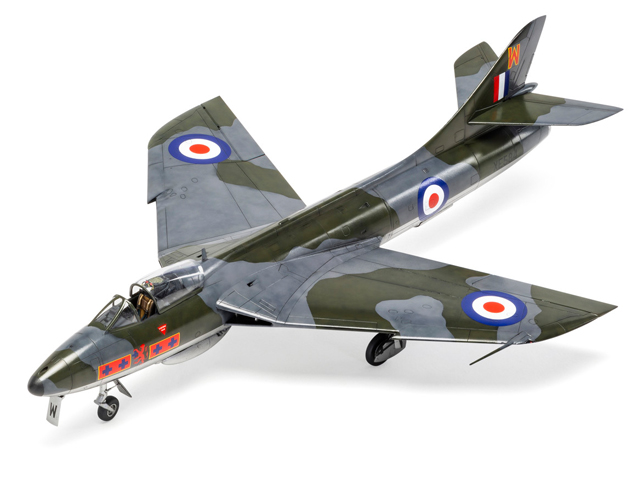
Arguably, the definitive version of the Hunter proved to be the F.6 Fighter, a variant which incorporated a number of significant improvements over its predecessors and highlighted the adaptability of the aircraft’s general design. The constant desire for greater speed and fuel efficiency resulted in Rolls-Royce developing the Avon 203, almost a complete re-design of the earlier engine, which would yield an additional 33 percent greater thrust for the Hunter pilot to access. The F.6 also incorporated an improved fuel management system and tank layout, as well as introducing the distinctive outer-wing leading edge extension, which gave the wing a saw-tooth appearance, developed to improve the high speed stability of the fighter. The Hunter F.6 was a thoroughbred fighting aeroplane, with the design changes only serving to enhance its reputation and most certainly not detracting from its aesthetic appeal.
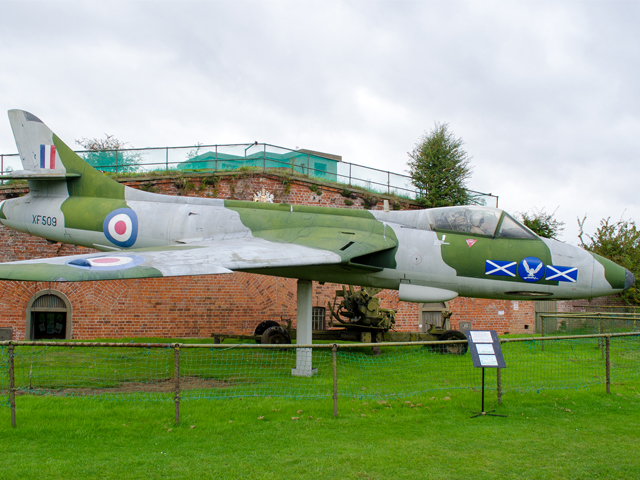
The Hawker Hunter went on to have a distinguished service career with both the Royal Air Force and the Fleet Air Arm, as well as becoming an extremely successful export aircraft for the British aviation industry. With RAF examples remaining in service until around 1994 and the civilian FRADU operated Hunters lasting a further year, the aircraft would also go on to be a regular performer at Airshows across the world, in both military and civilian hands, introducing this enigmatic aircraft to millions of enthusiasts over the years.
The Hunter was also used by two RAF aerobatic display teams during its service life, the ‘Blue Diamonds’ and the ‘Black Arrows’, both of which would regularly fly an impressive sixteen Hunters in tight formation. Indeed, at the 1958 Farnborough show, the ‘Black Arrows’ performed an awe-inspiring loop with 22 Hunters in close formation, a world record achievement which still stands to this day.
Commanding a significant position in the history of British aviation, the Hawker Hunter is a perfect example of the saying, ‘If it looks right, it is right!’ If there is a better looking aircraft than the Hawker Hunter, we would certainly like to see it.
