

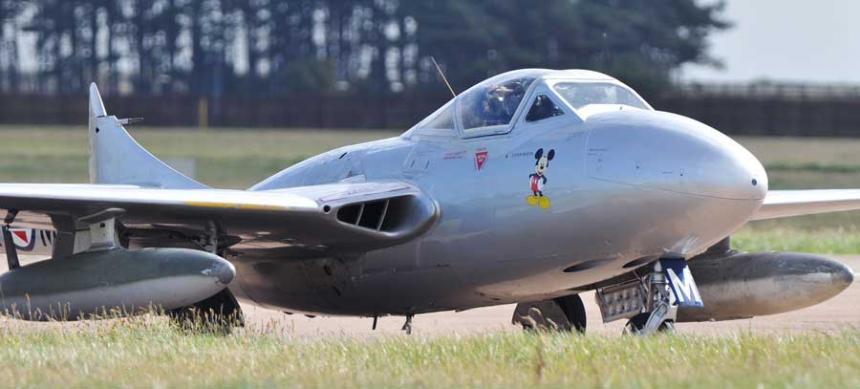
When you consider how long the development stages of any new technology can take, it is sometimes difficult to comprehend how jet propulsion and operational jet powered aircraft managed to appear during the Second World War. As the world was fighting for its very existence, the development of existing technologies was of paramount importance as all the combatant nations were desperate to secure any potential military advantage they possibly could. As manufacturing facilities were already working at maximum capacity, totally new technology was in most situations seen as a dangerous distraction. I think that I can fully understand this thinking – if someone had given me the option of an additional 100 Spitfires or a single new wonder weapon, I think that I would pick the Spitfires every time! Perhaps what I should have been asking is “what does the wonder weapon do?” before dismissing this option. Thankfully, some brilliant minds were determined to push the boundaries of technology and despite official instructions to the contrary, would in some cases work on these projects in their own time and at their own expense.
There is no doubting that in 1941 Britain was a nation very much under pressure. Just a few short months earlier, the fighter pilots of the RAF had thwarted German plans to launch an invasion of Britain, but despite this the country was still enduring the horrors of the night blitz against her major cities. Desperately trying to replenish military hardware of all types, the RAF were particularly keen to re-equip with the latest version of the Spitfire and to finally replace the Hurricane with its more famous stable mate – they had also only just started to go on the offensive, mounting hit and run strike raids on targets in northern Europe. It was under these difficult conditions that a small number of brilliant British designers and engineers began looking at the possibility of propelling Britain in to the jet age!
Following on from the acceptance of their brilliant Mosquito reconnaissance fighter, the De Havilland company were asked to develop a new jet engine,for eventual use in a new aircraft design. This is rather poignant as the Mosquito, which was one of the most successful aircraft of WWII, only actually entered RAF service in 1941 and already, the company was working on jet technology. Brilliant engine designer Frank Halford was charged with developing de Havilland’s first jet engine and, although he was aware of the ground breaking work of Frank Whittle, he had some specific design requirements for his own engine. Building on the work already undertaken by Whittle, Halford wanted to produce an engine which was of simpler design, whilst retaining the same compact dimensions and power output of the earlier engine. Referred to as the Halford H-1, the engine was known as a cleaned up version of the Whittle engine, using a single-sided compressor and a straight through design layout, with the sixteen individual combustion flame cans exhausting straight onto the turbine. The H-1 engine first ran on 13th April 1942 and immediately showed great potential – over the coming few weeks, the design was perfected by Halford and his team, with the engine managing to produce its full design thrust within this period. The only thing to do now was to get the engine into the air!
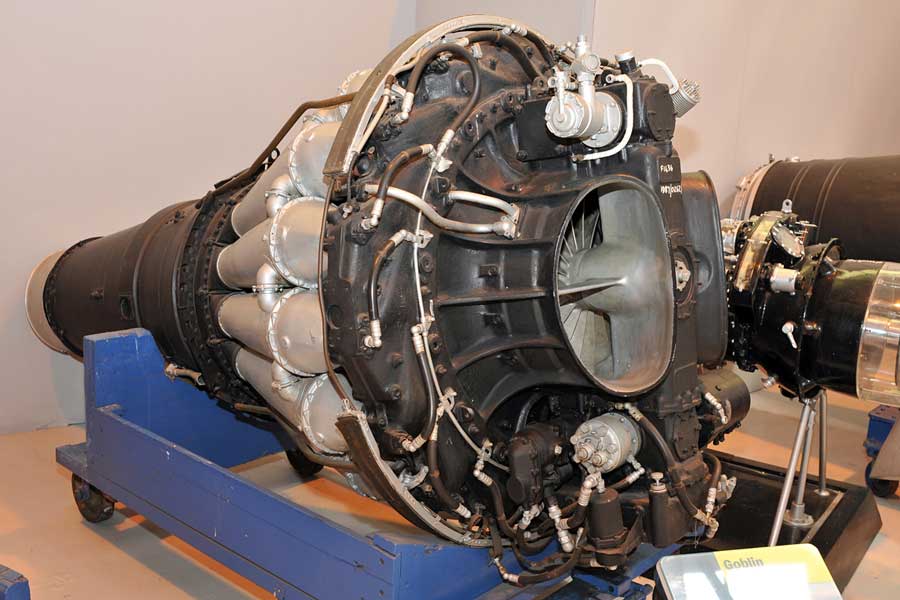
The de Havilland Goblin jet engine
Some of the most distinctive features of the early jet engines were that they were not overly powerful and were particularly slow to respond to power input requests. For this reason, many of the early jet-powered aircraft designs incorporated two engines which were invariably attached either in, or underneath each wing. As de Havilland began to develop their first jet fighter they decided that they would take a dramatically different direction – their aircraft would be a single seat, single engined aircraft. Using the same Air Ministry requirement (E6/41) as the one used on the Gloster Meteor project, de Havilland set about working on the new aircraft, knowing that the decision to proceed with a single engine design was extremely brave and potentially disastrous. The early jet designs had almost exclusively used two engines on aircraft, due to the relatively low power output and slow response of the early units, so deciding to proceed with a single engine design was putting great pressure on the engine itself – not to mention the confidence of the test pilot!
By the time that the new de Havilland jet fighter was ready for its first flight, the Halford H-1 engine had been perfected and was proving to be a very stable and reliable unit. It was now capable of developing 2,700Ibs of thrust and also had the benefit of a name change. The unit was now known as the de Havilland Goblin 1 turbojet and was to become one of the most important early engines in the history of jet aviation. The use of just a single engine on the new jet was to be significant in the design of the aircraft and ensured that it had an extremely distinctive profile. In order to ensure the single engine would provide enough power for the new fighter, the designers developed an ingenious short intake duct and exhaust nozzle for the fighter, which was initially designated de Havilland DH.100 ‘Spider Crab’. This was all housed in a relatively short, egg shaped central fuselage nacelle, which needed a unique twin-boom tail configuration for control stability and to allow the thrust egress from the central fuselage. Despite the excitement around this promising new aircraft, the continuing rigors of war dictated the future direction of the project. Already running behind the Gloster Meteor programme, the Air Ministry suggested that the construction methods for the Spider Crab should make use of both metal and wood, to take the pressure off the already stretched manufacturing industry and importantly, due to the unorthodox configuration of the design, the ‘Spider Crab’ was classed as an experimental design. These factors would be significant in determining the length of time it took for the new aircraft to enter service.
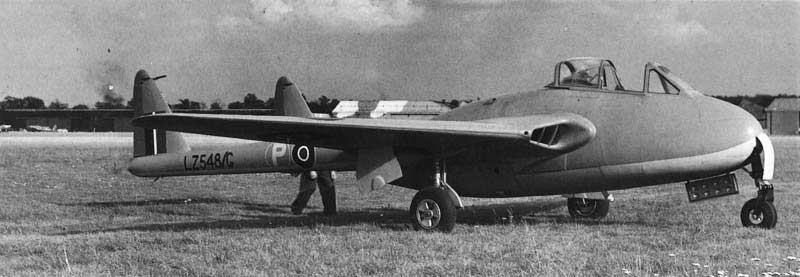
The D.H 100 Spider Crab prototype aircraft
For any designer, or engineer involved in the early years of jet aviation this must have been a time of great excitement, along with huge frustration. There is no doubting that the greatest minds in aviation had already come to the conclusion that piston powered aircraft had all but reached the end of their development potential and a new technology would be required to propel aviation forward in the future. With the work of Whittle, Halford and von Ohain, the world had seen the future of aviation propulsion, but the world was embroiled in an attritional war and every available aircraft was needed. Indeed, the replenishment of destroyed aircraft was an absolute priority, which very much dictated that existing aviation designs, with all their limitations, were very much a priority. Under these conditions, it is difficult to see how any new technologies could gain any development momentum and it could even be argued that diverting any time, or resources to anything other than the production of existing designs could be viewed as treason. Thankfully, whilst fully supporting the war effort, driven individuals were determined to continue with their ground breaking work on jet technology, certain that they were looking at the future of aviation.
The jet project development situation for the design team at de Havilland aviation must have been more difficult than any other company – they were quite literally victims of their own success. Their twin engined Mosquito simply proved to be such a magnificent aircraft that the Ministry of Air Production could not get enough of them and prioritised the manufacture of Mosquito variants – unfortunately, this dictated that the Spider Crab jet was a low priority project. To make matters even worse, the first flight of the new jet was delayed for an almost unbelievable reason – the only serviceable jet engine had to be sent to the US, to replace one destroyed in ground engine runs, in the Lockheed XP-80 prototype aircraft. As the Gloster Meteor was just a little more advanced, it was to be the Meteor that became the first Allied jet aircraft in service, with the de Havilland design always following just that little way behind.
On 20th September 1943, De Havilland DH.100 Spider Crab LZ548/G took off from the company’s Hatfield airfield, for its maiden test flight, in the hands of chief test pilot Geoffrey de Havilland Jr. Interestingly, the ‘G’ used in the identification code denotes the highly secret nature of the project – it was to be guarded at all times whilst it was on the ground! The flight lasted just over 30 minutes, during which time the aircraft exceeded 400mph and showed great promise – some flight stability issues were highlighted, which were to take some time to resolve and required a period of time spent in the company’s wind tunnel test area. With the success of the Mosquito and the fact that the Gloster Meteor had already entered RAF service, it would be April 1945 before a production aircraft would take to the air and by that time, the de Havilland DH.100 Spider Crab was powered by a de Havilland Goblin engine and had been re-named Vampire. The de Havilland Vampire would go on to be one of the most successful early jet aircraft in the world.

Colour image of the first RAF Vampire fighter
The unfortunate delays which were to beset the DH.100 Vampire programme dictated that its service introduction came too late to see operations during the Second World War. Had this not been the case, the aircraft would have proved itself to be a very impressive fighter/ground attack platform and quite possibly one of the most famous aircraft of the entire war. As it was, the Meteor was to take the accolade of being Britain’s first jet in RAF service, with the Vampire coming a close second. Despite being known as the second British jet it did have a number of notable firsts to its name – it was Britain’s first single engined jet fighter and was the first RAF fighter to exceed 500mph. Later versions of the Vampire would go on to set further records – it was the first jet aircraft in the world to take-off and land from an aircraft carrier and in 1948, the aircraft set a world altitude record of 59,446 feet. Also in 1948, the Vampire became the first jet aircraft to fly across the Atlantic, as six Vampires from RAF No.54 Squadron conducted a goodwill tour of Canada and the USA, performing a number of formation aerobatic display routines.
One of the strangest programmes in which the Vampire was to take part was the undercarriage-less fighter trials programme. For some reason, it was decided that the ability to operate a jet aircraft without undercarriage would save valuable weight and do away with the complicated engineering associated with retractable undercarriage. Landing on a thick, rubber mat, otherwise known as a flexible deck, the Vampire would grab an arrester hook and literally flop onto the deck of an aircraft carrier, or suitably equipped airfield – this must have been an impressive sight, but one which would surely have resulted in damage to the aircraft. Trials took place at RAF Farnborough and on board light fleet carrier HMS Warrior and whilst the trials proved that the concept could work, it was not taken any further by the British military. As all aircraft tend to be full of fuel and various weapons, I think that I need a little convincing about the merits of this programme – however, if it is good enough for famous test pilot Eric ‘Winkle’ Brown, it is good enough for me.
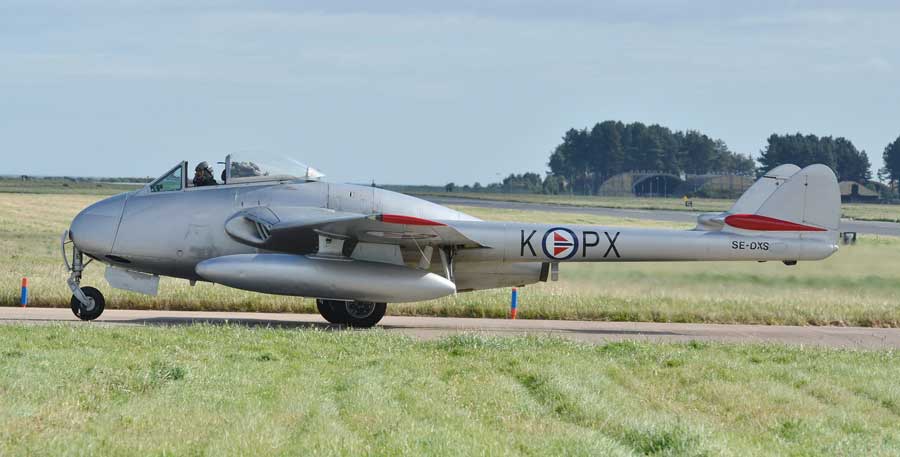
The distinctive shape of the de Havilland Vampire
The De Havilland Vampire F.Mk.I eventually entered RAF service in March 1946, with No.247 Squadron at RAF Odiham, going on to form a new wing with No’s 54 and 72 Squadrons. As the Vampire was too late to see operational service during WWII, it was not until 8th June 1946 that it was unleashed on the British public – the new Vampire fighter was given the honour of leading the Victory Day Flypast over London and heralding Britain’s lead in jet powered aviation.
For pilots who were used to flying late mark Spitfires and Typhoons, the new Vampire was an absolute dream to fly. Gone was the huge propeller in front of the pilots windscreen – gone was the tail wheel, nose up attitude of the earlier aircraft – importantly, gone was the noise and vibration of these mighty piston engines. The cockpit of the Vampire was far more pleasant an environment in which to ply your trade. The tricycle undercarriage and wrap- around canopy afforded the pilot an excellent field of view and made handling the aircraft on the ground much easier. The Vampire was also a very docile aircraft in flight and would have made the pilot transition from piston to jet quite painless, with just a couple of caveats. The early De Havilland Goblin jet engines were compact, simple and reliable - engineers colloquially described the operation of the unit as ‘suck – squeeze – bang – blow’, which actually describes the process rather well. The major vice of the unit was that it had rather sluggish acceleration, which really did need treating with respect by the first time jet pilot. If the pilot had converted from a piston fighter, the most significant difference was with regard to engine management – the pilot had to anticipate power demands to the Goblin jet engine, which really did require a little time to decide that it was going to comply. Perhaps the most disconcerting difference would have occurred on take off. Although the take off procedure was relatively simple, the nose wheel of the Vampire did not have the benefit of a brake and as it retracted into the fuselage, it would have located in a position right underneath the pilot, still rotating from the take off run. This caused so much noise and vibration, that the uninitiated pilot would have probably expected an imminent emergency landing.
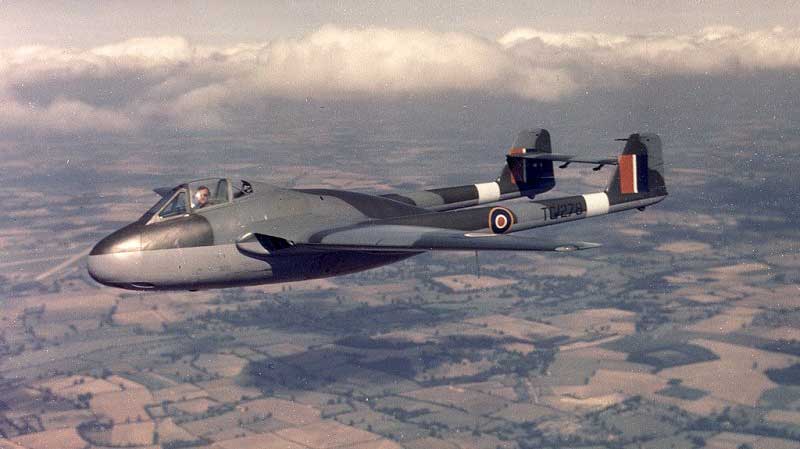
The RAF Vampire fighter in flight
Once at speed, the Vampire was an exceptionally pleasant aeroplane to fly – fast, responsive, very stable, with a great view for the pilot. Coming from a noisy, vibrating piston engine fighter the Vampire must have been an absolute dream. A very light aeroplane, which was extremely responsive and highly manoeuvrable, it is no wonder that the Vampire proved to be an extremely successful aircraft indeed. At its peak, the de Havilland Vampire equipped no less than 19 RAF squadrons at bases in Britain, Europe, the Middle East and Far East, and at a time when jet aviation was just becoming established, this early design really did prove to be a very special aeroplane. The fighter/ground attack versions of the Vampire were retired from RAF service in 1966, to be replaced by the classic Hawker Hunter and the much larger Gloster Javelin, but a training version of the Vampire remained in service at RAF Little Rissington until at least 1972.
Following a devastating world war, many countries had little enthusiasm for an expensive air defence programme and the de Havilland Vampire was a very attractive and cost effective proposition for many air forces. Proving to be relatively cheap to procure and operate, the Vampire was also easy to operate, simple to maintain and extremely adaptable – these attributes made it an irresistible choice for many air forces around the world. From Australia to Sweden, Egypt to Venezuela, the gentle whine of the de Havilland Goblin engine was heard for many years as the reliable Vampire provided sterling service all over the world. More than 3,200 Vampires were produced in Britain between 1945 and 1960, with a further 1,000 machines being licence built in six overseas countries. The Vampire went on to serve with the air forces of at least 26 nations – without doubt, the de Havilland Vampire was one of the world's most successful early jet aircraft and a credit to the design engineers of the British aviation industry.
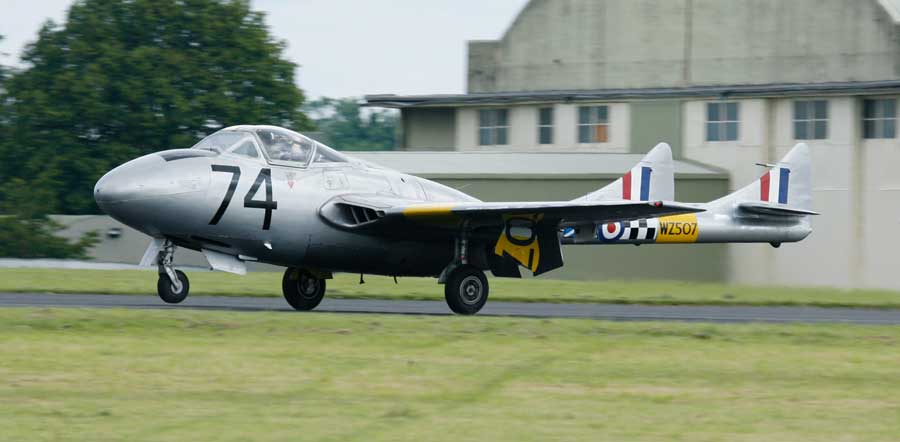
The beautiful lines of the Vampire T.II trainer
In my humble opinion, the de Havilland Vampire T.II trainer is one of the best looking jet aircraft that ever took to the skies. Sharing the same stable flight handling characteristics as the single seat variant, the T.II was the ideal platform to introduce the student pilot to the delights of fast jet flying. The Vampire T.II was the first advanced jet trainer to adopt a side-by-side seating arrangement for the student and instructor, which allowed the student to be more confident during the flight and the instructor a much clearer view of what the student was doing. To achieve this configuration, the cockpit area of the aircraft had to be widened and gave the fuselage pod an egg shaped appearance. This increase in frontal area necessitated a number of additional modifications to the airframe, but the T.II was essentially a classic Vampire, but made for two. Usually, when you adapt existing aircraft designs, it can result in something of a hybrid aeroplane, which looks much less appealing than the original – this was certainly not the case with the Vampire T.II trainer. It was a handsome beast which probably became the best known version of the de Havilland Vampire, even though it was the final variant of the series. Its operational effectiveness is underlined by the fact that almost 800 Vampire trainers were built, which went on to serve with more than twenty of the world’s air forces and help thousands of front line pilots to gain their wings.
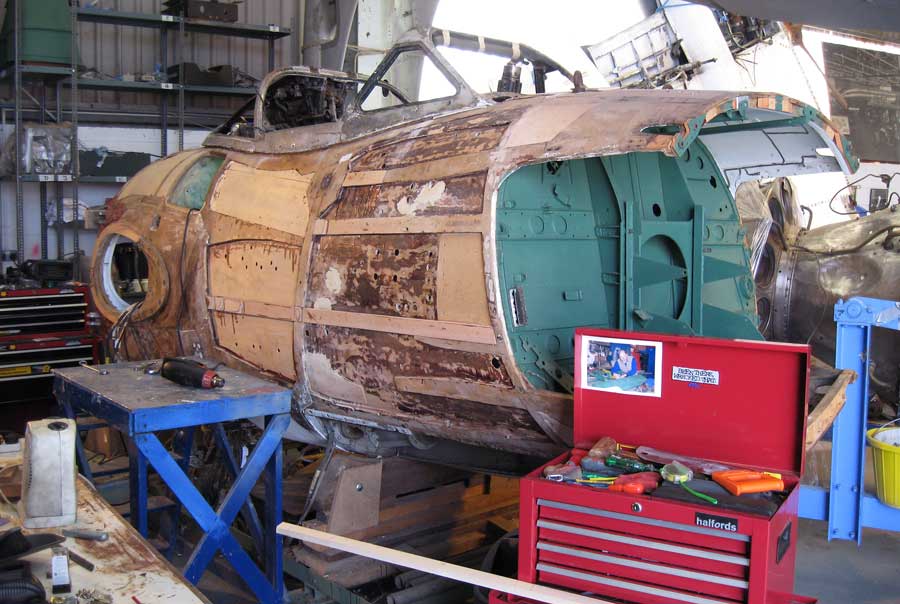
A Vampire T.II trainer under restoration at Salisbury Hall
Some years ago, I was lucky enough to pay a quick visit to the de Havilland Aviation Museum, at Salisbury Hall and I was absolutely enthralled by a Vampire T.II, which was in the process of being restored. I think that most people associate jet aviation technology exclusively with metal airframes and it was really quite alarming to see the construction of this T.II fuselage – it was made of wood! As you can see from the picture above, the Vampire made full use of the construction techniques utilised on the highly successful Mosquito aircraft and I don’t really know why this should cause me any concern, but it just did. I have heard the Vampire construction described as a ‘furnace in a wooden tube’, which perfectly describes my reservations, but if it did not concern the de Havilland designers, why should it concern me? This tried and trusted construction method was more than adequate for Britain’s first single engined jet aircraft.
Another thought that I had during my visit was just how similar the cockpit area of the Vampire T.II resembled that of the Mosquito – to me, it actually looks like a jet powered version of the Wooden Wonder (from the front end of the aircraft, at least!). I have included a picture of a Mosquito under restoration below, so you can hopefully see what I mean and don’t think that I have totally lost my mind.
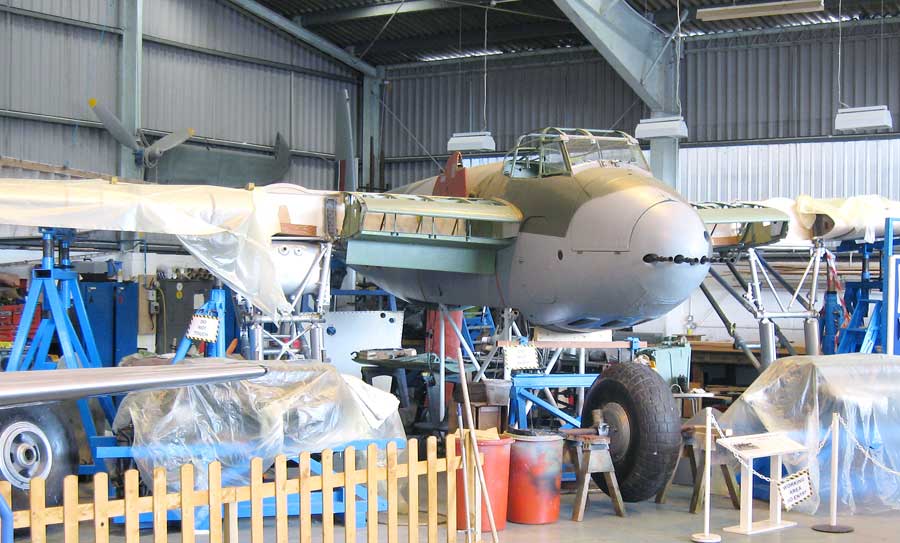
Mosquito restoration – there are similarities around the cockpit area
With such a popular aircraft as the Vampire, you might hope that you would be able to see large numbers of restored examples on the Airshow circuit. Thankfully, there are some Vampires still flying, but nowhere near as many as you might think. These aircraft are now quite old and certainly herald from the very early days of jet aviation and operators of display aircraft must really struggle to keep these historic aeroplanes in the air, with original parts being extremely thin on the ground. If you are ever lucky enough to see a de Havilland Vampire fly, you will very much enjoy the sight and sound of this extremely important early British jet – if you see the delightful Vampire T.II, you will undoubtedly be seduced by its extremely good looks.
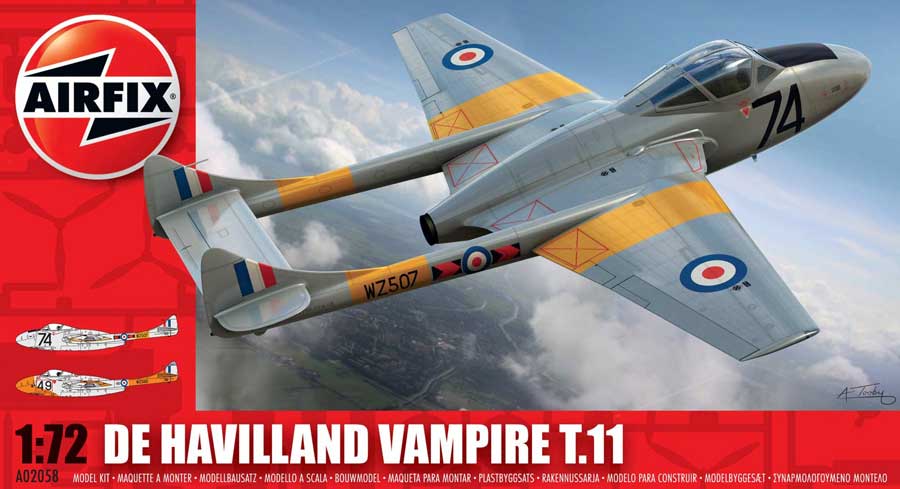
The stunning box artwork on the new Airfix Vampire T.II kit
Airfix have provided the plastic modeller with an excellent 1/72nd scale example of the de Havilland Vampire T.II, which is currently available in two versions. A55204 is released as a medium starter set, complete with cement, brushes and paint and includes decals to finish the model as a Royal New Zealand Air Force machine – everything you need to get modelling straight away!
Also in 1/72nd scale, A02058 includes decal options to complete one of two famous Vampire T.IIs, both of which have been restored to a high standard and both currently residing in the UK. WZ507 is the magnificent aircraft owned and operated by the Vampire Preservation Group, currently at the former RAF base at North Weald. This aircraft performs on the UK Airshow circuit, but nowhere near as often as it should do – it really is a benefit to any display programme and much requested by the aviation enthusiast. The second aircraft is WZ590, which is the beautifully restored Vampire that is on display at the Imperial War Museum, at Duxford.
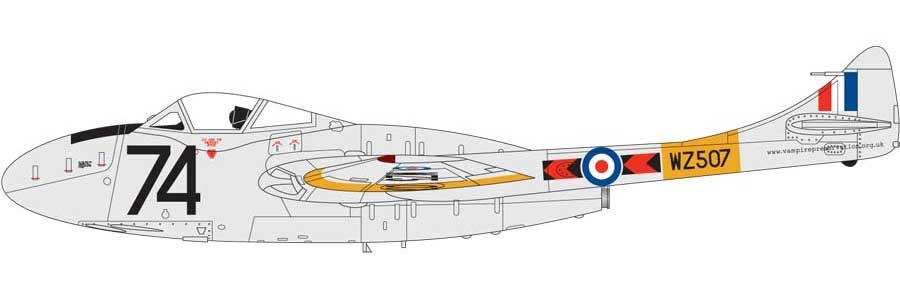
It is important to stress that this Airfix Vampire is a New Tooling release and has been produced using all the new manufacturing technologies available to them. Modelling reviews featuring this new Vampire have been extremely complimentary, which has seen large numbers of this impressive kit heading for new homes. To secure your example, please visit your usual stockist, or head to the main Airfix website.
As usual, thank you very much for reading our latest edition of Aerodrome. Don't forget, you can now also see a Corgi version of this blog over on Corgi Aerodrome.
I hope that you enjoyed our little exploration of early British jet technology this week and that I didn’t bore you too much with my admiration for the Vampire T.II. The Corgi team will be heading for the Royal International Air Tattoo in a couple of weeks, so if you are heading down to Fairford, why not look for the Corgi logo and drop in to say hello!
You can discuss this week's blog on the Airfix Aerodrome Forum, and if you have any comments, questions or suggestions for future editions, please feel free to let us know on Facebook or Twitter using #airfixaerodrome.
Enjoy your modelling
Michael
© Hornby Hobbies Ltd. All rights reserved.
Archive images licensed under Public Domain via Wikimedia Commons.

