

Like the majority of Aerodrome readers, aeroplanes have been a big part of my life for most of my life. As a young enthusiast, Britain really was a fantastic place to have an aviation infatuation, with a large number of active airfields all over the country and an unbelievable array of interesting aircraft for us to marvel at. It seemed that wherever you went, it was possible to see military aeroplanes either at their home airfields, or flying one of the many training flights taking place all over the country. Unfortunately, things are very different today – many of the bases I visited in the past are now no longer active and the eclectic mix of classic RAF aviation types have long since been withdrawn from service.
Thankfully, there are still a few venues where you can still see active RAF aircraft flying and perhaps the most interesting of these current bases is RAF Coningsby. In the latest edition of Aerodrome, we will review a recent visit made to this Lincolnshire airfield and look at some of the unique aircraft currently based there and why a visit to Coningsby is still something for the aviation enthusiast to look forward to.

Keeping Britain safe – The Eurofighter Typhoon Crown Copyright Image
As the Royal Air Force stabilises following years of contraction, the aviation enthusiast has to work much harder to find a venue that is worthy of an impromptu visit, with at least the possibility of seeing active military aeroplanes fly. At the head of this diminishing number of airfields, RAF Coningsby certainly offers the opportunity of seeing probably the largest number of different aircraft types flying at any current base, from the most advanced fighter aircraft in RAF service, to a rare example of its direct WWII predecessor. As one of the most active UK military bases, Coningsby is home to two front line combat ready Squadrons (Nos 3 and XI), both of which fly the magnificent Eurofighter Typhoon in an air defence role and a further two Squadrons in test, training and evaluation roles. RAF No.29(R) Squadron is charged with training pilots to fly the Typhoon, which has now developed from its original air defence role, to become a true multi-role platform and one of the most capable aircraft of its kind in the world. Arguably, one of the most interesting units based at Coningsby is No.41(R) Squadron, which operate a fleet of Tornado GR.4 and Typhoon aircraft in a critical test and evaluation role. Working closely with front line RAF Squadrons, defence manufacturers and research institutions, 41(R) Squadron is responsible for the development and evaluation of the next generation of aircraft, weapons and avionics and fly regularly in support of this role.
Clearly at the cutting edge of current RAF operations, there is also a section of the base at Coningsby that is in direct contrast to all this modern technology and helps to preserve the aviation heritage of the the Royal Air Force. Since 1976, Coningsby has been the home of the much loved Battle of Britain Memorial Flight and their collection of historic Spitfires, Hurricanes and one of only two Avro Lancasters still flying in the world today. With their own hangar and visitors centre at Coningsby, a busy programme of Airshows and commemorative flypasts usually dictates that there is always a possibility of seeing one of these classic WWII aircraft flying in the skies above this busy Lincolnshire airfield. We will look at the BBMF a little later and devote a future edition of Aerodrome to the 2016 season for these classic British aircraft.

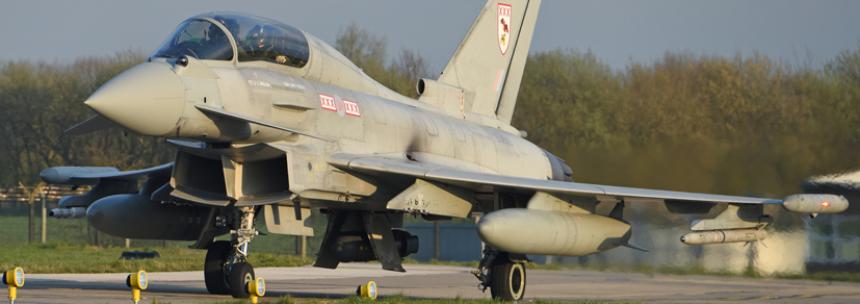
One of the Coningsby based Typhoons preparing for launch
One of the most important duties performed by the aircraft and pilots based at RAF Coningsby is to protect British airspace against unauthorised airborne incursions, by maintaining a constant state of air defence readiness around the clock. Referred to as Quick Reaction Alert, Britain maintains four Eurofighter Typhoons at a constant state of readiness in two locations in the UK - RAF Coningsby provides southern QRA, whilst RAF Lossiemouth covers the north. At both bases, Two Typhoons are kept in specially adapted shelters (known as Q-sheds) fuelled and armed for immediate take-off in response to any QRA scramble. The aircrafts' pilots are also at a constant state of readiness and throughout the length of their QRA duty remain in full flying kit in the aircrew ready room, which is adjacent to the Q-sheds themselves. If called upon to scramble, the pilots will sprint to their aircraft, which are already being prepared for flight and in a matter of just a few minutes, the aircraft are blasting into the air and heading towards the reported threat at full speed.
Although many of the QRA scrambles conducted by RAF Typhoons would usually be as a result of a Russian Tu-95 Bear bomber probing UK airspace for potential weakness, as they have done many times since the advent of the Cold War period, there are a number of other situations that may require the attendance of a QRA Typhoon. Any aircraft infringement of UK airspace may result in a scramble, which may include such incidences as a civilian aircraft not responding to air traffic control requests, an aircraft appearing to behave erratically, or one transmitting a distress signal through its transponder - in any of these cases, Typhoons from Lossiemouth or Coningsby could be scrambled to resolve the situation. Once the aircraft has been intercepted and identified, the Typhoon pilots will be in a position to either confirm the status of the aircraft and escort it safely to its destination, or escalate the situation with a highly visible show of force. In every QRA contact situation, they will have the option to warn and potentially destroy any aircraft that continues to pose a threat and ignore their demands.

Touchdown - the end of another training sortie for a Coningsby Typhoon student pilot
For most people, it is difficult to imagine a more exhilarating and adrenalin-charged situation than being tasked with protecting your country’s airspace with one of the most advanced fighting machines in the world – this surely has to be Boy’s Own stuff. Continuing a tradition that dates back to the days of the Battle of Britain, QRA pilots have been defending British airspace against aerial threats, using the most potent air defence fighters of the day as their mount. Using famous aircraft such as the incomparable Supermarine Spitfire, to the incredible English Electric Lightning, the RAF has stood ready to repel any airborne incursion over the years and the Eurofighter Typhoon is continuing the proud and incredibly important tradition.

The star of the 2015 Airshow season – Typhoon FGR.4 ZK349 GiNA
As the most potent aircraft in current RAF inventory, the spectacular Eurofighter Typhoon is definitely of great interest to the aviation enthusiast and the base at Coningsby is a regular destination for people desperate for a dose of fast jet action. The distinctive shape of the Typhoon is a regular in the skies above Lincolnshire, but as is the case with most modern air defence fighters these days, the current thinking is that an air superiority grey colour scheme is most appropriate for their mission profile. Even though I don’t think that you could ever describe the Typhoon as dull, there is no doubting that a splash of colour certainly enhances the appeal of the aeroplane and in this regard, there is one particular aircraft that reigns supreme. Simply known as GiNA by British aviation enthusiasts, Typhoon FGR.4 ZK349 was given a special paint scheme to mark last year’s 75th Anniversary of the Battle of Britain and has been arguably the most popular RAF aircraft since that date. Proving that the Typhoon looks even better when wearing a retro camouflage scheme, many enthusiasts had hoped that the RAF would allow GiNA to remain in this stunning scheme for the coming Airshow season and despite some worrying rumours to the contrary, she is still resplendent in her Battle of Britain scheme.

GiNA was spotted late in the day, basking in the late evening sunlight
Proving to be one of the most popular RAF aircraft of the modern era, Typhoon ZK349 was painted to represent Hawker Hurricane Mk.I (P3576) coded GN-A, which was the mount of Flt. Lt. James Brindley Nicholson during the Battle of Britain. Following actions that took place above Southampton on 16th August 1940, 23 year old Nicholson was awarded Fighter Command’s only Victoria Cross of WWII and stood to represent the bravery and tenacity of the British and Commonwealth pilots who valiantly repelled the Luftwaffe during the summer of 1940. You can read the story of James Nicholson and actions that lead to the award of his VC in Edition 14 of Aerodrome.
The 75th Anniversary of the Battle of Britain proved to be a significant commemoration for both the Royal Air Force and Britain as a whole, as a number of events took place during 2015 to pay tribute to the glorious ‘Few’ and their heroic deeds during the summer of 1940. Even though most people would have rightly expected Britain’s historic Spitfires and Hurricanes to be the centre of attention throughout the 2015 Airshow season, there proved to be a much more contemporary distraction, even if it was wearing a retro 1940s camouflage scheme. For many, Typhoon ZK349 GiNA proved to be an incredibly popular tribute to the pilots of the Battle of Britain and in many ways actually stole the show in 2015 from an RAF perspective. Indeed, GiNA was such a hit with the enthusiast that it was hoped ZK349 would be allowed to retain this much loved scheme for the 2016 Airshow season. Reports began to circulate in March that this unique looking aircraft was still wearing its 75th Anniversary camouflage and it was with this knowledge that I headed for RAF Coningsby, hoping to catch one more glimpse of the Battle of Britain Typhoon.

A pair of 100 Squadron Hawks were a welcome sight at Coningsby
As the busy summer Airshow schedule is just about to begin and aviation enthusiasts all over the country are planning how many shows they can get away with attending without the threat of divorce, many of the display pilots we will be watching have already been involved in some significant preparatory work. As the weather slowly begins to improve, pilots will have to practice and perfect their display routines, before eventually achieving their Public Display Approval and are in a position to confirm their display commitments. For the Coningsby based aircraft, this means that the usual flight operations can sometimes be interspersed with practice displays from either the Typhoon or the Battle of Britain Memorial Flight aircraft and as a number of these flights were scheduled for the day of my visit, I was hoping for some decent weather.
The 2016 Typhoon display will be flown by Flight Lieutenant Mark Long of No.29(R) Squadron at RAF Coningsby and by the time this latest edition of Aerodrome is posted, Mark will probably have been granted, or will be extremely close to receiving his Public Display Approval. Hearing great things about his display, I was hoping to catch a couple of his practice flights for myself and having also seen pictures on the internet of him using GiNA the camouflaged Typhoon over the past few weeks, I travelled to Coningsby in expectation. On my arrival, I was dismayed to find that I was the only person there and the airfield was completely shrouded in mist – had I picked the wrong day for my visit? Slowly, the temperature began to rise, the grey was replaced by blue skies and fellow enthusiasts began to turn up. As we all prepared for a great day of flying, we waited, watched the airfield and waited some more. Despite almost perfect early morning conditions and a number of scheduled display practices listed, absolutely nothing took to the air and depression began to take hold.

Flight Lieutenant Mark Long preparing to thrill the Airshow crowds this summer
At last we saw some movement on the far side of the airfield and it looked as if GiNA was being prepared for flight – with ground crew all around her and the canopy open, it seemed like just a matter of time before we would be all witnessing what we had come here for. Just as we allowed ourselves to get a little excited, the canopy closed, the aircraft was taped up and was taken off to the spray booth to be washed… what a disaster. Fortunately, things finally began to move on the airfield and aircraft began to take to the skies, starting with a pair of No.100 Squadron Hawks, which I had certainly not expected to see. In the early afternoon, Flt. Lt. Long did take to the air in a Typhoon, but it was not in the aircraft we had hoped for – as he commenced his display routine, this disappointment was quickly forgotten as this was definitely a case of man and machine in perfect harmony. Even though his practice display was cut short for some reason and the planned three displays turned out to be just this one curtailed effort, I saw enough to confirm that the 2016 Typhoon display will be the highlight of many an Airshow this summer and Flt. Lt. Long is destined for some serious aviation enthusiast hero worship – I hope he is prepared.

Supermarine Spitfire Mk. LF XVIE of the Battle of Britain Memorial Flight
The more numerous practice display flights on the day came from the Spitfires of the Battle of Britain Memorial Flight, a pair of which made multiple flights during the afternoon. Initially flying as single aircraft, the display culminated with a pairs routine, which will clearly be performed at a number of shows over the coming months. Although I had hoped to see the Lancaster for the first time in many months, it appears that a busy period of winter maintenance was overrunning somewhat and not only would the bomber not be flying on this day, it was possibly destined to miss a number of its planned Airshow commitments. As engine problems kept the aircraft grounded for the majority of the 2015 season, many enthusiasts will be keeping an eye on Lancaster developments over the next few weeks, hoping that the aircraft enjoys much better fortunes for the coming Airshow season. As one of the rarest and most revered historic aircraft in the world, enthusiasts simply could not contemplate another Airshow season without their beloved Lancaster.

Fighter break - BBMF Spitfires break into the circuit to land following their practice flights
As the BBMF fighters headed back to their hangar and the weather began to close in, the activity levels on the airfield slowly increased and the usually busy RAF Coningsby began to resemble something like I was used to. Apparently, my visit had coincided with night flying training, so the last couple of hours of light proved to be the busiest of the day. With multiple launches and recoveries taking place, it finally seemed like the Lincolnshire skies were full of Typhoons and it was an absolute joy to see. We also had a number of exotic visitors, with a pair of US Air Force V-22 Ospreys overflying the airfield and a Sentinel R1 surveillance aircraft making an unexpected stop at Coningsby. In the fading light, even GiNA the Typhoon made a reappearance, as she joined the other 29(R) Squadron aircraft on the ramp, looking resplendent after receiving an afternoon of TLC.
Even though the day did not quite turn out as I had planned, my trip to Coningsby was still an enjoyable one. Certainly, the last couple of hours made up for a very slow start to the day and Coningsby finally lived up to its reputation of being one of Britain’s most active military airfields – from Spitfires of the 1940s to the Typhoons of today’s Royal Air Force, visitors to Coningsby can usually see the most diverse selection of RAF aircraft and I am definitely looking forward to making my next visit.

The handsome Sentinel R1 was an unexpected visitor to Coningsby

We're proud to announce that Airix and Corgi are sponsors of the Royal Air Force Museum's 'Names on a Plane' campaign, which offers a once-in-a-lifetime opportunity to get your name written on a Red Arrow!
For details of how to get involved, head over to the website for the full story.

A big thank you to everyone who entered our First Birthday Competition, over 2000 of you entered! Now, many of you will have noticed that the internet gremlins had been at play, and the wrong choice of answers was initially displayed on the competition page, which was then corrected after the weekend.
The correct answer was of course that would you have to visit Cosford to see BAC TSR.2 XR220 on display. In the interest of fairness however, we've picked two winners from all of the entries received and we're delighted to announce that the winner of the first prize (a unique, fully authenticated Corgi die-cast Red Arrows Hawk pre-production model in 1/72nd scale plus a magnificent Squadron Print of BAe Hawk T.1 XX188) is David Burton. The second prize of the Squadron Print of BAe Hawk T.1 XX188 goes to Emma Reardon.
Congratulations to you both, and we'll be in touch to arrange the delivery of your prizes.
The previous edition of Aerodrome included a report from the recent No.208(R) Squadron Centenary event at RAF Valley, which also marked the end of the Squadron's association with the Hawk T.1 trainer and their imminent disbandment. As 2016 marks the 40th anniversary of the British Aerospace Hawk entering RAF service, I thought it would be a nice idea to request some reader Hawk images featuring some of the more colourful schemes used over the years and I am pleased to be sharing some of these pictures with you now.

Bae Hawk T.1 XX172. Image kindly sent in by Paul Bradley
Aerodrome reader Paul Bradley kindly sent us two images of colourful Hawks, along with the message that he can hardly believe the aircraft are already being withdrawn from service, as he remembers them entering service back in 1976. The picture above features XX172 of the Central Flying School, wearing a rather patriotic scheme at North Weald in 1987. Paul’s second picture shows an extremely handsome XX285 wearing No.100 Squadron 90 years Anniversary markings at an Airshow at the former RAF station at Kemble in 2007.

Bae Hawk T.1 XX285. Image kindly sent in by Paul Bradley
Our final Hawk picture has been sent in by Dave Sinnott and is a magnificent study of one of the two specially finished 208 Squadron Hawks for their Centenary celebrations. Clearly enjoying much better weather conditions than the ones I experienced whilst at Valley, Dave has managed to capture a beautiful image of XX256, which many aviation photographers would be proud to put their name to.

Hawk T.1A wearing the stunning 208 Squadron Centenary scheme. Image kindly sent in by Dave Sinnott
I would like to sincerely thank Paul and Dave for allowing us to share their fantastic images on Aerodrome and would like to encourage anyone who would like to send in their own pictures to drop us a line at aerodrome@airfix.com and we may well feature you in a future edition.
I have noticed a number of recent social media comments regarding future Aerodrome review features and suggesting they include a series covering Airshows and museum visits around the world. As much as I would genuinely like to support such an appealing request, I fear that my bosses would be less keen on the idea, but as the well-known saying goes, there is more than one way to skin a cat (what a horrible saying that actually is). If I can’t physically attend these overseas museums and events, there is nothing stopping our readers compiling their own report for a guest review spot in a future Aerodrome. I am absolutely certain that our readers would love to see interesting aviation related stories from around the world and images of aircraft that most of us could never hope of seeing in the flesh for ourselves.
With this in mind, it is over to you. If you would like to compile your own show report, or entertain Aerodrome readers with an interesting aviation article from your part of the world, please do drop us a line at aerodrome@airfix.com and we will see if we can put something together. It would be great to see Aerodrome readers keeping fellow readers informed on aviation matters from around the globe and I very much look forward to seeing if this type of feature can become a regular addition to our Aerodrome blog.
Desktop Wallpaper Winner
You may have seen last month that we ran a competition using our Customer Images feature, which allows you to upload your own model photos to the website, with one lucky winner's photograph being used for the May Desktop Calendar Wallpaper.
The competition was intense, we sifted through hundreds of entries but the final winner for Corgi was Mr Robert Allen and for Airfix was Mr Robert Blokker. Congratulations both, your fantastic photos of the Royal Aircraft Factory SE5a, C1149/W ‘Schweinhund’, Capt. Grinnell-Milne and Messerschmitt Bf 109E-7/Trop 1:72 are now featured on May's Desktop Calendar Wallpaper for each brand.


We were so overwhelmed with your photos that we have decided to feature a customer's photo on the monthly calendar again soon. So if you have already uploaded images they could still make it onto a calendar, and if you haven't then start uploading your images at the bottom of the relevant product page now!
The absence of the BBMF Lancaster during my recent Coningsby visit certainly reminded me just how popular this magnificent WWII bomber actually is and how many UK enthusiasts will be eagerly awaiting its return to the display circuit. It also reminded me that the Aviation Archive collector is just about to benefit from the arrival of a classic 1/72nd scale die-cast representation this aircraft, which could arguably be described as the most distinguished Lancaster of them all.
The 1/72nd scale Corgi Avro Lancaster is arguably one of the most significant die-cast aviation models in the history of the hobby and its popularity shows absolutely no sign of waning. This latest release, due to arrive in the next few days, marks one of the most successful Bomber Command Lancasters of WWII and not only serves to commemorate the achievement of this incredible aircraft, but also the brave crews that flew them throughout WWII.

Corgi AA32624 marks the most prolific Lancaster of WWII, ED888
The aircrew of Bomber Command made a significant contribution to the war effort in WWII and were to pay a heavy price for their devotion to duty. One specific RAF aircraft that highlights the contribution of Bomber Command aircrews is Avro Lancaster ED888 PM-M2 ‘Mike Squared’ - this magnificent aircraft completed an astonishing 140 bombing missions over enemy territory, the most flown by any Lancaster during the Second World War. Known as ‘The Mother of Them All’, this Lancaster managed to survive the war, shooting down two Luftwaffe fighters in the process. Avro Lancaster ED888 was the most prolific of the ‘Ton-up’ Lancasters and is a fitting way to mark the 75th anniversary of the first flight of Avro’s most famous bomber and the men who flew them.

Airfix modellers have the chance to build an instant BBMF collection with this Gift Set
If the historic aircraft of the much loved Battle of Britain Memorial Flight is more your style, then the Airfix range certainly has something for you, in the form of an instant BBMF model collection. A50158 is the impressive BBMF Collection Gift Set and includes a 1/72nd scale Lancaster kit (in Thumper Mk.III livery), a Supermarine Spitfire Mk.II, along with a Griffon engined Supermarine Spitfire PR.XIX. As this comes as a gift set, this box also includes twelve paints, two brushes and two poly cement tubes, to help you finish your models with a minimum of fuss. Always an extremely popular set with UK modellers, this instant BBMF model collection features three of the most famous historic aircraft in Britain, with the magnificent Avro Lancaster Mk.III demanding to be the centre of attention.
I am afraid that is all we have for you in this latest edition of Aerodrome. Once again, I would like to thank Dave Sinnott and Paul Bradley for sending in their Bae Hawk images and allowing us to share them with our readers. We are always happy to receive reader pictures and will still like to feature more of your colourful Hawks - I am sure that there are still plenty more out there. Please send any pictures to aerodrome@airfix.com and we will be sure to include your photo credit details if we include them in a future edition.
As usual, if you would like to discuss our latest blog, you can head for either the Airfix Aerodrome Forum or our Corgi Aerodrome Forum and join the chat. If you have any specific comments, questions or suggestions for future editions of Aerodrome, please do feel free to let us know by using either the Airfix Facebook or Corgi Facebook pages, our Airfix Twitter or Corgi Twitter accounts, using #aerodrome.
Please spread the Aerodrome word! If you have any friends or acquaintances who you feel would enjoy reading our aviation related blog, please let them know that they can find us at either http://www.airfix.com/uk-en/news/aerodrome or http://www.corgi.co.uk/news/aerodrome. You can also pick up Aerodrome on both the Corgi and Airfix Facebook pages.
Thank you very much for reading our latest blog and I look forward to posting the next edition of Aerodrome in two weeks’ time.
Michael
© Hornby Hobbies Ltd. All rights reserved

