
Welcome to this latest edition of Aerodrome and our regular look at the fascinating world of aviation. Although we are still technically in the teeth of a British winter, aviation enthusiasts are slowly beginning to venture out to their favourite museums and aerodromes, keen to get their first aviation experience of the year and start brushing up on their photography skills in preparation for the coming Airshow season. With quite a number of smaller events teams now becoming established around the UK, it is possible to join them for some interesting days out during the closed season where restricted attendance numbers and some slightly more unusual venues can produce an extremely memorable occasion. Events such as the regular Historic Aircraft Collection ‘At Home’ days at Duxford allow enthusiasts to meet some of the UK’s most famous historic aircraft display pilots and even take the opportunity to sit in one of their magnificent aircraft, and all well before the year's Airshow schedule gets under way. Alongside these more established events, many smaller airfields are now also arranging enthusiast events which help to raise public awareness of their activities and helps to bring much needed footfall (and revenue) to their beloved airfield. In this latest edition of Aerodrome and in support of our ‘Project Aerodrome’ initiative, we will be reviewing an extremely enjoyable late evening photoshoot at Manchester’s famous Barton Aerodrome, where a few hardy souls braved the conditions to experience a unique opportunity at this historic aviation venue. With some rare aircraft in attendance and their extremely supportive owners helping to make this a memorable evening, we also include some Top Tips for anyone heading out on an aviation night shoot.

An enigmatic night scene from the recent Barton photography event
From the perspective of the aviation enthusiast, any opportunity to get out and see aeroplanes before the start of the Airshow season is one to be grabbed with both hands, but with many historic aircraft undergoing their winter maintenance schedules during the early months of the year these opportunities can be few and far between. For organisers of these events, the aircraft maintenance issue can certainly have an impact on their availability to take part in proposed events, but they also have to contend with an even more unpredictable adversary – the good old British weather. Even outdoor events arranged to take place during the summer months can be ruined by bad weather, but during the winter months you are definitely relying on a good slice of luck to get your event off the ground.
It was under these conditions that the good people at the Friends of Barton Aerodrome were trying to arrange their first low light and night aviation photography event, which would be restricted to just a small number of members and feature some of the aircraft based at Barton, with any proceeds from the evening being donated to local charities. Obtaining the required number of enthusiasts to make the event viable was probably never going to be a problem for the organisers, but liaising with owners and operators of home based aircraft and securing their availability so early in the year would definitely be more challenging. And then there was the weather – the event was scheduled for Sunday 5th March and the previous week had seen Britain savaged by the effects of Storm Doris - and the two things that certainly don’t mix are light aircraft and high winds. Despite the best efforts of the organisers, the first date had to be cancelled at relatively short notice due to a deterioration in the weather and a reserve date of Sunday 12th March was set.
As I drove to Barton in the late afternoon of 12th March, it looked as if the weather would once again have an impact on this much anticipated event. Despite conditions being quite pleasant throughout the day, the skies were already turning grey and a steady drizzle was hitting the windscreen of my car. As attendees gathered in the historic control tower at Barton for our safety briefing the weather was still cold and very dull, but at least we had advanced a stage further than the previous week. Almost immediately, we were invited to go outside and photograph one of the locally based Robinson R44 Raven II helicopters which was originally scheduled to be one of the aircraft available on the night shoot, but would not now be available – the pilot had agreed to give us the chance to photograph the aircraft hovering in front of us for a few minutes before he disappeared into the gloom, positioning his aircraft for the following day's activities. As we all trudged back to the tower to continue our briefing, it looked as if we were in for a cold, damp evening.

Grey skies formed the backdrop for the first pictures of the day

The pilot of this Robinson R44 Raven II did his best to raise our spirits

Preparations are underway for the night photography event
As we all checked our camera gear one final time before heading out onto the airfield, and had the opportunity to meet the owners who had been kind enough to give up their time and valuable aeroplanes for our enjoyment, something fantastic happened. As we looked out of the control tower window, the skies were beginning to clear and the sun was putting in a rare appearance, if a little late in the day – it looked as if we were set for a fine evening and even the possibility of some moonlit shots. As several of the aircraft would be running their engines during the shoot, it was time for one final safety briefing before the evening could begin in earnest.
As we headed out onto the hardstanding at Barton in cold, but rapidly improving conditions, it was looking as if we were set for a really unique occasion and the only thing that could let us down now was an equipment failure, or our own lack of photographic skills. This type of photography does require some forethought and a little preparation and although modern cameras will certainly help you to get pictures in most situations, night photography is just that little bit different. We will include a few camera setting suggestions a little later in this feature, but for now, let’s take a closer look at some of the aircraft that were in attendance at Barton during our low light and night aviation photography evening.

The beautiful MS317 is one of the star attractions at Barton Aerodrome
Without doubt, this beautiful aeroplane is one of the most historic and enigmatic aircraft currently based at Manchester’s City Airport and for many in attendance at the night shoot, was the main aviation attraction. The Morane-Saulnier MS.315 series of parasol winged training aircraft were designed in the early 1930s as a primary trainer for the French Air Force and included several features which made it ideal for this task. With a powerful engine and sturdy wide-track undercarriage, the high wing afforded student pilots an excellent view of the ground, making the difficult landing and taking off procedure slightly less traumatic for them. Following the production of four prototype aircraft, a further 346 MS.315s were built, including 33 machines constructed after the Second World War, as the type proved to be an excellent military training aircraft.
The owner of this aircraft (G-MOSA) had been searching for a restoration project for some time and actually found it on the internet – first produced as a MS.315 in 1952, it entered the French register as F-BCNU and spent many years flying around France from a number of airfields. It was thought to have made its last flight at the famous La Ferte Alais aerodrome in 1989, before falling into a state of disrepair over the next few years. Sold to a collector in the US, the current owner found it as a restoration project in 2009 and had the aircraft shipped to the UK, where it underwent a painstaking four-year restoration in his own workshops. The size of this achievement should not be underestimated and was recognised by the award of a Royal Aeronautical Society Certificate of Appreciation in 2015 – they wanted to formally commend the owner for taking on this challenging restoration project of an extremely rare aircraft and completing it to such a high standard. As you can see from the pictures above, he is certainly the owner of a beautiful and most distinctive aeroplane.


A selection of images taken during the evening/night shoot


As the light began to fade, you can just make out the flame glow from the exhaust
The colour scheme applied to G-MOSA was chosen following many hours of research, made more difficult by the fact that colour references for aircraft of this era are incredibly difficult to come by. Although this aircraft never actually saw military service, she is finished as a Morane-Saulnier MS.317 operated by the French Navy from their base at Hyeres, in the South of France during the 1930s and carries a winged scarab beetle on the side of the fuselage which was the emblem of the base. The owner had to seek the permission of the French Navy to be allowed to use this scheme, but I think you will agree that it was well worth the effort – she looks magnificent.

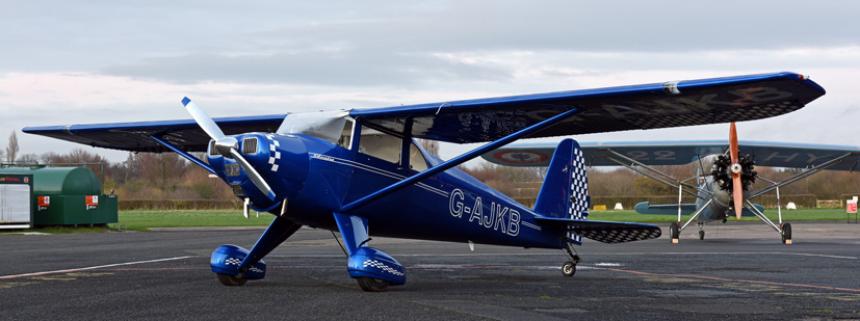
An American classic – the delightful Luscombe 8E Silvaire
Another extremely attractive and historic aircraft based at Barton is this delightful Luscombe 8E Silvaire Deluxe, which is something of an aviation equivalent of a classic American pre-war sports car. This series of aircraft first took to the air in 1937 and were highly advanced for their time – a relatively cheap, yet rugged two seat light sports/training aircraft, the Luscombe 8 adopted a revolutionary mainly metal construction. This made the aircraft tough, as well as good looking and in the years leading up to America’s entry into WWII, the production of this classic aircraft was protected for use in the US Civilian Pilot Training Programme. The metal construction of the Luscombe also dictated that large numbers of the almost 6,000 aircraft produced survived in relatively good condition, even if left languishing at the back of a hangar for many years.


The Luscombe produced some of the most memorable shots from the event
This particular aircraft is an ‘E’ model and includes a number of design improvements that make this later incarnation of the Luscombe arguably the most attractive version. These included the repositioning of the fuselage fuel tank to the wings, which allowed slightly more cabin space and the inclusion of two additional fuselage windows, which made for a more enjoyable pilot/passenger experience. Built in 1946, G-AJKB still wears its original US registration on the tail, as well as carrying the name ‘Lusky’. Wearing this smart blue and white colour scheme, G-AJKB is a regular visitor to fly-in rallies and Airshows around the UK and is most definitely a case of travelling in style.

A sturdy tripod is needed for long exposure photography
This Italian built high wing light aircraft first took the skies in the 1990s and was designed around the microlight aviation market, but attempting to provide the characteristics of a larger aeroplane. Marketed as the first microlight produced with general aviation style, the P92 is widespread use with flying training schools, private individuals and corporate owners and has been responsible for the training of hundreds of new pilots – a military version is also in service with the air force of Cambodia.

Another light, two seat sports/training aircraft, the owner of G-TCNM was on hand to fire the engine up for the gathered photographers, allowing some unusual pictures of her aircraft to be taken and with the skies now clear, a moonlit shot was possible, with a little careful composition. You can also see from the pictures above that the aircraft now also sports a rather appealing cat design on the tail, which only seems to have been added since its arrival at Barton.
Barton Aerodrome, or more accurately City Airport & Heliport, is home to the Mainair Flying School, which is the leading microlight training school in the North West and the longest established flying school at Barton. Providing pilot training, experience flights and a package of additional ground based tuition, Mainair are an important part of flight operations at Barton and their aircraft are regularly seen either in the air or being prepared for their next flight. Two of their aircraft were conveniently positioned during the night shoot and with the aid of some additional portable lighting, we were able to capture them before the light totally disappeared.

This 2 seat light training aircraft manufactured in Germany is an ideal aircraft for local flying schools to introduce students to the delights of flying. With a spacious side-by-side cockpit and state of the art flight instrumentation, the high mounted wing on the C42 makes take-off and landing a little less daunting for the student pilot. With around 1200 examples already built, these aircraft are destined to train future pilots for many years to come.

The other 2 seat light sports/training aircraft operated by Mainair is the Czech built EV-97 Eurostar, which is an all metal, low wing microlight. With an exceptional view from its large, bubble canopy and the ability to travel relatively long distances, the Eurostar makes for an ideal sports/touring aircraft, as well as training future pilots in some style. The more powerful ‘SportStar’ version of the aircraft was designed for towing gliders and banners, along with its flight training capabilities.

The Yak 52 is an extremely powerful training aircraft
I don’t think this aircraft was actually part of the arranged photoshoot, but if you will leave an attractive aeroplane lying around when photographers are in town, it is bound to come in for some attention. Representing everything that is good about Soviet aviation, the Yak 52 is a tricycle undercarriage primary trainer used by the Soviet Air Force and is as tough as old boots! With all metal construction and a tandem pilot/student cockpit arrangement, the Yak has lots of power available from its 9 cylinder Vedeneyev radial engine and is a fully aerobatic competition standard aircraft. Designed to be operated from even the most basic of airfields, this rugged training aircraft just gets on with the job at hand, with a minimal amount of maintenance and very little fuss - many would argue that this distinctive aircraft could even be described as a modern day warbird.

You might think that coming away from an event such as this with a collection of appealing images is dependent on having one of the latest ultra-expensive DSLR cameras in your bag, but you could not be more mistaken. The best camera for the job is the one you already have, but knowing your way around it and a little prior preparation will certainly help you to get better pictures. All modern cameras have a host of features designed to assist photographers of all abilities to get good images in almost all situations, which includes taking pictures of aircraft at night. Sensor technology has advanced so much that images can now be taken in even the poorest of light, with the sensor probably able to pick out detail you can’t actually see through the viewfinder. That being said, this will usually result in poorer quality, noisy images (in the days of film, this was known as grain) that will leave you a little disappointed with the results. So, what do we need to consider?
Preparation. This is probably the most important consideration before any night shoot – what pictures are you looking to come away with? If you simply want some record shots, then leaving your camera on Programme or Auto will yield perfectly acceptable results, knowing that the camera will be assuming many things and coming up with settings for what it thinks you want it to photograph. If you have more specific requirements, you will have to take more control. Knowing that most settings will have implications on others, so this is something of a balancing act.

A tripod is an essential piece of kit on any low light or night shoot
Tripod. This is pretty much an essential tool for night photography and you should not leave home without one. A good quality tripod will always pay you back over time, so go for as sturdy a design as you can, as longer exposures will definitely require a stable shooting platform. In conjunction with this, a remote release cable is almost as important as the tripod, as you need to avoid the possibility of even the slightest movement when using longer exposures. If you don’t have a cable release, use your cameras self-timer on a five second delay, as this will work almost as well.
RAW or jpeg, that is the question. Serious photographers will always say RAW, as this format retains the most detail and gives you much more latitude in post processing. The Jpeg format is fine for most people, especially if you don’t want to spend hours in front of the computer, but this is personal choice – I shoot both and have the best of all worlds, but you do need a good supply of memory cards.
White Balance. Again, this is down to personal choice. There will probably be multiple light sources in the vicinity of your shoot, which could have you tinkering all night long. Regular night shooters will certainly have a favoured setting, or may have produced a custom setting for their camera, but for most people, you will be very unlucky if the Auto white balance setting does not produce acceptable results (especially if shooting RAW).
Metering mode. Modern cameras come with a selection of cleverly designed metering options and you will probably get reasonable results from any of them, with the possible exception of spot metering. An evaluative, or centre weighted metering mode would work fine, but check images in your screen and experiment, making a note of the most pleasing results.
Shutter speed, Aperture and ISO setting. This is where things can start to get a little technical, as changing any one of these values will have an effect on the other two, so you really do have to have an idea of what you are looking to achieve. In the main, I would shoot using Aperture Priority mode, selecting an aperture that my lens performs well at and gives me a reasonable depth of field – this would usually be between f8 and f11. In order to capture the most information from the sensor and with the least amount of noise, I would usually set an ISO speed of 100, knowing that this will result in some potentially long exposures and rely on the rigidity of my tripod and hoping that I don’t accidentally kick one of the legs during exposure.


Long exposure times will accentuate movement of any kind
Shutter Speed. This may become an issue if your shoot involves turning propellers or re-enactors, which are becoming increasingly popular at this kind of event. Turning props will require a slower shutter speed to blur the motion and hopefully produce an attractive disc on the image, whilst people in the frame will need higher shutter speeds to avoid a distracting ghosting appearance, unless this is a specific effect you are looking to achieve of course. At this point, I would encourage anyone to experiment a little and see which combination of settings works for you. Each combination will result in a different look to your images, but as they say beauty is in the eye of the beholder and there really is no definitive combination of settings.
Composition. This is the last area I am going to mention and the one where I encourage you to be creative. Look for unusual angles and visually impactful images and don’t get hung up by watching what everyone else is doing – if you do your own thing, chances are they will be copying you before too long. Once you have the shots you need, try and get some that you will be proud of and don’t be afraid to fail – your favourite shot may just come from your mad, creative session.
As with most things in life, there is a certain amount of luck involved in capturing that special image, but prior preparation and a willingness to try something different will minimise the potential for failure. Don’t put too much pressure on yourself and enjoy the experience – if it’s a night shoot, one of those little pocket torches would be a good idea too.
Thank you to everyone involved in making the first Friends of Barton Aerodrome low light and night aviation photography event such an enjoyable occasion, especially to the aircraft owners who kindly supported this fantastic initiative by making their magnificent aircraft available. For more details on how to join this growing band of enthusiasts, please head for the FoBA website or visit their Facebook page, where you will also be able to obtain information regarding other events planned at Barton.

Please help us to promote the activities at your local airfield
Hopefully, our report from the Barton night photography event will encourage readers to support our ‘Project Aerodrome’ initiative and send us details of aircraft and individuals at your own local airfield. Events such as these really do show that there is a lot of unheralded activity going on behind the scenes at most airfields around the world and the idea behind ‘Project Aerodrome’ is to unlock some of these secrets and bring them to a much wider audience of like-minded aviation enthusiasts. As airfields begin to awaken from their winter hibernation and more people start to visit their favourite aviation venues, please do send in your pictures and any related stories, so we can post them in a future edition of Aerodrome. Please send any information to us at aerodrome@airfix.com or aerodrome@corgi.co.uk and we look forward to finding out about an airfield that is close to your heart.

Newark’s Avro Ashton is joining in with this weekend’s fun
Our good friends at Newark Air Museum have kindly send us details of a recent addition to one of their rare exhibits, as they prepare to support this weekend’s Comic Relief Red Nose Day. The museum’s Avro Ashton experimental jetliner has acquired a bright red nose, courtesy of museum members and volunteers, reminding everyone that a donation to this worthy cause, however small, will help people who need it most both here in the UK and in Africa. With celebrities and large swathes of the population donning a red nose for the day on Friday 24th March, Avro Ashton WB491 was not about to miss out on all the fun and is wearing one of the largest red noses in the UK. We would like to thank the museum’s Howard Heeley for sending us the information and allowing us to share the image above.
I am afraid that is all we have for you in this latest edition of Aerodrome, but we sincerely hope you found it an interesting read. As usual, if you would like to join in with all the latest social media discussions regarding Aerodrome and aviation matters in general, please head for either the Airfix Aerodrome Forum or our Corgi Aerodrome Forum and have your say. If you have any specific comments, questions or suggestions for future editions of Aerodrome, please do feel free to let us know by using either the Airfix Facebook or Corgi Facebook pages, or our Airfix Twitter or Corgi Twitter accounts, using #aerodrome – if you are Twitter regulars, you will know what this means! If good old fashioned e-mail is more your style, please use our usual address above where we will be only too pleased to hear from you.
Thank you for your continued support. We will have more news from the world of aviation in our next blog, which is scheduled for publication on 7th April.
Michael
© Hornby Hobbies Ltd. All rights reserved

