

As the Second World War entered its final stages, the Hawker Aircraft company were extremely proficient in producing high performance piston engined aircraft, using some of the most powerful engines ever to take to the skies. Despite this success, with aircraft such as the Tempest and Sea Fury representing the pinnacle of piston powered aviation, Camm was already working on the future of aviation propulsion – jet power. With an initial proposal for a new RAF jet fighter being turned down by the Air Ministry, Camm turned his attention to producing a jet powered equivalent of the Sea Fury, which eventually resulted in the sleek and graceful Hawker Sea Hawk. An elegant aeroplane, the Sea Hawk adopted a conventional design, but was the first Hawker aircraft to feature a nose wheel design, making it much more suitable for carrier based operation – it would also become Hawker’s first jet aircraft design to enter British service.
The Sea Hawk allowed Camm and his team the opportunity to learn many lessons about jet technology and the ever increasing speed requirements of modern fighter designs, all of which were incorporated into their next major project. Initially taking the Sea Hawk layout and sweeping the wings and horizontal stabilizers back at an angle of 35 degrees, the design was further revised by incorporating air intakes in the wing roots and a single jet pipe at the rear of the aircraft, producing an extremely attractive and slender looking aeroplane. Designated Hawker P.1081, the aircraft showed great promise and provided Camm and his team with valuable data in their quest to produce a new interceptor for the Royal Air Force – tragically, this prototype aircraft was lost in an accident, claiming the life of test pilot and former Battle of Britain hero Trevor Sidney ‘Wimpy’ Wade.
A revised Air Ministry requirement calling for an aircraft capable of attaining a speed of 629 mph at 45,000, a high rate of climb and the ability to carry significant armament saw Hawker’s develop their P.1067 fighter, which first flew from RAF Boscombe Down on 20th July 1951. Incorporating all the development lessons learned from their earlier jet designs and based around the new Rolls-Royce Avon turbojet, the new aircraft proved to be an instant success and held great promise for the future. As had been the case with several earlier Camm designs, he seemed to have a design philosophy which embraced the adage ‘if it looks right, then it probably is right’ and this was certainly the case with his new jet fighter. It was beautiful, arguably the most attractive jet fighter of all time and a classic early jet fighter. With a long, slender fuselage and swept-back wings and tail surfaces, the new Hawker jet was extremely easy on the eye, yet possessed all the attributes to make it a devastatingly effective fighting aeroplane – speed, manoeuvrability and firepower.
The outbreak of the Korean War and Britain’s significant involvement stimulated an urgency in the search for a capable new interceptor fighter for the Royal Air Force. It also led to a radical Air Ministry decision to procure not one, but two proposed future designs from different aviation companies ‘off the drawing board’, as the situation was given a high priority status – they also needed an insurance policy, should one project fail to result in a viable aircraft option. The two companies were Supermarine, with their design which went on to become the Swift and Hawker Aircraft with their new Hunter – both aircraft would go on to enter RAF service, although the Hunter proved to be the significantly superior aircraft, with almost 2,000 examples being built.
The Hawker P.1067 (Hunter prototype – WB188) made its first flight on 20th July 1951, in the hands of famous test pilot Neville Duke and heralded a period of continual development, as the new fighter was prepared for RAF acceptance. Early 1953 saw the first flight of the first production standard Hunter F.1, which came from an initial batch of 20 aircraft, all of which served ostensibly as a pre-production series, with each one incorporating a number of modifications and improvements, ensuring each aircraft was more or less unique. A significant development in the Hunter programme occurred on 7th September 1953, when the heavily modified first prototype aircraft (WB188 – now designated as the only Hunter Mk.3) captured the world air speed record for a jet powered aircraft. Once more in the hands of Hawker’s Chief Test Pilot Neville Duke, the aircraft took off from RAF Tangmere and flew a course between Bognor and Littlehampton, setting a new world record of 727.63 mph and marking a significant achievement for the Hunter development team. In a poignant twist of fate however, this record would stand for less than three weeks, being bettered on 25th September by an example of the Hunter’s main rival, the Supermarine Swift.
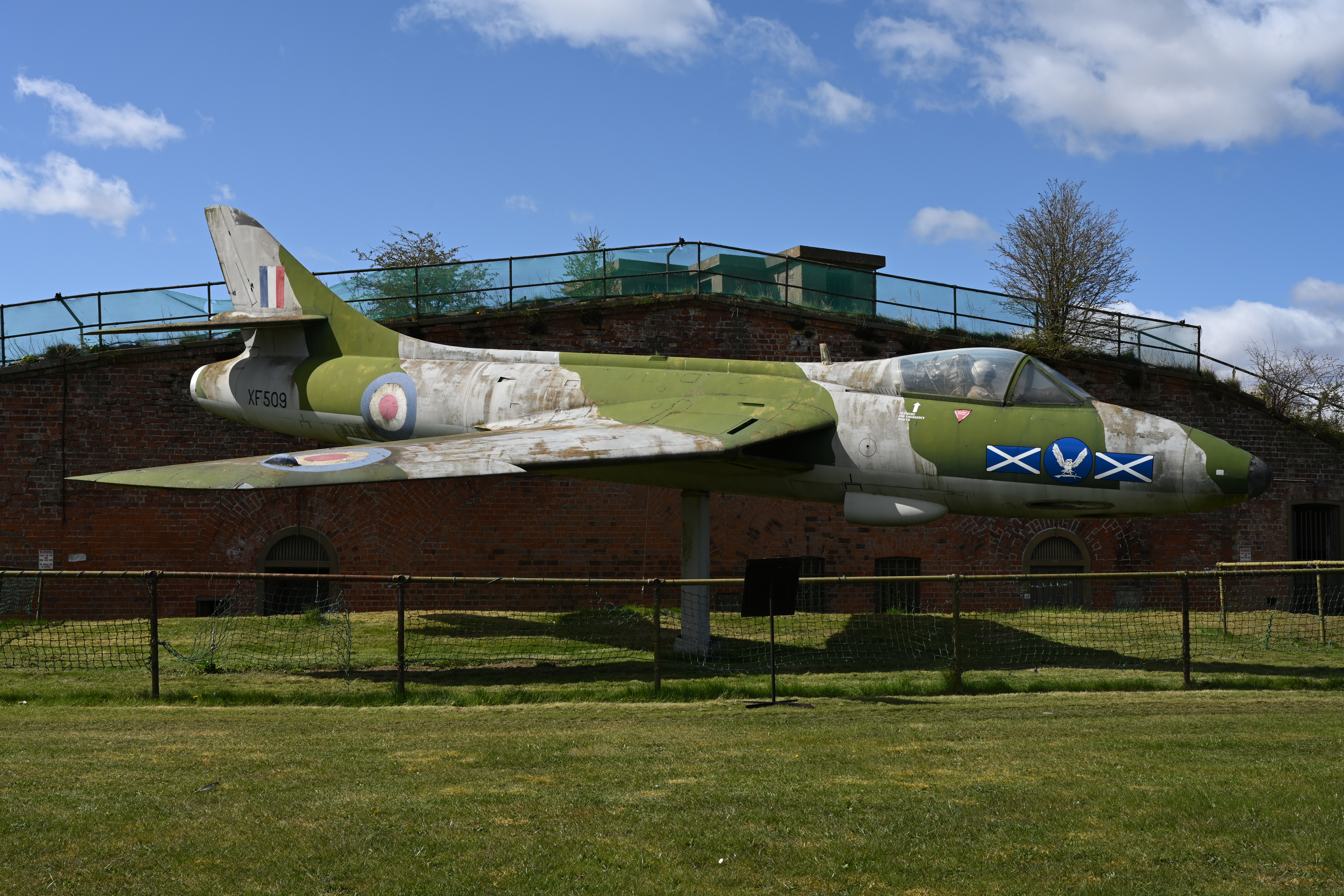
Entering RAF service in July 1954, the Hawker Hunter F.1 continued a proud company tradition of supplying the Royal Air Force with ground-breaking new fighter aircraft, following on from such classics as the Fury, Hurricane and Tempest over the previous two decades. The RAF now had their capable high speed interceptor fighter and could begin to replace the several first generation jets which were currently in service, such as the Meteor, Venom and the American designed Sabre, all of which were unable to match the Canberra bomber for speed. The Hunter proved to be highly manoeuvrable, possessed exceptional performance and was a relatively easy aircraft to both operate and keep serviceable. This first Hawker designed jet aircraft for the Royal Air Force included a number of notable firsts for the RAF, such as being the first high-speed jet aircraft to be equipped with radar and fully powered flight controls to enter service, along with the ADEN gun pack, which was fully removable from the aircraft to aid serviceability and speed of operational turn-around. Despite its impressive credentials as an interceptor, the Hunter was also a beautiful, graceful looking aeroplane and is still thought of by many aviation enthusiasts and historians as the most handsome jet aircraft to see RAF service and very much following the tradition of elegant looking Hawker designed fighters that had preceded it.

