

Welcome to this latest edition of Aerodrome and our regular look at the fascinating world of aviation. With the weather finally taking a slight turn for the better, many enthusiasts will be starting to think about their Airshow attendance list for the coming year and allow themselves to start getting a little excited about the impending 2017 season. The previous edition of Aerodrome looked back at the last of the great Waddington Airshows in 2014 and how Lincolnshire is looking forward to hosting another large two day event in September, this time at the former ‘Dambusters’ base at RAF Scampton. This clearly struck a chord with readers who attended what turned out to be the final Waddington show and we would like to thank everyone who sent messages saying how much they enjoyed the feature and to everyone who liked and shared the blog via our social media channels – your support is very much appreciated.
In this latest edition, we are going to be looking forward to a significant 2017 anniversary for one of Britain’s best loved aviation institutions by looking back at a very special event held in 2007, which celebrated the aircraft and personnel of the much loved Battle of Britain Memorial Flight. As we approach the 60th Anniversary of the Flight, I am sure there will be some special events already planned to mark this significant occasion and in anticipation of this, Aerodrome Edition 66 heads for the Imperial War Museum airfield at Duxford and the Golden Anniversary event staged to mark the previous milestone anniversary of the Battle of Britain Memorial Flight. With a collection of exclusive photographs and a report from the event itself, we will also look at why the BBMF hold such a special place in the hearts of the UK enthusiast and some of the history behind the Flight itself. We will end by looking at some recent livery changes for BBMF aircraft and look forward to another busy display season for the Battle of Britain Memorial Flight in their 60th Anniversary year.
 A classic formation flypast by the Battle of Britain Memorial Flight
In the years following the end of the Second World War, the Victory Day flypasts over central London became a popular event for a nation grateful for the sacrifices of Fighter Command’s pilots during the dark days of the Battle of Britain. The flypast also afforded the RAF an opportunity to show off their latest aircraft technology and to reassure the public that they continued to be protected by one of the strongest air forces in the world. Despite all this latest aviation hardware, it became a tradition for a Spitfire and Hurricane to lead this Victory Day flypast, in direct acknowledgement of ‘The Few’ and the men and machines who battled to prevent the Luftwaffe from taking control of Britain’s skies, as a precursor to invasion. As popular as these WWII fighters were, it was becoming increasingly difficult for the RAF to call upon these classic piston engined fighters, as Britain was now firmly in the jet age and the Spitfires and Hurricanes of the Second World War were now mainly to be found in museums, or as RAF station gate guardians. Something had to be done about the situation and former WWII fighter ace Wing Commander Peter Thompson was determined to do it.

Hawker Hurricane Mk.IIC LF363 was the founder aircraft of the Historic Aircraft Flight
Although today's much loved Battle of Britain Memorial Flight is probably most associated with Britain’s only airworthy Avro Lancaster PA474, the original establishment of the flight rests firmly on the wings of Hawker Hurricane Mk.IIC LF363. By the mid 1950s, LF363 was the only airworthy example of the Hurricane still available to the RAF and was required to perform many of the ceremonial duties to commemorate the Battle of Britain. Based at Biggin Hill, the aircraft became a favourite of Wing Commander Peter Thompson, who believed that the RAF should continue to mark its greatest battle honour by retaining airworthy examples of the aircraft that won the Battle of Britain and became a passionate advocate for the formation of a Historic Flight. He managed to persuade RAF officials to allow him to form such a flight, but with no public funding, everything would have to be done on a voluntary basis. He had his Hurricane, so the search for Spitfires began.
By 1957, only three airworthy Spitfires remained available to the RAF and these were flying meteorological sorties from RAF Woodvale as part of the Temperature and Humidity Monitoring Flight. Coming to the end of their operational service lives, all three Rolls Royce Griffon powered Spitfire PR XIXs (PM631, PS853 and PS915) were allocated to Wing Commander Thompson at Biggin Hill, leaving Woodvale on 11th July 1957, where they would join Hawker Hurricane LF363 and become the founding aircraft of the Historic Aircraft Flight, which would later change its name to the Battle of Britain Memorial Flight. Interestingly, in what was perhaps the most poignant display of the 50th Anniversary of the BBMF in 2007, these original four aircraft performed a formation flypast at Duxford, to commemorate the relatively humble beginnings of the flight.

Spitfire PR XIX PS853 left the Flight to finance the restoration of Hurricane LF363
From the first meeting of these four classic British aircraft at Biggin Hill in July 1957, the Battle of Britain Memorial Flight has undergone many changes and it would be fair to say that it has not always been plain sailing. The early years saw the flight having to change its home base several times, as RAF station closures began to take hold and seemed to follow the flight wherever it went. There were also aircraft acquisitions, disposals, restoration projects and accidents, but as the years passed, the fortunes of the Battle of Britain Memorial Flight began to improve markedly, with this fascinating story perhaps the subject of a future edition of Aerodrome. For many current enthusiasts though, arguably the most significant development in the history of the BBMF occurred when the Flight moved to their current home of RAF Coningsby in 1976. Working closely with Lincolnshire County Council, this also resulted in the opening of permanent visitor centre in 1986 and the opportunity for people to get close to the men and machines of this now famous historic aircraft flight on a much more regular basis – the BBMF had a home!

Europe’s only airworthy Avro Lancaster and star of the BBMF fleet
Although the Battle of Britain Memorial Flight is certainly regarded as a highlight act at any Airshow they perform at, the Flight’s aircraft are in high demand throughout the year and perform a multitude of ceremonial and commemorative duties alongside their Airshow commitments. Always an integral part of any state occasion which includes a flying element, the flight receives numerous requests to perform dedication flypasts and it is not uncommon for the aircraft of the BBMF to undertake several hundred flying appearances during a season, often being seen by many millions of spectators and aviation enthusiasts. Taking care of these priceless aircraft is a full time job for BBMF’s dedicated team of engineers and technicians, who as well as keeping the current airworthy fleet in superb condition, also turn their hand to more complex aircraft maintenance, restoration projects and preserving skills that have long since ceased to be taught to engineering students. A trip to the Visitors Centre allows a fascinating insight into their work and gives a clearer appreciation of the skills and effort required to keep these historic aircraft in the air, where they continue to captivate the nation.

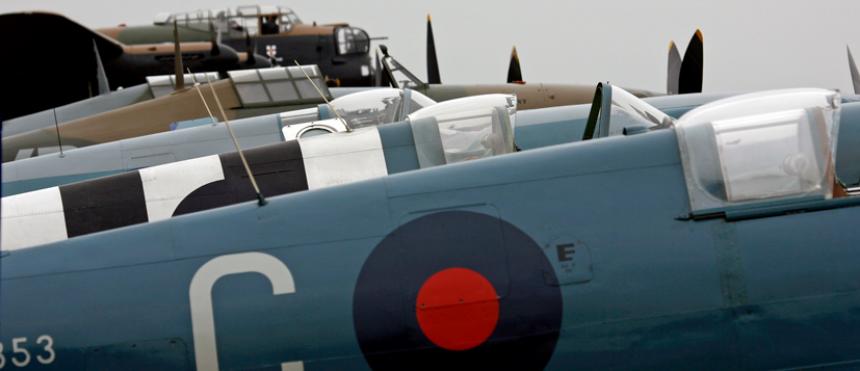
A sight for sore eyes - the memorable Duxford 2007 line-up of BBMF aircraft
For many UK aviation enthusiasts, one of the highlights of the 2007 Airshow season took place relatively early in the year and was a specially arranged event in addition to the traditional Airshow schedule. To mark the 50th Anniversary of the Battle of Britain Memorial Flight, the RAF, in conjunction with the Imperial War Museum airfield at Duxford, had arranged a celebration day, where the entire airworthy fleet of BBMF aircraft would be in attendance on the airfield at the same time, affording enthusiasts an extremely rare photo opportunity. With pilots, members of the ground crew and a number of other aviation celebrities in attendance, this event promised to be something very special, particularly when you consider that several of the Flight’s aircraft had been repainted during the winter months and this would be the first public appearance of these new colours. Without doubt, Duxford airfield was the place to be on Saturday 5th May 2007, for what promised to be a historic occasion – the only thing that could spoil things now was the good old unpredictable British weather.
Anyone who was fortunate enough to attend this memorable occasion will always remember the magnificent sight that greeted their arrival – all of the current airworthy fleet of BBMF aircraft lined up on the Duxford hardstanding as if on parade, just waiting for us to inspect them. Amongst their ranks, Lancaster PA474, Spitfire IIa P7350 and Spitfire Vb AB910 were all wearing smart new colour schemes and the day would offer the opportunity for a flight-line walk, where enthusiasts could inspect the aircraft more closely and a series of exciting flying displays, which would help to commemorate this auspicious occasion. Unfortunately, as can often be the case in Britain, the weather did not appreciate the magnitude of the events unfolding before us and as we walked between these historic aircraft marvelling at our good fortune, we did so under grey leaden skies, which threatened to curtail the day’s scheduled flying activities.

Avro Lancaster PA474 dominated the display line-up
No review of this event would be complete without stressing just how unusual it was to have the entire BBMF fleet resident on an airfield away from its home base at Coningsby and available for enthusiasts to photograph. Although different aircraft will certainly appeal to different people, the aircraft sporting new colour schemes for 2007 were bound to come in for closer inspection and we will focus on these first.
Although clearly not associated with the Battle of Britain, Avro Lancaster PA474 is arguably the most famous aircraft of the Battle of Britain Memorial Flight and one of the most significant airworthy historic aircraft in the world. Constructed at the Vickers Armstrong factory at Hawarden in May 1945, this Lancaster was destined to fight the Japanese as part of Britain’s ‘Tiger Force’, but the end of WWII dictated that she never saw action. After serving as a reconnaissance aircraft and pilotless drone, the aircraft was eventually earmarked for museum display, but not before starring in the feature films ‘Operation Crossbow’ and ‘The Guns of Navarone’. In 1965, the Commander of No.44 Squadron at RAF Waddington (the first Squadron to receive Lancasters in 1941) requested that the Lancaster be placed under his care and following the arrival of PA474, the aircraft began a period of restoration, flying on a number of occasions whilst this work continued.

The stunning ‘Phantom of the Ruhr’ artwork made its debut at the 50th Anniversary event
After operating under the stewardship of No.44 Squadron for several years, the Lancaster was passed over to the Battle of Britain Memorial Flight in November 1973, as it was felt the Flight had the time and necessary expertise to keep this important aircraft serviceable and to continue with her restoration to as close to wartime configuration as possible. Over the years, the Flight have a history of presenting their aircraft in different liveries, each one depicting a famous aircraft or action involving a Bomber Command Lancaster, but always commemorating the effort and sacrifice of the men flying and preparing these aircraft for operations during WWII.
Following the completion of her winter deep maintenance schedule, Lancaster PA474 was repainted in new colours for the 2007 season and was certainly one of the highlights of this Anniversary event, particularly as she now sported spectacular nose artwork on the port side of the fuselage. Now wearing the markings of Lancaster EE139 ‘Phantom of the Ruhr’, PA474 was commemorating a famous ‘Centurion’ aircraft, which survived no less that 121 operational missions during its wartime service career with Nos 100 and 550 Squadrons. Indeed, the Lancaster now carried the codes of both Squadrons The Phantom served with, which was a fitting tribute to one of only thirty-five Lancasters that managed to complete more than 100 missions, with only ten aircraft beating her score.

This extremely rare Spitfire saw combat during the Battle of Britain
Built as one of almost 12,000 Spitfires to come out of the famous Castle Bromwich Aircraft Factory, P7350 saw service during the Battle of Britain and possesses genuine combat provenance, including being shot down by a Messerschmitt Bf 109. Repaired and returned to operational flying, the aircraft went on the offensive with Fighter Command during 1941 and was used on many fighter sweeps over occupied Europe, before again suffering damage and requiring repair. Continuing to serve throughout the war, mainly in a training role, P7350 was deemed surplus to RAF requirements in 1948 and sold for scrap – thankfully, the scrapman must have been something of an aviation enthusiast and once he learned of the aircraft’s history, he presented the Spitfire to RAF Colerne as a museum piece and important part of Britain’s aviation heritage.
As suitable aircraft were needed to take part in the filming of the Battle of Britain movie, P7350 was airworthy once more by the summer of 1968 and was flown to Duxford, where she would take part in the flying sequences for the film. Once filming was completed, this now priceless aircraft was presented to the Battle of Britain Memorial Flight, where she became known as the Flight’s ‘Baby Spitfire’ and was for many years the only airworthy Spitfire that had taken part in the Battle of Britain – truly a unique piece of Britain’s flying heritage.

Lancaster PA474 watching over the ‘Baby Spitfire’
Spitfire P7350 was the second of the BBMF aircraft to debut at the 50th Anniversary event wearing a new colour scheme, or to be more precise, new Squadron codes. Retaining her RAF No.603 Squadron colours, the Spitfire was now coded XT-L to represent the machine flown by Gerald ‘Stapme’ Stapleton during the Battle of Britain, whilst flying on operations out of Hornchurch airfield, in Essex. Regarded as one of the most successful pilots of the battle, Stapleton achieved ‘Ace’ status during the summer of 1940, with all his victories scored whilst flying Spitfires. Adding even more importance to this magnificent 50th Anniversary occasion, Gerald Stapleton was amongst the crowd at Duxford and could give his seal of approval to this new scheme for Spitfire P7350.

AB910 resplendent in her new No.303 (Polish) Squadron scheme
It would be difficult to select one BBMF aircraft as being more famous than any other and if forced to do so, could possibly be likened to having to choose a favourite from amongst your own children. If this exercise had to be completed, then Spitfire Vb AB910 would certainly be in the frame – during an active wartime combat career, this Spitfire flew 143 operational missions during almost three years continual use. Entering service with No.222 (Natal) Squadron at North Weald in August 1941, this aircraft went on to see action during the disastrous Dieppe Raid of August 1942 (Operation Jubilee), before flying numerous sorties in support of the D-Day landings. Even when relegated to support duties after July 1944, this famous Spitfire still managed to make a name for itself. Whilst operating from RAF Hibaldstow in early 1945, the aircraft was being taxied to the runway with a WAAF ground crew fitter sitting on the tail, to prevent it from lifting in the windy conditions. The usual procedure would be for the pilot to hold at the runway threshold to allow his passenger to alight, before applying power and beginning his take off run. Unfortunately, on this occasion, he carried on to the runway and immediately applied take off power, with his terrified passenger clinging to the tail for dear life. As soon as the aircraft became airborne, the pilot realized something was seriously wrong, as the Spitfire was almost impossible to control. Fortunately, a potential disaster was averted and following a wide circuit of the airfield, Spitfire AB910 landed safely back at Hibaldstow with a rather shaken pilot and extremely relieved WAAF alive to tell this unusual tale.

Fancy a ride? Not the most comfortable place to take a Spitfire flight
Following the end of its service career, AB910 flew as an air racer for several years, before being returned to Vickers Armstrong for refurbishment in 1953. In the capable hands of celebrated test pilot Geoffrey Quill, she performed at Airshows all over the UK until the aircraft was presented to the Battle of Britain Memorial Flight in September 1965.

A close up view of the impressive Donald Duck nose artwork applied to AB910
AB910 was the third BBMF aircraft to sport a smart new scheme for the 50th Anniversary commemorations and unusually for a Spitfire, this included some rather elaborate nose artwork. Wearing the codes RF-D, the aircraft was presented as the mount of Polish fighter ace Jan Zumbach, who was commander of No.303 (Polish) Squadron, which made such a telling contribution during the Battle of Britain. His aircraft included artwork featuring Donald Duck and as the war progressed, Zumbach’s increasing victory tally would be carried on the port side of his aircraft, under the cockpit canopy.


Evocative formation - the original 4 aircraft of the 1957 Historic Aircraft Flight
Even though the weather conditions had only improved slightly by the time the day’s flying displays were due to get underway, the crowd had been reassured that barring any unforeseen deterioration, we would be treated to some memorable flying. This promised to include a new pairs routine with something of a twist and an evocative formation display befitting this occasion and as Rolls Royce aero engines began to roar to life, excitement levels began to increase. For many people fortunate enough to be present on this memorable day, one of the undoubted highlights will have been the extraordinary flypast which featured the four original aircraft of the Historic Aircraft Flight, back when it formed in 1957. Despite the fact that we were seeing these aircraft performing fifty years after their original gathering at Biggin Hill, much has happened since that time and seeing them together once more told quite a story. Even though three of the aircraft are still owned and operated by the Battle of Britain Memorial Flight, Spitfire PR XIX (PS853) was sold by the Flight in the mid 1990s to finance the restoration of Hurricane LF363, after it suffered significant damage following an incident at RAF Wittering in 1991. At the time of this 50th Anniversary event, PS853 was owned and operated by Rolls Royce, who were thankfully only too happy to make their aircraft available and enable this nostalgic formation tribute to take place.


The old and the new - seventy years of RAF fighter development in formation
Although this was certainly a day for historic aircraft to take centre stage, the latest RAF fighter of the day was allowed to make an appearance and despite the worst weather conditions of the day, performed two tight formation passes in company with the Flights Battle of Britain veteran Spitfire P7350. Illustrating the development of British fighter aircraft over a seventy year period, the Typhoon pilot was doing his level best to fly slow enough to keep station with this early Spitfire, with the pair only managing a couple of passes, before breaking formation and allowing the mighty Typhoon to attempt to blow away the gloom with its two mighty EJ200 engines.

The Phantom of the Ruhr prepares for her much anticipated display slot

The complete formation of BBMF aircraft for their 50th Anniversary flypast


BBMF fighter salute
Perhaps the formation that most enthusiasts were hoping to see during the 50th Anniversary show brought this memorable occasion to a close. Newly re-pained Avro Lancaster PA474 lead the two Hurricanes and five Spitfires of the BBMF in a series of spectacular formation flypast that definitely confirmed just how fortunate people in the UK are when it comes to experiencing airworthy historic aeroplanes. In a sight rarely seen in British skies, the massed ranks of the Battle of Britain Memorial Flight came together to mark their Golden Anniversary in some style, parading their magnificent aircraft for an adoring crowd and allowing many at Duxford their first glimpse of some exciting new liveries. Signifying the end of this spectacular commemoration, the Lancaster headed back to its home base at RAF Coningsby, leaving the fighters to perform two final formation passes, before breaking to land back at Duxford and receiving rapturous applause from everyone on the airfield.
Although this was certainly one of the most memorable aviation experiences I have been lucky enough to witness, the day could have been even more memorable had the weather been just a little kinder, but I suppose this is just me being a little picky. Frustratingly though, the weather on the following day was absolutely glorious, as this picture of the BBMF Dakota will testify, which was taken from on top of Duxford’s historic control tower and made an extremely memorable weekend even more special. Here is a final selection of images taken during the 50th Anniversary of the Battle of Britain Memorial Flight event at Duxford, held on 7th May 2007.

The Flight’s Douglas Dakota basks in the Duxford sunshine on the day after the 50th Anniversary event

The morning after the day before - a much quieter scene at Duxford

Clipped wing Spitfire Mk. LFIXe MK356 lands back at Duxford

Hurricane PZ865 was the very last Hurricane to be produced

All grace and power – the beautiful Spitfire PR XIX
I can hardly believe that it is ten years since I attended this BBMF 50th Anniversary event and the Flight is on the verge of yet another significant birthday. In a situation that is almost a mirror image of the one we experienced in 2007, Avro Lancaster PA474 is currently undergoing a major service and will emerge from the new Stephenson Hangar at Duxford wearing a smart new livery for the 2017 season – she will not be alone. With Spitfire PR.XIX PS915 already in a smart new silver scheme and two other aircraft rumoured to debut new liveries for 2017, could enthusiasts begin to get excited about the possibility of a 60th Anniversary event on a scale of the one held at Duxford ten years previously? We can only live in hope, but if such an occasion does take place, I and many thousands of fellow enthusiasts will be desperate to ensure we can take our place in the crowd and help celebrate the latest chapter in the history of the unrivalled Battle of Britain Memorial Flight.

The aircraft of the BBMF are always crowd pullers wherever they perform
Whatever happens during 2017, the aircraft of the BBMF will remain a highlight display act throughout the Airshow season and Aerodrome is planning a special 60th Anniversary tribute edition later in the year, to show just how attached we are to these magnificent aircraft and the personnel who give up their time to allow us all to enjoy them. This edition will be made up exclusively of reader supplied images and our search for contributions begins now – if you have any BBMF pictures you feel deserve to be included in our 60th Anniversary edition, please send them in to us, using our aerodrome@airfix.com or aerodrome@corgi.co.uk e-mail addresses. Your pictures can be taken during the coming Airshow season, or at any time during the previous 59 years, but we would be particularly pleased to receive pictures that show the affection in which the Flight has been held throughout its history and some of the differing liveries worn by the aircraft during this time. It would be great to think that we may even unearth some historic pictures that might be appearing on the web for the very first time, so please search your hard drives and raid those boxes of old prints to help us celebrate this significant anniversary. We will credit every photograph that we use and the tribute edition will remain in the Aerodrome section of the Hornby website for people to discover and enjoy at any time – let’s help to mark the 60th Anniversary of the Battle of Britain Memorial Flight.
I am afraid that is all we have for you in this latest edition of Aerodrome. The 60th Anniversary of the Battle of Britain Memorial Flight is sure to figure prominently throughout the coming Airshow season and we hope you have enjoyed this nostalgic look back at the Flight’s Golden Anniversary event at Duxford airfield. If fellow Aerodrome readers were also in attendance on 7th May 2007, please do send us a selection of your pictures, which may feature in a future edition of our blog and may be included in our special 60th Anniversary tribute edition.
As usual, if you would like to join in with all the latest social media discussions regarding Aerodrome and aviation matters in general, please head for either the Airfix Aerodrome Forum or our Corgi Aerodrome Forum and have your say. If you have any specific comments, questions or suggestions for future editions of Aerodrome, please do feel free to let us know by using either the Airfix Facebook or Corgi Facebook pages, our Airfix Twitter or Corgi Twitter accounts, using #aerodrome. If e-mail is more your style, then please use our usual addresses at aerodrome@airfix.com or aerodrome@corgi.co.uk.
Thank you for your continued support. We will have more news from the world of aviation in our next blog, which is scheduled for publication on 10th March.
Michael
© Hornby Hobbies Ltd. All rights reserved

