

We would like to welcome all our readers to the latest edition of Aerodrome and our fortnightly look at the fascinating world of aviation. This weekend will see two of the largest Airshow events in the world take place at Fairford and Duxford, as we reach the high-point of the 2016 display season – the Royal International Air Tattoo and Duxford’s Flying Legends Airshow. UK aviation enthusiasts are left tearing their hair out when these two fantastic shows clash over the same weekend, which forces them to either choose one event over the other, or spend an uncomfortable few days travelling between these Gloucestershire and Cambridgeshire airfields, particularly as both shows offer something of a unique experience. RIAT is one of the largest military Airshows in the world and its impressive aircraft participation list features many of the world’s latest aircraft and is usually a must attend event for the modern military aviation enthusiast. In its own way, Flying Legends is no less spectacular a proposition and is Europe’s premier Warbird Airshow – it also boasts an enviable array of rare and historic aircraft, many of which took part in the air battles of the Second World War and attracts visitors from all over the world.
When the latest RIAT/Legends date clash was announced last summer, I had no hesitation in choosing the classic aviation of Flying Legends above the more modern aircraft of the Air Tattoo, although as the date of the events has moved ever closer, it looks as if RIAT 2016 is shaping up to be one of the most significant of recent years. I am still happy with the decision I made and look forward to bringing you a full report from the Flying Legends Airshow in the next edition of Aerodrome, but if any of our readers are heading for Fairford, please do let us have some of your pictures so that we can include them in a future edition and give readers a flavour of the event. In this latest edition of Aerodrome, we look ahead to this weekend’s Flying Legends Airshow by looking back at a classic year for the show and to one aircraft in particular – Flying Legends 2009 was the year of the Focke Wulf.
As far as active airfields go, the Imperial War Museum site at Duxford has to be regarded as one of the most atmospheric former WWII sites in the world. Any visit to Duxford really is a step back into history, with its collection of historic airfield buildings on both sides of the A505 and the knowledge that both the RAF and the US Eighth Air Force operated from this location during the Second World War. As well as their huge collection of historic aircraft, spanning the entire history of flight, Duxford is also the home of many UK Warbird operators and visitors may be lucky enough to see some of the world’s rarest aircraft actually take to the skies during one of their visits. It is a truly memorable experience to be at Duxford when a Spitfire or Mustang takes off using the grass runway, with the sound of its mighty Merlin engine reverberating off the historic hangar walls and enveloping you in the music of piston power – if this happens when there are not too many people about, you can almost feel as though you have been temporarily transported back in time itself.

A classic USAAF scene at Duxford during WWII
Any visit to the Imperial War Museum at Duxford is something to look forward to, with so many things to see and do that one day really is not enough time to do the museum justice – indeed many enthusiasts will make a number of visits during the year, never tiring of the delights on display at Duxford. As well as being a popular year-round destination for a great many people, the airfield also plays host to a number of Airshows each year, which can always rely on great support from the public and are amongst the most popular events in the country. Most of these shows are organised by the events team at the Imperial War Museum, who can always be relied upon to provide enthusiasts and the general public alike with an interesting and varied flying programme, featuring both Duxford based aircraft and a selection of modern and historic acts from further afield. Despite the undoubted popularity of these events, there is one Airshow in the annual Duxford calendar that is often the first entry in the diary of many aviation enthusiasts each year and is one of the largest Warbird Airshows in the world – the Flying Legends Airshow. Organised each year by the Duxford based Fighter Collection, this show is unique in the world of historic aviation and over the past 23 years, has become something of an aviation phenomenon and attracts visitors from all over the world. With the lure of seeing the finest collection of airworthy historic Warbird aircraft anywhere in the world, set in the historic and atmospheric surroundings of a former operational WWII fighter station, it is no wonder that Flying Legends enjoys an almost iconic status amongst historic aviation enthusiasts the world over.

The Flying Legends 2009 poster did not feature the Focke Wulf
Without doubt, anyone who is lucky enough to attend a Flying Legends Airshow will not be disappointed with the aviation delights laid out before them. With a large number of rare and historic aircraft gathered from all over Europe and often some in attendance from even further afield, the organisers go to great lengths to ensure a distinctly 1940s feel to the entire proceedings and leave visitors in no doubt that they have been to a very special event – this Airshow truly is one of the most significant events of its kind anywhere in the world.

The magnificent Flug Werk FW 190A-8/N arrives at Duxford
In the lead-up to the event, enthusiasts are glued to the Flying Legends website, hoping to see the latest information regarding aircraft that will be in attendance at this year’s and hoping to see confirmation of ‘star items’ that will have everyone rushing to buy tickets. This was certainly the case in the days prior to the 2009 show, when rumours had begun to circulate that an incredibly interesting aircraft could well be making its debut at the show and even though the aircraft in question was actually a new build version of a WWII fighter, it had the UK aviation enthusiast captivated. I remember being sat at my desk, struggling to get my work finished so I could set off for Duxford, but keeping one eye on the forums to stay informed regarding aircraft arrivals. What I and many other enthusiasts were hoping to hear was that a Focke Wulf FW 190A-8/N was heading for Duxford from its home airfield in France, to become the star act at the latest Flying Legends Airshow. Even though this particular aircraft did not have the historic pedigree possessed by many of the other aircraft destined for Duxford that weekend, it would be the first time that many enthusiasts in the UK would have had the opportunity to see a flying example of this famous Luftwaffe fighter and its rumoured attendance was causing no little excitement. All day I had been reading reports that the aircraft had remained on the ground in France, with engine issues continuing to plague this relatively new aircraft, but without official confirmation, there was still hope that the Focke Wulf would make it.

The unmistakable profile of a Focke Wulf FW 190 in flight
During the late afternoon, enthusiasts based on the south coast began to report European based aircraft crossing the coast and heading for Duxford, but there was still no news of the FW 190. Then, at just after 4pm, one enthusiast reported seeing a formation of four Warbirds crossing the coast and although he could not tell what type of aircraft they were, he did include a rather grainy picture that he managed to grab with his digital camera – this was all the confirmation I needed! Amongst the formation of aircraft was the unmistakable profile of a Focke Wulf FW 190 – the Butcher Bird was on its way to Duxford. Within minutes, the forums were alive with confirmation that the aircraft had arrived safely at Duxford and this already highly anticipated show had become a must attend event. I quickly finished what I was doing and prepared for my Flying Legends weekend and a date with a Luftwaffe classic.

The star of Flying Legends 2009 Christophe Jacquard’s FW 190A-8/N
The Focke Wulf FW 190 was one of the most capable fighter aircraft of the Second World War and following its combat introduction in the skies above Northern France during August 1941, allowed the Luftwaffe to gain a period of air superiority. In over twelve months of aerial combat over occupied Europe, the FW 190 inflicted heavy losses on the Royal Air Force, as this new German fighter reigned supreme, particularly at altitudes below 20,000 feet. Until the capture of a pristine example during the summer of 1942, the FW 190 remained something of an uncomfortable enigma for the RAF and one of the most feared adversaries of WWII.
As Germany crumbled under the might of the Allied onslaught in the final weeks of WWII, the vast majority of her remaining air force was destroyed, either in the air, or more commonly, whilst still on the ground. For this reason, few genuine Luftwaffe aircraft survived the conflict, with many of the ones that did either serving as evaluation airframes, or finding their way to aviation museums around the world. The availability of a genuine Focke Wulf FW 190 airframe for use in a restoration project to airworthy condition was almost non-existent and the likelihood of seeing a reasonable number of these classic fighters flying once more was even more fanciful. Despite these significant factors against such a project, a small German engineering company Flug Werk GmbH looked into the possibility and thought that they had an ingenious solution – they were going to build a number of totally new Focke Wulf FW 190 fighters.
The project centred around the use of information the company managed to secure regarding the actual wartime production of the FW 190, which included original plans, production dies and surviving jigs from WWII. Using this information, the Flug Werk team intended to produce a number of FW 190A-8/N ‘new build’ kits, where the ‘N’ in the type description stood for ‘Nachbau’, or replica. Although these aircraft would obviously not have any wartime combat provenance, they would be constructed using very similar methods to the wartime aircraft and would be faithful 1:1 scale replicas of the aircraft that terrorised the skies of occupied Europe from the summer of 1941. The original aircraft were powered by a single BMW 801 radial engine, but as the team would not have access to any of these original engines, the Nachbau fighters would be modified to accept a licence built Shvetsov Ash-82FN 14-cylinder radial engine, which is an interesting feature all on its own. Now licence built in China, the original Ash-82FN engine proved to be one of the most rugged piston engines of WWII and was widely used by the Soviet Air Force. In a real quirk of fate, this engine actually powered the Lavochkin series of Russian fighters, which were the main adversaries of the Focke Wulf FW 190 in operations on the Eastern Front.

The Focke Wulf was a particularly aggressive looking fighter aircraft
It was obvious that the news of this new Focke Wulf production line would be of great interest to enthusiasts and Warbird collectors alike and as the project progressed through the early 2000s, the excitement began to increase. The first tentative flights of the Focke Wulf took place in June 2004, in the capable hands of chief test pilot Horst Philipp – for this and subsequent early flights, the undercarriage remained extended, as the retraction system was causing some problems and had not been completed in time for these early flights. By September, the aircraft was ready for its official press flight at Manching AFB in Germany and the world saw a Focke Wulf FW 190 take to the skies once more – a spectacular achievement for the Flug Werk engineers. Over the following months, the aircraft would be exhaustively tested and every aspect of its flying characteristics evaluated, all under the gaze of the world’s press and any number of wealthy entrepreneurs hoping to acquire one of these magnificent aircraft. Following the successful completion of the test programme, this first FW 190 was more or less left in the hangar, whilst the Flug Werk team started producing the aircraft kits to satisfy their many orders and try to recoup some of the significant outlay they had speculated on this fascinating project – their new Butcher Bird was a resounding success.

The Flug Werk Focke Wulf had enthusiasts flocking to Duxford in 2009
The 2009 Flying Legends Airshow offered the UK aviation enthusiast their first opportunity to possibly see an example of the Luftwaffe’s feared Focke Wulf FW 190 flying for the first time and even though the purists would describe the aircraft as just a newly built replica, Duxford would see huge crowds turning up over the weekend of the show, desperate for a glimpse of the 190. Indeed, the show would be memorable for actually having TWO Flug Werk FW 190s on the airfield during the show, but one of them was purely a static display item – we will look at this particular aircraft a little later.
For many, the star of the 2009 show was FW 190A-8N ‘Black 1’ (990013 F-AZZJ), which was owned by the famous French Warbird collector Christophe Jacquard. This particular aircraft had only made its maiden flight in early May and was due to make its European Airshow debut at the La Ferte Alais Airshow over the weekend of 30th/31st May. Unfortunately, the aircraft suffered a major electrical failure over that weekend and was unable to fly, although they did manage to start the mighty radial engine and allow enthusiasts to see the aircraft taxied along the crowd line. Early teething problems did appear to be plaguing this fascinating aircraft and even though it was scheduled to appear at the Flying Legends Airshow, the fact that it was still very new and had spent little time in the air meant that its attendance was by no means guaranteed. Even as the Focke Wulf made its historic first landing at Duxford and triumphantly took its place in the static aircraft line up, there was still a chance that the issues that affected the aircraft in France only weeks earlier could prevent this beautiful aircraft from displaying to a sizable and extremely hopeful crowd.

A sight many enthusiasts thought they would never see. The Focke Wulf FW 190 climbs into the air at Flying Legends 2009
For many enthusiasts, simply having the opportunity to see an example of the Focke Wulf 190 amongst the Spitfires and Mustangs at Duxford was treat enough. The 190 is simply a brute of a fighter aircraft, with everything about its design geared specifically for one purpose – to shoot down enemy aircraft. With its sturdy, wide track undercarriage, the 190 was capable of being operated from even the most basic of airfields in Europe and on the Eastern Front and its rugged, no nonsense design was intended to make the aircraft extremely serviceable and capable of absorbing significant battle damage. Designer Kurt Tank described his aircraft as a true war machine – a cavalry horse, compared to the Spitfire and Messerschmitt Bf 109, which he likened to racehorses, which required much more careful attention. When viewing this magnificent machine at close quarters, you can certainly see what he meant – with its large radial engine and huge paddle propellers, the Focke Wulf is a fearsome sight and looks every inch an aggressive fighting machine.
The Christophe Jacquard FW 190 was presented as ‘Black 1’, the mount of Luftwaffe ace Lieutenant Horst Hanning, whilst he was serving as Staffelkapitan of JG 2 ‘Richthofen’ at Tricqueville in early 1943. Hanning scored his first victory over the Eastern Front on the first day of Operation Barbarossa and had 30 victories to his name whilst still only 19 years old. The aircraft features a distinctive eagle design on both sides of the fuselage and whilst this does look particularly appealing, it does have a practical purpose – as well as allowing JG 2 pilots to quickly identify their comrades during combat situations, it also helps to mask the heavy dark staining that would occur behind the exhausts of the BMW 801 engine and down the side of the fuselage.

The FW 190 display at Flying Legends 2009 will live long in the memory for those lucky enough to experience it
As the time of the first display of the Flug Werk 190 approached during Flying Legends 2009, you could hear murmurings in the crowd as the expectation levels were reaching fever pitch. At the far end of the airfield, we could see the aircraft moving out towards the hard runway and everyone held their breath in anticipation of the aviation treat about to unfold before their eyes. Display pilot Marc Mathis applied power to the Ash-82 radial engine and in no time at all, the aircraft climbed almost vertically into the air – for the first time in my life, I was seeing a Focke Wulf FW 190 in the air and what a sight it was. The aircraft quickly retracted its undercarriage and levelled out to complete all the necessary systems checks. What happened next is one of the most memorable Airshow moments of my life and one I will hold dear until my last breath. Bearing in mind the aircraft had only made its maiden flight just two months earlier and had suffered a number of frustrating technical issues since that flight, we had no reason to disbelieve the commentator when he told us not to expect anything too much from the aircraft, as it was still being nursed into regular display flying. Almost as soon as these words had left his lips, Marc Mathis and his Focke Wulf appeared over my right shoulder – he rolled the aircraft on its back and commenced a fast, diving pass along the length of the Duxford crowd line, to the delight of the gathered masses. What a treat – it seemed like he was determined to show us all what this magnificent aircraft could do and over the course of the next few minutes, the Focke Wulf confirmed its star billing and left everyone who witnessed the spectacle feeling extremely privileged and just a little bit excited. As Herr Mathis taxied the Focke Wulf back to its parking position, he was given a rapturous ovation from the Flying Legends crowd, who knew they had just witnessed something very special indeed.
 The most popular man in the house – Focke Wulf pilot Marc Mathis performed a spectacular display
Unfortunately, this magnificent aircraft was to suffer a significant accident the following summer and was badly damaged in the resulting forced landing. Again with Marc Mathis at the controls, the aircraft was displaying at Hyeres Air Base in southern France, when the engine failed and the pilot was forced to ditch the aircraft in the Mediterranean – thankfully, he managed to survive the incident relatively unscathed and was rescued by an intrepid jet-skier. When later describing the incident, he said that this was the twelfth time that the engine had failed whilst the aircraft was in flight, but on previous occasions he had managed to quickly resolve the problem. Although the aircraft is now currently undergoing restoration to flying condition once more, it has not flown since this unfortunate ditching incident. The people who were lucky enough to see it perform at Flying Legends 2009 will count themselves extremely fortunate and will probably describe this experience as one of their all-time Airshow highlights. Although I was one of the lucky ones to see the mighty Butcher Bird fly, I sincerely hope that this will not have been the only time and that a Flug Werk Focke Wulf will grace the skies of Britain once more.

The ‘other’ Flug Werk FW 190 at Flying Legends 2009
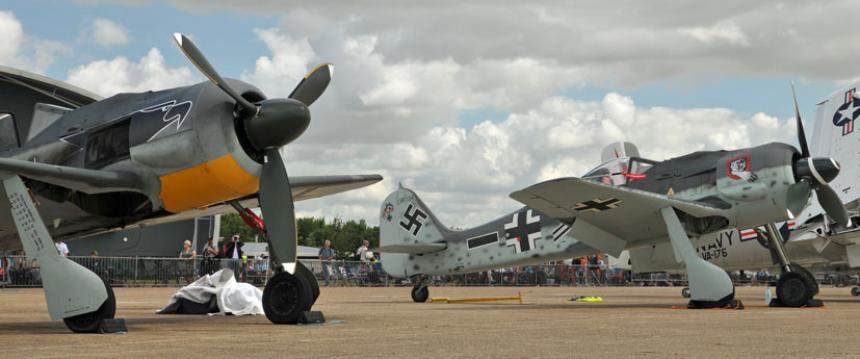
I mentioned earlier that although only one Flug Werk Focke Wulf FW 190 flew at the 2009 Flying Legends Airshow, there were actually two examples of these spectacular aircraft on the airfield during the Airshow weekend. Making for a unique sight, the show organisers arranged for both FW 190s to be parked next to each other, which really did make for some spectacular photographic opportunities. The other aircraft, which had the construction number 980554 and carried the registration G-FWAB was owned by Tom Blair/Spitfire Limited and had been at Duxford for some weeks prior to the Flying Legends Airshow. The aircraft was under the charge of the Aircraft Restoration Company whilst it was at Duxford and although UK enthusiasts had hoped that the aircraft would be test flown from this famous Cambridgeshire airfield and possibly even based there, that did not prove to be the case and it was exported back to Germany in January 2010. The markings applied to the aircraft were thought to be somewhat spurious, possibly referring to a late war Focke Wulf flown by Major Anton Hackl – Hackl was one of the Luftwaffe’s most successful aces and was credited with 192 confirmed victories, whilst completing over 1,000 combat missions.

A sight never to be forgotten. For just a few days during the summer of 2009, Duxford played host to two Focke Wulf FW 190s
For just a few short days during the summer of 2009, Duxford airfield was home to two extremely rare Focke Wulf FW 190A-8 fighters and anyone who was fortunate enough to see this spectacle will certainly regard Flying Legends 2009 as one of the most significant years in the history of this Warbird extravaganza.

Our friends at the Royal Air Force Museum have given us TWO PAIRS of tickets for the Farnborough International Airshow 2016 to give away, with VIP access to the Royal Air Force Museum chalet at the event to use as your base for the day.
The tickets are valid for either Saturday 16th or Sunday 17th July 2016.
Frequently heralded as the World's Greatest Airshow, the public days at Farnborough this year offer a huge variety of attractions including a display of vintage aircraft from the Brooklands Museum, the chance to try your hand in an aircraft simulator, entertainment for the whole family and shopping galore.
To be in with a chance of winning a pair of tickets, head for our competitions page and answer the aviation related question. Entries close at 10.30am on Monday 11th July, so you will need to be quick off the mark with this one. Our lucky winners will be notified the same day, leaving you plenty of time to make your arrangements for attending the show. Good luck to all who enter!
Due for release over the next few days, the latest 1/72nd scale Aviation Archive Focke Wulf FW 190 has a really interesting story behind it and illustrates just how frenetic the final days of the Second World War must have been. As the war was now clearly over for Germany, it seemed even more tragic that lives were still being lost in the final days of conflict, however fear of what could happen in the immediate future would drive some people to make some particularly dangerous decisions.

AA34316 will be the next release in the 1/72nd scale Corgi FW 190 series
As Allied forces closed on Germany from all sides and the war in Europe was coming to an end, there was one thing that frightened German servicemen more than anything else – capture by the advancing Red Army. Luftwaffe pilot Eugen Lorcher had no intention of letting this happen to him and on the evening of 8th May, he fuelled up his Focke Wulf FW 190 fighter and prepared to fly westwards, towards Germany. Taking off from his home airfield in the Czech Republic, Lorcher had also bundled his fiancée into the radio compartment of the aircraft, before making their incredibly dangerous bid for the relative safety in the west, well away from the advancing Russians.
Flying at extremely low level to avoid being shot down by marauding Allied fighters, Lorcher feared that his aircraft could be destroyed at any moment, as they were constantly taking hits from ground fire and were in real danger of simply striking the ground. Gaining height at the very last moment in an attempt to find a suitable landing area, the Focke Wulf belly-landed in a field near his parental home in Aufhausen, not far from Ragensburg and both he and his future wife walked away from this incredibly dangerous flight, hoping that their war was finally over and they could start thinking about rebuilding their lives.
AA34316 Focke Wulf FW 190F-8, ‘Black 3’ Feldwebel Eugen Lorcher, II./SG2 is due for imminent release and will be available on the Corgi website and at all good model stores over the coming few days.

Magnificent box artwork from the FW 190 and Beaufighter Dogfight Double Gift Set
As one of the most famous fighter aircraft of the Second World War, the Focke Wulf FW 190 has always been a popular subject with the Airfix modeller and the range can usually boast a number of examples to choose from. Unfortunately, this popularity usually means that it can often be difficult for the Airfix website and model shops to keep these kits in stock and it is a definite case of grab them whilst you can. With this in mind, there are currently only two kits of the FW 190 available on the Airfix website, one in the spectacular 1/24th scale series (A16001A) and a further example included in a classic 1/72nd scale Dogfight Doubles Gift Set (A50171). The Dogfight Set features an FW 190A-8 version of the Focke Wulf, which was used as the basis for the Flug Werk new build aircraft that we looked at in our Flying Legends 2009 feature above. It is supplied with an RAF Coastal Command Bristol Beaufighter Mk.TF.X and features decals to allow aircraft that took part in a significant WWII engagement to be modelled.
On the 9th of February 1945, a force of thirty-one Bristol Beaufighter long range fighter bombers took off from their bases in Scotland to attack the German Narvik-class Destroyer Z33 and its escort ships, which were at anchor in a Norwegian fjord. Unfortunately, this audacious attack proved to be a costly one for the Royal Air Force, with only a small amount of damage being inflicted on the German ships compared to the significant losses to their own numbers. The steep sides of the fjord in which the German ships were sheltering created an extremely strong defensive position for Luftwaffe anti-aircraft batteries on the hillsides and they were able to bring significant and highly accurate AA firepower against the British aircraft. The attacking force of RAF Beaufighters and their Mustang fighter escort were also intercepted by twelve Focke Wulf FW 190s of JG 5 and during the ensuing dogfight two Beaufighters were destroyed by the Luftwaffe fighters, with a further seven shot down by the murderous anti-aircraft fire. Many of the aircraft that managed to make it back to their base only did so after sustaining significant damage and this costly engagement became known as ‘Black Friday’ due to the heavy losses sustained.
With over 50 aircraft taking part in the engagement, this proved to be the largest air battle in Norwegian skies during the Second World War.
Both the Dogfight Double set and the 1/24th scale FW 190 are currently available on the Airfix website, but only whilst existing stocks last. They may also be available from your usual model supplier.
I am afraid that is all we have for you in this latest edition of Aerodrome, but I hope there was something of interest to you. If you would like to make any comments regarding our Aerodrome blog, or to suggest subjects you would like to see covered within a future edition, please use our direct e-mail addresses at aerodrome@airfix.com and aerodrome@corgi.co.uk to contact us.
In support of this week’s feature, if you managed to get any pictures of the Flug Werk Focke Wulf FW 190 aircraft, please do send them to us so we can include them in a follow up feature. As I will be attending this weekend’s Flying Legends Airshow, I would also be grateful for any pictures from the Royal International Air Tattoo, which is being held over the same weekend – Phantom and F-35 Lightning II pictures would be particularly gratefully received. Again, please use our email addresses as above.

A final look at the Flug Werk FW 190A-8/N at Duxford in 2009
As usual, if you would like to discuss our latest blog, you can head for either the Airfix Aerodrome Forum or our Corgi Aerodrome Forum and join the chat. If you have any specific comments, questions or suggestions for future editions of Aerodrome, please do feel free to let us know by using either the Airfix Facebook or Corgi Facebook pages, our Airfix Twitter or Corgi Twitter accounts, using #aerodrome.
Please spread the Aerodrome word! If you have any friends or acquaintances who you feel would enjoy reading our aviation related blog, please pass on our contact details, so they know where to find us - http://www.airfix.com/uk-en/news/aerodrome or http://www.corgi.co.uk/news/aerodrome. You can also pick up Aerodrome on both the Corgi and Airfix Facebook pages.
Thank you very much for reading our latest blog. If you are heading for either Fairford or Duxford this coming weekend, have a fantastic time and take lots of pictures.
Michael
© Hornby Hobbies Ltd. All rights reserved

