

This latest edition is a Holiday Edition and will therefore be a little shorter than usual, however, we will return to our usual format and back to back 2021 Airshow review features from the October edition onwards. For this edition, as the title suggests, we will be taking a look at two airworthy Spitfires currently flying on the UK Airshow circuit, both of which are hugely popular for different reasons and both having just taken part in last weekend’s Duxford’s Battle of Britain Airshow. With the emphasis being very much on imagery, we will see why one of these Spitfires is the very embodiment of the historic link between Britain’s most famous fighting aeroplane and Duxford airfield, whilst the other marks the link between the Spitfire and our nation’s resilience in the face of adversity. Even though the Spitfire made its first flight over 85 years ago, the aircraft remains as familiar to people today as it did when defending the nation during the Battle of Britain and the possibility of seeing a large number of airworthy examples flying in formation together was enough to see thousands of people heading for IWM Duxford and their latest Airshow event. Although this will not be our full show review, let’s join them to look at two of their Spitfire stars.
Restored Spitfires are revered the world over, but over the past couple of years, this particular Spitfire has become arguably the most famous in the world, ARCo’s NHS Spitfire
For anybody fortunate enough to have the opportunity, there is something incredibly emotive about seeing a Spitfire display over the historic surroundings of Duxford airfield, particularly if you are aware of the connection between the two, which stems back over 83 years. Since the first Spitfire arrived at Duxford in the summer of 1938, the airfield has sent this famous aircraft off to war, played host to a major film production which recreated the air combat of the Battle of Britain and been a centre for Spitfire restoration and operation in post war years, arguably doing more than any other location in preserving the legacy of this magnificent aircraft and making it available to a wide public audience.
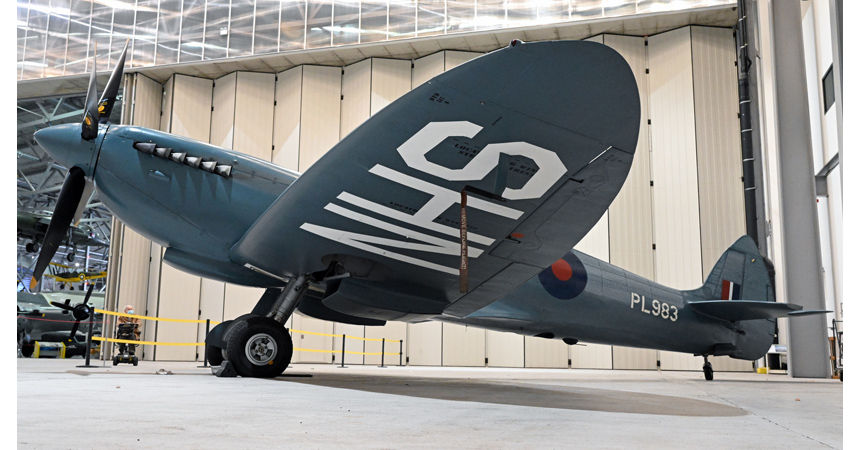
Within that history, the Aircraft Restoration Company facility at the eastern end (M11) of the airfield, has been responsible for the restoration, operation and maintenance of a great many aircraft types, with Spitfires being a particular area of expertise for them. A family owned engineering business which has embarked on a significant period of expansion over recent years, the ARCo area of the airfield always has something interesting going on and as they provide maintenance services for many Warbird operators (including the Battle of Britain Memorial Flight) and operate several historic aircraft themselves, there is usually a Spitfire or two to be found sitting outside their hangars on any given day. One of their Spitfire’s has unquestionably become the most famous example of the aircraft over the past few months and has enjoyed national media attention, as it embarked on an ambitious ‘tribute tour’ to mark the nation’s gratitude to NHS workers and their heroic fight against the Coronavirus pandemic, their beloved Spitfire PR.XI PL983 named ‘L’.
Supermarine Spitfire PR.XI PL983 was built at the Vickers shadow factory at Aldermaston during 1944, part of a mixed batch of Mk.XI and XIX Spitfires built at that time. A modified Spitfire Mk.IX optimised for photo reconnaissance operations, PL983 saw wartime service in this role with No.4 Squadron, flying from several bases both in the UK and in Europe, before passing to No.2 Squadron for post war service in occupied Germany. Later marked for disposal, the Spitfire was loaned back to Vickers Armstrong and prepared for service with the US Embassy, with it intended for use by the Civil Air Attaché in the UK, ferried from the Vickers Armstrong factory at Eastleigh to Hendon by famous Air Transport Auxiliary pilot Lettice Curtis. Curtis would go on to fly the aircraft regularly when it was not required for official duties, including taking part in several high profile air races in the UK.
Returning to Vickers Armstrong towards the end of 1950, PL983 would next be loaned to the Shuttleworth Collection for display and it would spend the next 25 years at Old Warden, presented in a number of different colours schemes, but unfortunately, displayed outside and uncovered, at the mercy of the British weather. Interestingly, this is where the ARCo owner John Romain first came into contact with the aircraft, as he visited Old Warden with his family and had his picture taken in front of it - he is now the custodian of this magnificent machine. A restoration to flying condition was started in in the early 80s but the aircraft was sold at auction in an incomplete state in April 1983, where the restoration was taken over and completed by Trent Aero Engineering. Making her triumphant first post restoration flight from East Midlands Airport in July 1984, the Spitfire would go on to star in the TV series ‘A Piece of Cake’, but was not a regular performer on the UK Airshow circuit. She would meet with a tragic accident in 2001, where the aircraft sustained significant damage.
A misty start at Duxford’s Battle of Britain Airshow, with the NHS Spitfire ready to play a starring role in the day’s proceedings
Complete with her hospital mission markings and Thank U NHS undersides, Spitfire PL983 also proudly carries the name of Lettice Curtis under its canopy
A sight to raise the spirits of millions, this is the view most people would have had of this famous spitfire as it conducted one of its hospital tribute flights during the national lockdown
The wreckage of the Spitfire was later secured by ARCo, who embarked on a second significant restoration project to return this Spitfire once more to her former glory. Thoroughly researching the history of the aircraft, her links to Lettice Curtis were of particular fascination to the team and the aircraft now proudly carries her name on the port side fuselage under the canopy framing. Indeed, the team behind the restoration soon began referring to the Spitfire as ‘Eleven’, due to the mark of the aircraft, which was soon shortened to ‘L’, as this was the first letter of the name of the famous pilot who flew her on many previous occasions. Within ARCo circles, the aircraft is rarely referred to as anything else and anyone hearing about this story are also quick to use this single letter description for this stunning aeroplane.
‘L’ made her first post restoration flight from Duxford airfield on 18th May 2018, in the extremely capable hands of ARCo supremo John Romain and on landing back and taxiing back to his facility, was heard to announce, ‘Wow, she’s fast!’.
Bringing the story of this magnificent aircraft right up to date, in addition to being known as ‘L’ amongst those closest to her, PL983 has recently inherited another name, one which has made her familiar to millions of people, the ‘NHS Spitfire’. The idea of flying Supermarine Spitfire PR.XI PL983 in tribute to the NHS staff who have been at the front line of fighting the dreaded pandemic we have been afflicted with over the past nineteen months or so came whilst pilot and owner of the Aircraft Restoration Company John Romain was test flying this aircraft over the local Cambridgeshire area during the first national lockdown. As he was flying the Spitfire over the towns and villages in the vicinity of Duxford, people who had been enduring weeks of lockdown restrictions and the frustrations of furlough, all came out into their gardens to wave at his aircraft. To him, it seemed as if the Spitfire was once again being viewed as a symbol of national resilience and hope, with her famous elliptical wings pointing the way to a more positive future. For one of these local flights, members of the ARCo team painted the words ‘Thank U NHS’ in white on the underside of the Spitfire, which could easily be seen by those on the ground, a development which quickly brought this already famous aircraft national media recognition.
The incredible popularity of the aircraft’s tribute flights soon led the team to discuss a more ambitious project, one which would see the aircraft flying over hospitals the length and breadth of the country, in a mark of gratitude for the incredible work staff were doing on our behalf and something which would have millions of people looking skywards to catch a glimpse of a Spitfire.
Two final shots from this year’s Duxford Battle of Britain Airshow, starting with this misty early morning shot taken during the early morning media escorted flightline walk
Heading home, Spitfire PR.XI PL983 backtracks to the ARCo hangars after taking part in the formation flypast at this year’s Battle of Britain Airshow at Duxford
In addition to these flights and to further enhance the popularity and impact of this project, the ARCo team also started an NHS Spitfire ‘just giving’ fund raising initiative, where for a small donation, people could have their name, or someone they chose to nominate hand written on the fuselage of this magnificent aircraft. With all proceeds going to NHS Charities Together, there was no shortage of people eager to take advantage of the opportunity and with each name added by hand to the Spitfire, the project must have turned into quite a time consuming exercise for the ARCo team, but a very rewarding one and clearly something they have been privileged to be involved with. It was thought that the iconic shape of the Spitfire could hold around 80,000 signatures in total and if they get close to that figure, this will be a magnificent and unique fundraising effort by the ARCo team on behalf of the NHS, at a time when they need all the support they can get. I applied to have my daughters names added to the Spitfire and it would be interesting to hear of how many other Aerodrome readers have their name, or that of a loved one added to the NHS Spitfire.
It would probably be fair to say that over the past couple of years, Spitfire PR.XI PL983 has become the most famous example of this aircraft type in the world and not only a popular sight as she flies between hospitals, but also at any event where she is scheduled to appear. When she is on the ground, everyone wants to get close to her, either to see if they can see their name on her fuselage, or simply to get close to an aircraft which has been an aviation symbol of hope over the past year or so. It has also been significant to see the number of youngsters interested in the story of the NHS Spitfire, with PL983 doing sterling work in bringing the aviation legacy of this magnificent aeroplane to a new generation of young admirers.
It remains to be seen how long this NHS tribute will remain on the Spitfire, but it will surely be a sad day when she returns to her normal RAF No.4 Squadron Photo Reconnaissance scheme and that is quite some statement coming from someone who is a self-confessed Spitfire purist!
A unique piece of our national heritage, this magnificent Spitfire is the only flying exhibit owned and operated by the Imperial War Museum
Even though many people will associate Duxford airfield with the aviation collection of the Imperial War Museum, the airfield actually has a rich and fascinating history, one which dates back to the final months of the Great war. Significant within that history is the airfield’s links to the Supermarine Spitfire fighter, an association which dates back to 4th August 1938. On that date, Supermarine’s Chief Test Pilot Jeffrey Quill delivered the third production Spitfire K9789 to Duxford based No.19 Squadron, the first unit to receive Britain’s exciting new fighter aircraft and the start of an association which endures to this day. These first Spitfires were replacing Gloster Gauntlet biplane fighters and represented a huge technological leap forward in aviation technology for the Duxford based squadrons and it wouldn’t be too long before they would be required to take their new fighters to war.
Supermarine Spitfire Mk.1a N3200 was constructed at the Vickers Armstrong works at Eastleigh, near Southampton during 1939 and delivered to RAF No.19 Squadron at Duxford on 19th April the following year. Wearing the codes QV and the distinctive black and white underside recognition markings synonymous with RAF fighters of the day, the aircraft embarked on its first operational sortie from Duxford on 27th May 1940, in the hands of Squadron Leader Geoffrey Stephenson, as part of the significant RAF response to the emergency situation at Dunkirk and the evacuation of the stranded British Expeditionary Force. During a day of savage dogfighting, Stephenson managed to down a Luftwaffe Stuka, before his Spitfire sustained damage to its engine, causing it to seize almost immediately. With few options available to him, he successfully executed a forced landing on the beach at Sangatte, to the west of Calais and was able to exit the downed fighter without sustaining injury.
A flying time capsule from a Dunkirk evacuation cover flight from 27th May 1940, this aircraft is still based at the same airfield from where it made that first fateful operational sortie
Squadron Leader Stephenson initially managed to evade capture, but his luck ran out a few days later in Brussels, when German troops finally managed to catch up with him and sent him to a detention facility. A constant headache to the Germans by being involved in numerous escape attempts, Stephenson would eventually find himself at the infamous maximum security Colditz castle, 30 miles southeast of Leipzig. His Spitfire lay damaged and partly buried in the sand at Sangatte, becoming something of an attraction for German troops stationed in the area, with many posing for pictures with the vanquished British fighter. The British fighter soon disappeared beneath the constantly shifting sands, but not before she had been stripped of many parts by German souvenir hunters.
The notorious shifting sands on the beach at Sangatte would hold on to their wartime Spitfire secret for many years after the end of WWII, lost from sight and just a distant memory for those local people who were aware of its story, but that was not to be the end for this particular Spitfire. Following a particularly violent storm in 1986, parts of the Spitfire’s wreckage became visible once more, a development which attracted plenty of local interest and eventually resulting in plans being drawn up for a recovery operation. Later that same year, the remains of Supermarine Spitfire Mk.1a N3200 were removed from the beach and placed on display in a French military museum, just as they were recovered, where it would remain for the next ten years.
Attracted by the provenance of this famous Spitfire and having seen wartime photographs of it lying in a forlorn state on the beach at Sangatte with German troops all over it, the wreckage was acquired by a UK based group in 2000 and earmarked for restoration to possible flying condition. Once returned to the UK, this complex and lengthy restoration would be placed in the capable hands of Historic Flying Limited and in March 2014, marking the end of an ambitious 14 year project, Spitfire Mk.Ia N3200 took to the skies once more. To add even more significance to this momentous occasion, her first post restoration flight took place at Duxford airfield, the same airfield where she had taken off from some 74 years earlier, as she embarked on her one and only WWII combat mission.
Since that first post restoration flight, Spitfire N3200 has been gifted to the Imperial War Museum and is the only flying exhibit owned and operated by the museum. A genuine WWII and Dunkirk evacuation combat veteran, she is without doubt one of the most historic aircraft in Britain today and a unique living (and flying) link to the Royal Air Force of 1940. What makes seeing her even more poignant is the fact that she is housed in the same hangar where she was wheeled out from on the morning of 27th May 1940, the day of her fateful first and only combat mission. It really is such a treat to be able to spend a moment or two in the company of this aviation phenomenon, whether she is part of the flying programme or not, as this aircraft is truly part of the aviation component of our national heritage.
Photographed in the hangar which protected the aircraft on the night prior to its combat mission over the Dunkirk beaches 80 years ago, this night shot is an unusual view of Spitfire N3200
Proudly carrying the Duxford name and the IWM logo, this beautiful Spitfire is the very embodiment of the enduring bond between this airfield and Britain’s most famous fighter
When N3200 is in the air, she allows us to experience the sights and sounds of a very early mark of Spitfire, something many people at Duxford would have also done in the early days of the Second World War. As arguably the purest example of this classic fighting aeroplane, one feature of a display from this aircraft that will always result in comments from spectators is the distinctive whistle the aircraft makes whilst performing its graceful ballet in the sky. An eerie, but not unpleasant sound, the noise is apparently produced as a result of airflow passing over the spent cartridge ejector chutes on the underside of its wings, something which causes them to produce a flute-like note – the captivating music of an early Spitfire! This whistling phenomenon was eliminated in later versions of the Spitfire due to the addition of a deflector plate to disturb the airflow over the opening, leaving the handful of airworthy early mark Spitfires as the only ones to make this distinctive sound. It’s fascinating little details such as this that have earned the Spitfire a unique place in the hearts of the British public and why operators offering experience flights in Spitfires have order books which are booked solid for years to come.
Some 85 years after the aircraft’s first flight, it seems as if Britain’s affection for the Spitfire is still as strong as ever and we are incredibly fortunate to have so many airworthy examples to admire, with Duxford acting as something of an accessible focal point.
That is where we are going to be leaving this Holiday Edition of Aerodrome, but you can rest assured that a full review of the 2021 Duxford Battle of Britain Airshow will be published in a future edition of our blog.
I’m afraid that is all we have for you in this latest edition of Aerodrome, but we will be back with more aviation related content for your enjoyment in four weeks’ time. If you would like to send us a selection of your own pictures, or suggest an aviation related subject you would like to see covered in a future edition of the blog, please use our aerodrome@airfix.com address to drop us a line - we will be delighted to hear from you.
Between editions of our blog, the aviation related conversation is always continuing over on the Airfix Aerodrome Forum and if social media is your thing, there is always interesting content and discussion taking place on our Official Airfix Facebook, Twitter and Instagram accounts, not forgetting our Official Corgi Facebook, Twitter and Instagram sites too. We would be delighted if you took part in all the aviation related discussions going on there and please don’t forget to let us know what you think about Aerodrome and any suggestions you may have.
The next edition of Aerodrome is scheduled to be published on Friday 22nd October, where we will have more interesting aviation content to bring you.
Thank you, as always, for continuing to support our Aerodrome blog.
Michael
Return to the Aerodrome home page
Model link section
Airfix
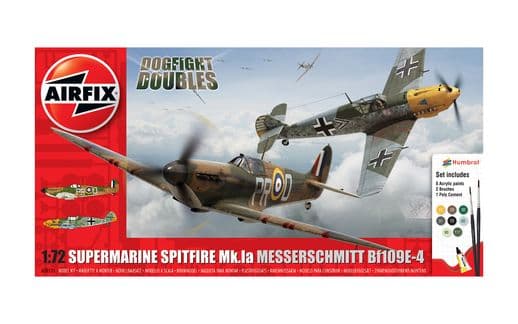
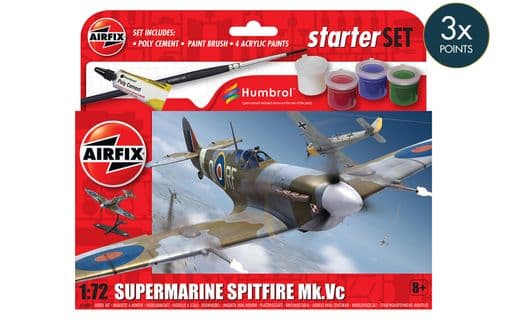
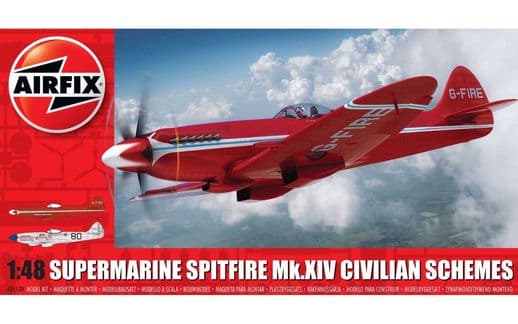
Spitfire & Bf 109E Dogfight Double set, New Spitfire Starter Set, Spitfire Racer, 1/48th scale Spitfire Ia, New tooling Spitfire Vc and Quickbuild Spitfire.

