View Basket

This thread has been locked and can no longer be posted to.

Where to start?

Posted at 15:04:57 Wed 6 Oct 2021

Hello everyone, glad to finally be here.

I have wanted a Hornby train set since I was a child, and now I have the means to finally invest some time and money, I’m lost at where to start. I have recently begun to board my loft space, as it’s something I’ve long wanted to do, and realised I would have enough space to assemble some track, and later on, some landscape.

I have begun to watch beginner videos and how to get started, but I have to admit that I feel a bit overwhelmed with where to start.

My plan was to start with a starter set, more specifically the R1271M iTraveller 6000 set, because it comes with the HM 6000 which I really like the look of.

I have come here to ask the experts what are a few of the do's and don’ts when starting out? It feels like this is a hobby where the sky is the limit in terms of how much you can spend, both in time and money, and how much space you can use.

I really like the look of the DDC, but is this for more advanced users, or is it something you can use from the start?

The RailMaster seems like something for large scale setups with multiple trains and connections, so is this something I should avoid until I’m more comfortable with how everything works?

I did try to keep this short, but there is so much I’d like to ask. For now, I’ll leave it here. If you have read all the way to this point, thank you, you’re a real trooper.

Thanks all.

My name is long, so just call me Lee.

Last Edited 15:08:30 Wed 6 Oct 2021
Posted at 08:42:00 Tue 2 Nov 2021

You can also get good lubricants in the pen type lubricators. Places like CPC electronics sell a pen oiler which has a good suitable oil in them for loco lubrication, you can find the oil on ebay in a clear cylindrical tube with a clear top and pocket clip.

Lubricants to avoid are WD40 and 3 in 1 as they soften plastics, and gum up mechanisms.

Last Edited 09:04:31 Tue 2 Nov 2021
Posted 08:42:00 Tue 2 Nov 2021

Posted at 14:23:24 Thu 4 Nov 2021

Thanks everyone, I always appreciate all your input.

With the price of some of these locos, and reading stories of them going up in puffs of smoke when having been not used for a long time, I want to make sure mine are well maintained and looked after.

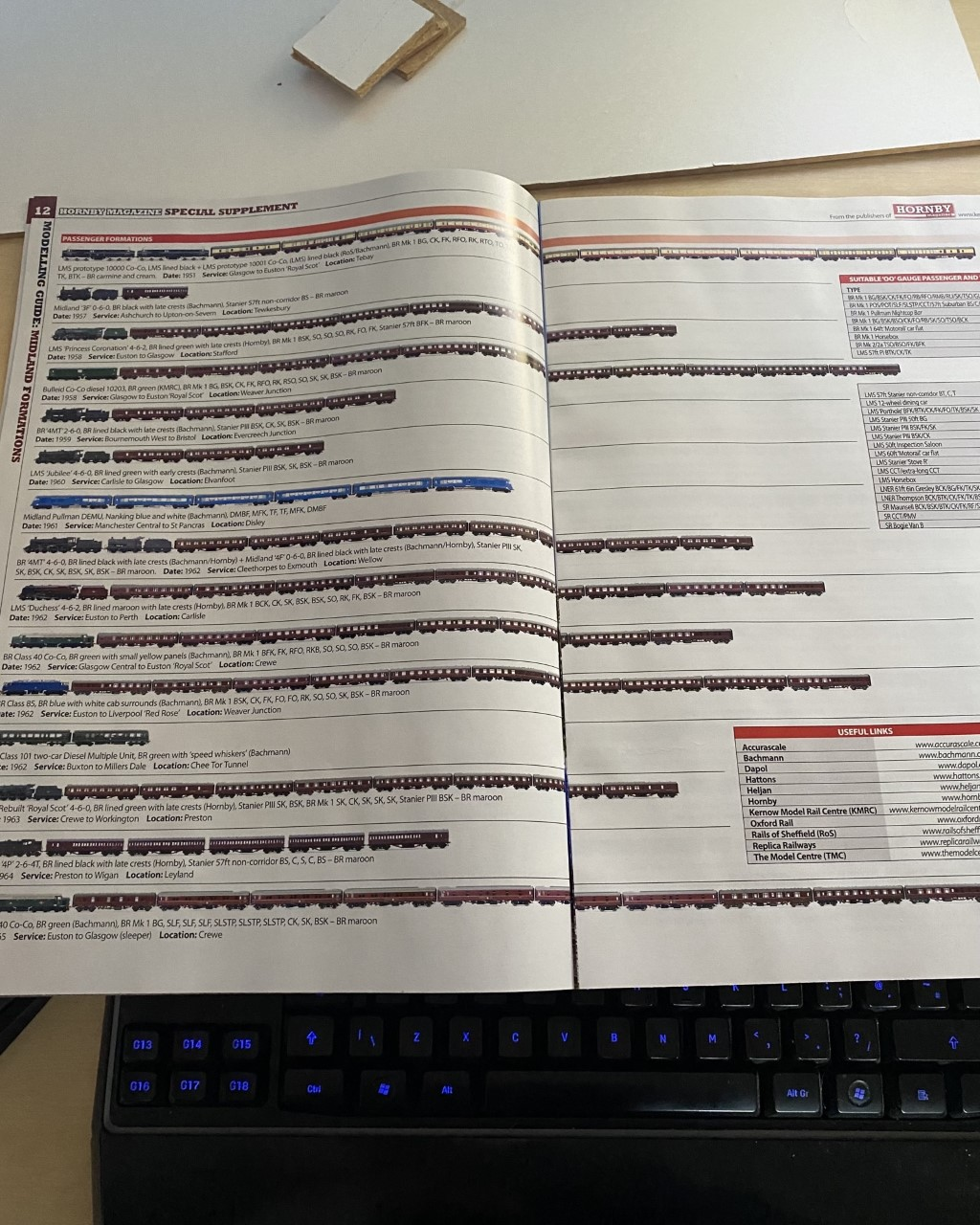
I've been looking at putting a few rakes of coaches together, and I got a Hornby magazine that had a free modelling guide addition that had historic loco/coach layouts which I had actually been searching for online.

I'm not looking to recreate the configurations exactly, but close enough. However, not all coaches are in the Hornby brand, some are Bachmann. I did want to keep to as few brands as possible, but I have no issue adding a few others if I can get a matching setup of coaches.

But I'm concerned about differing details and colours between Hornby and Bachmann, enough that they'll be noticeably apparent.

Are Hornby and Bachmann close in colour/size/details that you wouldn't notice they are different brands?

My name is long, so just call me Lee.

Last Edited 14:36:19 Thu 4 Nov 2021
Posted 14:23:24 Thu 4 Nov 2021

Posted at 14:45:54 Thu 4 Nov 2021

Looking at the rakes in your photograph, you will find that Hornby and Bachmann make very similar maroon Mk1 coaches that match one another very well. The roof shades are slightly different, but in real life they wouldn't have been light grey for long, having acquired a coating of soot from the steam engine hauling them.

Bachmann Mk1 coaches include more detail (wire rails and pipework on the roofs) but in my experience the Hornby models are more reliable (less likely to derail or uncouple on uneven track). If you go for crimson and cream livery, Bachmann's crimson is significantly darker than Hornby's, but in reality the shade of coaches varied quite a bit with age and weathering.

Last Edited 15:43:12 Thu 4 Nov 2021
Posted 14:45:54 Thu 4 Nov 2021

Posted at 16:05:28 Mon 8 Nov 2021

Thanks Doc, having looked around and a watched numerous different videos of both real and model trains, I agree with you that coaches of differing colours, conditions and ages is pretty much the norm.

Having made some decent progress on my loft this weekend (as painful as it was), it occurred to me that I may need to raise some of my baseboards up to the angle of the roof to access the storage underneath.

How does this work in terms of track and power distribution? As the baseboard would raise and lower, I’d need a few mil between track pieces for clearance. So I assume I’d need to power the track on both sides of the break, then keep the gap between the tracks as small as possible so the loco doesn’t cut out.

Would this sort of setup mess with controlling trains in terms of a controller and DCC? As in, would it still recognise the other section of track as one complete layout as long as it’s all plugged into my Elite controller?

Or more simply, is there a track piece that can be connected and disconnected, or engaged and disengaged to accommodate such a lifting method, while still being pinned to the baseboard, so that when the baseboard is raised, all I have to do is simply disconnect the specific track piece, raise the board, then the reserve when lowering?

Edit: what is the purpose of insulated fishplates, and why/when would you use them as opposed to normal fishplates?

My name is long, so just call me Lee.

Last Edited 16:24:33 Mon 8 Nov 2021
Posted 16:05:28 Mon 8 Nov 2021

Posted at 16:41:17 Mon 8 Nov 2021

Insulated fishplates, or even points, I find very useful on a DC layout, the branch or sidings off the running loop can have their own controller to control a train in the insulated sidings while the express continues on the loop, or is brought into play from it's own separately controlled insulated station stop or siding. Also useful just before buffers, better to grind to an ignominious halt than crash off the end of the track. With a little practice you can blend in the moving train controller to the controller setting in the insulated length of track.


Posted 16:41:17 Mon 8 Nov 2021

Posted at 17:38:00 Mon 8 Nov 2021

So they act in the same manner as normal fishplates, connecting track, without the electrical transfer from track piece to track piece. Got it.


Thanks Corky, much appreciated.

My name is long, so just call me Lee.


Posted 17:38:00 Mon 8 Nov 2021

Posted at 20:39:14 Mon 8 Nov 2021

If you go DCC and use electro frog points then you have to use insulated fish played between the two frog ends and the adjoining tracks as the polarity of the frog changes.

On my layout the frame work is is attached to the wall and the 8 track boards are screwed to the frame work. If problems arise with the circuitry under the board's they are individually liftable. So the rails end at the board edges. To achieve this the rails that will bridge the gap are first soldered to copper clad board strips. The strips are put on the track where the boards join. Sleepers are removed 2 on each side of the gap. The track is then laid and fastened down. Then the rails and the copper clad boards strips are cut through at the join. End result aligned track on 2 boards. Each piece of track has a dropper wire soldered to it in its centre and the droppers are soldered to the power buss. Last week I had 6 of the 8 boards up and all went back in place afterwards.

Inspired by a challenge

Last Edited 22:12:30 Mon 8 Nov 2021
Posted 20:39:14 Mon 8 Nov 2021

Posted at 15:57:14 Tue 30 Nov 2021

Is there a surefire way to tell what what spec a loco or rolling stock is?

By this I mean the older, lower detail products where the moulds date back to the 70s and 80s, to the newer super detail stock, like the R4404B Hawksworth coaches. The more I build my collection the more I notice a difference between the two and like to stick to one, preferably the newer stuff.

When I look on Hattons they normally have a picture of the product in the box, and the newer stuff comes with that wrap around thick plastic casing that opens vertically, then locks at one end. While the older stuff is just placed in a flimsy plastic mould with a formed plastic shroud placed over it.

Is there a database with release dates for Hornby products?

This is another thing I’d like to see added to the Hornby website.

My name is long, so just call me Lee.

Last Edited 16:32:16 Tue 30 Nov 2021
Posted 15:57:14 Tue 30 Nov 2021

Posted at 16:43:50 Tue 30 Nov 2021

Regretably, the website is totally misleading with regard to Railroad-series locomotives with only 3 being shown (and one of those - the class 56 - is not Railroad!), the rest being intermingled with main-range models.

The catalogue shows no less than 18 Railroad steam locos (3 with sound) and 22 Railroad/Railroad Plus diesels and electrics. Coaching stock is well covered on the website but against just 6 wagons, the catalogue contains 10 individual wagons plus 4 3-wagon packs.

Price is probably as good an indicator as any at the moment (the 2022 range may be presented more accurately) for locos and rolling stock. As very much a generalisation, if the mainline loco is around £100 or less, it is likely to be Railroad, ditto coaches at around £25 and wagons at £12.

Having Railroad product in separate R-number series might help, but not at the moment.

You may be able to pick up a 2021 catalogue cheaply at this time of year.


Posted 16:43:50 Tue 30 Nov 2021

Posted at 19:02:54 Tue 30 Nov 2021

Going Spare - I had a feeling you were going to say that. What I’ve been doing is just googling the R number, then adding release date, and seeing if I can pick up information that way. Sadly very few Hornby rolling stock seem to have listed release dates.

I could always contact Hattons or Hornby and ask, but I’d really not do this for every coach and wagon I buy. Not to mention Hornby customer service have given me incorrect information before.

My name is long, so just call me Lee.

Last Edited 19:27:33 Tue 30 Nov 2021
Posted 19:02:54 Tue 30 Nov 2021

Bassett-Lowke Members Login

Forgotten Your Password?

Need to Register?