

Welcome to this latest edition of Die-cast Diaries and your latest update from the world of Corgi precision die-cast models. As usual, there is plenty of model news and project updates to bring you in edition number 28 of our blog and readers can look forward to some July – December range updates, the latest instalment in our popular Vanguards 21 series and a final opportunity to grab some aviation bargains in our spectacular Airshow Special promotion.
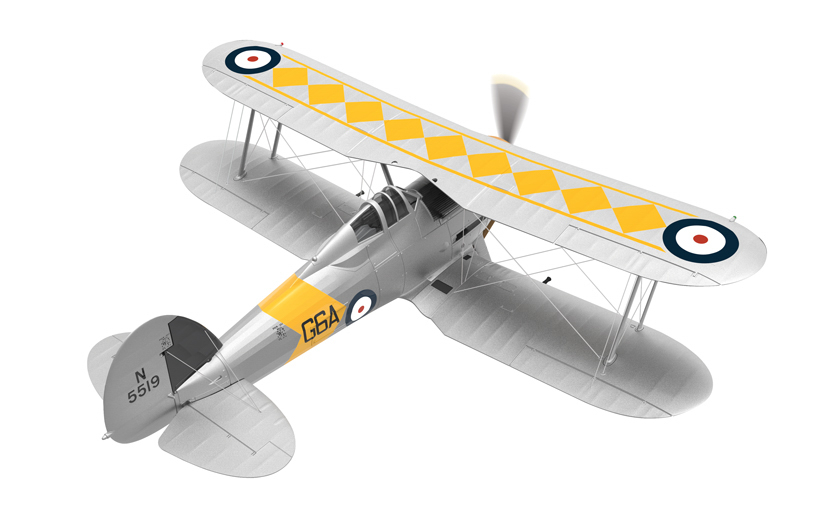
Gloster Sea Gladiator AA36211 is one of the most famous aircraft to serve with the Royal Air Force
One of the fascinating features of any new Corgi range launch is the amount of preparation that goes on behind the scenes to bring you the words and images that accompany the launch. Our talented design department have been working on product images for many weeks prior to launch, ensuring the catalogue and website have all the imagery they need to inform the collector. Also, the supporting product copy must adhere to strict space parameters around which to effectively describe each individual model release and provide the collector with the information they need. This can be particularly challenging in some cases, as the history behind certain model representations can be so rich and interesting, and it is not possible to include everything in the limited space available. To illustrate this, we are going to take a closer look at two of the recently announced models from the July – December 2017 range and why they are both significant additions to the Aviation Archive range.
The beautiful Gloster Gladiator not only represented the pinnacle of biplane fighter design for the Royal Air Force, but it is also a significant model in the history of the Aviation Archive range. First appearing back in 2006, this model was a landmark release for Corgi and one of the first die-cast models to feature metal rigging, adding a new level of realism to these magnificent biplane models. Modellers looking to build an accurate, fully rigged scale representation of the Gladiator would previously have had to buy a plastic kit and not only construct and paint the model to a high standard, but would also have to attempt the challenging task of rigging the model, which required plenty of planning and lots of dexterity. The new Corgi Gladiator allowed the die-cast collector to simply take their new model out of the box and place it on display, admiring the beautifully executed wire rigging without any of the effort.
The Gladiator has been a popular subject with collectors ever since that first release, but the latest announcement in this range is a very special machine indeed and one which went on to become one of the most famous aircraft in Royal Air Force history – here is the full website description of the Gloster Sea Gladiator N5519/G6A, AA36211:
The beautiful Gloster Gladiator represented the absolute pinnacle of biplane fighter design, but entered service just as the first of the fast monoplane fighters were already dictating the future of aerial warfare. A thoroughbred aircraft in every sense of the word, the Gladiator was the last biplane fighter to enter RAF service and the first to feature a fully enclosed cockpit. Highly manoeuvrable and extremely fast by biplane standards, the Gladiator also served with the Royal Navy, with aircraft modified for operations at sea by the inclusion of a strengthened fuselage, arrester hook and catapult spools, as well as provision for the stowage of an inflatable dinghy. Sea Gladiator N5519 wears the attractive pre-war colours of No.802 NAS, serving on board HMS Glorious, with the black fin marking this aircraft as the Squadron Commander’s mount. All twelve of the 802 NAS Sea Gladiators based on HMS Glorious were lost during operations in the defence of Norway in June 1940, when the carrier was sunk by the German Battleship Scharnhorst.
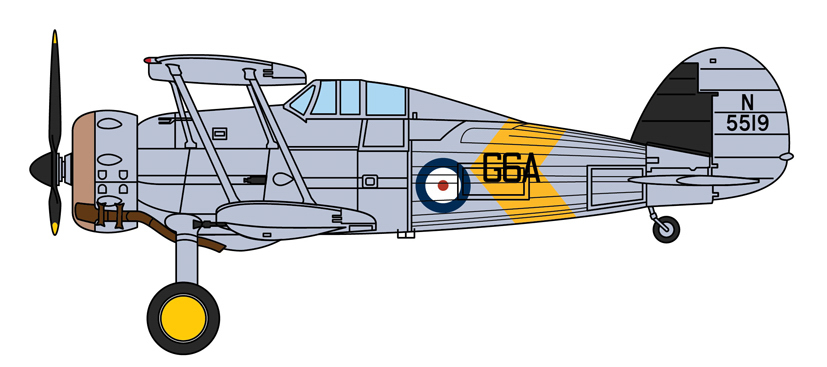
An exclusive look at the original profile artwork for the new HMS Glorious Gloster Sea Gladiator
The former 802 NAS Gloster Sea Gladiator N5519 was not on-board HMS Glorious when the ship tragically went down in the Norwegian Sea and was actually one of the most famous of all the 747 Gloster Gladiators produced. Left behind on the Island of Malta when the rest of No.802 NAS returned to the UK, N5519 was one of the celebrated ‘Defenders of Malta’ – a handful of Gladiators who provided air cover for the Island against significantly superior numbers of Italian Air Force aircraft. Based at RAF Hal Far, these Gladiators fought valiantly and took on almost mythical status when they were later christened ‘Faith, Hope and Charity’ by a Maltese newspaper – ‘Charity’ was the name given to Gladiator N5519.
This famous Sea Gladiator claimed a number of aerial victories during the battles that raged in the skies over Malta, but was to eventually fall victim to a fighter of the Regia Aeronautica. In late July 1940, N5519 ‘Charity’ was being flown by F/O Peter Hartley during heavy fighting above Grand Harbour when his aircraft was hit in the fuel tank by an Italian Fiat CR.42 Falco. The Gladiator burst into flames and crashed into the sea just off the south-east coast of the Island – although badly burned, the pilot parachuted into the sea and following a lengthy period of treatment and recuperation, returned to flying duties. Gloster Sea Gladiator N5519 ‘Charity’ was the only Malta Sea Gladiator to be shot down during aerial combat over the Island.
For the RAF fighter pilot trained to fly the Gloster Gladiator, they must have felt really quite special as they walked out to their gleaming silver fighters, which were at that time the fastest things in Britain’s skies. As the crème de la crème of Britain’s Royal Air Force, they must have had a feeling of invincibility whilst flying in their new fighter, safe in the knowledge that nothing in the sky could touch them – after all, they were in the fastest, most advanced fighter currently in service. Even as they filled their senses with the sheer enjoyment of flying the RAF’s latest fighter, the winds of change had already started to blow and engineers at Hawker, Supermarine and Messerschmitt were already developing the future of the world’s fighter aircraft design. In spite of this, under the RAF’s Expansion Scheme the biplane Gloster Gladiator was ordered in larger numbers than any of its predecessors and as more RAF fighter units began to equip with the aircraft, orders also came from the Fleet Air Arm and a number of overseas air forces.
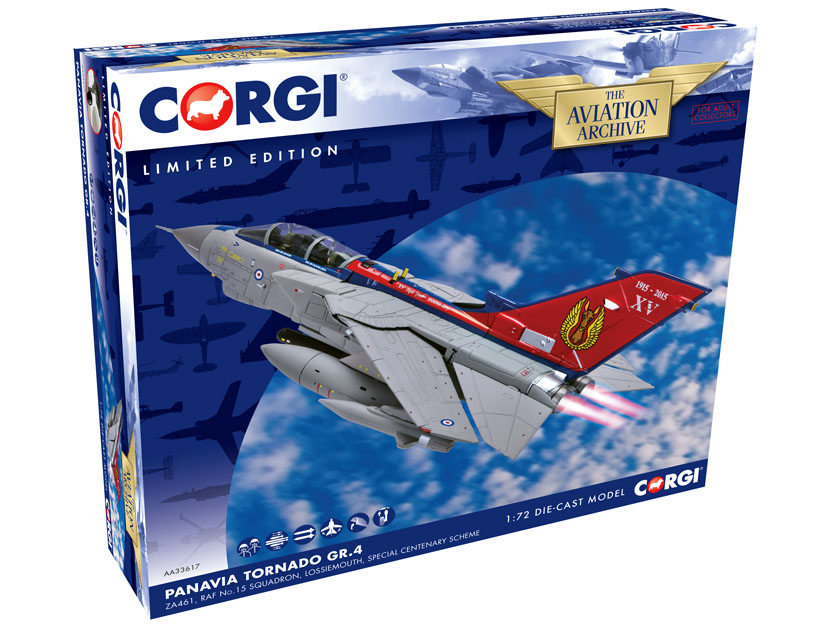
Box artwork featuring one of the RAF’s most distinctive Tornado schemes
As much of the work in preparation for a new range launch takes place many weeks in advance of its publication, certain circumstances can arise where catalogue copy become out of date and includes incorrect information, especially when describing contemporary subject matter. This proved to be the case with the recently announced Panavia Tornado GR.4 ZA461 presented in its spectacular RAF No.15 Squadron centenary scheme (AA33617). At the time of writing the text, No.15 Squadron were still resident at their Lossiemouth home, but between then and the launch of the new range the Squadron disbanded and their Tornado aircraft left Scotland’s main airbase for the last time. Here is the updated description currently displayed on the Corgi website.
As we fast approach the Centenary year of the Royal Air Force in 2018, we can expect this significant occasion to attract plenty of media attention and form the basis of a spectacular Airshow year. In advance of these commemorations, a number of individual RAF Squadrons have already marked their Centenary years and delighted aviation enthusiasts by presenting one of their aircraft in a special commemorative scheme. Without doubt, one of the most attractive schemes applied to an RAF jet was the one that adorned Panavia Tornado GR.4 ZA461 of No.15(R) Squadron, whilst it was still based at Lossiemouth in Northern Scotland. With the impending drawdown of the remaining RAF Tornado force looming, this aircraft became something of a talismanic airframe for the ‘Mighty Fin’ and the proud service record of this magnificent aircraft. Sadly, No.15 Squadron disbanded in March 2017, ending a glorious 102 years of service with the Royal Flying Corps and Royal Air Force, whilst also bringing to an end Scotland’s long association with the Panavia Tornado. The RAFs last three remaining Tornado Squadrons are all now based at Marham in Norfolk, where they will remain until their intended service withdrawal date in 2019.
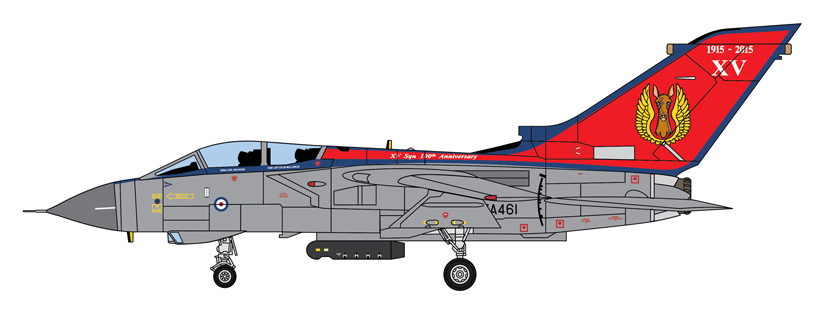
Tornado GR.4 ZA461 is one of the most distinctively presented RAF aircraft of the modern era
Benefitting from much of the advanced technology developed during the controversially cancelled TSR.2 project, the Panavia Tornado was a Tri-national programme to develop one of the most sophisticated all-weather strike attack aircraft in the world. With three major partners developing the aircraft and sharing production costs, it was hoped that economies of scale and shared technology would allow each country to introduce a highly advanced strike aircraft that would act as a significant deterrent to the Warsaw Pact nations. With its variable geometry wings and large tail, the distinctive Tornado is all about speed and power and during a long and successful service career, it has successfully taken part in a number of combat situations most notably during the Gulf War of 1991. With many operators looking to replace the Tornado with fifth generation fighter/strike aircraft, the days of this Cold War warrior are now numbered, but if called upon in the near future the capable Tornado will be ready for action.
Hopefully, this feature will have given you an interesting insight into some of the many actions that have to be completed before any new Corgi range launch can take place and some of the challenges that face the Corgi team. It has also allowed us the opportunity to showcase two of the highlights from the recently announced July – December range.

Over the previous few editions of Die-cast Diaries we have been bringing you a nostalgic look back at the history of the Vanguards model range and how the Lledo factory in Enfield became a significant venue in the collectable die-cast vehicle market. We have seen how the design team in North London broke away from their traditional promotional model range to introduce an exciting new range of models intended for the discerning collector, with the Vanguards range appearing for the first time in 1996. In this latest instalment we are going to be looking at the first few years of Vanguards model production and how this proved to be an exciting time for the company and for die-cast collectors all over the world. We will also see how the changing face of manufacturing brought about some significant challenges and how the Vanguards range finally became part of the Corgi product portfolio.
As with the previous instalments of our Vanguards 21 feature, we are indebted to Vanguards research guru and motoring expert Mark Pinnigar who has personally witnessed most of the developments we have been describing over the past few months and continues to be a driving force behind the brand. When discussing the history of a company and its range of models in this way, it is always important to get the information from someone who speaks from a position of authority and as Mark saw the Vanguards story unfolding before his very eyes, we can certainly be sure of its authenticity.
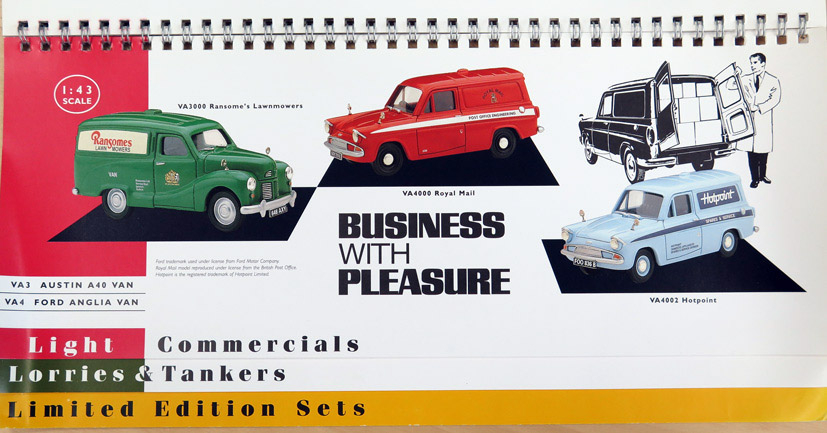
The original 1996 Vanguards catalogue highlighting some of the new commercial vehicles in the range
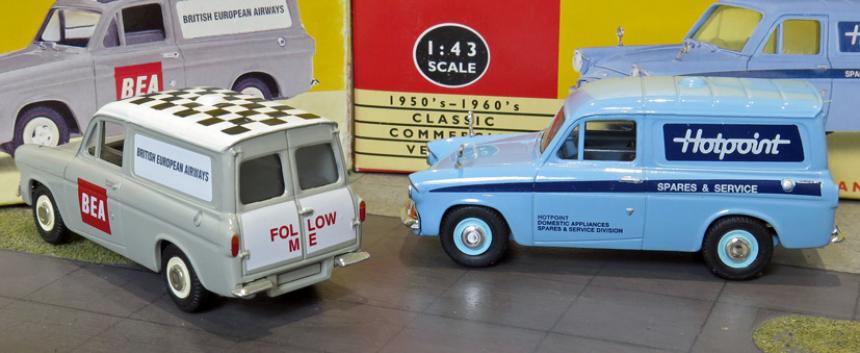
Previously, we saw how the classic Ford Anglia saloon holds a special place in the history of the Vanguards range and how chronologically, this was the first model to represent this impressive new collection of highly detailed collector’s models. We begin our latest review by returning to the Anglia, this time not in its guise as one of the most popular British saloon cars of the 1950s and 60s, but as a range of vehicles that had to work much harder for their living. The first Vanguards range catalogue included a collection of 1/43rd scale light commercial vehicles which included the Ford Anglia van, Austin A35 and A40, along with the distinctive Morris Minor. Each model was presented with the same impressive levels of detail and featured iconic brand names which used the vehicles on a daily basis, such as Hotpoint, the Post Office and BEA (British European Airways). Again, presenting the collector with models that offered something just that little more authentic than had previously been available, they proved incredibly popular and left people wanting much more.
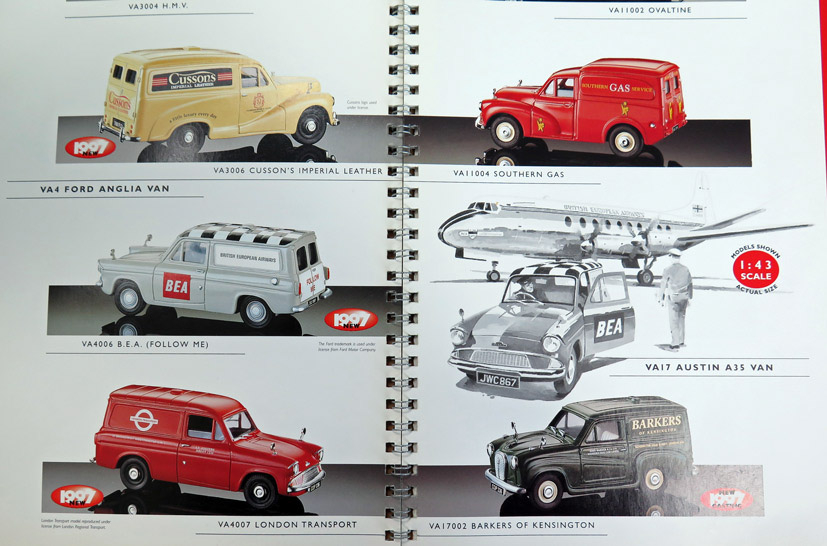
VA4006 Ford Anglia van BEA ‘Follow Me’ was an unusual and extremely popular release
The pressure was now on to try and keep up with consumer expectations and over the next few years, as well as maintaining their core promotional model business and existing product lines, around forty newly tooled Vanguards models were produced along with hundreds of individual livery options. Mark remembers this as both an incredibly busy time, but also one of great excitement and optimism for the future. He recounts how everyone at the factory with any knowledge or interest in motoring was encouraged to come forward with their ideas – everything was considered and no idea was a bad idea. They wanted to ensure that the range stayed at the forefront of the industry and kept providing their growing customer base with new and interesting products.
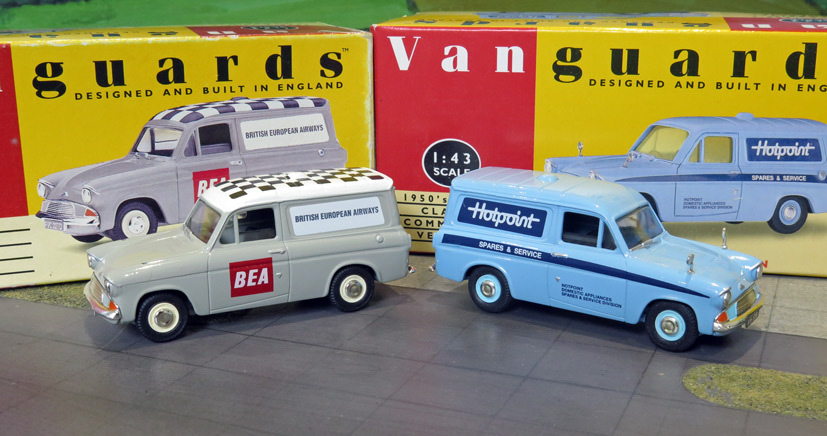
Ford Anglia vans VA4006 and VA4002 make for an attractive and colourful display
It is also interesting to note that at this time everything was still being run from the Lledo factory site in Enfield. The models were designed in-house, all the tooling moulds were engineered in house and even the distribution was handled from the main factory, but despite the fact that large volumes of product were leaving the site on a weekly basis, company officials were already aware that the marketplace was changing and may never be the same again. The stunning successes enjoyed by the Lledo company over the previous few years had not gone unnoticed and a new breed of competitor was slowly beginning to gain a foothold in the market and challenge the dominance of established players in the field. Low cost, high volume producers in the Far East has seen their opportunity and entered a market where they could significantly undercut the prices of established brands, placing them under immediate pressure.
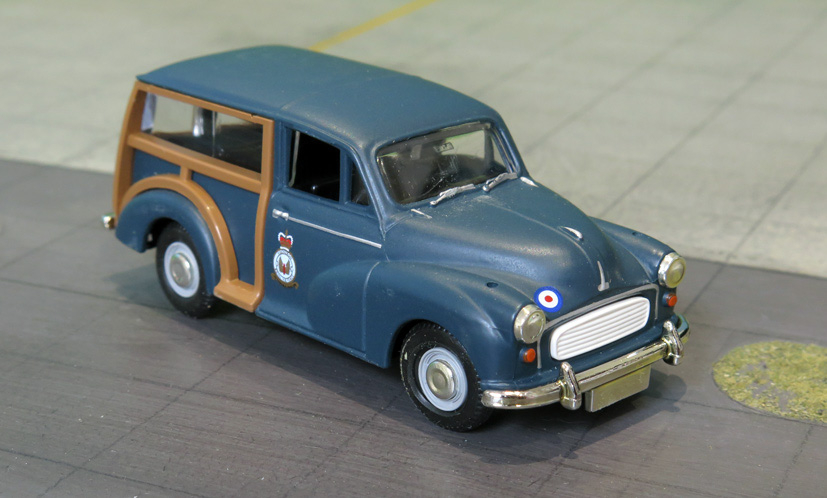
This Morris Minor Traveller was a stylish way for RAF personnel to get about
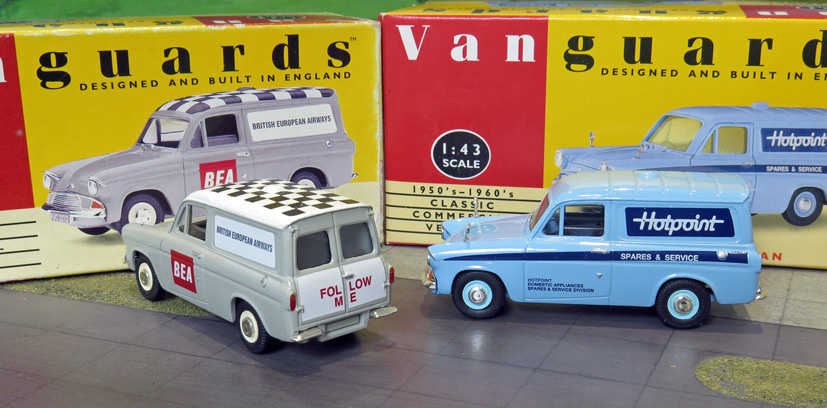
These appealing models quickly secured a loyal collector following with the launch of the 1996 Vanguards range
The Vanguards brand which had proudly proclaimed its models as being designed and built in England were facing a tide of increasing costs and quickly realised that some of their manufacturing would have to be done in the Far East if they were to remain competitive, but this in itself would prove to be a costly exercise. The first Vanguards model to be produced in a Far Eastern factory was the new Rover 2000 saloon, but the winds of change were already blowing at gale force and ever escalating costs soon saw the company’s banks taking over and official receivers being called in. What only months earlier had seemed like such a vibrant and forward-thinking company, releasing the finest quality collectable products in the market, had succumbed to the lower cost base of Far East manufacture and around 250 Lledo employees unfortunately lost their jobs in 1999. What could be sold off was, and Corgi saw an opportunity to expand their own collectable product base and own some of the best die-cast models in the industry – they purchased much of the former Lledo tooling bank and intellectual property rights, including the Vanguards model range.
This was clearly a difficult time for the committed people who brought the Vanguards model range to market in the first place and an uncertain period for the future of the brand itself. Although it appeared the models had secured their immediate future by coming under the protection of one of the world’s great toy and collectable manufacturers, everyone associated with establishing the brand had been dismissed and there was no continuity for the Corgi development team who would now be responsible for bringing new models to market. Little did the die-cast world know that this would just be the beginning of the Vanguards story and that these much-loved little models would go from strength to strength under Corgi ownership.
The heading used for this section of the feature is a little misleading and should actually be the other way around. An appropriate way to leave this latest edition of our Vanguards 21 series is to confirm which was the last new model tooling developed under the original Lledo management and which was the first to appear whilst in the hands of the new owners. Mark kindly confirmed that the last Vanguards tooling developed by the Lledo team was the Vauxhall Victor (VA38000) and it is interesting to note that the original Vanguards ‘Designed and built in England’ box wording was replaced with the more accurate ‘Precision die-cast replica’, to reflect the fact that some of the range were by this time being manufactured in the Far East. Although included in the July – December 1999 catalogue, this model never made it into production at Lledo, due to the difficult situation the Company was in and was to become one of the first Corgi Vanguard releases. The first new Vanguards tooling to be announced following Corgi’s acquisition of the tooling and intellectual property rights was the Singer Chamois, a model which was again developed by the original Lledo team but never released.
In the next instalment of our Vanguards 21 series, we will look at the transition from Lledo to Corgi ownership and some of the challenges faced in returning these fantastic models to market. We will also look at some of the significant releases during this period and how after a short sabbatical, Mark Pinnigar returned to help shape the future of the Vanguards range.
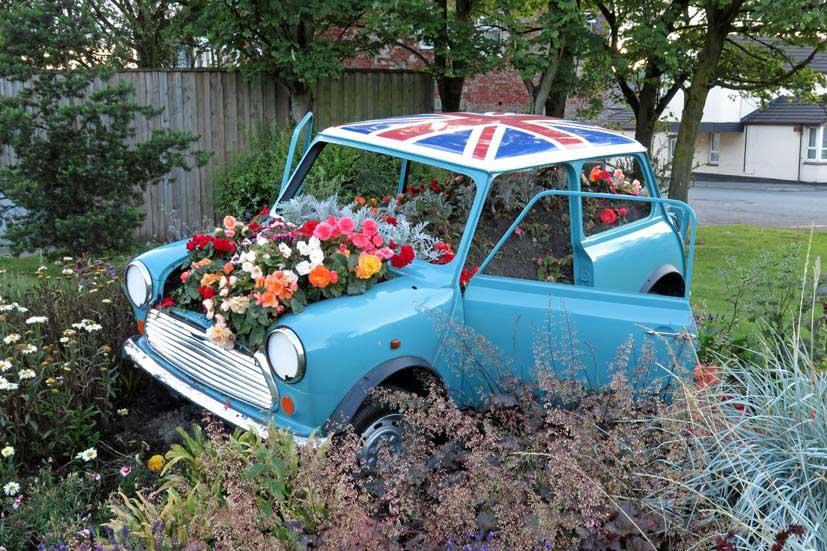
A rather radical use for a classic British vehicle
Announced last month to help commemorate the 21st birthday of the Vanguards model range, we would like to remind you of a unique opportunity for one Corgi collector to have their own car take its place in a future Vanguards model range. This chance to achieve Vanguards modelling immortality is open to anyone who owns a vehicle that Corgi currently have in their tooling inventory (which is rather extensive) who will see their vehicle released as limited edition in 018, available for collectors all over the world to purchase. We are really excited about this unusual way in which to commemorate the 21st anniversary year of the Vanguards range and we are grateful to all the people who have already taken the time to send in their details.
Now for the obligatory small print - clearly, there are going to be some important caveats accompanying this opportunity. The successful vehicle owner will have to submit details of a car model that is already part of the Vanguards range and we have the tooling already in place. Even though our tooling bank is extensive, if your vehicle has any non-standard or bespoke components fitted, it may not be possible to consider it as the cost of tooling for these extra parts may prove to be prohibitively expensive. We also have to say that our Vanguards experts will know exactly what can and cannot be achieved and their decision will be final with regard to the successful vehicle owner. Other than this, what could be finer than having a model of your own car sitting in the display cabinets of Vanguards collectors all over the world?
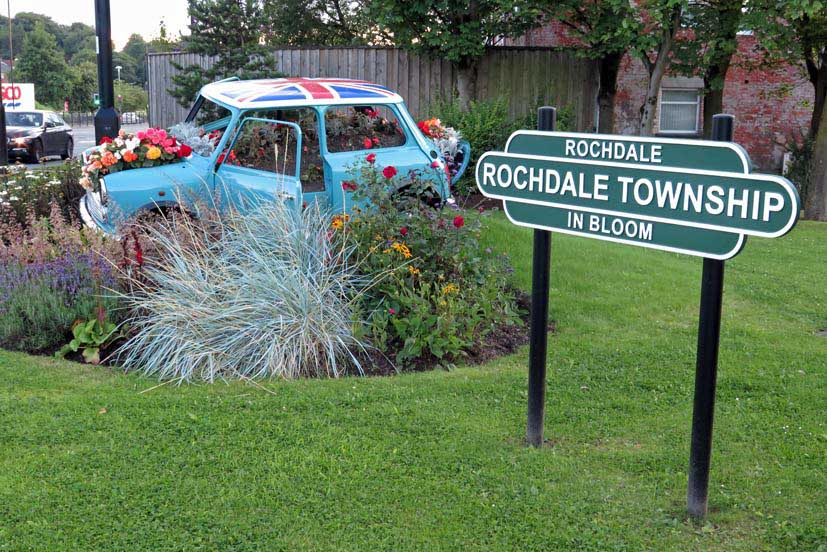
As one of Britain’s most famous cars, the Mini is used to being the centre of attention
Whether you have a classic Ford Anglia or a boy racer Peugeot 205 GTI, we want to hear from you. Please send a picture of your car and a brief description of your vehicles history to us at diecastdiaries@corgi.co.uk and we will endeavour to reply to every respondent, keeping a log of all the vehicle suggestions we receive. One lucky owner/collector will have their beloved vehicle selected for inclusion in a future Vanguards model range and we look forward to announcing this in a future edition of Die-cast Diaries. The project will receive full coverage in future blogs, Collector Club magazine articles and social media posts, making your car its Vanguards equivalent one of the most famous in the UK.
What are you waiting for? Grab this opportunity for Vanguards immortality and have bragging rights over all of your friends and acquaintances – we will bring you details of some of the cars suggested in the next edition of Die-cast Diaries.
Finally, it's that time of year again when we're on the hunt for one of your Customer Images to feature on our Desktop Calendar Wallpaper - simply head over to our News section for details, plus how you could win £100 to spend on the website. Get snapping!
That is all we have for you in this latest edition of Die-cast Diaries. Having already received several suggestions for possible vehicle options in our exciting Vanguards 21 range inclusion opportunity, we are really looking forward to seeing what else turns up over the next few weeks. Please use our direct diecastdiaries@corgi.co.uk contact details and stake your claim for Vanguards range immortality.
As usual, we are always keen to hear your views on our Die-cast Diaries blog and any ideas you may have for future model related content. There are a number of ways you can get a message to us - as well as our dedicated e-mail address, we also have our Die-Cast Diaries forum and our social media pages on Facebook and Twitter using #CorgiDiecastDiaries. Please do join in with all the discussions, better still why not start your own Corgi related thread?
Thank you for your continued support and happy collecting,
The Corgi Team
© Hornby Hobbies Ltd. All rights reserved.

