


Welcome to the latest edition of Corgi Die-cast Diaries, your regular blog review of all the news, updates and topical stories from the captivating world of Corgi die-cast model collecting.
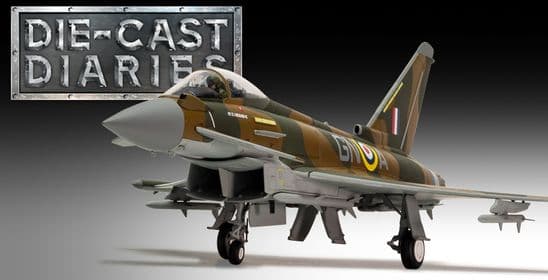
Before we dive into this latest blog update, could we please just take a moment to thank everyone who came to see our model display at the recent Royal International Air Tattoo and the first public outing for our decorated pre-production sample model of the new 1/48th scale Eurofighter Typhoon FGR.4 model. To say she was rather popular over the weekend would be something of an understatement and we are grateful for all the feedback we received regarding the Aviation Archive range. We will share these comments with the wider Corgi team and hope to be meeting many more die-cast collectors at events in the future. We will have a report on our display at RIAT in the next edition of our blog, including pictures of the impressive diecast post war British jets we had out for inspection in our display cabinet.
For this latest update, we will begin by looking at a true Aviation Archive heavyweight and the latest release from a tooling which has always been amongst our most popular models, ever since the first one appeared back in 2002, our 1/72nd scale Boeing B-17 Flying Fortress. This latest model is a colourful addition to the range and marks a hard working aircraft which set a record of completing 129 missions without suffering a single mechanical abort, testament to the design and construction of this magnificent aircraft. This will be followed by a selection of exclusive product imagery featuring no fewer than tree impending Vanguards related releases, one triple model set, one double set and a stand-alone release. Each of these releases have attracted significant pre-ordering activity, so we know that many of our readers will be interested to see these latest development images.
Before then, let's make a start by looking at our die-cast tribute to one of the USAAF 447th Bombardment Group's celebrated 'Centurion' bombers from the Second World War and one which was revered amongst crews at its home base at Rattlesden in Suffolk.
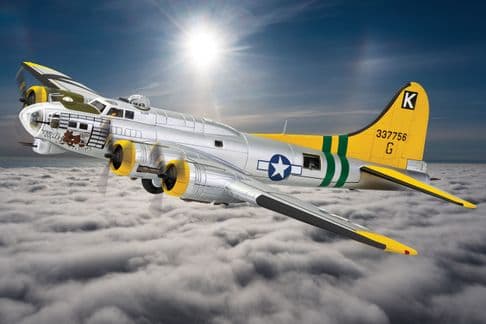
The next release from our 1/72nd scale Boeing B-17G Flying Fortress tooling is something of a classic, an aircraft which posted a combat record of 129 missions without suffering a single technical abort - she looks pretty stunning too!
Aviation Archive collectors will know exactly what we mean when we describe certain model aircraft subjects as being 100 percent Corgi territory and one die-cast model which is very much at the head of this particular group is our 1/72nd scale Boeing B-17 Flying Fortress tooling. A magnificent model which, like our Lancaster, was probably responsible for attracting many a collector into this hobby in the first place, our B-17 tooling is something of a dream come true for aviation fans - a stunning scale representation of one of the most famous aircraft of the Second World War, beautifully finished and with that hugely appealing weight die-cast models bring. With well over twenty previous model releases in this series, the latest impending addition to the range is just a little bit special and one which will soon be finding a home amongst many a die-cast model collection.
With the previous two B-17 Flying Fortress releases presenting aircraft wearing olive drab camouflage finishes, this latest release returns to a more colourful presentation of the bomber and an aircraft which was the pride of the 708th Bomb Squadron. With an impressive record of 129 missions to her name, this Fortress benefitted from some unique artwork and managed to survive the war, only to be flown back to the US and unceremoniously scrapped. Before we move on to look at the interesting story behind this aircraft, can we just confirm that the supporting images we are showing all feature an advanced production sample of the model, therefore highlighting the fact that it will be available in just a few weeks’ time. They are also being published for the very first time, just the latest in a long line of Die-cast Diaries blog image exclusives we have brought our readers.
The military airfield at Rattlesden in Suffolk was constructed for American use during 1942 and was classified as an ‘A’ standard airfield. With three concrete runways and 50 dispersed aircraft hardstanding points, it was initially intended for use by twin engined Martin B-26 Marauder bombers, but when it was later felt that these aircraft would be better suited flying from bases further south, Rattlesden became home for the soon to arrive B-17s of the 447th Bombardment Group. The first bombing mission undertaken by aircraft of the 447th took place on Christmas Eve 1943, when their B-17s were sent to flatten a suspected V-1 flying bomb site near Saint Omer, a mission which would set the tone for a busy few months to come. Fully committed to the campaign in preparation for D-Day, the 447th would be sent against targets such as airfields, rail marshalling yards, suspected rocket sites, submarine pens and naval installations across France, Belgium and into Germany itself, interspersed with joining other units in concentrated attacks against city targets. On D-Day itself, the unit bombed the beachhead sectors in advance of the landings, following pathfinder aircraft for target identification.
The weeks following D-Day saw no let-up in mission activity for the Fortresses of the 447th, as they undertook almost daily missions in support numerous strategic objectives, which included the Battle of the Bulge and Operation Varsity. They flew their final combat mission on 21st April 1945, targeting a marshalling yard at Ingolstadt in Germany and by the summer of the same year, all serviceable aircraft were flown back to the US, where the 708th Bomb Squadron was inactivated on 7th November 1945.
All the images here feature an advanced production sample model of 'Milk Wagon', a model which should be gracing our display cabinets by early October this year.
One of the most enduring features of US air operations from Britain during the Second World War was their use of nose artwork to adorn many of their combat aircraft, a practice which was generally frowned upon by RAF hierarchy, but seemingly ignored by their American counterparts. The adoption of nose artwork is thought to have taken many forms, from being a good luck charm for the crew or highly visible warning to enemy fighter pilots to leave them alone, if they know what’s good for them. They could also have been a simple reminder of home, which must have seemed such a long way away during the savage air fighting at that stage of the war. Whatever the reason for applying it, the practice ensured that some of these aircraft and the men who flew them, will be remembered for many generations to come.
Boeing B-17G-70-BO serial number 43-37756 was built at Boeing’s Seattle factory in the early spring of 1944 and delivered to the USAAF at Dow Field, Maine on 18th May the same year. She was assigned to the 708th Bomb Squadron, 447th Bomb Group and later flown to Rattlesden, Suffolk, England, where she would join the rest of her unit already engaged in combat. Flying her first combat mission on 20th June 1944, she would be in the air again the following day, this time on a raid to the Big One - Berlin, in the hands of a different crew. This crew had recently transferred to Rattlesden from the 15th Air Force, flying bombing missions from bases in Italy. As this was quite unusual for base personnel, on landing back following the Berlin mission, they were asked by members of the ground crew how did it compare to flying missions from the opposite side of Europe and they replied, ‘It was like a ‘Milk Run’, obviously a little tongue in cheek, as this was a colloquialism for a mission which was without incident, met little or no Luftwaffe activity and one which incurred no crew casualties.
This off the cuff remark would stay with this particular Flying Fortress from that point onwards and 43-37756 would later benefit from the addition of some impressive and rather unique artwork. She would be adorned with a friendly looking cartoon cow and the words Milk and Wagon painted either side of it. For every successful mission flown, a new milk bottle would be added to the scoreboard on the portside nose of the bomber, with the white bottles painted over a black background, so they could be more easily seen. If the addition of this nose artwork was intended to bring the crew luck, then this proved to be a shrewd move, as ‘Milk Wagon’ was definitely seen as being a lucky ship. She would eventually set a record for a Fortress in the 447th Bomb Group, as she racked up no fewer than 129 missions without suffering a single abort due to mechanical issues, testament not only to the strength of the B-17, but also the ground crews who kept her in the air.
Following the end of hostilities, Milk Wagon was flown back to the US and despite her impressive war record and distinctive nose artwork, was sent to Kingman Storage Depot 41 in the Arizona desert for scrapping, a fate which awaited so many former wartime military aircraft.
Possessing such an interesting wartime story as this, is it any wonder that our scale die-cast representations of some of the world's most iconic aircraft continue to be of interest to thousands of model collectors. 'Milk Wagon' is now in production and should be available in our warehouse at the beginning of October.
Not all the stars of the most popular TV and film productions are human, some come on four wheels and have particularly attractive bodywork.
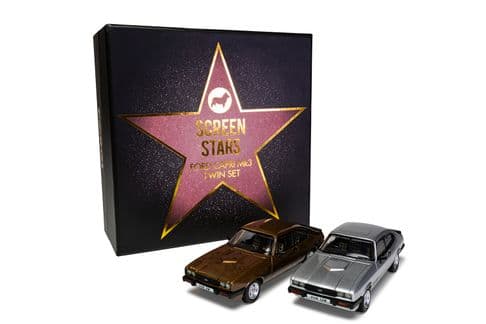
We are delighted to be introducing a new range of high quality die-cast vehicle models to blog readers for the very first time within this latest edition, our Screen Stars range. A high quality range of models which may be positioned within our Gifting range, but utilise our popular Vanguards model tooling, these models represent some of the most iconic vehicles to have ever appeared on screens large and small, four wheeled stars of some of the best loved films and TV series productions of the post war era. In addition to including some incredibly appealing model releases, this new range also benefits from new high quality packaging, a presentation style which sets these models apart from anything else in the range and exuding collectability all the way.
This set was first announced by our Brand Executive David Mather with the launch of our current May to August 2022 range, however, this is the first time that the models have featured within the Corgi blog, even though they are now quite advanced down the development road. In fact, the images we are using to illustrate this section of the blog are a combination of those produced for catalogue and range launch, in addition to several which show the latest advanced production samples of the models - that right, this hugely popular set in not too far away from release now.
The vehicular stars of this first release are both Ford Capri Mk.3s, beautiful cars which were hugely popular and desirable vehicles during their production life and therefore appearing regularly in the best loved shows on our TV screens. The Ford Capri actually started life as the intended European motoring equivalent of the hugely successful Mustang Mk.I introduced by the American parent company and was first unveiled at the end of the 1960s. Marketed as a stylish, yet affordable two-plus-two sports coupe aimed at the working man, the Capri proved to be a real success for Ford and would go on to enjoy a 17 year production run, with almost 2 million cars sold during that time. It is hardly surprising that this handsome car proved to be such a winner, particularly when learning how Ford’s marketing department at the time positioned the car to the British public. The Capri was described as ‘The car you’ve always promised yourself’ and with motoring temptation like that, how could we possibly resist?
The following selection of images illustrate just why this new two model set has proved so popular with collectors, iconic TV related vehicles in beautifully produced scale form, presented in appealing high quality packaging. We won't have to wait long now to get our hands on one of these!
Central to the success of the Capri was its distinctive styling, sleek and sporty looking, with a range of powerful engine options which gave it something of a muscle car mystique. Exhilarating to drive and incredibly pleasing on the eye, perhaps the most appealing feature of the Capri was how it was generally attainable for large sections of the population, and if you were fortunate enough to own one, you knew you would be attracting admiring glances wherever you drove. Also widely used by Police Forces across the country, both in marked and unmarked versions, the Capri is undoubtedly a British motoring icon and one which still commands our attention if we see a pristine example at a motor show, or summer fete.
With the widespread availability of classic programming across multiple platforms these days, many of the shows we remember from years past are as familiar to younger people as they are to those who watched them live, back in the day, before the days of box sets and intelligent TV planners, you know, when you had to wait a week between episodes and binge watching just wasn't a thing. That may go some way to explaining why this particular set has been so well received and why from the day it was announced, has attracted such hectic ordering activity. Let's take a look at the box description which accompanies this first 'Screen Stars' release.
Particularly well suited to the demands of high speed pursuit, the Ford Capri Mk3 3.0S holds a special place in the heart of fans of British television crime fighting in the late 1970s and early 1980s. The vehicle type retains a cult following to this day.
Everything about this impending release exudes quality and it will surely prove to be a valued addition to many a model collection in the weeks to come.
Debuting in 1969, the Ford Capri Mk1 was intended as the European equivalent of the iconic Ford Mustang. The Mk2 arrived in 1974 and added a useful hatchback body option while retaining the sports coupe’s attractive basic outline. The Mk3, launched in March 1978, brought in many detail upgrades, with the most obvious the partially shrouded twin-headlamps, front-spoiler, wrap-around bumpers and slatted grille. These, combined with the rear-spoiler, lowered the drag coefficient to 0.374, a reduction of 12.6%, and improved both high-speed stability and fuel economy. This made an attractive showroom package and remained in production at Ford’s Cologne plant until December 1986 when the model was retired after 18 years, by which time 324,045 Capri Mk3s of all types had been produced and a total of nearly 1.9 million Capri’s had been sold.
CC91990 Screen Stars Ford Capri Mk3 twin model set is now scheduled for imminent release and should be with those collectors who pre-ordered it over the next couple of weeks.
A trio of fabulous sporty Fords, this set includes a collection of iconic 1970s RS types, with each one being a representation of a car possessing Ford's rich sports rallying pedigree by the bucket-load.
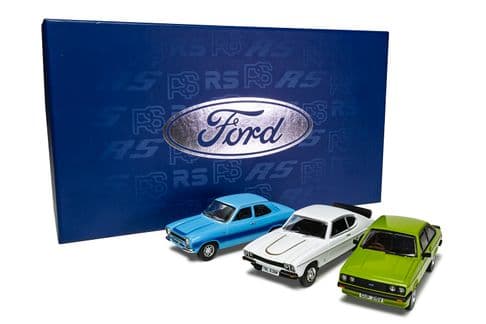
Staying with our high quality 1/43rd scale Vanguards model pack theme for this next update, another beautifully presented multi-model set which is also about to released, our 1970s Ford RS Collection unleashes a particularly colourful collection of performance Fords on the collector world. Again, these models are being shown here at the advanced production sample stage, meaning that this set is also in line for a summer release.
1970s Ford RS Collection
Since 1970, the RS badge has adorned the ultimate fast Fords, cars which have won in motorsport the world over and created an enduring legacy of success which proved the old adage, win on Sunday, sell on Monday. RS was first seen on the 1968 Ford Taunus 15M Rallye Sport, a front-wheel-drive 2-door saloon or coupé with a 90bhp 1699cc V4. Having said that, the legend really began in 1970 when the Capri RS2600 and Escort RS1600 were launched - both vehicle types won prodigiously, and cemented RS in the public consciousness as Ford’s glamorous symbol of speed and success. Here we celebrate four generations of RS Escort, the cars with which the magic initials, RS, became synonymous.
Let's now take a look at the individual models which make up this attractive set.
Ford Escort Mk1 RS2000 - Olympic Blue.
Ford’s ‘Total Performance’ maxim led to the creation of the Lotus-Cortina in 1963 which, whilst successful in racing, never quite dominated rallying. That changed, however, when its engine and gearbox were transplanted into the new smaller, more nimble Escort in 1968. The Escort became the car to beat on the special stage; a position it maintained until the dawn of the 1980s. By November 1970 Ford had opened a dedicated factory, Advanced Vehicle Operations (AVO) in Essex, to produce the RS Escorts. In 1973 they launched the most refined and the bestselling MK1 Escort RS, the RS2000, of which 5,334 would eventually be produced.
The Escort RS2000 modelled here was purchased from Ford RS dealers Tate of Leeds in August 1974, at cost of £1665.41 on the road with a full tank of petrol. The car’s first owner, Jim Humby, shared it with brother Henry for many years and had it restored in 2001. Current owner, Yorkshire-based Steve Smith, purchased it from Jim in November 2004. He was attracted by this one-family-owned local car that had only covered 49,000 miles in forty-seven years and has made further improvements to it. This remarkably original Escort RS2000 remains in excellent condition and is much admired by enthusiasts to this day.
Ford Capri Mk1 RS31000 - Diamond White.
The Ford Escort dominated rallying in the early 1970s, however, Ford faced strong opposition in the European Touring Car Championship (ETCC) and conceived the Capri RS3100 as something of a BMW-beater. In this regard, it certainly delivered - Ford went on to win the 1974 ETCC manufacturers’ crown. The racers’ 3.4-litre Cosworth-designed DOHC engine used the original Essex V6 block and produced 455bhp but, like the rest of the car, pushed the rules to the limit. The road-going RS3100s were all built at Halewood in November 1973 and featured a 3091cc version of the Capri’s usual OHV Essex V6. Although ETCC rules demanded that a minimum of 1000 cars should be built, only 250 were ever produced.
The RS3100 modelled here was registered on May 1st, 1974 and cost £2193.32, of which £166.86 was car tax. It was supplied to the first owner, Stan Zaremba, by Ford RS dealers Gowrings of Reading and he would keep the car until November 9th, 1980. It later featured in the book ‘RS The Faster Fords’ by Jeremy Walton and has also appeared in various enthusiast magazine articles. The fourteenth and current owner, Kent-based Vernon Witney, acquired the Capri in 2007 and used it until 2012, before taking it off the road to embark on a thorough nut and bolt restoration to original specification. This work was completed in 2020.
Ford Escort Mk2 RS2000 Custom - Java Green.
The Mk1 RS2000 had proved to be a conspicuous and, most crucially, profitable success for Ford. Thus, when the Escort Mk2 range was being planned, the RS2000 was given a distinctive new, more aerodynamic nose and moved upmarket, although it was produced with other Escorts at Ford’s factory in Saarlouis, Germany, due to the oil crisis forcing the closure of AVO. The resulting car was perfect for the moment and its image was not hindered by being seen catching bad guys in ‘The Professionals’ every week on TV, or by Ari Vatanen’s high profile win on the 1976 Tour of Britain in an RS2000.
The RS2000 modelled here was first registered on March 7th, 1980 by RS dealership Woking Ford, Surrey and cost first owner, LMH Electrical Contractors, £3,470. In 1996, it was purchased by Inverness-based Leslie Nicholson who had some light restoration work done and subsequently won many local concours. In 2003 Merseyside-based Eddie Gaskell bought it and during his tenure it was photographed for the cover of the book ‘Factory-Original Sporting Mk2 Escorts’ by Dan Williamson. Current owner, Aled Hopwood from North Wales, had seen it at several events and was later able to buy this exceptionally presented car, which by early 2019 had then covered 73,000 miles.
A final look at a three model set which is certain to be a popular addition to the Corgi range.
Currently scheduled to be available by mid-September, this is another set which features Vanguards models which will be of great interest to collectors of our 1/43rd scale motor vehicles. Our 1970s RS Collection triple model set is available for pre-order now.
The many qualities of Ford's RS performance vehicles did not just attract the attention of those looking for an attention grabbing way in which to get around.
Can you imagine exceeding the speed limit ever so slightly and noticing a Police liveried Escort Mk.2 RS2000 in your rear view mirror? Some might say that the sight would be as attractive as it was worrying and how it might be worth receiving a quick advisory, just to get a better look at this stunning car, but that is a matter of opinion.
To most of us, seeing a Police vehicle will have us immediately checking our speed, feeling unusually guilty about something and just wanting them to be going after someone else, but if that someone else were somebody will illegal intentions, can you imagine their disappointment if they saw a police performance Ford on their tail - could their day get any worse? As some of the most capable cars on Britain's roads, the performance attributes of Ford's RS line obviously appealed to the Constabulary, because at the end of the day, if they were giving chase to someone who had done wrong, they weren't exactly going to drive their vehicle in a careful and considerate manner, so the Police needed as much speed as they could get.
From an enthusiasts perspective, performance Ford's in Police livery were doubly appealing, not only providing the cars with an even stronger visual appeal, but also adding a little extra tweak to the already enigmatic reputation of these highly desirable cars. We all love a Police car, but when that car is an RS Ford, can things get any better?
VA14904 Ford Escort Mk2 RS2000, Merseyside Police.
As more motorways were opened in the 1960s, Police traffic patrol cars diverged into two distinct types - large 6-cylinder cars were used to patrol motorways, whilst rapid, powerful but compact cars, often vehicles initially developed for rallying, were used in urban areas. The Escort modelled here was supplied by local Ford RS dealers Blakes, one of a second batch of 15 cars, entering service with Merseyside Police in January 1981, based at Smithdown Lane Police Station. Merseyside had a serious problem with vehicle crime in this particular era and needed urban patrol cars that could be used in pursuits but also perform more mundane duties as and when required. Their fleet of over 25 RS2000s proved to be perfect for this combined task.
Merseyside Police initially used Mk1 Escort Mexicos in this role, before replacing them with Mk2 Escort RS2000s and may have been influenced in this choice by local politics, as Ford had a plant at Halewood and were a major employer in the region. The example modelled here was used for road rallying after being sold by the Police in 1983 but since 2015, has been owned by former Humberside Police Traffic Patrol Officer, Graham Carter. He spotted the car for sale on the internet, recognised its number plate and realised the historical significance it possessed. It was in reasonably good condition and, unusually, still featured its original steel wheels. Graham spent a year restoring it to its original Police specification, which included fitting the correct brown interior and recreating the original force livery.
Another model which is sure to be of interest to many Die-cast Diaries readers, these images once again feature an advanced production sample of this release and we can expect to find it in stock on the Corgi website and in all good model stores by the middle of September.
That's all we have for you this time and indeed for the next four weeks. Due to this being the holiday season and your editor being in need of s well-earned rest, we are going to be taking a short break from our fortnightly blog schedule, returning in four weeks' time with another selection of exclusive Corgi model project updates. In the meantime, we are always interested to hear your views on all things Corgi, so if you would like to drop us a line to comment on anything blog or model related, or indeed to suggest a topic you would like us to include in a future edition, please use this diecastdiaries@corgi.co.uk link for all correspondence.
If you can’t wait for the next blog, you will find plenty of Corgi model collecting discussions taking place on our official social media channels, access to which can be obtained by clicking on the respective links at the foot of the Corgi website homepage.
Link access to Corgi social media sites.
Thank you for continuing to support our Die-cast Diaries blog. Our next edition is scheduled for publication on Friday 26th August.