

Welcome to the latest edition of Corgi Die-cast Diaries, your regular blog review of all the news, updates and topical stories from the captivating world of Corgi die-cast model collecting.
In a week where tens of thousands of aviation fans will be heading for the Cotswolds and the latest instalment of the aviation spectacular which is the Royal International Air Tattoo, this latest Corgi blog update is one which is equally unashamedly aviation-centric and will therefore be of huge interest to the Aviation Archive fans amongst our numbers. As you would expect, both of the updates we have for you this time are significant exclusives in their own right and feature two new model toolings from our impressive and ever growing 1/48th scale post war jets range.
We begin by bringing you a series of exclusive 'First Look' images featuring our new Eurofighter Typhoon FGR4 in pre-production form, resplendent in this model's distinctive launch scheme, the first time we have seen a fully painted metal example of a model many collectors are really looking forward to getting their hands on. We follow this with an update of equal magnitude, one which features our recently announced 1/48th scale BAe Harrier II tooling for the very first time. A logical and highly anticipated addition to this extremely popular range, we have our first major blog update from this project, as we bring you a selection of design screenshots, which show us all what we have to look forward to as this new model approaches release, in addition to bringing you an exclusive first look at the SLA prototype model produced from these design files. Strap yourselves in for a supersonic VSTOL update edition of your Corgi Die-cast Diaries blog.
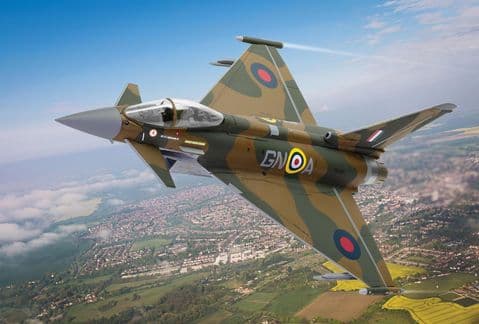
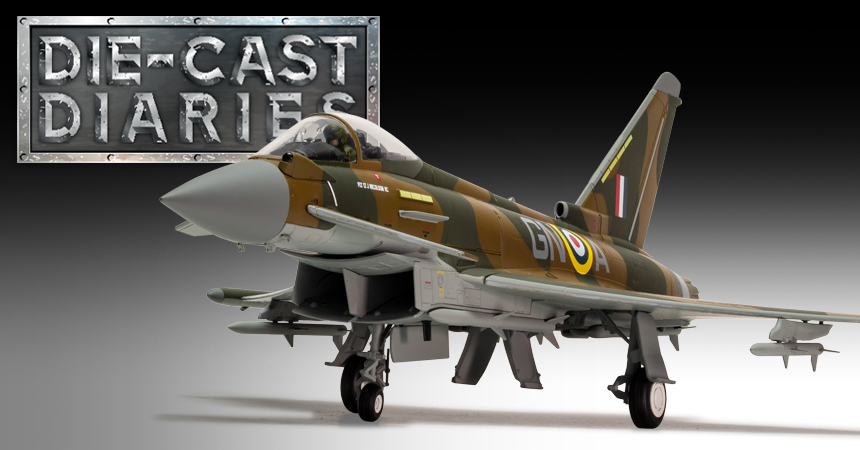
All the images we are showing in this section of the blog feature the first pre-production sample model from our new 1/48th scale Eurofighter Typhoon FGR4 tooling and whilst we are already aware of several issues which need addressing, we think she is looking rather spectacular.
It has been quite some time since we brought readers an update from our 1/48th scale Eurofighter Typhoon new tooling project, so we thought that as we are in RIAT week, what better time could there be to address this situation? Announced at the beginning of 2021, this stunning addition to our growing 1/48th scale range of post war jet powered aircraft, brought the aviation story of the Royal Air Force up to date and probably came as something of a surprise addition to many Workbench readers. The relative lack of updates over the past year or so, does not mean that we have been taking it easy with regards to project Typhoon, as this is a hugely complex new tooling venture for us and one which has challenged our design and development team at every stage. Featuring the latest aeronautical technologies across its design, our scale die-cast tribute to this modern aviation classic is something we are extremely proud of and the sight of these pre-production sample images are a culmination of many long hours of work and confirmation that this exciting new model is advancing nicely towards its winter release date.
Before we go on to look at the details behind the unusual scheme selected for the new Typhoon's launch livery, we do just have to stress that the images you are seeing here all feature a pre-production sample model from our new Typhoon tooling and whilst it is hugely impressive even at this stage, it is still subject to alteration and must be viewed as such. The assessment report for the model has already been produced and changes are already being applied to the tooling design, before the next sample models are produced. Nevertheless, it has to be said that we are delighted with how this model has turned out and everyone who has clapped eyes on it has said just one thing - Wow! We think we have produced a fitting tribute to the RAF's current multi-role strike fighter and an aircraft with is our current airspace dominator. The Typhoon is destined to be in service for many years to come and our new die-cast scale representation of it is destined to be the stunning centrepiece of many a model collection.
A highly detailed representation of the RAF's current air supremacy fighter, the new Typhoon model features many moving and optional parts, including a choice of jet-pipe petal positions.
Although thrilling Airshow crowds with an exciting flying display is certainly not a specific design requirement when producing the world's latest and most capable jet fighters, this ability certainly cements the aircraft's reputation in the hearts of the general public at large, whilst at the same time also proving invaluable in attracting a healthy stream of young people interested in pursuing a career in the modern Royal Air Force. As the throngs head down to RAF Fairford this coming weekend, one of the show highlights everyone will be looking forward to seeing will be the RAF's current Typhoon display jet in its distinctive Union Flag livery, a marked departure from the usual grey presentation of RAF squadron Typhoons.
Benefiting from the call sign 'Anarchy 1' and referred to colloquially as 'Blackjack' by enthusiasts and photographers alike, this is the second RAF display Typhoon to be presented in a creative and hugely distinctive scheme, the first being ZK349, which wore a representation of an RAF Hawker Hurricane scheme from 1940, to mark the 75th anniversary of the Battle of Britain in 2015. An aircraft which also earned a special place in the hearts of Britain's aviation enthusiast community, this is the striking scheme we decided to present the first model from our new 1/48th scale Eurofighter Typhoon FGR.4 tooling in and doesn't she look magnificent. Let's take a look at the fascinating story behind the idea of putting wartime RAF camouflage on a current front-line RAF fighter jet.
More Typhoon pre-production model image delights - this is going to be one popular model.
In a development which came as a complete surprise to Britain's army of aviation enthusiasts, the Royal Air Force decided that they were going to make a particularly high profile commemoration of the impending 75th Anniversary of the Battle of Britain in early 2015, one which would involve the repainting of one of their Eurofighter Typhoon jets in a rather distinctive scheme. When it triumphantly emerged from RAF Coningsby's paint shop in the early summer of 2015, Eurofighter Typhoon FGR.4 ZK349 had been finished in a spectacular Battle of Britain style Fighter Command camouflage scheme, complete with roundels and fin flash from the era, a representation of those worn by RAF fighters during the summer of 1940, making a poignant and highly attractive tribute to the ‘Few’ in the year which marked the 75th Anniversary of the battle.
With pictures from the official media unveiling ceremony quickly circulating around press outlets and enthusiast forums, a great many people immediately became desperate to catch their first glimpse of this beautiful aeroplane, one which had assured its position as the aircraft most people wanted to see in that Battle of Britain 75th anniversary year almost overnight.
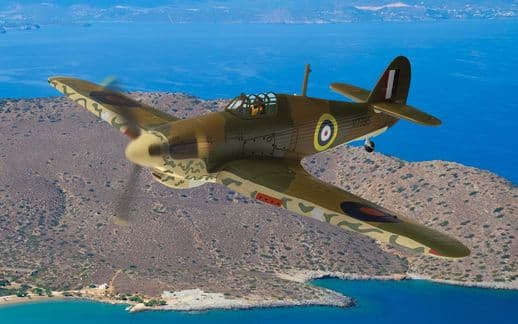
Wearing the fuselage codes GN-A and displaying a rather distinctive ‘Red Devil’ emblem on the port side of the fuselage, underneath the cockpit canopy, the Typhoon was painted to represent Hawker Hurricane Mk.I P3576 of No.249 Squadron, an aircraft which was the mount of Flight Lieutenant James Brindley Nicolson during the Battle of Britain and one which had particular historical significance. This was the aircraft Flt Lt Nicolson was flying on Friday 16th August 1940, when he was involved in combat actions which resulted in him being awarded the Victoria Cross, the only Battle of Britain pilot and indeed the only Fighter Command airman of the Second World War to be afforded such a national accolade.
In this larger scale, the Eurofighter Typhoon looks truly magnificent, a fitting centrepiece to any model collection.
On Friday 16th August 1940, Flight Lieutenant Nicolson was scrambled from RAF Boscombe Down in Wiltshire with the rest of 249 squadron, taking to the air in his Hawker Hurricane Mk.I P3576 as part of ‘Red Section’. The Hurricanes were sent to intercept an incoming raid of Messerschmitt Bf 110 Destroyers, which were approaching the Southampton dock area and forming part of a large force of attacking Luftwaffe aircraft that day. Flying at approximately 17,000 feet (Angels one-seven in RAF speak), Nicolson spotted a Bf 110 in front and slightly below him and immediately launched his attack. As he lined up the enemy aircraft in the gunsight of his Hurricane, his fighter began to shudder violently and he could see the tell-tale signs of bullet tracers enveloping his aircraft.
Flying his Hurricane erratically in an attempt to get out of the line of fire, he looked over his shoulder to see what was on his tail, only to have his worst fears confirmed - he was in the sights of a Messerschmitt Bf 109 single engined fighter. The Messerschmitts had been patrolling high above the larger Bf 110s and had watched as the RAF Hurricanes launched their attack against the twin engined heavy fighters, completely oblivious to their presence. When they made their move against the Bf 110s, the British pilots were unaware that they themselves were being hunted.
With bullets ripping into the cockpit of his Hurricane, Flt Lt Nicolson was now in a fight for his life. At least four cannon shells from the attacking Messerschmitt had found their target, with the Hurricane now badly damaged and unable to defend itself - one of the shells had shattered the Perspex of his canopy, sending a shard of the plastic painfully into the RAF pilot's left eyelid, causing blood to pour into his eye and resulting in temporary blindness. A second shell had grazed his left leg, hitting him in the foot, with a third striking vital flight instrumentation in the cockpit. The fourth shell caused the most significant damage to Nicolson’s aircraft, as it struck the gravity feed fuel tank of the fighter, which was positioned just behind the instrument panel, in front of the cockpit. Nicolson’s Hurricane had now started to burn.
Although we still have development work to do, we are delighted at the amount of detail we have managed to incorporate into the new Typhoon model, which will be a stunning representation of this multi-role aircraft.
In the midst of a frenetic dogfight and with his aircraft now in flames, Nicolson had to get out of his Hurricane immediately. Pulling the pin on his 'Sutton Harness', releasing the belts which were holding him securely in the seat of the fighter, he managed to wriggled up against the effects of the slipstream and prepared to abandon the aircraft. Just as he was about to jump out of his burning Hurricane, he looked back towards the instrument panel to see a Messerschmitt Bf 110 passing right in front of his fighter. In that split second, overcome by rage and defiance, rather than making good his escape, he instinctively climbed back into his burning aircraft. With flames licking around his hands and face, he regained control of his fighter and fired all eight guns at the Messerschmitt which now filled his gunsight, continuing to fire until the cockpit inferno around him became so intense he simply had to get out.
Engulfed in flames, he finally managed to jump free of his fighter and tumbled headlong towards the ground, with the rush of air helping to extinguish the flames which now engulfed his flying suit. Unfortunately for Flt. Lt. Nicolson, the flames had already inflicted significant injuries on him, however, despite the intense pain from his badly burnt hands, he had to try and pull the parachute ripcord or he would simply plunge to his death. After several frantic attempts, the harnesses pulled tight under his arms and the parachute finally inflated reassuringly above him. Still in agony from his wounds, Flt. Lt. Nicolson floated with a strange serenity towards the ground, just seconds after playing his part in the ferocious combat still taking place in the skies above him.
For his actions of selfless valour in the face of the enemy, James Brindley Nicolson would become the only RAF Fighter Command pilot of the Second World War to be awarded the Victoria Cross.
A model we know many readers will be looking forward to getting their hands on, our new Typhoon is edging ever closer to its initial release date.
Throughout the summer of 2015, Eurofighter Typhoon FGR.4 ZK349 wearing its spectacular Battle of Britain scheme representation, proved to be not only an incredibly popular addition to the UK Airshow scene, but also served as an aviation focal point that year’s 75th Anniversary commemorations. As well as performing dynamic individual display routines at shows the length and breadth of the country, the RAF had prepared something particularly spectacular for this significant anniversary, an evocative ‘Synchro Pair’ routine, in conjunction with one of the Battle of Britain Memorial Flight’s airworthy Spitfires. Representing different eras of RAF fighter development, this pairs routine was only scheduled to be performed at six events on the Airshow calendar and as such, is still remembered fondly by those who were fortunate enough to catch one of those evocative displays.
The Battle of Britain marked Typhoon proved to be a public relations masterstroke for the Royal Air Force and became arguably the most famous individual RAF aircraft in recent history. Indeed, ZK349 was viewed with such overwhelming public affection that she was simply referred to by the name GINA, in reference to the codes worn on the fuselage sides of the aircraft, commemorating the No.249 Squadron Battle of Britain Hurricane flown by VC winner Flt. Lt. James Nicolson. Indeed, after the end of the 2015 Airshow season, enthusiasts were so attached to the jet that they launched a petition to implore the RAF to retain the markings on this much loved Typhoon, unfortunately to no avail. Operational requirements dictated that GINA was returned back to her more familiar, if less attractive air superiority grey scheme during 2016 and a relatively anonymous place amongst the many other Typhoons on the ramp at RAF Coningsby.
Having researched her current whereabouts, it seems as if ZK349 is now part of the Typhoon sustainment fleet at RAF Coningsby, where she is either undergoing deep maintenance, going through upgrade, or is simply being held in storage, despite her unique history.
The sight of these pre-production sample images illustrate a significant advancement in this project and an impending new model release which will do justice to this particularly distinctive RAF Eurofighter Typhoon FGR4. Currently, we are still able to take pre-orders for this stunning new model, but as we approach initial release, this situation is likely to change - our new Typhoon is a very special model indeed!
The latest addition to our growing range of 1/48th scale post war jets, our Harrier II tooling will be a popular addition to the range. This and the following few images are computer rendered screenshots produced from the new Harrier II CAD files.
In a development which took quite a few Corgi collectors somewhat by surprize, the launch of the 2022 model range was a little different this year, as we made the decision to split our release schedule into three separate launches, for several very valid reasons. Uppermost in our thinking was the desire to provide collectors with a more realistic expectation regarding the availability of new models and not to include new tooling projects in a range until we were in a position to give a reasonably accurate release date and one which was not too far in the future. Having said that, we did still want to keep people informed on some of the exciting new projects we were working on, even if they didn't currently have a dedicated page on the Corgi website and therefore currently unavailable for pre-order. Nevertheless, we wanted to let you know these new models were just around the die-cast corner.
One of the most ambitious projects we currently have on the die-cast drawing boards is the latest addition to our growing 1/48th scale post war jets range, the stunning British Aerospace Harrier II (McDonnell Douglas AV-8B Harrier II), an aircraft which may no longer be in service with the Royal Air Force, but one which is still revered in the hearts of enthusiasts all over the country, especially those fortunate enough to have experienced them at close quarters during their service career. Our first catalogue of the year not only included the exclusive announcement that we were working on a new Harrier II model tooling, but also featured an image taken during a visit made to undertake a LIDAR scan of a preserved Harrier at the very beginning of this project.
A true warrior of a military aeroplane, the Harrier will be an incredibly popular addition to the Aviation Archive range, but will pose more than a few problems for our design engineers during the development phase, not least down to the fact that this incredible aircraft could carry such a varied amount of different weapons options operationally. As an exclusive 'first look' at this latest new tooling project, we are delighted to now be in a position to bring our readers not only pictures from the CAD files produced from the LIDAR scan undertaken last year, but also to showcase the prototype SLA model produced from our initial design files.
A further selection of computer rendered images produced from the new 1/48th scale Harrier II design files.
As you would expect, it is important that we let everyone know our usual caveat with regard to showing these images, as they represent the early stages of this model's development and is still very much subject to design modification. This is particularly important when it comes to the Harrier, as this tooling will incorporate so many design and weapons variations to allow each RAF variant of the aircraft to be represented, in addition to those machines in service with the US Marine Corps - we told you this one was a real test for our product designers. It could even be said that all these images are representations of hybrid Harrier IIs, however, they all clearly illustrate the enormous potential possessed by this exciting project and a stunning future addition to the Aviation Archive range.
From the very early stages of Hawker Siddeley's new V/STOL aircraft development programme during the 1960s, the US military had shown great interest in the project, not least because several of their own aviation companies were also working on VTOL and V/STOL (vertical and/or short take-off and landing) programmes. Initially, this interest would have certainly been with a view to incorporating British technical innovations into their own home grown designs, but as the Hawker aircraft progressed towards acceptance by the Royal Air Force, this interest increased towards securing the Harrier for their own forces. US interest was backed up with significant financial support and a welcome sharing of development and implementation costs, with several prototype aircraft heading to the US for test and evaluation purposes - if Britain’s Harrier jump jet was going to work, then America would be looking for a piece of the VSTOL action.
As the Harrier GR.1 entered Royal Air Force service with No.1 Squadron at Wittering, the US military stepped up their interest in acquiring this unique aircraft, as they had their own requirement for a close air support fighter for their Marine Attack Squadrons. This interest encouraged Hawker Siddeley to continue developing the aircraft, ensuring that they improved and perfected the already successful Harrier design, to ensure it was the best combat aircraft it could possibly be. Many political commentators on both sides of the Atlantic criticised the aircraft as something of a white elephant, one which might be able to take-off and land vertically, but was this just a party trick for an aircraft which only had limited endurance and striking capability.
This next section shows a final CAD render and how these files were used to produce the prototype SLA model from the design files - we have much to look forward to with this beautiful new model.
Thankfully, the incredible flexibility and future development potential the Harrier possessed won the day and the aircraft (which was referred to by the US military as AV-8A) entered service with US Marine Corps Attack Squadrons in 1971. The new aircraft would be used as fast, fixed-wing close air support for amphibious US Marine operations, based amphibious assault ships for the initial strike, then further support operations flying from forward air bases on land. The flexibility offered by the aircraft meant that they could be operated from even the most basic of landing areas, operating either as single aircraft, or in small groups to support ground based Marine operations.
As the aircraft would invariably be stationed so close to the front line, both RAF Harrier and USMC AV-8A pilots would gain a much clearer picture of the battlefield situation, something which would greatly enhance their operational effectiveness. Being much closer to the action, they could quickly re-fuel and re-arm to be back on station much quicker than conventional jet aircraft and negating the concern that the aircraft were too lightly armed and short on range. Within the fast-paced framework of a modern battlefield, the Harrier was never too far away from the action and provided a unique fixed wing strike platform with which to disable and disorientate enemy forces.
With the incredible operational flexibility offered by the Harrier, but at the same time accepting there were some definite limitations with the first aircraft, work on developing a more powerful variant of the aircraft began almost as soon as the Harrier entered service. The aircraft clearly possessed so much potential that this programme got underway as a joint venture between Hawker Siddeley in the UK and McDonnell Douglas in the US, although not everything would proceed as smoothly as you might think, something which regularly affects multi-nation aircraft projects. Making extensive use of composite materials throughout construction of the Harrier II, this would be an extensively modified aircraft, one which was designed to be stronger, lighter and possess greater power, increasing both its operational range and the weapons loadout it could carry.
Three mode images showing the SLA Harrier II prototype model from different angles. We will be looking forward to receiving our engineering sample model next!
Although visually sharing many similarities with its famous predecessor, the Harrier II was a very different aviation beast altogether and can be thought of as a completely different aircraft in its own right. Effectively, this new generation of Harrier was related to its predecessor, but was a more capable aircraft in every respect, a space age development on this VSTOL theme. The programme would result in the introduction of the much more capable Harrier GR.5 in 1987 and further successive upgrades over the next couple of decades which would keep the Harrier as one of the world's foremost strike/attack aircraft and one which possessed such unique attributes that it was described by many as being the most valuable fixed wing aviation asset available to any air arm.
With two very distinct variants of Harrier to consider, we decided that this later incarnation of the famous aircraft would make the most appropriate addition to the Aviation Archive range, as this was the final variant to see Royal Air Force/Joint Force Harrier service and is still operational with the USMC. Indeed, a deal has only recently been agreed between British Aerospace and the US to support their AV-8B Harrier II fleet until at least 2029 - it's such a shame that Britain did not see the benefits of keeping this magnificent aircraft in service for a few more years.
In any case, our new 1/48th scale die-cast tribute to the enduring legacy of this incredible aircraft is one we are working hard on at this moment and we are determined that it will continue the high standards we have set for this popular new range of large scale post war jet models. We think the Harrier will be a hugely popular addition to the range and one we very much look forward to bringing you details of as it continues to negotiate its design and development journey. For now though, we hope you enjoy this first look at our new Harrier II model and like us, are looking forward to when this new model can take its place at the head of our die-cast aviation collections.
A final look at the Harrier II SLA prototype model, an impressive first look at this welcome future addition to our 1/48th scale Aviation Archive range of models.
Right then, that is our latest aviation related model project update blog done and dusted and it's off to RIAT. If you are going to the show, please do come and say hello to the team - the Airfix/Corgi tent will be in the RED Zone, at the eastern end of the Fairford crowdline. If you do come and see us, you will have the opportunity to see our Eurofighter Typhoon pre-production model in the metal, as one will be on duty over the show weekend!
We are afraid that's all we have for you this time, but as usual, we will be back in two weeks with another selection of exclusive Corgi model project updates. In the meantime, we are always interested to hear your views on all things Corgi, so if you would like to drop us a line to comment on anything blog or model related, or indeed to suggest a topic you would like us to include in a future edition, please use this diecastdiaries@corgi.co.uk link for all correspondence.
If you can’t wait for the next blog, you will find plenty of Corgi model collecting discussions taking place on our official social media channels, access to which can be obtained by clicking on the respective links at the foot of the Corgi website homepage.
Link access to Corgi social media sites.
Thank you for continuing to support our Die-cast Diaries blog. Our next edition is scheduled for publication on Friday 29th July.