

Welcome to the latest edition of Corgi Die-cast Diaries, your regular blog review of all the news, updates and topical stories from the captivating world of Corgi die-cast model collecting.
We have a truly spectacular update for Corgi fans this week and without wanting to set the excitement levels racing too early in the blog proceedings, we have something of a new Spitfire tooling 'Scramble'. Although these models are not yet available for pre-order on the Corgi website, both our new Spitfire tooling projects are advancing nicely and in this latest update, we are delighted to be in a position to bring you an exclusive first look at metal engineering samples from both our new Spitfire tool sets, but that's not all we have for you. In addition to this and sharing the blog headline billing as far as exclusives are concerned, we will also be bringing you details of the first scheme options both models will be presented in and they are both absolute crackers!
Not wanting to leave Vanguards fans out of the exclusive updates action, we have a selection of images from no fewer than four new 1/43rd scale Volkswagen Van models, each one presented in striking liveries, two of which benefit from roof mounted new tooling additions. All four of these models are at final production sample stage of their development, so this update also serves as notice of their impending arrival. We have much to get through, so let's make a start straight away.
Corgi gave a long association with producing scale die-cast models of Spitfires, including this one which is a representation of the aircraft recovered from Sangatte beach and is now owned and operated by the Imperial War Museum Duxford.
As arguably the most famous aircraft ever produced by Britain's aviation industry, the Supermarine Spitfire has earned not only a legendary status, but is still one of the most familiar aircraft to millions of people across the world, despite the prototype aircraft making its first flight over 86 years ago. A beautiful aeroplane from an aesthetic perspective, the Spitfire was a deadly fighting aeroplane at heart and the only British fighter to be in constant production throughout WWII, with the final variants being 100 mph faster and possessing more than twice the power of the first machines to enter service. Regarded as Britain's saviour during the Battle of Britain (the poor Hurricane always gets a raw deal), the Spitfire is still an aviation icon and if you were to ask a youngster what their favourite aeroplane is, they will invariably reply Spitfire - quite remarkable really.
In the world of Corgi die-cast model production and in particular the Aviation Archive range, the Spitfire has always been an incredibly important subject for us and must be considered one of the most important model subjects we have ever replicated in scale form, certainly over the past 20 years or so. This association thrives to this day, which is the main reason for this latest project update, as we check in on the latest additions to the Corgi Spitfire model family. The Aviation Archive range has been able to boast the inclusion of a Spitfire model since 1999, with this first model appearing in 1/144th scale and as part of a multi-model set. This original tooling was quickly followed by an altogether more ambitious and it has to be said, more popular 1/72nd scale model the following year, but we will get on to that model in a moment or two. The next new Spitfire tooling for Aviation Archive arrived in 2002 and was something of a ground-breaking model at that time, a diecast Supermarine Spitfire Mk.I in an impressive 1/32nd scale and in die-cast metal - a model collection centrepiece of real stature. As far as the die-cast model collector was concerned, you definitely could not go wrong with a Spitfire.
For many collectors, 1/72nd scale is regarded as being THE scale for die-cast aviation model collecting and Corgi's association with the Spitfire in this scale has been rather impressive. Indeed, it has to be said that as far as the Aviation Archive range is concerned, the Spitfire has always been one of our first subjects no matter what the scale, such is the iconic status of this aircraft. First appearing in 1/72nd scale back in 2000, this first Spitfire tooling was an absolute beauty and is probably responsible for setting many an Aviation Archive collector of on this die-cast journey we are still enjoying.
A new pair of 1/72nd scale Corgi Spitfires are due to join the Aviation Archive range soon. This picture shows the first metal engineering samples produced from each tooling.
This first tooling representation of the Spitfire in 1/72nd scale had an incredibly challenging design brief to meet, with the tooling design required to allow several versions of the Spitfire to be produced, from the Mk.I right through to the Mk.IX. Rolls Royce Griffon engine powered Spitfires arrived in 2009 and the following year, designers returned to the earlier mark of Spitfires to produce a new tooling which incorporated all the latest design and manufacturing advancements, a tooling which is still very much in use to this day. Indeed, this methodology is how we arrived at our decision to produce a completely new tooling of the Mark IX Spitfire variant, an aircraft which was arguably the most effective of the wartime Spitfires and one which served from its introduction during the summer or 1942, right through until the end of the war. We wanted our representation of this important Spitfire variant to have the benefit of all the latest technologies our designers and the die-cast manufacturing process had to offer, but with something of a twist - we were looking to do two new projects at the same time.
The Mk.IX variant of the Spitfire was arguably the most important version of this magnificent fighting aeroplane. It was actually intended as something of a stop-gap solution to a pressing Focke Wulf Fw190 problem the RAF were struggling to cope with, effectively holding the line until the next major Spitfire development could be introduced. In fact, this marriage of the existing Spitfire airframe with the latest, more powerful version of the Merlin engine produced something of a fighting thoroughbred and one which would become the second most heavily produced variant in the entire production run of the fighter and if including the aircraft powered by the licence built Packard Merlin 266 (Spitfire Mk.XVI), even eclipsed the Mk.V in production numbers. With a reputation such as this, we wanted to use all the technological advances our industry had to offer to produce our definitive representation of this important Spitfire variant in 1/72nd scale.
Blog exclusive - the first time we have shown pictures of our two new Spitfires in the metal, with this image showing the Mk.IX and some of its optional parts.
One of the most interesting facts about our new dual Spitfire tooling project concerns the research information we used to design the new models. Previously, all our Spitfire models have been produced using genuine Vickers Supermarine drawings and technical specifications, something which is also true of our sister brand Airfix and their impressive history of producing Spitfire kits. In the case of our new Spitfire T.9 tooling, we decided to undertake a detailed LIDAR scan of a Spitfire for the very first time, which is an impressive first for the brand and for this fascinating project. It is also interesting to note that when these scan images were scaled and overlayed on top of the original drawings we had on file, they were almost an identical match, providing us with dual research confidence in our design.
The aircraft we scanned is without doubt the most distinctive airworthy Spitfire flying in Britain today, Supermarine Spitfire T.9 TE308 in her stunning ‘Grey Nurse’ squadron markings and we are incredibly grateful to our friends at Biggin Hill Heritage Hangar for allowing us this opportunity.
So, on to this latest selection of new Spitfire development images we are showing for the first time in this blog update. What you are seeing here are pictures of the first engineering samples produced from the newly designed tooling moulds, which are in essence the first time the moulds have been used to produce die-cast components. Previously, we have brought you pictures from the CAD designs themselves and followed these with images of the SLA prototype models, which were produced on a specialist prototyping 3D printer to check the validity of the design. This latest update is therefore a significant stage in the development of our new Spitfires and whilst we are happy to share this news with our readers, it still has to be stressed that these represent pre-production development models and even though they are now in metal, may still be subject to alteration before the toolings can be signed off for production.
What you can see here are both the cleaned up metal castings of the new Spitfires, showing the impressive levels of surface detail and how we have attempted to replicate this panel detail in a much more subtle (and accurate) way for a die-cast model in this scale. You can see wing and fuselage detail in these views and confirmation of the high metal content these new models will have, something which is always of interest to die-cast model collectors. Obviously, these metal components are augmented by separate tools containing the plastic and clear parts, something you can also see with the selection of built up models we are including.
New Spitfire exclusives, this next series of images show various shots of the recently received metal engineering samples produced from our newly designed tool sets.
Once our design team have inspected every aspect of the raw metal components, they would usually go on to fully assemble the model, again checking fit and scaling accuracies as they go, before giving the model a coat of primer, just so they can get a clearer indication of the surfacing detail representation and part fit validity. In relation to our new Spitfires, what actually arrived at Corgi HQ for inspection turned out to be quite a surprise and not at all what we were expecting. Over the course of producing seven years of Corgi blogs, we have often said how the iconic shape of the Spitfire is a real treat for the eyes and how the aircraft is so beautiful that no matter what colour you paint a Spitfire, it will still look stunning. Well, we think we might have just found a colour which actually contradicts this statement, as the colour used on our engineering samples is 'different' to say the least - what do you think?
Despite the strange colour used on these models, you can't keep a good Spitfire model down for long - the colour certainly fulfilled the task for which it was intended and allowed our designers to do their work, even though everyone here is desperately looking forward to seeing the new models in pre-production sample form and a much more Spitfire-like colour presentation. This brings us nicely to the subject of yet another blog exclusive and confirmation of the two scheme options which have been selected to announce the arrival of these beautiful new Spitfire models.
As this exciting dual Spitfire tooling project reaches an important stage in its development, we are delighted to now be in a position to show blog readers details of the scheme options chosen with which to unleash these models on the die-cast collecting world, the first time this information has been published outside the Corgi development team. We are also confirming the new product codes for each model, which is an indication that it won't ne long now before both models are added to the Corgi website and will be available for pre-order - we will of course bring you confirmation of their range inclusion when we are in a position to do so. For now though, let's take a look at those schemes, starting with the Spitfire Mk.IX.
AA29101 - Supermarine Spitfire Mk.IX MK329/JE-J(jr) W/Cdr. J.E. Johnson, No.144 Wing Royal Canadian Air Force, 'Beer Truck', June 1944.
The arrival of the Luftwaffe’s impressive new Focke Wulf 190 fighter over the Western Front in August 1941 saw RAF Spitfire Mk.Vs operating over the Channel falling victim to the ‘Butcher Bird’ in ever increasing numbers and something had to be done. A major Spitfire upgrade was in progress, but the Mk.VIII was still some way off, as manufacturing facilities prepared their tooling jigs for the new aircraft, but there was a temporary solution. One of the major features of the new Spitfire was its use of a powerful new version of the Rolls Royce Merlin engine and it was proposed that fitting this new engine to a Spitfire Mk.V airframe would give the fighter a welcome performance boost.
The first 100 Spitfire Mk.IX fighters were actually Mk.Vc airframes adapted to take the new Merlin 61 two stage, two speed supercharged engine, with this combination producing a thoroughbred fighting aeroplane, one which was more than capable of challenging the FW190 and the latest ‘F’ variant of the Messerschmitt Bf 109. In fact, the new Spitfire was considered so successful that this would become the second most heavily produced variant in the entire production run and if including the aircraft powered by the licence built Packard Merlin 266 (Spitfire Mk.XVI) even eclipsed the Mk.V in production numbers. With further powerplant refinement taking place throughout the production life of this variant, the first Mk.IX Spitfires began joining RAF Squadrons from July 1942, with this famous mark of Spitfire going on to see service past D-Day and into the post war era. The last major Merlin engine powered variant of the Spitfire, this ‘emergency stop-gap fighter’ would actually go on to be considered something of an aviation classic.
This Spitfire comes equipped with an unusual wing loading, one which would have been roundly welcomed once it arrived at the Squadron's forward operating airfield in France.
Wearing full D-Day identification markings, Spitfire MK329 JE-J 'Junior' was the personal mount of RAF ace pilot James Edgar 'Johnnie' Johnson, one of the RAF's top scoring fighter aces of WWII and one who's impressive tally of 34 confirmed aerial victories was scored exclusively against Luftwaffe single engined fighters. Flying extensively in support of the D-Day landings, Johnson and the squadrons under his command would be employed in aggressively clearing the skies of northern France of Luftwaffe fighter opposition, something they proved rather effective at doing. In fact, by D-Day, Johnson was one of the most successful Allied air aces still flying operationally, with his victories showing no sign of abating.
Johnson and his No.127 (RCAF) Wing were one of the first fighter units to be sent to operate from forward landing bases in France following the successful Normandy landings, which is where the unusual story of this particular aircraft comes from. It appears that Spitfire Mk.IX MK329 was something of a hybrid machine and not the one Johnson actually flew in combat, but more of a hack airframe. It is reputed that once his unit had been sent to operate in France, he used this Spitfire to fly back to the UK on unofficial 'Beer Runs', returning to their temporary home with two beer kegs attached under the wing of his aircraft. This practice was frowned upon by the RAF top brass, so units came up with ingenious ways around the restrictions, using standard external fuel tanks which had been thoroughly washed out for the purpose of transporting their beer, however, despite their very best endeavours, the beer still had a nasty aftertaste of fuel. It is thought that as Johnson was particularly highly regarded by both his men and his superiors, a blind eye may have been turned on his unofficial Spitfire sorties and the refreshing ordnance they ferried.
There are few details regarding the actual production and service career of Spitfire MK329 in existence, which Johnson described in his memoirs as being a collection of components from various different Spitfires, something of a mix and match airframe. This is borne out by the fact that its serial MK329 is very similar to that of his usual and favoured combat mount around that time, Spitfire MK392 - is this the reason why he referred to this aircraft as 'Junior'? Whatever the true story, this beautiful Spitfire and its unusual underslung load makes for a fitting first release for our new Spitfire Mk.IX tooling.
AA29201 - Supermarine Spitfire T.9 TE308 (G-AWGB) Finished as A58-606 'Grey Nurse' Shark mouth, operated by Biggin Hill Heritage Hangar.
It is somewhat surprising to learn that one of the most potent fighting aeroplanes of the Second World War was not produced in a two seat training variant, meaning that pilots converting to this beast of a machine would be making their first flight in the Spitfire as their first solo. The Vickers Supermarine company did propose the development of a two seat variant of the Spitfire, but as there was no official support for the project at the time, they simply returned to further development work on the fighter.
Once the war had ended and with stories of unofficially modified two seat Spitfires circulating, Vickers Supermarine revived their interest in producing a two seat Spitfire as a private project and in 1946, selected a Spitfire Mk.VIII airframe as their donor aircraft. In fact, one of the most interesting facts about the two seat Spitfire variant is that there is no such thing as a new-build Spitfire T.9 trainer, as every single example was originally manufactured as a single seat fighter.
Something of a post war phenomenon, the two seat Spitfire did attract several military operators over the years, however, it is during the warbird restoration era and possibly even as recent as just the past decade that the popularity of ‘Spitfires made for two’ has really taken hold. As arguably the most famous aircraft of all time, the ability to boast that you had flown in a Spitfire used to be the preserve of talented and extremely fortunate pilots, however, as they now had the opportunity to carry a passenger, the Spitfire flying floodgates had opened and there was seemingly no end of people queueing to get Spitfire experience in their bucket list log books.
Over recent years, offering Spitfire experience flights has become an extremely lucrative business, to the point that only a few years ago, almost every Spitfire under restoration was being converted to T.9 or two seat Spitfire standard. These aircraft are now much loved in their own right, regularly appearing at Airshows and operating in all but the poorest weather conditions, offering Spitfire flights to their latest lucky recipients. If you are ever fortunate enough to take a flight in one of these magnificent aircraft, you will surely never forget the experience, with yourself and your loved ones going on to have a close affinity with the actual Spitfire you flew in, or the one which was flying next to you. These Spitfires made for two are maintaining and even enhancing the legacy of this magnificent aeroplane, bringing R.J Mitchell’s classic design to the hearts of a new generation of Spitfire converts.
The most unusual addition to the Corgi Spitfire range, this aircraft was designed for two and marks one of the most distinctively presented airworthy Spitfires in the world today.
Spitfire TE308 was originally constructed as a Mk.IXe variant in 1945, but due the end of the war in Europe, was immediately placed in storage, where she would remain for the next five years. She was then selected as a conversion airframe to T.9 trainer standard, initially destined for service with the Egyptian Air Force, but when this sale fell through, embarked on a service career with the Irish Air Corps. Following decommission, she would go on to be used during the filming of the famous move 'The Battle of Britain', before moving into private ownership and various periods spent in France, Canada and the US over the next few decades. She would later be purchased by Warbird Experiences at Biggin Hill and returned to British skies at that time wearing a standard RAF day fighter scheme, however, things were about to change.
In a development which saw this Spitfire become one of the most distinctive airworthy Spitfires in the world today, TE308 was given a smart new scheme in honour of the fighters flown by the men of No.457 Squadron Royal Australian Air Force. With each of their aircraft benefitting from the application of sinister looking shark mouths under the engine cowling, the unit was referred to as the 'Grey Nurse Squadron' and this Spitfire now carries the registration A58-606 and the codes ZP-W in honour of Squadron Leader Bruce Watson. She flies in tribute to all RAAF and RAF pilots and is undoubtedly one of the best looking airworthy Spitfires in the world.
Would you like to take a flight in the Grey Nurse Spitfire? If you would, please give our friends at the Biggin Hill Heritage Hangar a call, who would be only too pleased to let you know what packages they have available.
This is a significant update from our dual new Spitfire tooling projects and borrowing a line from the Battle of Britain movie for the occasion, 'They won't stop now!' The updates are going to come thick and fast now, until these models are either in our display cabinets, or on the shelves of your favourite model shop and awaiting your collection and we can't wait to bring you further exclusive updates.
A collection of classic campers, the Vanguards range can now boast an accurate scale representation of this iconic vehicle within its ranks.
After spending some quality time with our new Spitfire toolings, we return to earth with a look at some impending additions to our popular Vanguards range, but with no let-up in the iconic design we took as inspiration for these new models. When it comes to motoring style icons, we readily accept that such classic names as Jaguar, Ferrari, Aston Martin and Mercedes are as instantly recognisable as they are unattainable for most of us, but would you expect a relatively cheap, effective and reliable commercial and passenger vehicle to be occupying a similar space in people's affection? Perhaps not, but certainly in recent times, that is exactly what the classic Volkswagen Campervan series has managed to do, vehicles which were intended to get Europe's businesses moving again after the war, but ones which have now earned something of a cult status.
The distinctive Volkswagen Camper Van was a development of the famous VW Beetle automobile and even though on first look it appears to be a much larger vehicle, it utilises the same basic chassis, engine and transmission of the earlier Beetle. At a time when Europe was in need of a cost effective light transport vehicle to get business moving, it would form the basis of a successful series of vehicles which could be produced as a microbus, pickup, transporter, van, general utility and recreational vehicle – quite an important machine really.
A significant new tooling addition to the Vanguards range, this beautiful new model has been developed as both the original Volkswagen Type 2 Split screen (T1), which was in production from 1950 until 1967 and the later Volkswagen Type 2 Bay window (T2) version, which was in production from 1967 until 1979. Just to add a little context to these descriptions, the original Beetle was referred to as the Type 1 Volkswagen Beetle. A design which became extremely well known during its lengthy production run, the Campervan has been enjoying a significant renaissance over recent years and is now seen very much as something of an aspirational purchase and one of the ‘coolest’ vehicles you could possibly be seen in. For that reason, many of these vehicles are now receiving some long overdue tlc and are changing hands for handsome sums of money.
Let's now take a closer look at all four of the soon to be released new models.
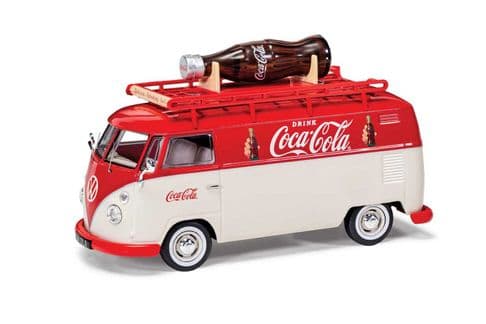
CC02740 Coca-Cola Volkswagen Campervan Type 2 (T1) Split Screen - Giant Coke Bottle.
When it comes to the world of diecast model collecting what could be more appealing than the combination of an iconic mode of transport and the colours of arguably the world’s most recognisable brand? That is exactly what we are presented with when considering our 2021 Coca-Cola range of models, twelve different model aircraft and vehicles which combine their instantly recognisable profiles with the red and white branding of the world’s most famous soft drink. The latest impending releases in this series features a pair of vehicle types which are almost as famous as the Coca-Cola brand itself and are definitely associated with being more than a little cool and quite free spirited.
Taking inspiration from a vehicle which actually wears a similar livery to this, can you possibly think of a more eye-catching vehicle to be seen anywhere, especially on a hot day when you are desperate to quench your thirst? Utilising our newly tooled Volkswagen Type 2 Split screen (T1) model, this attractive release benefits from some lofty tooling modification, but we wonder if you can guess what they might be? Offering rather an overt indication of what the cargo being carried by this particular Volkswagen van might be, our designers have managed to produce a really appealing opaque finish to the oversized Coke bottle on the roof of this model, which will make for an appealing addition to our Coca-Cola model range, a range which is already proving popular with collectors. This is a model which is destined to liven up many a model display.
CC02746 Coca-Cola Volkswagen Campervan Type 2 (T2) Bay Window - Surf Van.
Acting as something of a rather distinctive representation of the adventurous nature of people aspiring to own one of these iconic vehicles, this second Coca-Cola related release is a surfer's dream and the only way to transport your boards down to the beach. Again adorned with the famous Coca-Cola branding, this new model also benefits from additional tooling modification and something tells us that if you were seen anywhere near Fistral beach in a VW Camper bedecked like this, you might attract quite the crowd.
The release of these two models means that collectors now have the complete range of Coca-Cola inspired models to choose from, other than the Christmas Truck, which was a complete sell out last year and will be made available again for this year's festive season - it is currently only available for pre-order. Both of the above models have been photographed in advanced production sample form and are now therefore scheduled for imminent release.
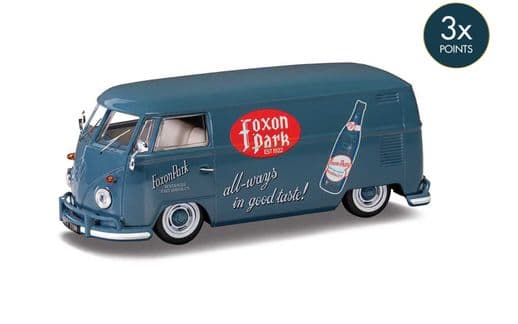
VA14503 Volkswagen Type 2 (T1) Panel Van, Foxon Park.
The Volkswagen van modelled here left the production line in the company’s Wolfsburg factory on March 4th 1957 and was despatched to Ohio, USA eleven days later. It was first painted in the distinctive livery of the Connecticut-based soft drinks maker Foxon Park in the early 21st century by the then owner because he’d always admired the livery on the company’s fleet of American-made vans. It was imported into the UK in 2008, still sporting the Foxon Park livery over olive green paint, but even though it was road legal, it was in need of some work. Current owners, Northamptonshire-based VW enthusiasts Sharon and Chris Lodge, bought the van in July 2009 and after using it for two years decided to completely restore it.
The van was stripped down by well-known specialist Bobby Wilcox of Milk and Two who painstakingly rebuilt the structure, correcting the many poor-quality repairs revealed by media blasting. The 1600 engine was rebuilt by Laurie Pettit and Rayvern Hydraulics built a custom suspension system to give the van that all-important stance. Mr Whitewalls added a white band to tyres mounted on stock 15-inch rims. It was painted in its original factory colour, L31 Dove Blue, by Bruce Collins at WRP Paint & Restoration and expert signwriter Allen Osbourne then reinstated the Foxon Park livery by hand, a process which took two days to complete. The finished van was featured on the cover of Volks World magazine and is one of the UK’s most admired Type 2s.
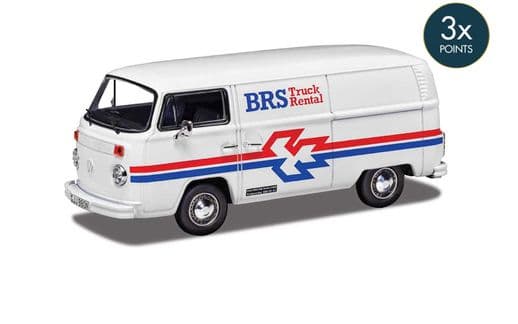
VA14602 Volkswagen Type 2 (T2) Transporter Delivery Van, BRS Truck Rental.
BRS Truck Rental was established in 1975 and was part of the government-owned British Road Services company created in 1949 as part of a very ambitious post war plan to nationalise the UK’s transport system. The vast majority of BRS’s van rental fleet at this time were UK-built diesel-engined vehicles such as the Ford Transit and the company rarely bought foreign vehicles although contract hire fleet companies sometimes requested them. BRS did, however, buy six VW Type 2 vans in early 1975 including the example modelled here, believing that the quieter rear-engined positioning of their petrol engines and more car-like driving position might appeal to customers who’d not previously driven a van.
Production of the T2, the second-generation Type 2 Volkswagen commercial, commenced at Hanover, Germany, in August 1967. It was both slightly larger and slightly more powerful than its predecessor and was a wholly new design in both structure and styling. It remained faithful to VW’s traditional layout however, using a rear-mounted air-cooled engine in a unitary construction body. Like the original Type 2 it was available from the factory in an array of guises, although specialist conversion companies also used it as a base for vehicles such as fire engines. The vehicle modelled was made in early 1975, the twenty fifth year of Type 2 production, and on August the 9th of that year Volkswagen celebrated the production of the four millionth Type 2.
Again, both of the above models are being shown for the first time in advanced production sample form and will therefore soon become attractive additions to any Vanguards model collection.
Well that certainly turned into a monster of a Corgi blog update. We are afraid that's all we have for you this time, but as usual, we will be back in two weeks with another selection of exclusive Corgi model project updates. In the meantime, we are always interested to hear your views on all things Corgi, so if you would like to drop us a line to comment on anything blog or model related, or indeed to suggest a topic you would like us to include in a future edition, please use this diecastdiaries@corgi.co.uk link for all correspondence.
If you can’t wait for the next blog, you will find plenty of Corgi model collecting discussions taking place on our official social media channels, access to which can be obtained by clicking on the respective links at the foot of the Corgi website homepage.
Link access to Corgi social media sites.
Thank you for continuing to support our Die-cast Diaries blog. Our next edition is scheduled for publication on Friday 15th July.