

Welcome to the latest edition of Corgi Die-cast Diaries, your regular blog review of all the news, updates and topical stories from the captivating world of Corgi die-cast model collecting.
Despite the fact that this year marked the 104th anniversary of the death of a certain famous Great War aviator, the passage of time has certainly not diminished the legacy of a man who for many is still regarded as the greatest fighting airman to have ever lived, Manfred Albrecht Freiherr von Richthofen, the Red Baron. In this latest edition of our Corgi blog, we will be taking a look at two recently released additions to our Aviation Archive range, both of which help to tell the story of the Red Baron and his final patrol in scale die-cast form and both of which occupy an important position within our collection of 1/48th scale WWI aircraft. We will see how the real aircraft on which these models are based played their own parts in arguably the most historic day the world of aviation has known and how when they landed back at Cappy Aerodrome, things would never be the same again.
Coming back down to earth, our second major development update is nothing less than a 'Triple Treat' for Vanguards collectors, as we have exclusive final sample images of no fewer than three impending new tooling releases, each one showcasing the Ford Escort Mk.II in various RS2000 guises. In a week which saw the much anticipated release of our Ford Escort Mk3 XR3i model in Sunburst Red, we will discuss why sporty Fords in 1/43rd scale continue to be so popular with collectors and why in the motoring world, motorsport connections help to sell road cars in their thousands for forward thinking motor manufacturers.
Product artwork produced in support of our 2018 Manfred von Richthofen centenary release, which was one of the most popular Aviation Archive releases of recent years.
For anyone with even the slightest interest in the subject of aviation, the sight of a red coloured biplane or triplane will immediately make them think of one man - Manfred von Richthofen, the famous 'Red Baron', a man who was revered by his nation and admired by his adversaries. Von Richthofen is considered to be the man who did most to elevate the importance of aviation in any future military strategy, whilst at the same time becoming something of a worldwide flying celebrity, whose fighting exploits held millions of people spellbound, with stories of fighting chivalry in the air. The reality may have been very different, but this sanitised version helped the world escape the horrors of war for just a few precious moments.
It is quite interesting to consider the fact that whilst most people associate Manfred von Richthofen with his distinctive Red Fokker Dr.1 Dreidecker, he actually scored the majority of his aerial victories whilst flying various Albatros biplane fighters an aircraft which was itself one of the most significant fighting aeroplanes of the Great War. Indeed, by the time the Red Baron had taken delivery of his first Fokker Dr.1 fighter, he already had 59 victories to his name and gained notoriety of being arguably the most gifted fighting airman the world had ever seen. The final aircraft von Richthofen flew, Fokker Dr.1 425/17, was a fighter specifically manufactured for the famous ace between the end of 1917 and the beginning of 1918. As the mount of one of the world’s most famous airmen and a hero to both the Luftstreitkrafte and the German nation, the aircraft’s construction was to a particularly high standard and was reported to have benefitted from superior quality fabric covering and the latest version of interrupter gear, which allowed the aircraft’s two Spandau Maxim machine guns to fire through the arc of the propeller, following the line of sight of the pilot. It was also noted that the engine was of a much higher build quality than other machines which fell into British hands, once the wreckage of von Richthofen's crashed aircraft had been assessed.
From an Aviation Archive perspective, the enduring legacy of the Red Baron was clearly something we had to incorporate within our 1/48th scale Great War aviation model series and to this end, we not only introduced scale representations of several aircraft which were flown by von Richthofen, but have also included models flown by different pilots who all have direct links to the Red Baron in some way or another. Representations of aircraft flown by Manfred von Richthofen are Albatros fighters AA37801 and AA37809, with the Dreidecker represented by AA38304, the double model set AA39913 (with Arthur Brown's Sopwith Camel) and most recently, AA38308, our scale representation of the final aircraft von Richthofen flew in combat, Fokker Dr.1 425/17.
Linked releases - All three of these models are linked to that fateful day in April 1918 when the reign of the famous Red Baron ended in a field near the Morlancourt Ridge.
It could even be argued that Fokker Dr.1 425/17 AA38308 is one of the most significant models in the entire Aviation Archive line-up, not only commemorating the centenary of the death of Manfred von Richthofen, but also one which can be displayed on its own, or as part of a wider display featuring several other 'linked' models within the range. Released as part of our 2020 model range, Fokker Dr.1 AA38310 flown by Wolfram Freiherr von Richthofen and AA38110 Sopwith Camel flown by Wilfred 'Wop' May are representations of aircraft which were directly involved in the actions which led to the death of the Red Baron on 21st April 1918. Both of these airmen were novice pilots and were instructed by their respective flight commanders to stay out of any combat actions and simply observe the fighting from a safe distance to gain some experience - of course, both would ignore this advice.
With the adrenalin rush of combat drowning out the words of their mentors, both novices found themselves in the same piece of sky at the same time, each thinking the other could be an unexpected first victory for them. When Manfred von Richthofen saw his cousin engaged in combat, he left his own dogfight to come Wolfram's rescue, successfully driving off the Sopwith, but inexplicably proceeding to chase it low over enemy lines, where the rest is now aviation history. Both novice airmen walked away from this incident unscathed, however, the famous Red Baron would not be so lucky, crashing behind enemy lines and dead by the time Allied troops reached the crash site.
If you didn't want to display your Manfred von Richthofen Fokker Dr.1 model with representations of these duelling novice pilots who were indirectly responsible for his death, the latest pair of releases in this popular range now offer the collector another Red Baron display option - two of the Jasta 11 Fokker Dr.1 fighters which took off from Cappy aerodrome with the Red Baron at the start of his fateful final patrol.
Something hugely collectable in the Aviation Archive range, this special edition of the Red Baron's final fighter aircraft now has thinks to two more 1/48th scale releases, in the form of our latest Fokker Dr.1 Dreidecker releases.
Although the men at Cappy Aerodrome in the Somme Valley didn't know it yet, they would never forget the morning of Sunday 21st April 1918, a date which would also be firmly etched into the pages of history. With the morning patrol cancelled due to a thick, low hanging mist, the pilots of Jasta 11 killed time by relaxing or making adjustments to their assigned aeroplanes. Several of the men were with their enigmatic commander, Manfred von Richthofen, playing with his beloved dog Moritz and trying to forget the horrors of war for just a few precious minutes.
By this date, the famed Red Baron was not a well man. Suffering from combat fatigue and what we now recognise as post-traumatic stress disorder, von Richthofen had become withdrawn and somewhat distant from his fellow airmen over recent weeks and was noted to have made uncharacteristic lapses of judgement during combat on recent sorties. On this morning, however, all appeared to be well and he was laughing with the other pilots as they teased his dog, presumably as he was excited to have his cousin Wolfram joining the flight for the coming patrol.
With a model of Wolfram von Richthofen's Fokker Dr.1 already in the range, we are pleased to announce that the two latest additions to our Aviation Archive range are representations of aircraft flown by two other Jasta 11 pilots who eventually joined Manfred von Richthofen on his final patrol, playing their own small part in one of the most significant days in world history. Both models are available now, so let's see why we think both make such valuable additions to the Aviation Archive range, detailing their respective link to the Red Baron on 21st April 1918.
As the science of aerial combat started to evolve during the air battles of the Great War, the Luftstreitkräfte were the first to introduce a hunting aeroplane designed to dominate the skies and to shoot down other aircraft - the Fokker Eindecker. Initially deployed as single aircraft protecting reconnaissance flights, they would later go on to form dedicated fighting squadrons, known as Jagdstaffel or Jastas, where the entire unit was dedicated to gaining air superiority over the enemy. The final incarnation of German fighter deployment tactics was the creation of the Jagdgeschwader, or fighter wings, the most famous of which being Manfred von Richthofen’s JG.1, the famed ‘Flying Circus’. Only the finest pilots were invited to join these units and with the Red Baron as their enigmatic leader, how could anyone presented with the honour of being asked to join this unit even think about turning the opportunity down?
A specialist fighting wing, Jagdgeschwader 1 was made up of Jastas 4,6,10 and 11 and was intended to be a highly mobile hunting unit, deployed strategically to areas of the front where their skills were needed most. The title ‘Flying Circus’ came about partly because of the array of distinctive colour schemes applied to aircraft of the wing, but also to the fact that they had their own dedicated rail transportation to take them to and from the various combat zones along the front lines. Wherever the fighting was at its most intense, you could be sure the ‘Flying Circus’ would soon be in town.
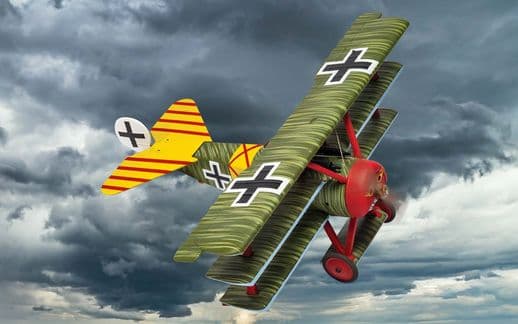
Another significant addition to the Aviation Archive range, Werner Steinhauser's Jasta 11 Fokker Dr.1 has now been released and is a representation of one of the fighters which took off from Cappy Aerodrome on 21st April 1918 on what turned out to be Manfred von Richthofen's last patrol.
Flying one of the six Jasta 11 Fokker Dr.1 fighters which climbed away from Cappy Aerodrome in the mid-morning of Sunday 21st April 1918, Werner Steinhauser was beginning to develop into an extremely gifted aviator under the guidance of his inspirational Commanding Officer, Manfred von Richthofen. When he initially joined the unit in early 1918, he only had a solitary observation balloon victory to his name, but now that he found himself in the company of some of the Luftstreitkräfte’s most gifted fighter pilots, he began to show real skill and poise during combat situations and as a consequence, his victory tally was increasing.
Flying alongside von Richthofen in his own distinctively marked personal Fokker Dr.1 fighter on the morning of the 21st April, Steinhauser would be involved in the intense fighting with the Sopwith Camels of RAF No.209 Squadron which ultimately resulted in the death of his famous mentor. The famed ‘Flying Circus’ never really recovered from the loss of von Richthofen and from this date, an ever-increasing number of Allied fighters in the air at any one time would result in the loss of many of Germany's most talented fighter pilots. Going on to score a further six aerial victories after this fateful day, Werner Steinhauser would himself be shot down and killed near Neuilly on the 26th June, just three days before he would have celebrated his 22nd birthday.
On the morning of 21st April 1918, there was something of a leisurely start to the days flying activities at Cappy Aerodrome, as poor weather had disrupted the planned early morning patrol. In an attempt to keep up morale on base and to use this short lull in the fighting constructively, several members of the ground crew decided to prank their beloved Commanding Officer, the famous flying ace Manfred von Richthofen and his much loved dog Moritz. Von Richthofen described his Great Dane as ‘The most beautiful being in all creation’, but despite his clear affection for his companion, he would have joined in with everyone else in howling with laughter as Moritz wildly ran around the airfield that morning, desperately trying to shake off the set of aircraft wheel chocks which had been tied to his tail.
A small moment of levity during the horrors of war, little did everyone know that later that same day, Moritz’s owner, the infamous Red Baron, their leader and the most successful fighter ace the world had ever known, would be lying dead in the cockpit of his crashed Fokker fighter, the victim of a single rifle bullet fired at the low flying Red Triplane, by an Australian trooper occupying a position on the Morlancourt Ridge.
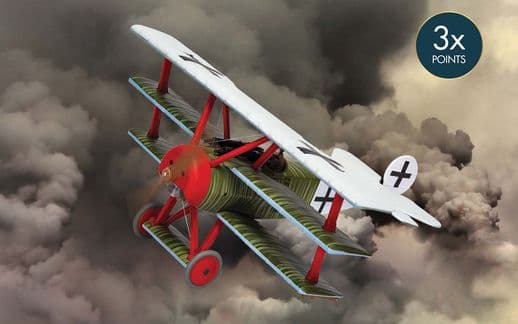
Ltn. Hand Weiss was one of a handful of pilots who joined Manfred von Richthofen on what turned out to be his final combat patrol on Sunday 21st April 1918 and this is our scale representation of his Fokker Dr.1 fighter.
At 10am on 21st April 1918, six Fokker Dr.1 fighter aircraft of Jasta 11 took off from Cappy aerodrome to embark on an offensive patrol over the Somme Valley region. Led by their inspirational commander, Manfred von Richthofen, this was an elite unit where only the finest fighter pilots were invited to join the squadron - the ‘Best of the Best’. Hans Weiss has joined Jasta 11 with a reputation as being something of a balloon specialist, but by this date, he was credited with an impressive ten combat victories. As the formation approached Le Hamel, they spotted a pair of Allied reconnaissance aircraft over the town and dived in to attack.
As the battle commenced, an unseen flight of Sopwith Camels joined the melee to protect the reconnaissance aircraft and just minutes later, the infamous reign of the Red Baron would be over. The distinctive white coloured Fokker Dr.1 flown by Weiss had been hit by return fire from the British reconnaissance aircraft, severing one of his rudder cables and forcing an immediate return to Cappy. Nursing his damaged aircraft back to his home airfield, Weiss would live to fight another day, however, his Commanding Officer would not be quite so lucky. Weiss would later go on to command Jasta 11, but only for a three week period, before he too fell in combat, the victim of Canadian ace Merrill Taylor.
An enigmatic pair, both of our latest 1/48th scale Fokker Dr.1 releases have links to the final combat sortie flown by Manfred von Richthofen on 21st April 1918, the death of the most famous airmen to have ever lived.
The enduring legacy of Manfred von Richthofen continues to fascinate people to this day and from a scale die-cast model perspective, we are pleased that we have been able to make our own small contribution to this fascinating story, if only by allowing collectors and historians to display a series of models which all share a link to the final day in the life of the world's most famous aviator. Fokker Dr.1 releases AA38311 Werner Steinhauser and AA38312 Hans Weiss are both available now.
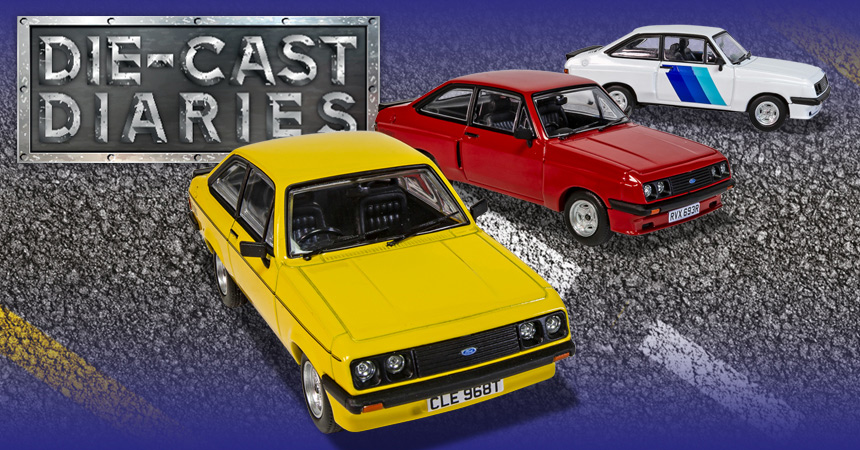
Pictured together for the very first time, this diorama image features the three Ford Escort Mk.II RS 2000 models which will soon grace the ever popular Vanguards model range.
Over the past couple of years, it really has seemed as if hardly an edition of our Die-cast Diaries blog goes by without us being able to bring readers news of further Vanguards model range investment, or the ongoing development of a previously announced new tooling project. We are delighted to continue this trend in this latest update, as we bring you details of an impending tripletastic sporting Ford addition to the range, with each one being a variation on the same iconic Ford Escort Mk.II RS2000 theme.
A new Ford small family car which was unleashed on an unsuspecting motoring world in 1967, the Escort must have delighted Ford executives in the months following its launch, as it really did seem as if everyone and their dog wanted to get behind the wheel of one. This desire was only enhanced following the success of the Ford works team in various rally sports competitions and the release of such exciting new Escort variants as the RS 1600 and 2000 models, introducing the British public to the concept of the attainable 'Hot Hatch'.
The success of the original Mk.I Escort was further enhanced following the release of the updated Mk.II variant in January 1975, a design which was something of a collaboration between Ford UK and Ford Germany. The bodywork facelift gave the new Escort a more angular, purposeful appearance than its predecessor, with the car already occupying an extremely lucrative position in the European marketplace. Although the base L and slightly higher spec GL models in both two and four door options would continue to be the bread and butter cars for overall Ford sales numbers, the sporty RS Mexico and RS 2000 models clearly highlighted the fact that this car possessed genuine motorsport credentials, even if your particular Escort was much more conservative in its appearance, a link the Ford marketeers were ruthless in exploiting at every available opportunity.
Individual images of the three new Ford Escort Mk.II RS 2000 models which have all now advanced to the advanced production sample model stage, meaning they are only weeks away - VA14900, VA14902 and VA14903.
At that time, it seemed as if hardly a week went by without the sight of a racing Escort taking the chequered flag at some rally/motorsport event or other across the world and with all that success, who wouldn’t want to own a car which possessed a motoring association with success such as this? Even though the vast majority of Escorts on Britain’s roads were what you would expect a popular small family car to look like, everyone who saw them knew that beneath that plain exterior, there was a rally sport beast just waiting to be unleashed!
As we now all know, the Escort would go on to be a resounding success for Ford and over the course of its 33 year production run, would result in the manufacture approximately 4.1 million vehicles in six distinctly different marks, produced for the British, European and world motoring markets. On several occasions during that time period, the Escort had the distinction of being Britain’s best-selling car, a fact which serves an indicator as to why the Escort also made such an effective transition into the world of scale diecast models.
Now a highly anticipated series of new releases for our popular Vanguards range, we are delighted to be in a position to inform readers that the three new Ford Escort Mk.II RS 2000 models featured here are now in the final stages of their respective development journeys and all three should be in our warehouse and available for dispatch in just a few short weeks’ time. We have already featured VA14900 the yellow RS 2000 and VA14902 the X-Pack car in Venetian Red in a previous edition of the blog, so this final update will be welcome news for those intending to add these models to their collections. VA14903, the Series X in Diamond White has not featured previously, however, we are delighted to confirm that the model images you are looking at here all show final advanced production samples of each release, meaning all three will be available soon. If you have any, or all of these models on pre-order, it's time to start thinking about making some space in that display cabinet and prepare for the arrival of some new 1/43rd scale Ford classics.
Taking a final look at each of these impending releases in turn:
VA14900 - Ford Escort Mk2 RS2000 Custom in Signal Yellow.
The Mk1 Ford Escort RS 2000 had proven to be a massive motoring hit, especially in the UK, and encouraged Ford to take the second generation Mk2 RS2000 ‘up market’, positioning it as the performance car every young professional could aspire to own. A new deformable polyurethane nose transformed its look and gave it a distinctive, angular and more glamorous identity, however, this styling upgrade was also a practical one, as it reduced overall drag from a CD of 0.444 down to 0.386. Announced at the 1975 Geneva Motor Show, the RS 2000 became the best-selling RS Escort ever made with over 23,000 vehicles being produced at Ford's Saarlouis plant in Germany before production ceased in July 1980.
VA14902 - Ford Escort Mk2 RS2000 X-pack in Venetian Red.
Ford’s AVO plant, which had been established to produce short runs of limited-edition cars, was mothballed in 1975, however, the company still wanted to offer enthusiasts the option to build the RS Escort car of their dreams. With this in mind, the customer or dealer-fit Series X modifications were developed. The Series X tuning parts catalogue addressed every area of the car, engine, brakes, suspension and body styling but customers could pick the components they wanted or more importantly, fit their available budget. Six X-pack RS2000s were built by Ford's engineers at Aveley using the full body kit, which was made for the company by the Fibresports company of Essex.
This particular model features a Mk.2 Escort RS 2000 with the X-body pack fitted, a modification which gave this already purposeful looking car an even more aggressive appearance, almost as if it had been ‘working out’ and was a little musclebound. It is also interesting to note that the extensive Series-X performance accessories available for the Ford Escort were much more than just distinctive new body panels for the car and in many cases, the modifications didn’t actually alter the external appearance of the car in any way. Series-X options could include such things as uprated suspension, GP1 motors and carbs, new fuel tanks and vented disk brakes, all of which would improve the performance of the vehicle without altering its looks. In truth, most people associate an X-pack Escort with these extremely distinctive new body panel additions, however, they should not be confused with cars benefiting from Series-X performance enhancements.
It is also possible to tell whether a body kit was supplied as a Ford original set or not by the application of an embossed logo on the part. It would be interesting to hear whether Vanguards fans prefer the clean lines of the yellow RS 2000, or the more robust looks of the X-pack alternative - perhaps you could let us know. Thankfully, we won’t have to make the potentially expensive decision which faced RS 2000 owners back in the 70s and 80s and we will easily be able to afford a scale Corgi representation of both vehicles to grace our display cabinets very soon.
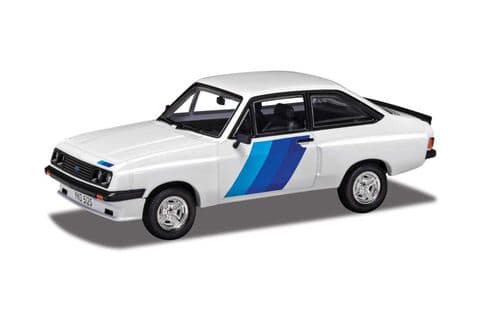
VA14903 - Ford Escort Mk2 RS2000 Series X - Diamond White.
The Escort modelled is one of only two known survivors of the six RS2000s built by Ford’s engineers at Aveley to promote the Series X options available from official Ford Rallye Sport dealers. Photographs of the car wearing its original German Cologne-registered number plate K-HJ 184 appeared in brochures and as posters at the time because it is believed this was the only example to feature the full graphics package in existence at that time. It lived up to its looks, however, with an impressive mechanical specification that included a Group 1 twin-carburettor 145bhp engine, 7.5x13 RS alloy wheels wearing Pirelli CN36 tyres, Bilstein anti-dive suspension, close-ratio Rocket box, limited-slip differential, ventilated disc brakes and a 69-litre, long-range fuel tank.
It was used for promotional work in Europe before being sold to a museum in Belgium, where it would remain until 1991. Although the car has always been left-hand-drive, it would later be registered in the UK and offered for sale by well-known historic car dealers Oakfields. It was purchased from them by a London-based Saudi Arabian Prince who kept it as part of his collection of interesting cars but using it only sparingly. He sold the car after it had been in his possession for around twenty years during 2012/2013, with the new owner later entering this remarkably original survivor in the 'Expert' concours class at Ford RS Owners' Club events. The car ran out as the National Day winner for both years and would also take the overall Gold Cup in 2013.
We have all been looking forward to these new RS 2000 releases for quite some time now and just like buses, when they do turn up, they do so in threes! We don't think many Vanguards collectors will be disappointed with this development and whilst all three happen to be sporty Fords, we know many readers will be looking forward to adding at least one of them to your collections. As we confirmed earlier, all three of these models are now advanced production samples and we would therefore expect them to arrive in our warehouse over the next few weeks, barring any unforeseen shipping delays.
That's all we have for you this time, but as usual, we will be back in two weeks with another selection of exclusive project updates in what will be the 100th edition of the Corgi Die-cast Diaries blog. In the meantime, we are always interested to hear your views on all things Corgi, so if you would like to drop us a line to comment on anything blog or model related, or indeed to suggest a topic you would like to see covered in a future edition, please use this diecastdiaries@corgi.co.uk link for all correspondence.
If you can’t wait for the next blog, you will find plenty of Corgi model collecting discussions taking place on our official social media channels, access to which can be obtained by clicking on the respective links at the foot of the Corgi website homepage.
Link access to Corgi
Instagram social media sites.
Thank you for continuing to support our Die-cast Diaries blog.
Our next edition is scheduled for publication on Friday 3rd June.

