

The preservation of historic aeroplanes is something that will be close to the heart of many aviation enthusiasts, but over recent years escalating costs, lower visitor figures and the effects of general financial austerity have put a huge strain on existing collections and potential future projects. We will all have our favourite aviation related venues but if you are lucky enough to live near one of the UK’s aviation museums, you probably have great affection for this particular operation and its continued success.
For this thirtieth edition of Aerodrome, we are going to break with our usual format and take a closer look at one of the country’s lesser known provincial aviation museums and how it helps to preserve the rich aviation heritage of the Greater Manchester area. We will also see how it faces something of a challenging future, perhaps more so than any other current aviation museum venue.
The history of Manchester and the surrounding area is dominated by the Industrial Revolution and the spectacular growth in textile manufacturing during this period. Through the cotton industry and mechanical automation of the manufacturing process, Manchester became one of the most important cities in the world and became famous for not just manufacturing, but also for technological development. The fantastic MOSI museum (Museum of Science and Industry) in the heart of Manchester utilises some of the city's most historic buildings to preserve this rich heritage for future generations and even allows visitors to experience what it would have been like to work in one of the regions many cotton mills. It also marks the rich engineering and technological heritage that Manchester can boast and it continues to grow in size and importance, with significant expansion planned in the coming few years.

The museum is the former site of the Manchester City Exhibition Hall
Of particular interest to the aviation enthusiast and possibly one of the best kept secrets in the North of England is the Air & Space Hall, which occupies a separate building, opposite the main MOSI site in the historic Castlefield area of Manchester. Over the years, I have been lucky enough to visit this museum on a number of occasions and it really is a treat to have a fantastic collection of aeroplanes available more or less on your doorstep. Having said that, the collection is certainly housed in a totally unique building, which is not exactly ideal for the display of historic aviation and the museum itself is quite a challenge to find. These factors may prove to have a significant impact on the future of this collection, but we will look at this a little later in this article – let’s first take a look at the history of the Air and Space Hall and its historic home.
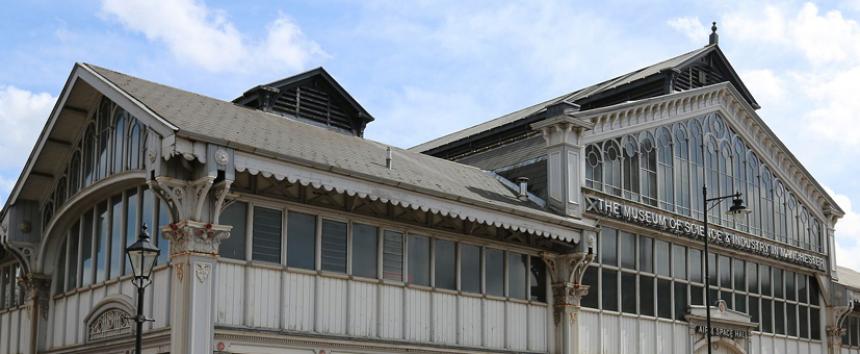
The aircraft collection of the Museum of Science and Industry in Manchester is housed in a building which is as historic as some of the aviation exhibits it protects. Built in 1876 to house the open air Lower Campsfield Market, it is constructed using an iron skeleton and extensive glass panel usage – extremely important to the industrial history of Manchester, this is a grade II listed building. By 1900 this impressive building became the City Exhibition Hall and over the years many events and public exhibitions were housed within its unique frame. The building soon became one of the most famous buildings in the wider Manchester area and a reason that many people visited the city centre.

The unique structure of the Museum gives a clue to its historic past
During the Second World War the building was used for the construction of barrage balloons, which were cited around the region to defend against Luftwaffe bombing attacks. Following the end of hostilities, the building reverted to the City Exhibition Hall, where it hosted such events as the 1953 Brighter Homes Exhibition, which included two completely built houses and all the latest household labour saving aids.
The building took on its current role as the home for the Air and Space Hall of the Museum of Science and Industry in May 1983 and in the process, provided a unique display venue for this collection of aircraft and aviation memorabilia. Once inside, you cannot fail to be impressed by the construction of this historic building and how they managed to shoehorn this collection of aeroplanes into what is basically a market hall. The exhibits are positioned between the huge iron support columns which keep the original glazed roof structure in place and dictate where the aircraft can be displayed. There is also an elevated viewing gallery, which extends around three sides of the museum and really does allow visitors a unique viewing perspective – this really is one of my favourite features of the Air and Space Museum.
Unfortunately, my latest visit proved to be something of a disappointment and led me to do some follow up research on the future of this collection. I was very much looking forward to taking some pictures from the elevated gallery but on my arrival, I was told that the entire area was not open to the public and had been closed for a number of months. Despite my protestations and offering to waive any health and safety liabilities the museum may be concerned about, I was told that there was absolutely no chance of going up there, as well as being given the reason why. I was told that the building is less than ideal for the display of historic aeroplanes and not only because of the metal support columns that are not found in an aircraft hangar. Apparently, the building is impossible to heat effectively and the roof is now in poor condition, requiring significant and costly remedial works. The leaking roof was responsible for the closure of the viewing gallery and although an assessment of corrective works has been completed, it seems unlikely that this work will be carried out. The building is leased from Manchester Council and its listed status significantly increases the cost of any remedial works. Although the museum itself has significant cash reserves, they do have some ambitious development plans and using a significant chunk of this money to renovate the Air and Space hall would seriously compromise the plans they currently see as being more appropriate to the future of the Museum of Science and Industry. When considering this information, it seems highly likely that the Air and Space section of the museum and its fantastic aviation displays may not be part of the future plans for the MOSI and they may be on borrowed time.

A beautiful replica of the first ‘All British’ aeroplane to fly, the Roe 1 Triplane
Despite the disappointment of not having access to the elevated viewing gallery, I was still excited to be paying my first visit to the museum for a number of years and was determined to make the most of my time here. Lancashire, and more specifically the Manchester area, has a rich aviation heritage and many of the exhibits at MOSI celebrate the region's connection to Britain’s aviation industry and how it was a world leader in the field. Let’s take a closer look at some of the aircraft on display.

Used during the Avro Vulcan project, the Avro 707A is a striking exhibit
For many aviation enthusiasts, the 2015 Airshow season will be remembered as the last time the mighty Avro Vulcan displayed to UK audiences. As the last flying Vulcan in the world, this much loved aircraft was a product of the Lancashire aero industry and was constructed at nearby Chadderton, before being assembled and test flown from Woodford. This was to be the world’s first delta bomber and as the Vulcan project incorporated new and ground-breaking aviation technologies, a number of interesting test and development aircraft were used to gather important flight data. One such aircraft was Avro 707A WZ736, which was an experimental jet aircraft, produced to test the tailless delta configuration used on the Vulcan, but more specifically, the low speed handling characteristics of the aircraft - it was basically a 1/3rd scale version of the Vulcan.
WZ736 was the second 707A experimental aircraft to be constructed and even though the Vulcan prototype had already flown, it was decided to construct the aircraft with a view to speeding up the development programme. Constructed at the Avro facility at Bracebridge Heath, near Lincoln, the aircraft was transported by road to RAF Waddington, where it made its maiden flight on 20th February 1953 – piloted by American pilot Sqn. Ldr. J.C Nelson, the aircraft flew from Waddington to the Avro airfield at Woodford.
Whilst the aircraft was at Woodford, powered flying controls were installed on the direct recommendation of Vulcan test pilot Roland Falk and it went on to provide valuable data for both the Vulcan project and high speed delta flight in general. Following its time at Woodford, WZ736 went on to serve with the Royal Aircraft Establishment at both Farnborough and Bedford and was used in auto-throttle development trials, as well as a host of general flight research projects. Finally withdrawn from service in the summer of 1962, she was used as a spares aircraft for other machines in the Avro 707 fleet.

The Avro 707A is very much linked to Manchester’s aviation heritage
Wearing a distinctive all-over deep orange livery, WZ736 makes for an extremely futuristic addition to the Manchester Air and Space museum exhibits and very much links in with one of the most important post war Avro designs. The colour of the aircraft is a little difficult to corroborate, as many of the 707 aircraft wore distinctive, colourful schemes, possibly to signify the specific flight trials the different airframes were involved with. Despite this, there is no denying that WZ736 is a spectacular looking aircraft that helps to tell the story of the Manchester aviation industry.
Arguably the most exciting jet aircraft ever produced by the British aviation industry was the English Electric (BAC) Lightning and this magnificent supersonic fighter was very much a product of the Lancashire aviation industry. Providing Britain’s fighter interceptor support throughout the Cold War period, the Lightning possessed blistering performance and remains as one of the fastest aircraft to ever serve with the Royal Air Force. Powered by a pair of Rolls Royce Avon engines stacked one on top of the other, the Lightning was a fuel hungry beast and designers were constantly challenged to try and provide more fuel for the aircraft to allow for longer patrol times and more effective interceptions.

English Electric P.1A was virtually hand built at Salmesbury
Lightning WG763 displayed at Manchester is a P.1A development aircraft which was important in ensuring that this stunning fighter progressed to RAF squadron service. It was virtually hand built by engineers at the English Electric factory at Salmesbury, near Preston and was produced in a pristine natural metal finish. Built as the second P.1 Lightning, the aircraft first flew on 18th July 1955 and was used to trial the fighting capabilities of the new jet, by flying with both cannon armament in the nose and trialling the much needed additional fuel tank application on the belly of the aircraft.
This particular aircraft made its first public appearance at the 1955 Farnborough Airshow, where famous British test pilot Roland Beamont displayed her to appreciative crowds. Her flying career proved to be relatively short, but during this time, WG763 was employed in supersonic gun firing trials and low speed handling trials and following her withdrawal from flying in 1964, she was used as a ground instructional airframe at RAF Henlow. Indeed, she spent much of the 1960s and 70s at Henlow, including time spent as the station gate guardian. Thankfully, she was saved from further deterioration and preserved for the nation, moving to the new Manchester Air and Space Museum as one of their first acquisitions in 1982. She is currently displayed in a clean configuration, without the nose mounted cannon and the belly fuel tank.

The old and the new. Different eras of flight at Manchester
Lightning P.1A is a deceptively large aeroplane and serves as an imposing welcome to MOSI visitors, as she is situated at the entrance of the museum and is the first aircraft that you see upon your arrival. She also serves as a spectacular illustration of Lancashire aviation throughout the ages, as she is sighted next to a replica of the first all British aircraft to fly in the UK. The Roe 1 Triplane (usually referred to as the Avro Triplane) was the first all-British aircraft to take to the skies and is therefore an extremely significant aircraft.
The first A.V Roe aeroplane to take to the skies had been powered by a French manufactured engine, but the first flight of the Roe 1 Triplane ‘Bullseye’ at Walthamstow Marshes in 1909 was to be the first by a completely British aircraft and was a significant event in the history of British aviation. The original aircraft is now part of the Science Museum collection in London, but Manchester can boast this spectacular replica example, which was built by Avro apprentices in 1952. It was completed to mark the aircraft’s attendance at the 1909 Blackpool Aviation meeting and its first display in Lancashire. Importantly, from 1910 A.V. Roe established his aviation factory in Manchester and began his and his company’s famous association with the region.

The Japanese Ohka is one of the more sinister exhibits at MOSI
One of the most interesting exhibits at the Air and Space Museum has absolutely nothing to do with the aviation heritage of Manchester and Lancashire, but clearly illustrates the desperation and futility of the final months of WWII. Looking like a rather attractive mini jet, the Yokosuka MXY7-11 ‘Ohka’ (Cherry Blossom) was a purpose built, rocket powered flying bomb, which was intended to be flown on kamikaze suicide attacks against US shipping in the Pacific. As the industrial might of America began to turn the tide of the war in the Pacific and inflict a series of crushing defeats on Japanese forces, they were subjected to a growing number of fanatical and terrifying suicide attacks. These desperate attacks were difficult to defend against and not only began to take a toll of US shipping, but also affected the moral of servicemen facing these attacks.
Unable to match the size and effectiveness of the American forces, Japanese military officials could see the potential of these kamikaze attacks and began to develop a rocket powered aircraft specifically designed to perform this task. Had these terrifying weapons been deployed in large numbers, they would undoubtedly have taken a heavy toll of American shipping and potentially prolonged the carnage of the Second World War.

The diminutive Ohka was difficult to shoot down, if deployed correctly
Operationally, the Ohka would be carried underneath a Mitsubishi G4M2e ‘Betty’ bomber, which thankfully proved to be the flaw in the effective use of this human guided bomb. The range of the Ohka was severely limited and it would need to be carried to within 37 km of any potential target, which is why it would need to be carried underneath a Betty bomber. Unfortunately, the Betty was no match for US Navy fighters, which were available in large numbers and were mounting highly effective combat air patrols and many of the attacking aircraft were destroyed well before the point of release. Should an aircraft manage to get lucky, an Ohka attack would see the weapon release from its parent bomber, before gliding towards its chosen target ship. Once within range, the Ohka pilot would ignite the three solid fuel rocket motors and accelerate the craft towards its target – if he managed to get to this stage, the attack was invariably successful, as the speed of the Ohka was so high that it was almost impossible to destroy it before it impacted on the American ship.
A number of these aircraft did manage to attack US shipping successfully, however results varied dramatically, with just one constant - all attacks resulted in the death of the pilot. On one dramatic occasion, the Ohka hit its target ship, but the warhead passed right through the hull of the vessel and out of the other side, before detonating harmlessly in the ocean on the other side. The few successful Ohka attacks caused absolute consternation amongst US military planners and they immediately increased both the range and the number of aircraft performing defensive air patrols, which effectively eradicated the Ohka flying bomb threat. There is no doubting that this was potentially a significant weapon in the Pacific war, but thankfully the Japanese forces were in no position to effectively deploy this fearsome weapon.

US carrier air power was too effective for the Ohka to have a significant impact on the Pacific war
Whilst I was at MOSI, a group of school children were walking around the museum and when they came across the little Cherry Blossom kamikaze attack aircraft, one youngster shouted ‘Look at that cute plane!’ A real case of how appearances can be deceptive – we can only hope that their field trip caused them to look a little deeper into the historic significance of some of the exhibits.

The massive Avro Shackleton AEW.2 dominates the exhibition hall
Without doubt, the most impressive exhibit at the Manchester Air and Space Museum is Avro Shackleton AEW Mk.2 WR960, which is very much a product of the Lancashire aviation industry and was the main reason for my latest visit. Tracing its lineage back to the famous Avro Lancaster bomber, the Shackleton was a long-range maritime patrol aircraft, which was used primarily on anti-submarine operations, but was also required to perform a number of other roles. Entering RAF service in 1951, the majority of Shackletons were powered by the mighty Rolls Royce Griffon engine and were the last aircraft in the illustrious line of four engined propeller powered bomber aircraft to see Royal Air Force service. Bearing in mind the sheer size of the Shackleton and the lack of available space at the MOSI museum, this is probably the last aircraft that visitors would expect to see displayed here and it is a wonder how museum planners managed to get her inside the building at all. The fact that they did is to their eternal credit and WR960 makes for a stunning centrepiece to this collection of aeroplanes.
Avro Shackleton WR960 was constructed as an MR.2 variant at Woodford aerodrome during 1953, making her first flight early in 1954. She entered service with the RAF later the same year and, throughout her service career, flew in the colours of No.8, 42, 205, 210 and 228 Squadrons, as well as spending time on charge with the Aeroplane and Armament Experimental Establishment. In 1972, WR960 returned to Woodford for conversion to Airborne Early Warning configuration, which is how she is now displayed at Manchester and is worthy of further investigation.
As the British government issued plans of their intention to scrap HMS Ark Royal, the navy were concerned that their ships would lose important airborne early warning capability, which was simply not an option. The solution was to put the radar units used on the Navy Fairey Gannets into the airframe of the trusty Avro Shackletons and, although these were obviously land based aircraft, the impressive endurance of the Shackleton would greatly enhance the effectiveness of the navy’s airborne early warning capabilities. Twelve Shackleton airframes were converted to AEW Mk.2 standard and operated in the colours of No.8 Squadron, originally at RAF Kinloss in early 1972. Following the completion of significant runway strengthening works at nearby RAF Lossiemouth, the Shackletons moved to Lossiemouth in August 1973, where they remained until the unit finally disbanded in 1991.

Avro Shackleton AEW.2 WR960 in RAF No.8 Squadron colours
The aircraft on display at Manchester’s Air & Space Gallery carries a specific piece of artwork, which tells an interesting story connected with the AEW Shackletons of No.8 Squadron. All twelve of the Squadron's aircraft were named after characters from either ‘The Magic Roundabout’ or ‘The Herbs’ children’s TV programmes of the 1960s, with WR960 being named Dougal. I have not been able to find a definitive reason why these aircraft were named after these particular characters, but it does seem to be connected in some way with Shackleton T.4 VP293, which was serving with the Royal Aircraft Establishment. This particular aircraft had a tendency to bounce on landing, which earned the aircraft the nickname Zebedee, after another character from ‘The Magic Roundabout’ and some 8 Squadron aircrew may have had a connection to this aircraft. Whatever the reason, the unusual artwork on these RAF Shackletons makes for an interesting story and certainly endears these mighty aircraft to anyone who discovers this tale.

Shackleton WR960 carries this unusual piece of artwork
Avro Shackleton WR960 is by far the most imposing aircraft on display at the Manchester Air and Space Gallery and it is well worth paying this museum a visit just to marvel at this huge Cold War aeroplane. With a number of exhibits already removed from the museum over recent years, it could be that the future of these remaining aircraft is far from assured and it would be a real shame if Manchester lost this fantastic link to its aviation heritage. Whatever happens in the future, if you have the opportunity to visit the museum, you will certainly enjoy the experience, even if the viewing gallery remains closed to the public. You can always challenge your group to be the first to spot Dougal!

Examples of the new Airfix Shackleton MR.2 on display at the Telford IPMS show
The Airfix range has seen a number of high profile new tooling additions during 2015, but perhaps the most significant release has been the new 1/72nd scale Avro Shackleton MR.2, which is already proving to be a hit with modellers all over the world. Produced using the latest computer design technologies available to the Airfix team, this magnificent new model features extremely high levels of detail, along with a number of construction options for the modeller. This new model has proved to be so popular with modellers that initial deliveries were snapped up almost straight away. Thankfully, further supplies of this submarine hunting version of the Shackleton have arrived and it's available once again.
The Corgi Aviation Archive collector cannot currently add a die-cast example of the Shackleton to their collections, but with both a 1/72nd scale Lancaster and Vulcan already in the range, we can hopefully look forward to a die-cast version of this other Avro classic in the not too distant future – we will have to keep our fingers crossed.
That’s it for the latest edition of Aerodrome - I hope that you have enjoyed this week’s look at one of the lesser known UK aviation museums and some of the delights that reside there.
I will be looking to feature more reader stories and features within Aerodrome in 2016, so if you would like to share some interesting pictures, or an aviation related story, please drop us a line with your idea. I already have a couple of reader features in place for next year, but it is always good to receive your ideas and general feedback, so please don’t be shy.
As usual, you are welcome to discuss our latest blog either on the Airfix Aerodrome Forum or Corgi Aerodrome Forum. If you have any specific comments, questions or suggestions for future editions of Aerodrome, please feel free to let us know via Airfix or Corgi Facebook, or on Airfix or Corgi Twitter using #aerodrome.
Until next week, thank you very much for reading.
Michael
© Hornby Hobbies Ltd. All rights reserved

