

Welcome to this latest edition of Aerodrome and our regular look at the fascinating world of aeroplanes and the historic aviation scene in the UK.
Making a triumphant return following an enforced three year hiatus, this year's Royal International Air Tattoo was blessed with glorious weather and an impressive selection of aeroplanes gathering from all over the world and as you might well expect, the crowds were back in some force to witness this spectacle. With eight hour flying displays on both Saturday and Sunday and an extensive static display which could easily take a full day to explore effectively, there are so many highlights at a RIAT show that they could easily provide blog content for several editions of Aerodrome, but as the dust has now settled on this year's show and as temperatures are now returning to normal, it's time to make a start with the first one.
In this first Aerodrome blog review of 2022, we are going to be taking a slightly alternative look at this year's proceedings, as we focus on a selection of aircraft which formed part of the impressive static display at Fairford and didn't actually take part in the main flying programme - they were, however, undoubted aviation stars of RIAT 2022. We will be deviating slightly from this criteria at the end of the blog, as we look at arguably the most 'high profile' aircraft in current RAF inventory and certainly the most distinctively presented. Prepare yourself for a little aviation Anarchy with the RAF's Typhoon display jet.
It's RIAT and classic jet powered aircraft all the way in this latest edition of Airfix and Corgi Aerodrome.
The Luftwaffe provided enthusiasts with a Tornado fix at this year’s show, sending a pair of tooled up ECR jets which only confirmed how much we miss the mighty fin.
As far as aviation events go, there are few in the world that can rival the size and popularity of the Royal International Air Tattoo and in normal years, for one glorious week each July, the sleepy Gloucestershire village of Fairford quite literally becomes the centre of the aviation world, as its now famous airfield stages an event of such magnitude that it must bring millions of pounds into the area’s economy with each successive event. It also has to be said that the RIAT show has ensured that this picturesque corner of rural Britain has become familiar to millions of people the world over and it will now forever be inextricably linked with aeroplanes.
This year, however, it has to be said that this was a very different RIAT. Always the first show entered in many an enthusiast's diary immediately following return from the latest show, we have all had to wait three years to feel the RIAT thrill once more, ensuring that there was a clamour for tickets for this latest event and a degree of certainty for organisers that this would once again be a sell out event and absolute confirmation that Airshows remain one of the most popular summer outdoor pursuits in the country.
The RIAT phenomenon arrived at RAF Fairford in 1985, when this gargantuan event was hosted by the airfield for the first time, initially taking place every two years, but from 1993, arranged annually. Its record of hosting the event since that date has only been broken on two consecutive show occasions, when RAF Cottesmore stepped into the breach for two RIAT shows from 2000, as the airfield infrastructure at Fairford was undergoing extensive renovation works, however, everything was back to normal by 2002. Indeed, the show's return to Fairford proved to be something of a record breaking development, as the 2003 event attracted the attendance of no fewer than 535 aircraft and earned the Royal International Air Tattoo the accolade of being the largest military Airshow in the world. Although it is unlikely that this impressive total will ever be beaten in the years to come, this year’s show was nevertheless a huge occasion in its own right, with hundreds of aircraft packed onto the airfield, representing air arms from countries from all around the world and as usual, it proved to be the aviation event of the year.
There is always something special to see at a RIAT show, which is why it attracts so many visitors each year.
Gathering an impressive selection of aircraft from locations all around the world to be in the same place at the same time, is clearly always going to be of great interest to aviation enthusiasts, but creates something of a logistical nightmare for the team behind such an undertaking. Having to contend with the usual aviation variables of aircraft serviceability, ongoing operational commitments, aircrew availability, the prevailing world political situation and the weather, if the majority of the aircraft scheduled to be in attendance actually arrive at the airfield, something akin to an aviation miracle has occurred. Unfortunately for show organisers, a successful RIAT is no time for resting on one's laurels and no sooner has the last aircraft arrived at Fairford to make the latest show a roaring success, arrangements have to be made to get them all safely away again.
Departure Monday is an extremely busy day for the RIAT team, as most of the aircraft taking part in the latest flying and static displays have to leave the airfield, dictating that from around 10am in the morning, aircraft movements are taking place every few minutes and Fairford once again becomes one of the busiest airfields in Europe. Even then, planning will already be underway for the next show, with the absolute certainty that they will have to serve up another feast of aviation for the gathered masses.
For this first review from the 2022 show, we will be looking at some of the stars of the static display, aircraft which arrived on the Friday, were admired by thousands over the weekend and left again on Monday. A fleeting Gloucestershire visit for some rare overseas based aviation classics.
As majestic as it is rare, the E-4B was one of the undoubted highlights of this year's RIAT show.
One of the largest and certainly rarest aircraft attending this year's RIAT show was the E-4B Advanced Airborne Command Post, an impressive aircraft which boasts a unique list of capabilities for a very specific and rather sinister set of operating circumstances. Colloquially referred to as the 'Doomsday Jet', this specialist aircraft is a hugely capable flying command post for senior US military and political figures, a safe and effective environment high above the earth for them to direct operations in the event of extreme national emergency. For most of us, this conjures up the terrifying prospect of nuclear conflict, which is why these aircraft inherited their doomsday name in common parlance, even though the Americans prefer to call it the Nightwatch or simply the E-4B.
It is obvious from its profile that this aircraft is a militarized variant of the famous Boeing 747 airliner, an aircraft which has a legendary reputation both in terms of its load carrying capacity and operability, credentials which made it the ideal choice for this specialist role. With the ability to fly for long periods due to its in-flight refuelling capability, the E-4B serves as a significant deterrent against potential attack on American interests around the world, as it can remain on station to direct response and retaliation in the event of ground facilities being compromised. At least one of these aircraft is always kept at a state of 24 hour, 7 day a week alert, with the wider Global Watch Team also having members stationed at one of many specially equipped bases around the world, so they are prepared for all and any international eventuality.
The E-4B have been designed to provide a safe operating environment for senior US officials at a time when they may be called upon to make the most difficult, yet critical decisions for their country and for humanity. They are protected against the effects of electromagnetic radiation and nuclear/thermal blasts and the aircraft's high-tech air conditioning system is designed to allow the onboard computer and communications equipment to remain functional in all situations. Each aircraft carries thirteen external communications systems and benefits from a highly advanced suite of satellite communications equipment, ensuring that the President, or members of his Joint Chiefs of Staff are able to communicate with world leaders and direct the appropriate response to any situation they are faced with. Of course, when the President is aboard any of the four E-4B Nightwatch aircraft, it immediately becomes 'Air Force One'.
These impressive aircraft also have a secondary role of providing VIP transport support as and when required and providing specialist communications support in the event of international disaster relief efforts - quite impressive beasts really.
Originally delivered to the US Military as replacement for their ageing EC-135J National Emergency Airborne Command Post aircraft, the first of the E-4s were designated as 'A' models and were based on the Boeing 747-200 airliner. These entered service in 1974, however, the fourth and final aircraft in the fleet was delivered to the upgraded 'B' standard and over the following few years, the three existing E-4s were also upgraded to this standard, with this work being completed by 1985. All four aircraft are assigned to the 595th Command and Control Group and operate out of Offutt Air Force Base in Nebraska.
The E-4s appearance at this year's RIAT was a huge coup for the organisers, as these aircraft rarely appear outside the US and appear even less than this at Airshow events - this was certainly the first time I had ever been lucky enough to see one of these beauties and as such is definitely amongst my personal highlights of the 2022 show. Its appearance was to commemorate both the show's theme of the 75th Anniversary of the US Air Force and the 60th Anniversary of the National Airborne Operations Centre and as it was only destined for the static display, its arrival on Friday had everyone at Fairford rushing to the swollen crowd line to document the occasion. With everyone scanning the sky for an aircraft many of us had been following on Flightradar24 for an hour or so, we were treated to an initial fly through, before the E-4 turned into the pattern for landing.
As most airlines have now retired their 747 aircraft, this was a rare opportunity for most of us to catch a glimpse of this 'Queen of the Skies' in military guise and we definitely weren't going to miss this opportunity. As she flew majestically overhead, it was a magnificent, if slightly eerie experience, as we knew what we were actually looking at was basically a flying nuclear bunker and whilst serving as a high profile deterrent to conflict, everyone would have been hoping that all her onboard systems will never be called upon in anger. In any case, this rare and impressive aircraft proved to be a definite highlight of RIAT 2022.
Sharing the rare classic jet aviation billing with the E-4B 'Nightwatch' at this year's show, but coming in a slightly more diminutive package, enthusiasts definitely had a number of unusual highlights they would have been hoping to see at RIAT 2022, not least of which was the Douglas A-4N Skyhawk. The Skyhawk has to be regarded as one of the most successful light attack jets of the post war era and even though around 3,000 aircraft were produced, few found their way to the UK and even fewer turned up as attendees at previous RIAT shows. For this reason, the advertised attendance of an adversarial A-4N jet at this year’s show proved to be a huge draw for many, even if it was just destined to grace the impressive static aircraft display.
The lightweight, yet extremely rugged Douglas A-4 Skyhawk was the primary attack aircraft for both the US Navy and the US Marine Corps from the mid 1950s onwards and was small enough to be operated from many of the WWII era aircraft carriers which were still in service at that time. Despite its diminutive, slightly ungainly appearance, the Skyhawk was fast and agile and could deliver a similar weapons load to that of a wartime B-17 Flying Fortress and was incredibly popular with both pilots and ground crews alike.
The beautiful aircraft which attended this year's show is now based in Germany and is one of the jets operated by Canadian firm Top Ace, private contractors who provide specialist adversarial flight operations support for the Luftwaffe and other NATO Air Forces who have a requirement for their services. This A-4N Skyhawk has been upgraded to feature the very latest electronic equipment, enabling them to provide the highest levels of adversarial aircraft simulation for Luftwaffe pilots and are regarded as some of the most effective aircraft of their kind in the world. Featuring Active Electronically Scanned Array radars and Infrared Search and Track systems, no expense has been spared in equipping these classic jets with the latest equipment with which to complete their task and when combined with the legendary agility of this famous jet and when flown by former military pilots, they can challenge the capabilities of even the latest generation of air defence fighters.
The Top Aces company was founded in 2000 by three former Royal Canadian Air Force CF-18 pilots and is now regarded as one of the leading providers of contracted adversarial training for air forces in Canada, Germany and in the US. This particular Skyhawk was constricted as an A-4N variant in 1976 and taken on charge with the US Navy with BuNo.159823, before being supplied to the Israeli Air Force as part of an order for 26 newly built aircraft. Seeing extensive service with the Israelis, wearing the distinctive three colour camouflage used by the IDFAF and the fuselage number 405, it is interesting to note that the Israelis were the largest operators of the Skyhawk outside the US and it is thought that they eventually managed to acquire around 350 of these capable little jets.
Following withdrawal from service, this aircraft was one of several bought by American company Advanced Training Systems International and taken to their facility at Phoenix Mesa Gateway Airport in Arizona. At the end of 2013, she was one of seven A-4Ns and three TA-4Js acquired by Canadian based Discovery Air Defence Services Inc (Top Aces), where she was allocated the registration C-FGZE. She now flies adversarial missions for the Luftwaffe and is operated out of Wittmundhafen Air Base in Northern Germany, from where she flew to attend the RIAT show.
Top Aces retain strong links with the Israeli Air Force and should they need to acquire further A-4s, it is thought that through their contacts, up to sixty former Israeli machines may be available, some of which were flown as recently as 2015. Other aircraft types in their fleet include Dassault/Dornier Alpha Jets and incredibly, a number of former Israeli Air Force F-16 Fighting Falcons - I wonder if we will ever see examples of these at a future RIAT show.
Marking a classic era of jet powered aircraft types, the Top Aces team and their A-4N Skyhawk were never without a healthy crowd for the duration of this year's show and I was extremely fortunate to be allowed a short over the barrier opportunity to grab some shots of this magnificent aircraft. I didn't manage to take any pictures of the Skyhawk's arrival at Fairford, however, I was in position to photograph its departure back to Germany on the Monday, so two out of three is still quite the achievement.
The magnificent SAAB SK35 Draken performing a missed approach prior to landing and flaming on lighting the burners - could we possibly love these classic Swedish jets any more?
A trio of aircraft which also swooped in to captivate the masses at Fairford late on Friday afternoon prior to the main show days where a selection of the immaculately presented Swedish Air Force Historic Flight. When we talk about aircraft types that just have that something a little bit special in the eyes of the aviation enthusiast, the machines produced by the Swedish aviation industry in the post war years are certainly amongst the most enigmatic, stylish aircraft which not only looked spectacular, but were also amongst the most capable jet aircraft in the world. What made these aircraft all the more appealing is that fact that they rarely appeared at UK Airshow events, but when they did, left a lasting impression on those who were fortunate enough to see them. Looking almost like something from an episode of Thunderbirds, Sweden certainly knew how to produce capable jet aircraft.
A magnificent organisation dedicated to the preservation of the unique aviation heritage of Sweden and in particular the aircraft produced by the SAAB company, the Swedish Air Force Historic Flight has a fleet of aircraft which has to be the envy of every Airshow organiser in the world, aircraft which on their own could command huge crowds even if they were the only aircraft in attendance. As an unexpected bonus for this year's RIAT crowds, the SwAFHF were good enough to send three of their stunning aircraft to illuminate the show's static display and like everyone else on the showground, I was hoping to catch a glimpse of them in the air, in addition to catching up with them in the static display - I got lucky in this regard. The aircraft in attendance this year were their SAAB J32 Lansen, SK35 Draken and SK37 Viggen, all three of which were two seat aircraft to fit in with the training theme of this year's show and what a sight for sore eyes they were too.
SAAB J32 Lansen (Lance)
The Saab J32 Lansen is a two-seat attack fighter of the Swedish Air Force which entered service in 1956 and went on to enjoy a long and distinguished career. Powered by a licence built version of the Rolls Royce Avon turbojet, the Lansen was an early generation jet aircraft, but one which was designed from the outset specifically to undertake all weather attack missions – one of the first aircraft with this capability in the world. The aircraft proved to be such a successful design that it was later developed into both fighter and reconnaissance variants and although its appears to bear some similarity to several early fighter designs of the era, such as the North American Sabre, the Lansen was a proud achievement for the indigenous Swedish aviation industry.
This particular Lansen is the only airworthy example of the aircraft currently flying in the world and it has been many years since one of these attractive early jets has attended a UK Airshow – it is no wonder that the Saab Lansen came in for plenty of enthusiast attention over the weekend of the show.
SAAB SK35 Draken (Dragon)
At a time when many of the world’s smaller air forces elected to purchase aircraft produced in the US, Soviet Union or Great Britain, the Swedish Air Force were determined to introduce capable indigenous designs, a decision which ultimately resulted in the production of some the most exciting aircraft to appear in European skies. The SAAB Draken can trace its development history back to the late 1940s and was to be a highly advanced fighter interceptor replacement for the J29 Tunnan and J32 Lansen aircraft. Featuring a double delta wing, the Draken was an impressive performer and almost looked as if it had been designed as a creation for an episode of Gerry Anderson’s Thunderbirds programme - it did, however, prove to be as good as it looked.
A highly capable fighter of the Cold War era, the Draken had the distinction of having several impressive aviation accolades attributed to it, which included being the first Western European combat aircraft to enter service which possessed true supersonic capability and being the first fully supersonic aircraft to be deployed in Western Europe. A contemporary of Britain's British English Electric Lightning fighter, the Draken presented the Swedish Air Force with a fighter aircraft tailored to their unique requirements and one which did not rely on the continued support of any outside nation. The SK35 variant was an unarmed two seat training development of the J35A fighter and whilst it does look radically different, these aircraft could be turned back into fighters without too much trouble, should the need ever arise.
SAAB SK37 Viggen (Bolt - Thunderbolt)
An aircraft which looks even more spectacular than the Draken, the SAAB AJ37 Viggen (Thunderbolt) was one of the most capable aircraft in the world when it first entered service in 1971 and was specifically developed to be a highly advanced and fully integrated fighting aircraft optimised for service with the Swedish Air Force. Originally intended as a highly advanced replacement for the J32 Lansen, the Viggen proved to be such a capable aircraft that it developed into an attack fighter, fighter interceptor, reconnaissance platform, maritime strike and two-seat training aircraft – undoubtedly one of the most flexible aircraft of its kind in the world. Not only was this something of a thoroughbred aircraft, it was designed to be extremely rugged and capable of operating from dispersed locations with limited facilities.
Serving as a significant deterrent threat to any potential enemies, these exceptional aircraft were designed to operate away from their home bases at short notice, but retaining their full tactical effectiveness at all times. With Sweden boasting vast areas of forest and having plenty of places to hide their aeroplanes, Viggens were regularly dispersed around the country, operating from improvised landing strips and public highways, which made their detection by a potential enemy extremely difficult. The Swedish people were so used to sharing their roads with Viggens that the sight of one blasting off a highway would just have them giving way, before continuing with their journeys, but always keeping an eye out for other aircraft.
Undoubtedly one of the most capable aircraft in the world, the Viggen has a number of significant achievements to its name and whenever the aircraft made one of its rare UK Airshow appearances, it was always guaranteed to draw large crowds of enthusiastic admirers. The aircraft had the distinction of being the first canard aircraft design in the world to be produced in quantity. In addition to this, the fighter interceptor variant of the Viggen was the only aircraft to obtain an acknowledged radar 'lock-on' against the speedy and elusive American Lockheed SR-71 Blackbird reconnaissance aircraft.
The SK37 was a dedicated training aircraft with no radar and a reduced fuel carrying capacity and just 17 of these aircraft were eventually produced. The higher set rear cockpit allowed both pilot and student to have almost the same forward view and if anything, this variant was even more impressive looking than its single seat counterparts, especially when wearing this stunning splinter camouflage.
Despite their age and the fact that both the Draken and Viggen have been out of service for many years now, both still look rather futuristic and their popularity as Airshow performers is unrivalled - if the Swedish Air Force Historic Flight are in town, expect the crowds to come along too.
We are ending this first RIAT 2022 review with a slight deviation from our main theme, but for good reason. Enthusiasts often complain that whilst overseas air arms regularly present examples of their current front line aircraft in attractive schemes for promotional/recruitment purposes and allow them to attend Airshow events across Europe, the RAF rarely adopt the same policy. Thankfully for this year, the RAF could actually boast one of the most distinctively presented aircraft at Fairford and rather than simply beautifying the static display, this one was going to thrill us with a dynamic display routine.
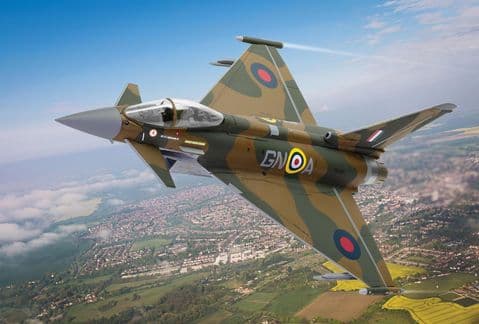
Any enthusiast will tell you that even though the Eurofighter Typhoon is undoubtedly one of the most capable multi-role combat aircraft in the world today, if you really want the British public to engage with their modern Royal Air Force, present the Airshow display jet in a strikingly different colour scheme. The RAF even have a precedence for this kind of thinking, as the aircraft they presented in a representation of a Hawker Hurricane scheme to mark the 75th Anniversary of the Battle of Britain back in 2015 became arguably the most famous single RAF aircraft of recent years and was even known by her fuselage codes - GINA. This was a particularly well-loved aircraft.
Thankfully, the RAF hierarchy decided that for this season, a Typhoon would once again be allowed to do its bit for public relations and recruitment, but rather than choosing a scheme from Royal Air Force years past, this time they elected to go with a striking and even more patriotic scheme than the last one. Now colloquially referred to as 'Blackjack' by thousands of enthusiasts all over the country by virtue of its distinctive presentation, whether you are a fan of the scheme or not, there can be no denying that she is a real head turner. With the pandemic disruptions of the past couple of years and some serviceability issues affecting the availability of this aircraft for what few Airshow events did take place during this period, many people will have been hoping to catch up with Blackjack during this years display schedule and Flt Lt Adam O'Hare, who is otherwise known as 'Anarchy 1' this year, was desperately keen to oblige them.
Putting together a dynamic display routine of exciting manoeuvres and with copious use of the aircraft's afterburners, Flt Lt Adam O'Hare utilises the legendary power and agility of the Typhoon to maximum effect, ensuring that everyone goes home with a selection of appealing photographs and a renewed appreciation of the Typhoon's capabilities after every show. Also highlighting the excellent serviceability of the RAF Typhoon, 'Blackjack' performed on Friday, Saturday and Sunday of this year's show, before taking off as scheduled on Monday and heading straight for Farnborough. It has to be said that the men and women behind the Royal Air Force Typhoon Display Team are doing sterling work in representing the modern RAF and encouraging youngsters to consider a career in the force - well done to one and all.
I’m afraid that’s another edition of Aerodrome in the can, however, we will have more aviation delights for you in just four weeks’ time. Should anyone have an interesting aviation related story of their own they would like to share, or details of an interesting aviation heritage project taking place near to them, please do consider sending details to us here at Aerodrome, so we can share them with our ever-growing, worldwide blog audience, who I am certain would be delighted to hear about it.
To send us details, or to simply open lines of blog communication, please use our aerodrome@airfix.com address when getting in touch.
Between editions of our blog, you will always find interesting aviation discussions taking place on the Airfix Aerodrome Forum and if social media is more your thing, please just click on the respective social media image links at the foot of this page for quick access.
The next edition of Aerodrome is scheduled to be published on Friday 16th September.
Now in our seventh year of publication, thank you for continuing to support our Aerodrome blog.
Michael