

Welcome to this latest edition of Aerodrome and our regular fortnightly look at the fascinating world of aeroplanes and the historic aviation scene in the UK. Unfortunately, due to a number of unforeseen issues, it was not possible to bring you this edition of our blog last Friday as intended, but as they say better late than never and we intend to get back on track by bringing you the next Aerodrome as scheduled on Friday 23rd March, which will see us back on track once more.
The original intended title for this blog was going to be ‘A tale of two Spitfires’, but for reasons which will become apparent when you read edition 90 of our blog next week, I was forced into a change of tack almost as soon as I had begun taking pictures and gathering research material together. We will certainly be staying in the same part of the world and the two editions will definitely be linked, but the original title just didn’t seem to be appropriate any more. Over the course of the next two editions of Aerodrome, we are going to be looking at two separate projects in the North of England, both of which feature Spitfires and both coming to fruition thanks to the drive and determination of the same man. In this first edition, we will be looking at the story behind a chance discovery which led to a town’s determination to commemorate its contribution to the war effort during WWII and to honour a local pilot who paid the ultimate sacrifice whilst flying the aircraft they financed. In the next edition, we will see how this initial project proved to be the catalyst for an equally ambitious project which can claim to be a little more mobile than this week’s subject and continues to draw attention to the rich aviation heritage which this part of the United Kingdom can boast. I know this may all sound a little cloak and dagger, but please stay with it and join me on a little winter trip to the seaside.
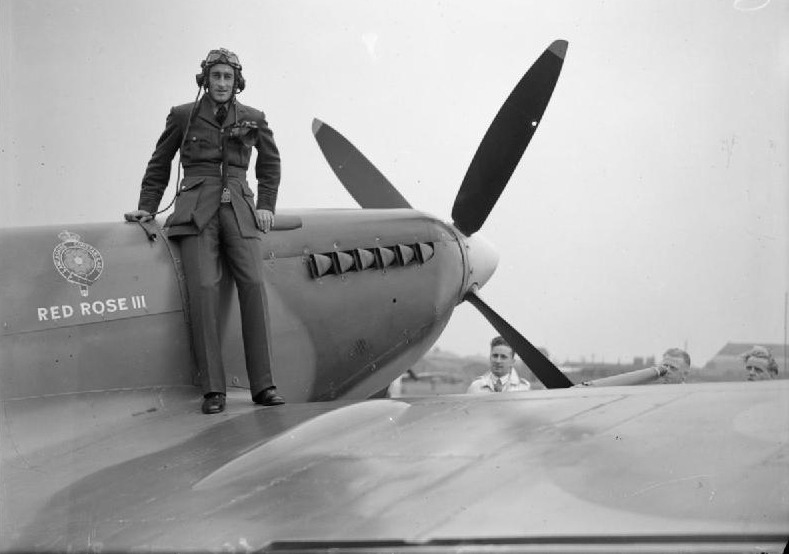
Supermarine Spitfire LF Mk.IXb MH819 ‘Red Rose III’ at Squires Gate aerodrome, Blackpool carries the badge of the Lancashire Constabulary
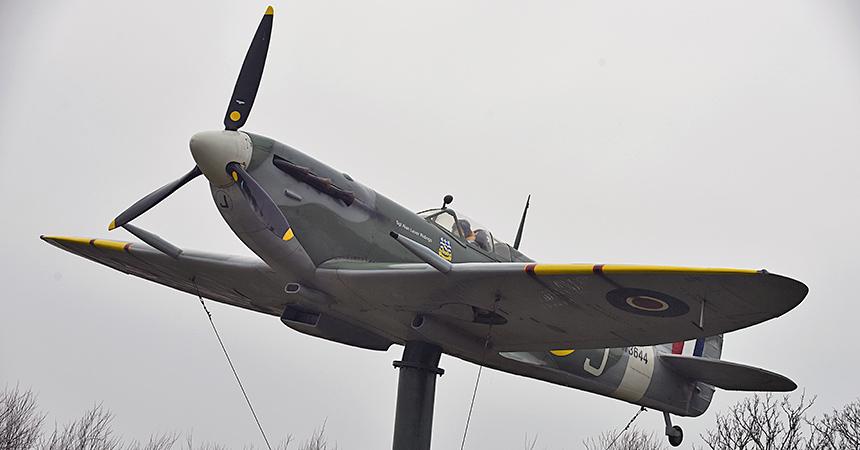
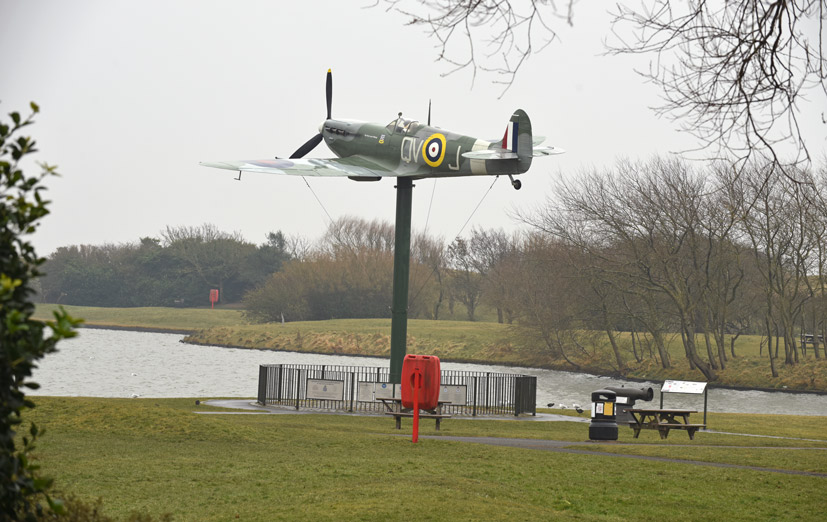
For people living in the North West of England, the pretty seaside village of Lytham St Annes can be a popular destination during the summer months, particularly if you are planning a pleasant day out with the family or just relaxing at the beach away from the stresses of everyday Lancashire life. Just down the coast from Blackpool but much quieter (some might say more civilised), St Annes benefits from a long, flat coastal road and if you are looking for a slightly more active day than sitting eating ice cream and waiting for the tide to come in, the promenade is always busy with walkers, joggers and cyclists, no matter what the time of year. Most out of town visitors would not walk the full length of the promenade but if you did, you would find the delightful Fairhaven Lake at the southern end of the road and make a rather dramatic discovery – a full sized Spitfire replica on a 30ft high display pole. If you were not expecting this sight, it can be a real shock and even though the Fylde area has a rich aviation heritage, a Spitfire in flying configuration at a local beauty spot is not the sort of thing you see every day. Having annoyed the joggers trying to run down Inner Promenade whilst taking pictures on two occasions now, I thought it was only fair that we looked a little deeper into the story behind the Fylde Spitfire Memorial.
An unusual sight at Lytham’s Fairhaven Lake
As with many memorials and dedications to our wartime heritage, the impetus behind the replica Spitfire at Fairhaven Lake is linked to the efforts and determination of a single person, who manages to gather the support of others to help make something significant happen. Former leader of Fylde Borough Council, Mr John Coombes was spending time looking through some dusty old boxes he found in the basement of a council building, when he came across a collection of official archives containing details of an interesting project from the early 1940s. He had found information relating to a scheme organised by the council at that time and their efforts to encourage contributions from the local Lytham St Annes community to raise funds to buy their own Spitfire – a so called ‘Presentation Spitfire’. Included in the box was a black and white photograph of Supermarine Spitfire Mk.Vb W3644, which carried the name ‘Lytham St Annes’ on the side of the fuselage, under the cockpit. This discovery fascinated Mr Coombes who immediately set about finding further details regarding this fascinating aircraft, its history and the story behind its purchase by the people of the local area.
The subject of Presentation Spitfires is a fascinating one and helps to tell a story of defiance and determination, at a time when Britain was standing alone against the might of the marauding German military and was in danger of not being in a position to continue fighting. In the wake of the Dunkirk evacuations and the disastrous deployment of the British Expeditionary Force in Europe, Britain knew that they would be the next to face onslaught from the Luftwaffe, possibly as a prelude to invasion. As Lord Beaverbrook and his Ministry of Aircraft Production feverishly attempted to increase the production output from Britain’s aircraft manufacturing facilities, he launched his ‘pots and pans for Spitfires’ appeal, in a desperate search for valuable metals, but probably as more of a propaganda exercise to galvanise the nation for the struggles to come. At around the same time, his office received a rather strange request from a British national living overseas – ‘How much to buy a bomber?’ He gave a figure off the top of his head, £20,000 and thought no more of it … that was until the money arrived on his desk a few days later. This was just the first of many such donations, from individuals, companies and overseas communities who were all so moved by Britain’s determination to fight on that they wanted to help the only way they could. With the Battle of Britain helping to establish the reputation of the immortal Spitfire, it was inevitable that Lord Beaverbrook would soon be faced with answering a similar financial question to the one posed previously, how much for a Spitfire? This time he quoted a nominal figure of £5000, possibly not knowing how significant this amount would become.
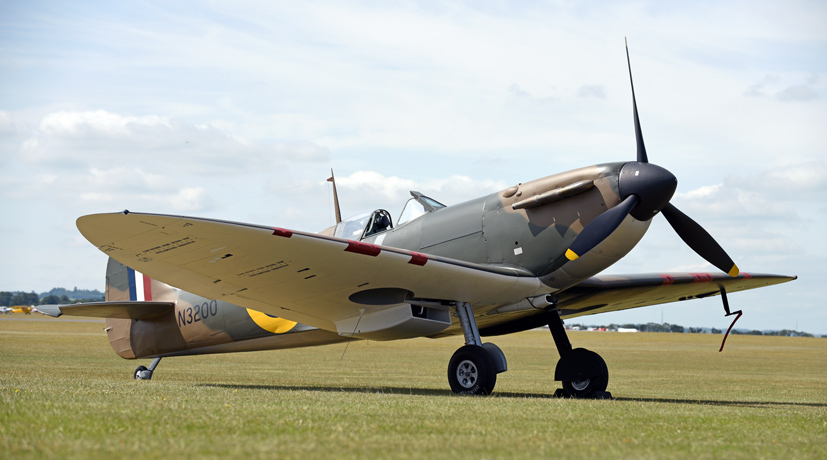
The attractive Supermarine Spitfire inspired the great and the good to put their hands in their pockets in a selfless act of unified nationalism
Even as the savage dogfights of the Battle of Britain were still raging in the skies above southern Britain, the first ‘Spitfire Funds’ began to surface, with individuals sending in what they could to buy aircraft to help our boys fight back. The £5000 figure to buy a Spitfire must have quickly become common knowledge and it is interesting to try and put this in some form of contemporary context. Equating this to current monetary terms, they would be looking for approximately £300,000 to buy their Spitfire, which is clearly not an insignificant amount, especially considering the country was at war, there was nationwide rationing and people were really living under considerable hardship. The average weekly wage of the day was probably a little over £2.00 and out of this, there would be rent, food and clothing costs which would leave little room for Spitfire donations – indeed, the Pilot Officers who were taking RAF fighters into combat were only earning around £2.50 each week, which really puts the cost of a Spitfire into perspective. Despite this, the rush to contribute towards these funds gathered pace with each passing week and there seemed to be no end of support for schemes hoping to give our pilots more and more Spitfires to help win this war. With high profile schemes launched at first by national newspapers, large corporations and then local newspapers, contributing to these funds served to galvanise the nation, allowing everyone to get involved, young and old, rich and poor, for the greater good and future survival of the country. As their popularity grew, new collections were launched at a more local level, with towns and cities racing to buy their Spitfire and carry the name of their town proudly into combat against the Luftwaffe, showing their unified defiance and determination never to yield – indeed these fund raising efforts actually induced something of a competitive spirit between different areas, with such sentiments as, if the town next door can raise enough for a Spitfire in just six weeks, we’ll do it in four!
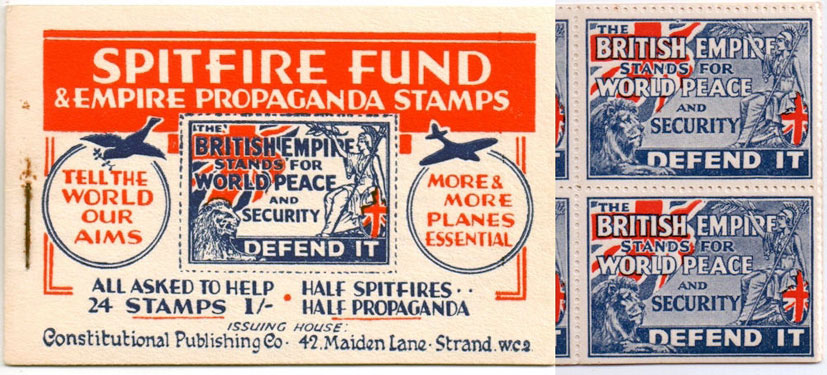
Britain and the Commonwealth nations needed little encouragement to support their local Spitfire Fund
To many people who come across the history of these Presentation Spitfires, it is absolutely fascinating to see how people who had very little in the way of money and possessions and were under extreme hardship, (including for many months being under the very real threat of invasion) could embrace this initiative so wholeheartedly, coming together as a town, city or region to put their name on one of Britain’s premier fighter aircraft. In truth, of course, these funds were set up to procure many different aircraft over the course of the war, but there can be no doubt that there must have been nothing quite as satisfying and pride inducing than seeing the name of your town painted on the fuselage of a Supermarine Spitfire. The £5000 figure originally quoted by Beaverbrook was also a little optimistic for the purchase of the latest combat ready Spitfire, with a figure somewhere between £6,500 and £10,000 being more realistic, but this hardly seemed to matter, as most communities simply continued with their fund raising efforts once their target had been achieved.
Many historians have argued over the years that not one extra aircraft was produced as a result of these schemes and they would all have been made anyway, but the significant influx of additional capital cannot have been an unwelcome benefit to the nation and the unifying effect on the general population at a time of war proved to be particularly significant.
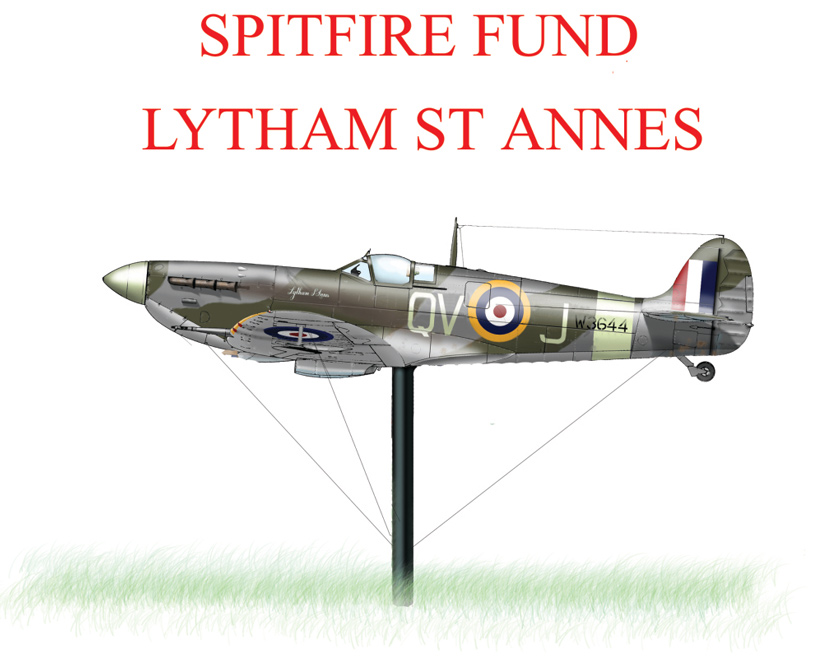
An early artists impression of what the Lytham St Annes Spitfire Memorial may look like
For a public servant, the fascinating story of local Spitfire Funds and the pride in supplying a presentation aircraft to the war effort must be inspirational and on discovering the existence of the Lytham St Annes Spitfire, it is perhaps no wonder that John Coombes was moved to try and commemorate its history. He slowly began to piece together a plan to have a permanent memorial erected in the town, which from the outset would involve a full size replica of the aircraft which went to war proudly displaying the name of Lytham St Annes on the side of its fuselage. It would require a significant amount of public money to see the project through to completion, so in 2009, The Lytham St Annes Spitfire Display Team was formed as the fundraising entity behind the Fylde Spitfire Memorial Fund. A team of volunteers would then attend local events, Airshows and 1940s weekends with the aim of raising as much money as possible – as their presence began to gain momentum, their displays would include a mobile Spitfire cockpit section, members wearing WWII uniforms and a collection of weapons and WWII memorabilia. Indeed, as the group really began fund raising in earnest, the opportunity to purchase a full size replica Spitfire, which was thought to have previously served as an RAF gate guardian, proved too good to pass up and the team’s ground display took on an impressive new perspective. We will be hearing a little more about this Spitfire in the next edition of Aerodrome.
As the fund raising efforts continued apace, further research was undertaken on the aircraft which the town purchased in 1941 with a donation of £6500 and its service record with the Royal Air Force. Following its construction, Supermarine Spitfire Mk.Vb W3644 was taken on charge at No.6 Maintenance Unit at Brize Norton on 16th July 1941. It appears to have spent the next few months at various technical establishments either being repaired as a result of suffering minor damage or being upgraded with the latest improvements. Flown to No.37 Maintenance Unit at RAF Burtonwood on 11th February 1942, the aircraft was finally allocated to No.19 Squadron, where over the course of the next few months, she would fly Ramrod and Rhubarb operations over enemy occupied Europe whilst stationed at several different RAF bases. She would have carried the distinctive ‘Lytham St Annes’ wording on the side of the fuselage, which marked her as a machine funded by the people of this Lancashire seaside community.
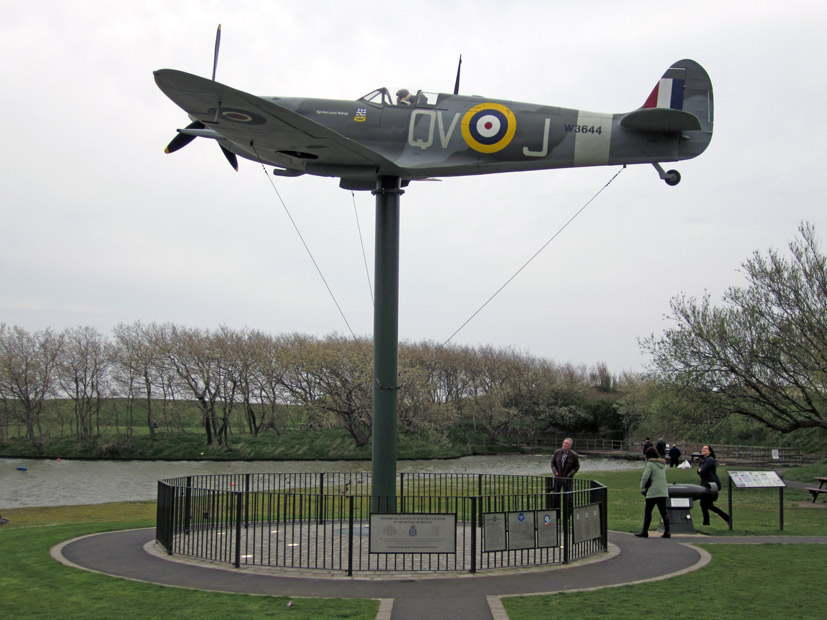
The Fairhaven Spitfire Memorial will always draw admiring glances, no matter what the weather
On 23rd June 1942, Spitfire W3644 had taken off from RAF Hutton Cranswick in Yorkshire, to fly a Ramrod bomber escort mission over enemy occupied France. Protecting a force of RAF Boston bombers sent to attack targets near Morlaix, the Spitfires of No.19 Squadron were bounced by the Focke Wulf Fw 190s of JG2 during their return flight to England. In the ensuing fighting, W3644 was shot down by one of the Luftwaffe fighters and seen to crash into the sea south of Start Point, off the south Devon coast – tragically, the young pilot, Sgt. Alan Lever Ridings, was to lose his life as a result of this combat. The research was given a new level of poignancy when it was discovered that 20 yr old Sgt. Alan Ridings was also a fellow Lancastrian, coming from the town of Middleton, just north of Manchester. Indeed, he also had family connections to Lytham St Annes, with his mother and Grandparents living in the area.
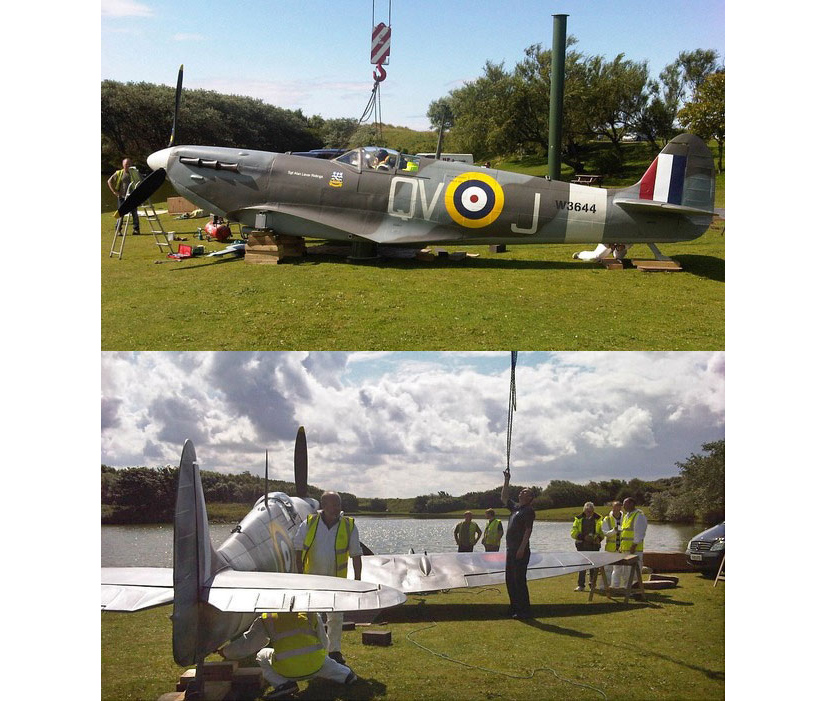
Some fascinating views of the Lytham St Annes Spitfire Memorial being lifted into place – Images are the property of photographer Amy Welch
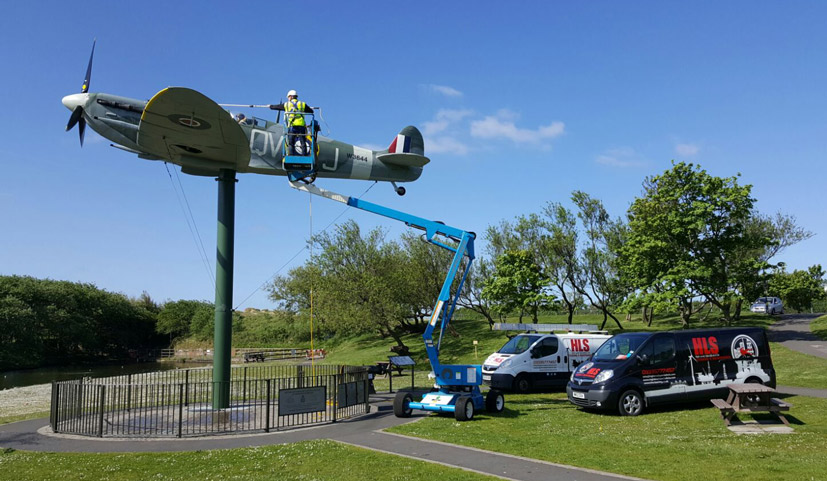
Thankfully, a long overdue splash of colour for the Lytham St Annes Spitfire, courtesy of specialist cleaning company HLS Cleaning
Following the culmination of much hard work by a great many people and three long years of tireless fundraising, the Fylde Spitfire Memorial Fund finally managed to achieve its target of raising £40,000 for the permanent memorial to Spitfire W3644, the generosity of the people of Lytham St Annes and local pilot Sgt. Alan Ridings, who was to lose his life whilst flying the aircraft in combat. With the project always intending to mount a full sized replica of the Spitfire on a display pole as a distinctive focal point for the memorial, a specialist manufacturing company was approached to construct the aircraft, once the target funds had been achieved. GB Replicas are one of the UK’s premier manufacturers of high quality, full size replica aircraft, with commissions coming from museums, collectors, Film and TV studios, as well as gate guardians at both current and former RAF stations. Based in Great Yarmouth, Norfolk, their engineers were only too happy to help with this fantastic project, constructing a faithful replica of Spitfire W3644, including the QV-J codes the aircraft wore whilst serving with No.19 Squadron at RAF Hutton Cranswick on the date of its final flight.
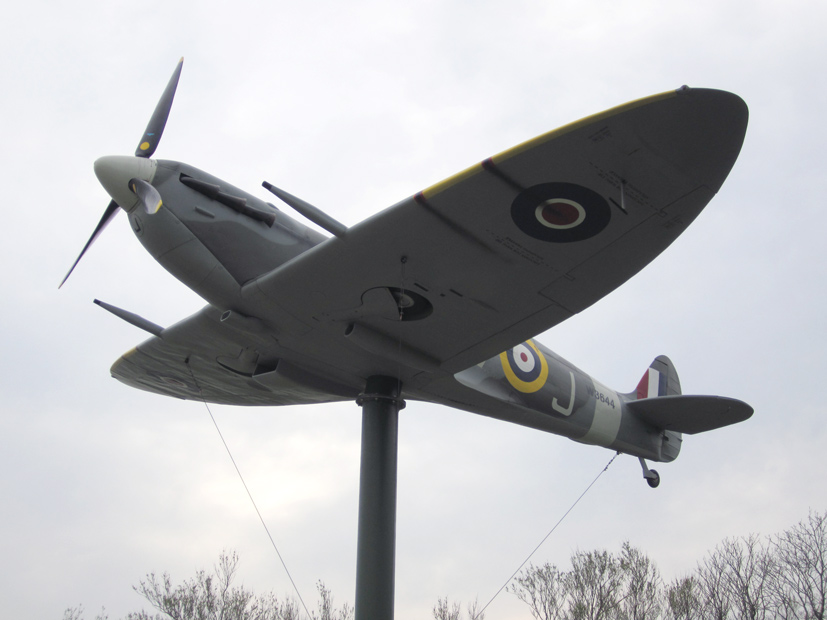
The imposing angle at which the Spitfire Memorial is positioned certainly allows a clear appreciation of the classic lines of Britain’s most famous aircraft
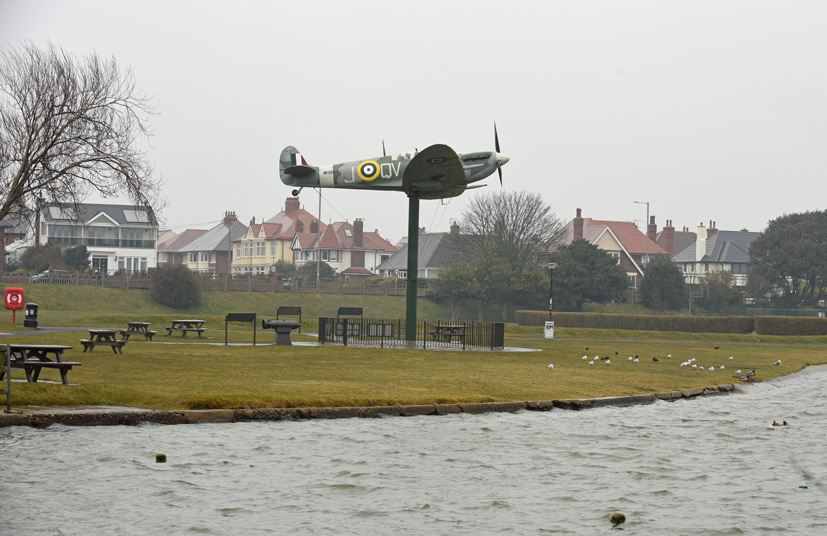
An alternative view of the W3644 memorial shows its position at the head of Fairhaven Lake and how effective a duck shelter in can be on wintery mornings
In what must have been a triumphant, yet slightly sombre occasion, the Lytham St Annes Spitfire memorial was officially unveiled at a ceremony at Fairhaven lake, Lancashire on 19th August 2012. Present at the ceremony were council officials and local dignitaries, members of the fundraising team, members of the public who had supported the project and relatives of the pilot who had been killed whilst flying the real Spitfire W3644. The site selected for the memorial is Fairhaven Lake, a local beauty spot and a place where people can enjoy some peace and quiet, taking time to read the various dedications and learn more about this distinctive local landmark. Proudly carrying the Lytham St Annes coat of arms and the name of pilot Sgt. Alan Lever Ridings on the port side fuselage, the memorial serves as a permanent reminder of the town’s significant contribution to the war effort during WWII and to the ultimate sacrifice made by a young pilot who bravely took his presentation Spitfire into battle.
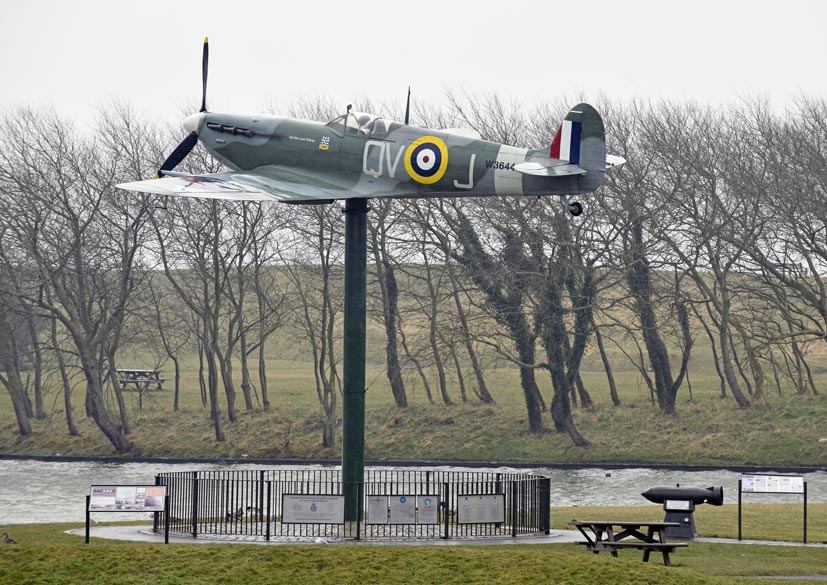
It is unusual not to see a crowd of interested onlookers under the memorial, unless you choose to visit on a freezing cold February morning
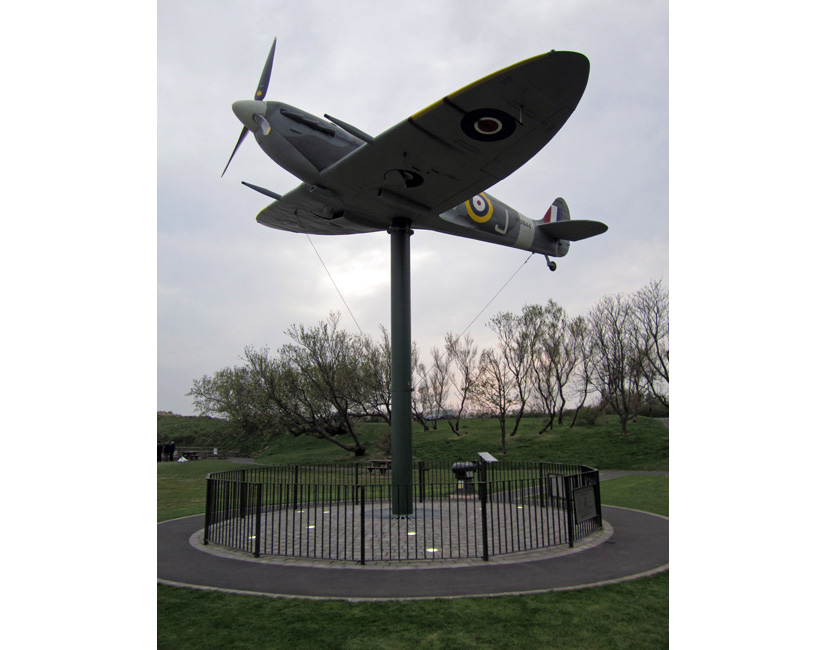
A magnificent tribute to a local airman and his Spitfire purchased by a Lancashire seaside town in 1941
With the Spitfire mounted high above the lake in dramatic flying configuration and a pilot figure sitting in the cockpit which adds real poignancy when reading the story behind it, this really is a fitting tribute to both pilot and the local community and the team behind the project deserve great credit. If you ever find yourself in the Blackpool/Lytham St Annes area, it is well work seeking out Fairhaven Lake and its distinctive Spitfire secret, you will certainly not be disappointed. I apologise in advance for the poor quality of the photographs I have included in this feature, unfortunately on both occasions I have visited the memorial, the weather has not been good. Indeed, during my latest visit only a few weeks ago, I discovered just how cold my finger ends can get without actually dropping off. I really must try to make my next visit on a nice summers day. I would like to thank The Lytham St. Annes Spitfire Ground Display Team’s Mike Fenton for his kind assistance with the production of this feature. We will be back in the area for more Spitfire discovery in the next edition of Aerodrome.
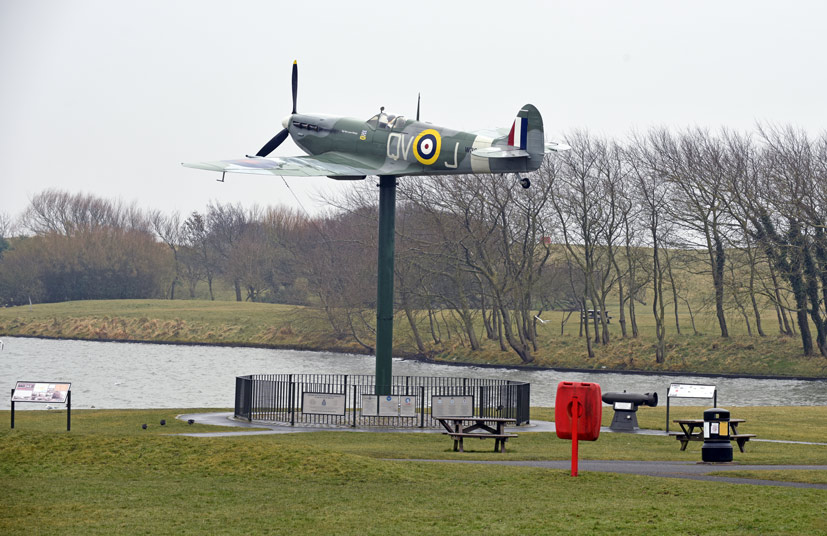
The Lytham St Annes Fighter, Bomber and Coastal Command Memorial with all its information placards and donations bomb
I’m afraid that’s all we have for you in this edition of Aerodrome. Please don’t forget, if you have any interesting aviation stories you would like to share with fellow Aerodrome readers, please do drop us a line as it would be great to hear from you. It is always interesting to discover new airfields, projects or historical facts behind the subject of aviation and we would be only too happy to include reader supplied features in future editions of our blog. If you would like to get in touch, please could you use either our aerodrome@airfix.com or aerodrome@corgi.co.uk e-mail addresses and we will endeavour to reply to all messages received.
If social media is more your thing, all the latest Aerodrome and aviation related discussions are taking place right now on both the Airfix Aerodrome Forum and Corgi Aerodrome Forum and your contributions will be most welcome. Again, if you have any specific comments, questions or suggestions for future editions of Aerodrome, please do feel free to drop us a line and let us know your thoughts. We also have our popular Airfix Facebook and Corgi Facebook pages, along with Airfix Twitter or Corgi Twitter accounts available for viewing – please could we ask that you use #aerodrome when posting about an aerodrome topic.
The next edition of Aerodrome is due to be published on Friday 23rd March and we look forward to seeing all back here then.
Thank you for your continued support.
Michael
Return to the Aerodrome Home Page
© Hornby Hobbies Ltd. All rights reserved.

