
As the world was plunged into the horrors of a savage global conflict in the early 1940s, it seems inconceivable that the spectre of intolerance and prejudice could still haunt the ranks of the mighty American war machine. With thousands of young African-American servicemen wishing to make their contribution in helping their country secure a victory for the free world, they were fighting an equally savage battle for equality even before they had set foot on the battlefield. It speaks volumes for the character of these young men, that they fought both of these battles with enthusiasm and tenacity and in the process, went on to write a glorious chapter in the history of the US Armed Forces. The story of the Tuskegee Airmen is one of frustration, disbelief and ultimate triumph, which thankfully leave most people who look into the subject with an enduring sentiment of hope. It is also a story that involves a very powerful and influential lady, who displayed immense courage in publicly supporting civil rights for her nation's black population.
The Tuskegee school was the brainchild of former slave and successful tradesman Louis Adams. After buying a suitable building, he secured the services of some of the country’s leading African-American business professionals and scholars so that he could give the best possible education to his future students. His fund raising activities were the stuff of legend and they were soon able to purchase 1000 acres of abandoned plantation land, which was to form the nucleus of the grounds of the future Tuskegee Institute and present Tuskegee University campus.
In the late 1930s, the US military selected Tuskegee to train African-American pilots due to the institute's commitment to aeronautical training, availability of instructors and suitable, if rather basic aerodrome facilities. Importantly for the programme, the climate in Alabama was conducive to year round flight training activities. In 1940, following instructions from President Franklin D. Roosevelt, the US Army created the 99th Pursuit Squadron at Tuskegee airfield - this facility would be used to train black pilots for the new squadron.
As Europe edged closer to war in 1939, US Congress had seen the need to drastically increase the number of trained pilots graduating from their flying schools. The Civilian Pilot Training Programme was established at universities around the country and following the concerted efforts of African-American activists, six historically black colleges were included in the new programme. The Tuskegee institute was selected as one of these colleges and following an outstanding record of success in the civilian flight programme, the US War Department selected Tuskegee to be one of the new pilot training facilities.
When considering the struggles of the Tuskegee Airmen, there is no avoiding the fact that this programme was taking place at a time of clear discrimination and racism. In the late 1930s there were no black pilots in US military service and many officers were either men of the South, where many people still saw black people as being inferior to whites, or they were indifferent to this open discrimination. Worse than this, a military report published some years earlier described black people as lacking the moral fibre for military service – disgracefully, the report concluded that black people were subservient, mentally inferior and barely fit for combat. Unequivocally, it went on to state that young black men would not be suitable for positions of authority, which very much included being put in charge of a military aeroplane.
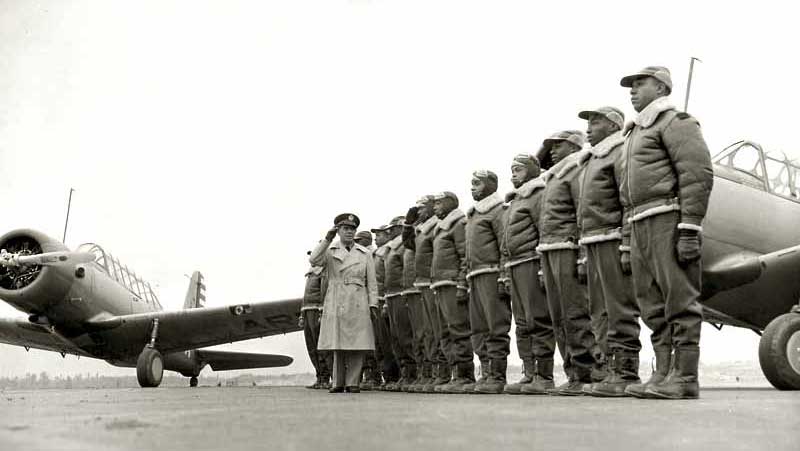
Trainee pilots stand to attention at Moton Field
The sinister undertones of the Tuskegee experiment are that it appeared to be offering totally diverse outcomes for a divided US population. For the young black men of the programme, who were keen to do their patriotic duty and show the world what they could do, it finally presented them with an opportunity to forget the discrimination they had suffered for most of their lives and train for war on an equal footing. For others, this was not an exercise in proving that black men were capable of becoming fighter pilots, but rather an opportunity to conclusively illustrate that they were not. Many people still did not want to see a black man flying a military aeroplane and were looking for an excuse to ensure this did not happen.
In March 1941, Mrs Eleanor Roosevelt, wife of the President of the United States, was in Tuskegee for a meeting with the trustees of the Julius Rosenwald Fund. Established to improve the educational opportunities and quality of life for black and other disadvantaged people, Mrs Roosevelt was a staunch supporter of the activities at the various Tuskegee campuses and was famous for her support of civil rights for her nation's black population. She was particularly interested in the aeronautical school that was operating at Tuskegee and this visit was to have a profound influence on the future of black American pilots in the US Air Force.
Having completed her trustee meeting in the morning, she spent most of the afternoon touring the hospital at Tuskegee, which was conducting pioneering work in the treatment of infantile paralysis – as usual, she took plenty of photographs, so she could give the President a full review of her visit. It is reported that as she finished her visit and made her way out of the hospital, she could hear the sounds of flying operations at nearby Moton field and informed her driver that she would like to be taken there. Obviously, there was also a large entourage of secret service personnel and other military officials and this impromptu diversion caused them to be more than a little uncomfortable. A quick phone call to the President informed him of this development, with the ultimate aim clearly being for him to refuse permission on grounds of security, but knowing his wife was strong minded and passionate about her support for the Tuskegee Institute, he simply replied, “Well, if she wants to go, there’s nothing we can do to stop her”.
As Mrs Roosevelt’s car pulled up at the Tuskegee airfield, she was clearly excited to finally be able to visit the establishment she was instrumental in setting up. Trainee pilots and officials alike were a little bemused by the melee that accompanied their illustrious visitor, but extended a warm welcome to all nonetheless. The First Lady was introduced to Charles Alfred ‘Chief’ Anderson, who was the head of the civilian pilot training programme at Tuskegee and its chief flight instructor. A significant figure in the US, Anderson was the first and at that time, only African American pilot to have received his commercial flying licence and was very much respected by the student pilots at Moton. Following the exchange of pleasantries with Mrs Roosevelt, the two began discussing how the young pilots were doing and if Anderson had all the support he needed. It is reported that the First Lady said to Chief Anderson, “Everyone is telling me that black people can’t fly aeroplanes.” Before Anderson could offer his reply, she then asked if he would take her for a quick aerial tour of the facility – this put him in a very difficult position, but he was talking to the First Lady of the most powerful nation on earth … what could he do?
Minutes before Mrs Roosevelt arrived at Moton field, a rather burly and serious looking secret service agent had approached Chief Anderson and informed him of the impending visit of his illustrious charge. He was also warned that under no circumstances should he offer to take the First Lady for a flight and if asked to do so, he should decline in the strongest terms. When Mrs Roosevelt made her request, Anderson apparently looked at the agent, looked again at the President’s wife and gladly accepted the opportunity. When recounting the incident later, Anderson is reported to have said, “This was the wife of the President of the United States – who was I to say no!”
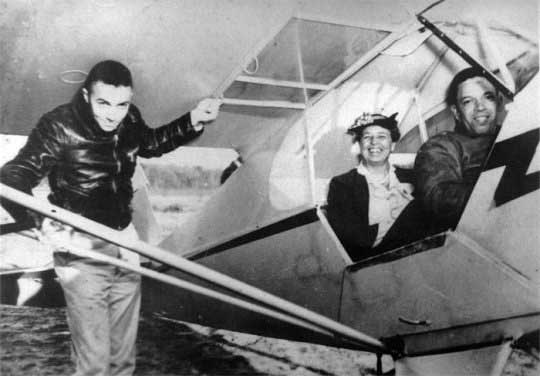
The First Lady Eleanor Roosevelt and her famous Tuskegee flight
Eleanor Roosevelt was a particularly impressive lady and it soon became clear that she had a specific reason for visiting the airfield at Moton and orchestrated what was something of a public relations masterclass. As she climbed into the back seat of the little Piper J-3 Cub light liaison aircraft, with Chief Anderson at the controls, she was insistent that her flight was photographed and that the film be developed immediately so she could take it back to Washington with her. The Piper Cub duly took off and the pair enjoyed an extremely pleasant forty minute flight around the Tuskegee area – as they did, a number of Secret Service agents were nervously awaiting their return to Moton Field.
The flight passed without incident and Chief Anderson recalled that the First Lady enjoyed the experience very much. When they landed back at Moton Field and the engine came to a halt, Eleanor Roosevelt said to Anderson, “Well, you can fly alright.”
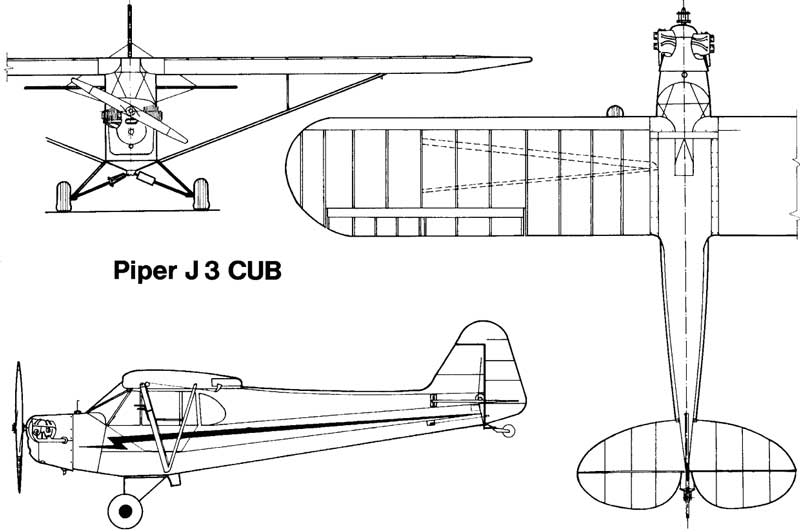 Plan drawing of the Piper J-3 Cub observation and liaison aircraft
This incident was to prove pivotal in the fight against segregation and discrimination in the US, as well as furthering the cause of the Tuskegee pilots. It was certainly the first time in history that a First Lady of the United States had flown in an aircraft, with a black pilot at the controls. More significantly, using her weekly newspaper column My Day as a medium, she used this visit to bring the activities of the Tuskegee Airmen to a worldwide audience – before this article, most people outside Alabama would have been completely oblivious to this programme, but following the publication of this famous picture she ensured that the trainee pilots at Tuskegee received the publicity they deserved. Looking at how happy she looks in the photograph, it makes you think that she must of had absolutely no trepidation whatsoever in taking the flight with Chief Anderson and was probably rather pleased with herself that her plan was coming together nicely – an extremely impressive lady.
There was obviously one other person that Eleanor Roosevelt wanted to influence and that was her husband, the most powerful man in the world – the President of the United States. She will have told him that she was extremely impressed with the capabilities of the trainee pilots at Tuskegee and that they should be incorporated into the flying training programme for Army Air Corps airmen at the earliest opportunity. Just weeks after Mrs Roosevelt’s visit to Moton Field, the 99th Pursuit Squadron was activated at Tuskegee and the African-American pilots based there began training to become fighter pilots in the US Air Force. Eleanor Roosevelt would continue to champion the causes of the Tuskegee Airmen.
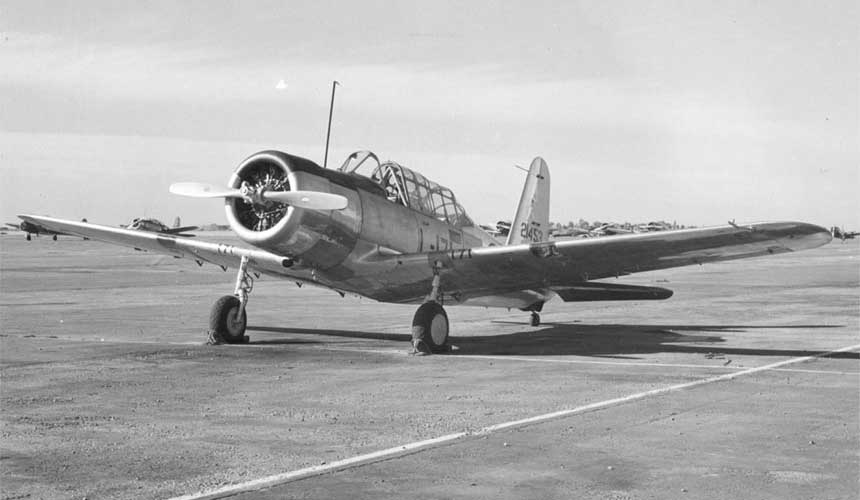 A Vultee BT-13 Valiant basic training aircraft used to train Tuskegee pilots
Despite some reports to the contrary, the flight training undertaken by the African-American pilots at Tuskegee was exactly the same as the training received by their Caucasian counterparts. As their training was taking place whilst the facilities at Moton airfield were being upgraded, initial progress was felt to be a little ponderous, but the programme soon sorted itself out and cadets began to excel. The young pilots received their basic and advanced flying training whilst at Tuskegee, with the eventual aim of transitioning to single engine fighters by the end of the course. The aircraft normally flown would have been the venerable Boeing Stearman bi-plane for primary flight training, followed by the monoplane Vultee BT-13 Valiant for basic training. The students would then move on to the AT-6 Texan for advanced flying training, before being introduced to the Curtiss P-40 Warkawk, which was one of the most advanced fighters in USAAC service at that time. The first black American pilot to solo as a USAAC officer was Captain Benjamin O. Davis Jr, on 2nd September 1941 and in March of the following year, the first batch of pilots from Tuskegee were inducted into the US Army Air Corps – a truly historic moment in American history.
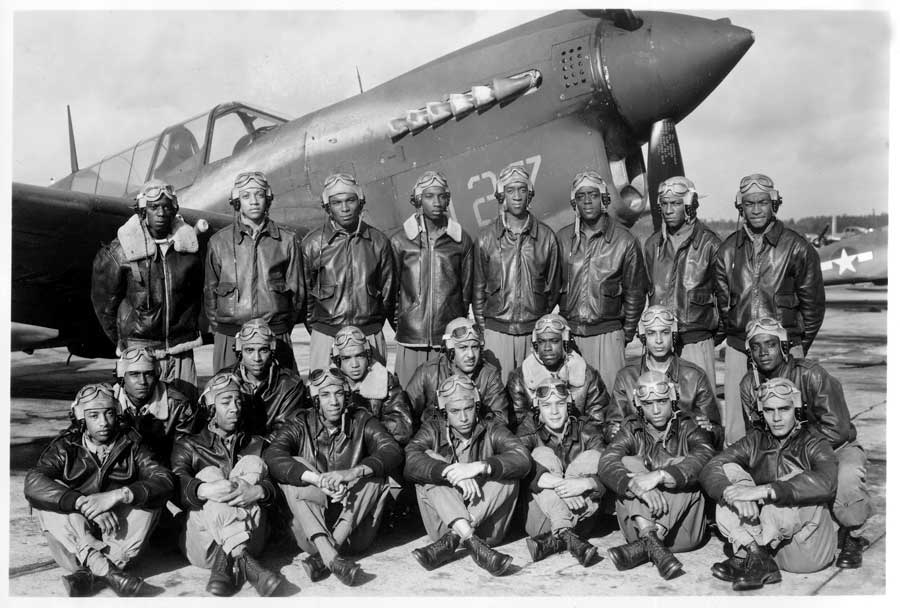 Iconic image of the Tuskegee Airmen and one of their P-40 fighters
The Tuskegee airmen of the 99th Fighter Squadron arrived in North Africa at the end of May 1943 and were assigned previously used Curtiss P-40 Warhawk fighters, which were already outclassed by the latest Luftwaffe fighters. Initially, the squadron were ordered to perform standing patrol sorties and ground attack missions in support of Allied ground operations. Whilst serving with the 12th Air Force, the 99th Fighter Squadron attacked countless enemy ground installations in Tunisia, Sicily, and on the island of Pantelleria.
The first aerial victory for a Tuskegee pilot occurred on the 2nd July 1943, when the Warhawks of the 99th were escorting a force of B-25 Mitchells, sent to attack targets around Castelvetrano, Sicily. As the formation approached the target area, a number of Luftwaffe Focke Wulf FW190s rose to challenge the bombers – immediately, the US Warhawks dived to attack them, which seemed to discourage the Focke Wulfs, as they all immediately broke off the attack. Without warning, two of the Luftwaffe fighters turned back and a dogfight ensued – 1st Lieutenant Charles B Hall attacked the first German fighter, which was caught in a well aimed hail of bullets. It fell from the sky and was seen to crash in flames – this was the first confirmed ‘kill’ for any of the Tuskegee airmen. The second Focke Wulf was engaged by Lieutenant W. I. Lawson, who raked the machine with bullets from his six .50cal M2 Browning machine guns and reported seeing smoke billowing from the German fighter. It was seen to plummet earthwards, but as none of the other 99th Fighter Group pilots actually saw it impact the ground, this could only be claimed as a ‘probable’.
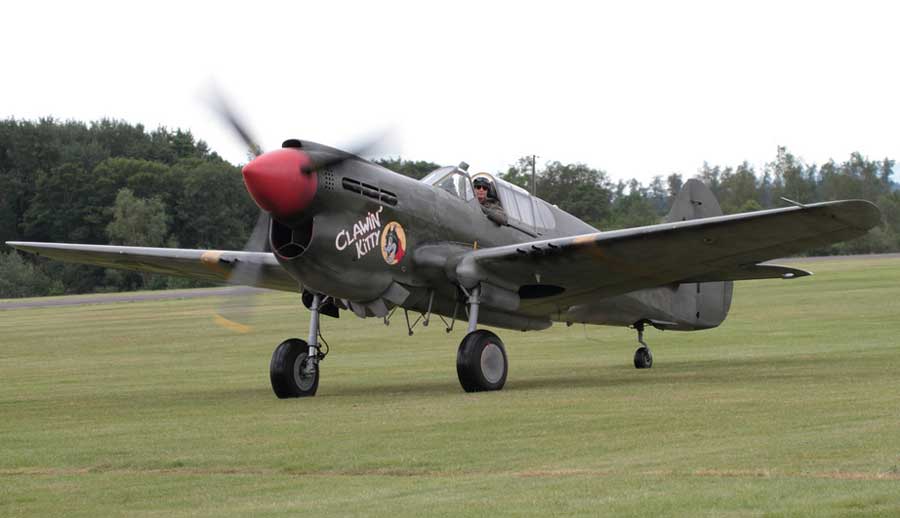 A restored P-40 Warhawk in Tuskegee Airmen livery
This should have been a day of celebration for the Tuskegee Airmen, as they had announced their combat arrival in theatre – unfortunately, it proved to be a day of sadness with the loss of two pilots. During the confusion of this first combat engagement, two of the P-40s collided in mid air and both 1st Lt. Sherman H White and 2nd Lt. James L McCullin were killed. These two pilots were to be the first Tuskegee Airmen to be killed in combat.
Unfortunately, the combat introduction of America’s first black airmen did not occur without prejudice and discrimination rearing its ugly head again, with some white commanders questioning the resolve of the 99th Fighter Squadron pilots. When the Tuskegee pilots had first entered theatre, the squadron had scattered when attacked by enemy fighters, which was seen as unforgivable by some commanders and a clear indication of their unsuitability for the task. When looking closer into this incident, the squadron was on one of its first missions and was still coming to terms with actual combat. They were bounced by a much superior force of enemy aircraft, diving from a position high above them and from out of the sun – it was absolutely the worst tactical position to begin an engagement and most fighter pilots would have done exactly the same thing – live to fight another day! The fact that it was the unfashionable Tuskegee pilots that were involved resulted in it being viewed as an unforgivable lack of discipline and there were calls to send them back stateside immediately.
Well-used to prejudice and hardship, commanders of the 99th argued that rather than withdrawing the unit, they should be given a much more prominent role in the fight against Nazi Germany. Instead of undertaking tedious standing patrols and ground strafing missions, they should be let loose against the Luftwaffe. In early 1944 the Tuskegee Airmen, who were now the 332nd Fighter Group, which comprised of the 99th, 100th, 301st and 302nd Fighter Squadrons, were assigned to the US 15th Air Force and tasked with flying bomber escort missions from Ramitelli air base in Italy. Now equipped with the rugged Republic P-47D Thunderbolt, they had the opportunity to see much more action as they completed escort missions into southern and central Europe, right into the teeth of the Luftwaffe. Combat victories for Tuskegee pilots began to increase steadily and the legend of the ‘Fighting Red Tails’ began to take shape.
As the pilots of the 332nd Fighter Group settled into their new role, they were finally in a position to show what they could do. Confident in their abilities and wanting everyone to know who they were dealing with they painted their aircraft with distinctive red spinners and red tails – this helped identify them as a friendly unit to the bombers they were protecting and as an adversary to fear for the pilots of the Luftwaffe.
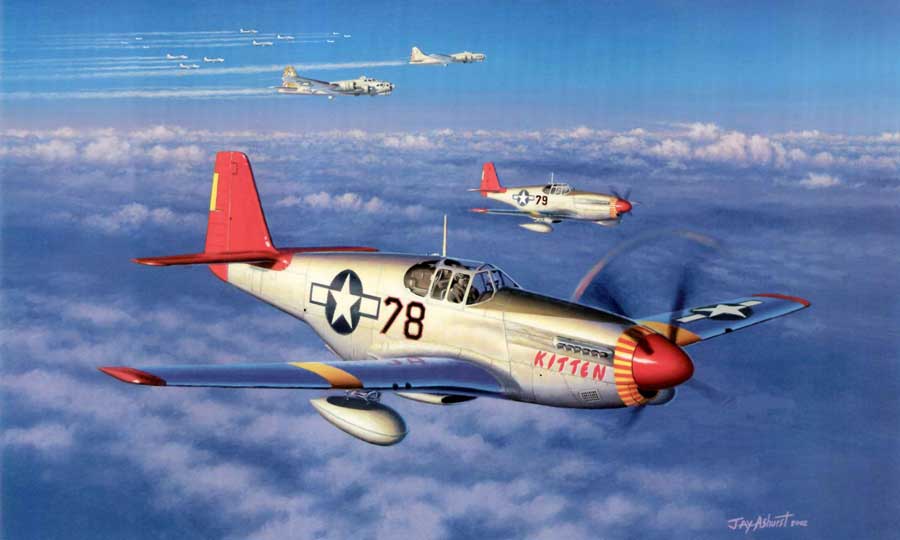
Magnificent painting by Jay Ashurst entitled ‘Fortress Delight – Red Tail rendezvous at dawn’. We would like to thank Jay for allowing us to use this stunning image
On a typical bomber escort mission, the Tuskegee fighters would fly above the bombers, weaving from side to side, in order to stay close to the slower moving bombers – this tactic also allowed them alternate positions in which to search for any impending enemy fighter attack. Whilst the ‘Red Tails’ were proving to be highly proficient at shooting down enemy fighters, they were also steadfast in protecting the bombers under their charge – a fact that was very much appreciated by the bomber crews. There had been some complaints from bomber crews that fighter units assigned to protect them would chase after Luftwaffe fighters at the first opportunity, leaving them to fend for themselves if attacked again. Luftwaffe units quickly learned to send in small numbers of aircraft to draw off the protecting US fighter escorts, before committing larger numbers against the unprotected bombers. Shunning the opportunity for personal glory, the pilots of the ‘Fighting Red Tails’ would remain with the bombers throughout their mission, acting as a high profile deterrent against any potential Luftwaffe fighter attack and more importantly, much appreciated reassurance for the vulnerable bomber crews. Indeed, so effective were the Tuskegee Airmen at their assigned task that bomber crews throughout the Mediterranean Theatre would actually request the Red Tails as their assigned escort fighters.
Asked to give an interview after the war, one B-24 Liberator pilot recalled “the P-38 Lightning pilots always seemed to stay too far away from us, whilst most of the Mustang groups stayed in too close. All they wanted to do was go down on the deck and chase those 109s, but the Red Tails were always there, right where we wanted them to be! We loved those guys. We had no idea that the pilots were black – this was the best kept secret in the Army Air Corps.” I am not too sure about the final comment, but it was clear that the Red Tails of Ramitelli were well respected by friend and foe alike.
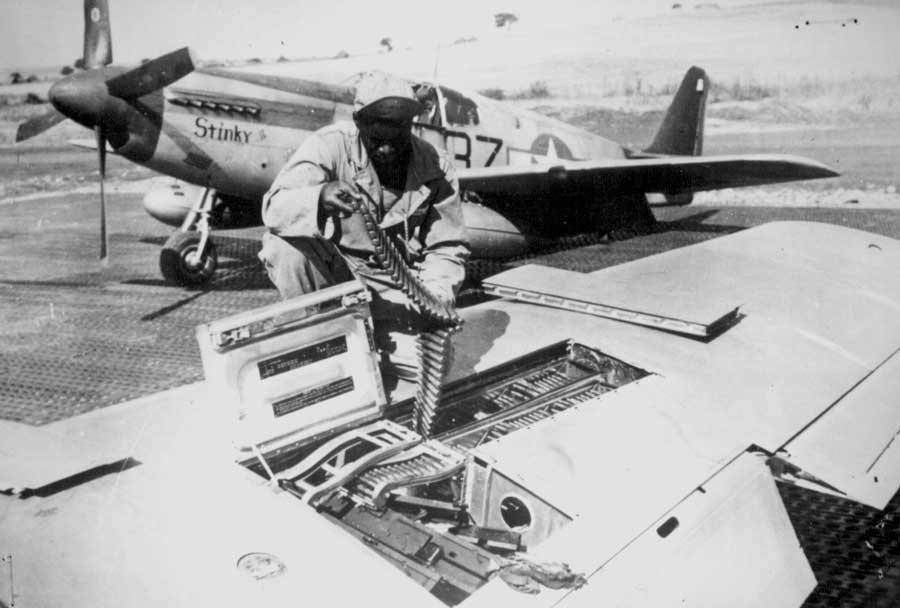 Tuskegee ground crew re-arming a North American Mustang
In spring 1945, the Chicago Defender newspaper ran an article claiming that in over 200 escort missions the Tuskegee Airmen had never lost a bomber under their charge to enemy fighter activity. This story became popular folklore and the Red Tails were revered for this unbelievable achievement – unfortunately, it was not true. Combat and loss records could not be accurately verified until quite recently, when it was discovered that a total of 27 bombers were lost whilst protected by the Red Tails, but this compared with an average loss rate of around 50 aircraft when compared to other escort groups in the 15th Air Force – nearly double the loss rate of bombers protected by the Red Tails.
There was a price to pay, however and even though the unit was to enjoy an enviable combat reputation, they did not achieve the number of aerial victories enjoyed by other fighter units. In obeying their orders and steadfastly sticking with the bombers they were assigned to protect, the men of the 332nd Fighter Group were not in a position to rack up their personal victory scores – they did earn the lasting respect of many airmen who may not have survived the war had it not been for their devotion to duty. The history books will show that no Tuskegee Airman was to achieve ace status (scoring five or more aerial victories) for many of the reasons discussed above, although it is argued that Lt. Lee Archer should have had his score of 4.5 victories upgraded to 5, as his bullets were the ones that finally downed the .5 shared victory. Despite this, the Red Tails managed to destroy 111 Luftwaffe aircraft in the air, with a further 150 on the ground in a relatively short period of time in the final months of WWII. The Luftwaffe referred to the Tuskegee Airmen as the Schwartze Voglemenschen – ‘Black Birdmen’ and learned to fear the Red Tailed Mustangs of the 332nd Fighter Group.
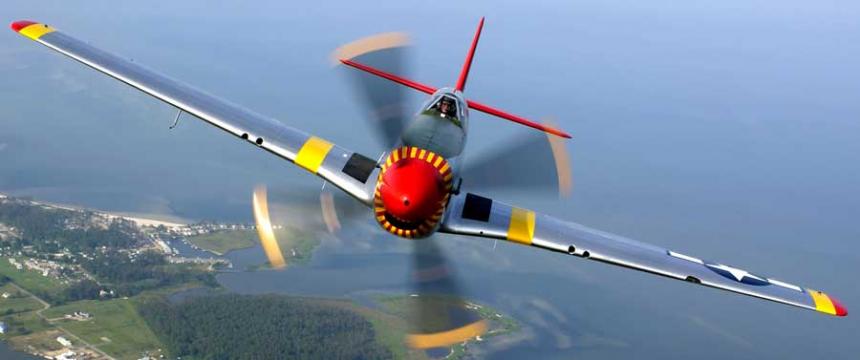
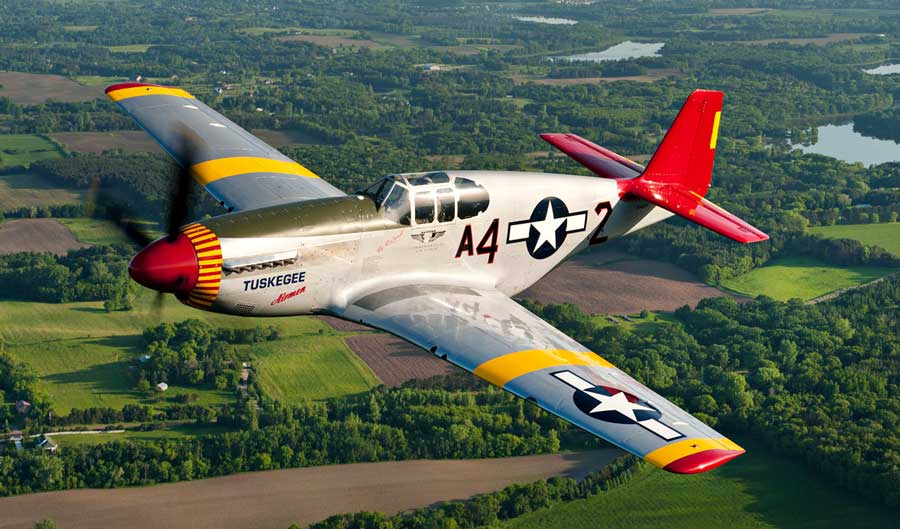 Beautiful air to air image of the Tuskegee P-51C by Max Haynes. Thank you to Max and the Red Tail Project for allowing us to feature this image
In the last months of the Second World War, the tide had very much turned in favour of the Allied forces and German resistance was become more sporadic, but more desperate. Although the numbers of enemy fighters rising to challenge Allied bombers was diminishing, they could count amongst their numbers some of the highly advanced jet and rocket fighters of the Third Reich. These posed a significant new threat for Allied airmen, but fortunately the Red Tails were up to the task. On 24th March 1945, 43 Tuskegee P-51D Mustangs were escorting a large force of 5th Bombardment Wing Flying Fortresses sent to attack the Daimler-Benz tank factory in Berlin. As they approached the target area the Luftwaffe attacked in some strength – amongst the attacking aircraft were Messerschmitt Me 163 Komet rocket powered fighters and the new Messerschmitt Me 262 twin engined jet fighter. Both of these aircraft had a significant speed advantage over the American Mustangs and it would certainly be difficult to thwart a concerted attack against the bombers, but the Red Tails were brave, tenacious and in no mood to allow their bombers to fall prey to the Fuhrer's wonder weapons. The 332nd tore into the attack and even though no Tuskegee pilot had managed to shoot down a Luftwaffe jet before this day, they would claim three destroyed in just a matter of minutes. Three different pilots would manage to destroy an Me 262 on this day – 1st Lieutenants Roscoe C Brown and Earl R Lane and 2nd Lt. Charles V. Brantley all joined the illustrious 262 killers club and for its outstanding performance in combat on that day, the 332nd Fighter Group was to be awarded a Distinguished Unit Citation.
The Tuskegee Airmen conducted themselves with bravery, determination and dignity on two fronts during the 1940’s. Not only did they take on the best pilots that the Luftwaffe hurled against them, in the skies above Europe and the Mediterranean, but they also fought the discrimination and bigotry, which they were forced to endure a little closer to home. Their story is one of pride and achievement, which paved the way for many black American service personnel in the years that followed and will serve to inspire anyone who cares to look in to the story of the ‘Fighting Red Tails’.
The colourful aircraft of the Tuskegee Airmen have long been a favourite with both the die-cast aviation collector and plastic modellers, with something of a renaissance taking place following the release of the 2012 feature film ‘Red Tails’. The Corgi Aviation Archive range has included Tuskegee Airmen releases of both the Republic P-47 Thunderbolt and the North American P-51D Mustang in 1/72nd scale, with examples appearing in both the standard range and the more elusive US Special releases. Unfortunately for us collectors there is not currently an example of a Corgi Red Tail available, but with the impending release of the completely re-tooled P-51D Mustang we can only hope that we will be presented with a new model announcement in the not too distant future. Until then, I am afraid that it is the secondary market for a die-cast Tuskegee fighter model, if you have yet to add one of these to your collection.
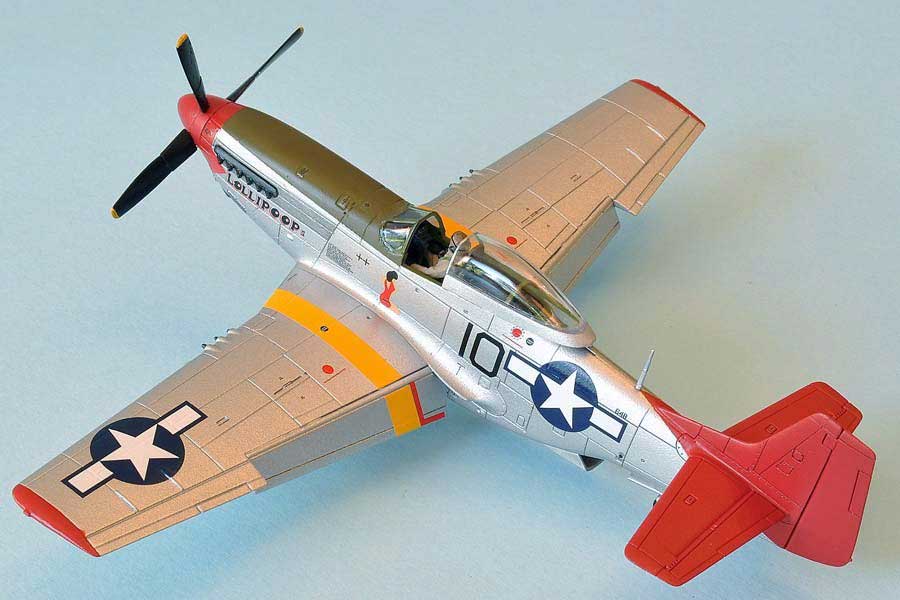 A beautifully finished model of a 1/72nd scale Tuskegee Mustang
The plastic modeller is faring a little better on the Red Tails front, as Airfix currently have a classic 1/72nd scale version of the P-51D Mustang available (A01004), which is in the colours of 1st Lt. Spurgeon Neal Ellington, who was flying in the colours of the 100th Fighter Squadron out of Ramitelli airfield. His personal aircraft was named ‘Lollipoop II’ and Ellington was a prolific strafing ace, earning the Distinguished Flying Cross for his low level exploits.
Airfix also have an impressive example of a Tuskegee Mustang in the much larger 1/24th scale, but I am afraid that this is now sold out on the Airfix website, although you may still be able to find this kit in your local stockist.
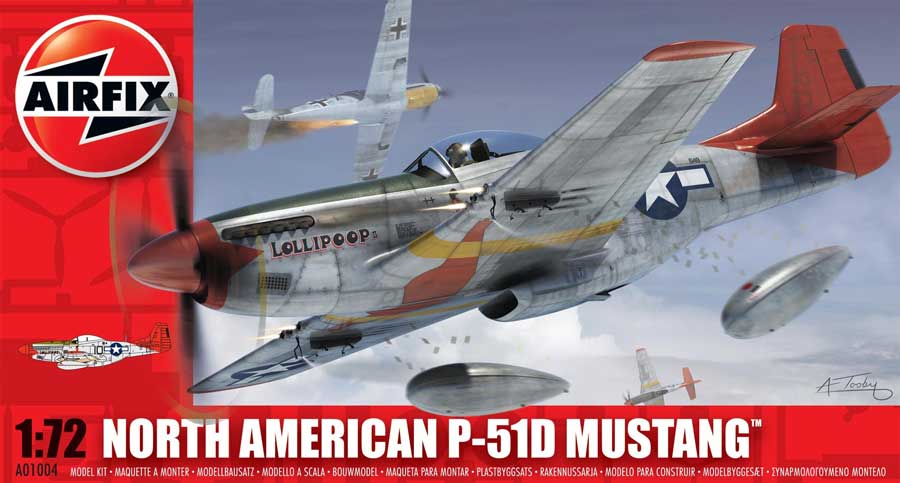 Evocative artwork featured on the Airfix kit packaging
I hope that you have enjoyed our latest edition of Aerodrome – it certainly includes some real food for thought. I know that I have been left with great admiration for Mrs Roosevelt who was a really impressive lady. She was probably the best ally that particular President had!
Next week we will be taking a look at one of the many Airshow events of the summer, but this one can actually boast the appearance of an Avro Lancaster.
You can discuss this week's blog on the Airfix Aerodrome Forum or Corgi Aerodrome Forum, and if you have any comments, questions or suggestions for future editions, please feel free to let us know on Airfix Facebook or Corgi Facebook, or on Airfix Twitter or Corgi Twitter using #aerodrome.
As usual, thank you very much for reading and for your continued support. I'm off on my holidays tomorrow (which will undoubtedly involve some plane spotting), so Aerodrome will be taking a break next week and will be back on the 21st.
Michael
© Hornby Hobbies Ltd. All rights reserved.
Archive images licensed under Public Domain via Wikimedia Commons, other images used with permission where credited

