

With the days now growing slightly longer and the sun putting in the odd appearance now and then, this is the time of year when the aviation enthusiast begins to get a little excited about the coming Airshow season and starts planning which events to attend. After studying the Airshow calendar and cleaning your camera and lenses, it is time to prepare your excuses for the weekends that you are intending to spend away from the family – this can be one of the most challenging conversations of your entire year. In any case, the first few months of any new year are usually a time for planning and preparation, as the majority of the events we hope to attend are still many months away – well, that is usually the case! This year, even though we are still only in the middle of March, I have been fortunate enough to break my aviation duck for 2016 a couple of times already and this latest edition of Aerodrome will feature an extremely enjoyable recent visit to the Newark Air Museum.
Even though I have been a passionate aviation enthusiast for most of my life, I am embarrassed to admit that I had never previously visited the Newark Air Museum and with this in mind, I was very much looking forward to making my first visit and discovering the aviation delights on display at this long established aviation museum. As usual, an early start was the order of the day, to ensure that I could get maximum benefit from my visit and unusually for this time of year, I was rewarded with a dry and reasonably fine day. With my trusty camera in hand to record the day’s proceedings, I thought that my visit would make an interesting feature for this week’s edition of Aerodrome, for anyone who has yet to visit this magnificent museum, or those who would just like to re-acquaint themselves with a favourite destination. With so much information gathered during my visit, it will not be possible to fit everything into a single feature, so I intend to produce further articles in future editions of Aerodrome throughout 2016, but for now, I hope you enjoy the first instalment of the Aerodrome visit to Newark Air Museum.
Situated two miles north east of Newark on Trent and just a short distance from the A1 motorway, the Newark (Notts & Lincs) Air Museum is conveniently located in the centre of England and is relatively easy to find. I say relatively easy, as most visitors will probably use the postcode of the museum to instruct their car satellite navigation system to plan the route and this will more than likely take you past the main entrance. Occupying a section of the Newark Showground, the postcode covers a wide area and if you are looking for a specific museum entrance off the A1133 Drove Lane, you will probably miss your turning – look for the brown museum sign on the road, which will direct you to the main showground entrance and on to the air museum itself.
The Newark Showground is a major attraction in this part of the world and hosts activities and exhibitions covering agriculture, antique fairs, vintage tractor shows throughout the year and has other attractions such as motor auctions, a golf centre and the air museum on site. The entire site occupies 200 acres of the former Royal Air Force airfield at Winthorpe, which was purchased from the Ministry of Defence in 1964, following the cessation of flying operations at the base some years earlier. It is fitting that the Newark Air Museum occupies part of this former operational airfield and helps to commemorate the men and machines that were stationed there.
Officially opened in September 1940, RAF Station Winthorpe (No.51 Base) was a wartime expansion airfield and constructed as a satellite airfield for nearby RAF Swinderby. Almost as soon as the airfield was opened it was attacked by the Luftwaffe, who dropped parachute landmines over a wide area – although the runway suffered some damage, there were no reports of casualties during, or as a result of the attack.
The first units to operate from Winthorpe were the Polish bomber crews of Nos. 300 and 301 Squadrons Royal Air Force, who flew bombing training missions in their Fairey Battles and Vickers Wellingtons - these aircraft operated from the grass runway at Winthorpe when the airfield at Swinderby was waterlogged. On 23rd June 1941, a damaged No.301 Squadron Wellington crashed at a nearby farm following a raid against targets around Bremen. Although two airmen were tragically lost as a result of the crash, the farm tenants, Mr and Mrs Broadberry bravely pulled the remaining crew members from the burning wreckage of the Wellington. For their selfless act of bravery, they were both awarded British Empire Medals.

An early Avro Manchester Mk.I twin engined heavy bomber
In 1942, the airfield was temporarily closed to allow the laying of extensive concrete runways and support buildings, in preparation for Winthorpe to be able to operate four-engined heavy bombers. Unfortunately, the layout of the main runway was poorly thought out and would have seen fully laden aircraft passing right over the nearby Ransome and Marles ball bearing factory – for this reason, the airfield was never developed into a fully operational bomber base. Instead, late 1942 and early 1943 saw the arrival of No.1661 Heavy Conversion Unit and its invaluable training infrastructure for new and replacement heavy bomber crews. This important work saw the majority of Britain’s heavy bombers being based at Winthorpe until the end of WWII, including Manchesters, Lancasters, Halifaxes and Stirlings, along with many thousands of aircrew and support personnel. The station would also still act as a relief landing ground for many of the surrounding RAF bases that littered this area of the country – although not particularly well known outside the local area, RAF Winthorpe actually played an important role during the Second World War.
Following the end of WWII, the Heavy Conversion Unit was quickly disbanded at Winthorpe and the airfield passed to the control of RAF Transport Command and satellite duties for RAF Syerston – over the next few years, RAF Halifaxes, Dakotas, Oxfords and Horsa gliders would all use the airfield as a practice dropping zone and aircraft were still regularly operated from Winthorpe. This was to be something of a swansong for flying operations at the airfield, as the following ten years saw RAF Winthorpe change ownership a number of times, whilst still remaining under Ministry of Defence control – significantly many of these changes involved ground based operations and flying was a rare occurrence. By 1959, the airfield was more or less closed and was handed to the care of RAF Maintenance Command, before receiving a new lease of life following the acquisition of 200 acres of the site by the Newark and Nottinghamshire Agricultural Society in 1964.

Almost as soon as the Winthorpe site had been purchased from the MOD, discussions began to take place about the possibility of establishing an aviation related museum on the former RAF Winthorpe site and over the next few years, a committed group of enthusiasts began to put their plans into action. As aircraft and exhibits began arriving at the site, members sought and were granted charitable status, formed a limited company and secured a permanent home for their collection. On 14th April 1973, the Newark Air Museum officially opened to the public and from this date, the volunteer trustees have been continually striving to expand and improve both their collection of aircraft and artefacts, along with visitor experience and enjoyment.
Their collection of aircraft, aero engines and aviation relics now form part of one of the largest non-profit making volunteer managed aviation museums in the UK, with their major source of income coming from public admissions and any trading profits from their on-site shop. This certainly makes a visit to their impressive museum all the more impressive, as a great many people must have voluntarily given up their time and expertise over the past forty-six years – let’s take a closer look at a few of their magnificent aircraft.

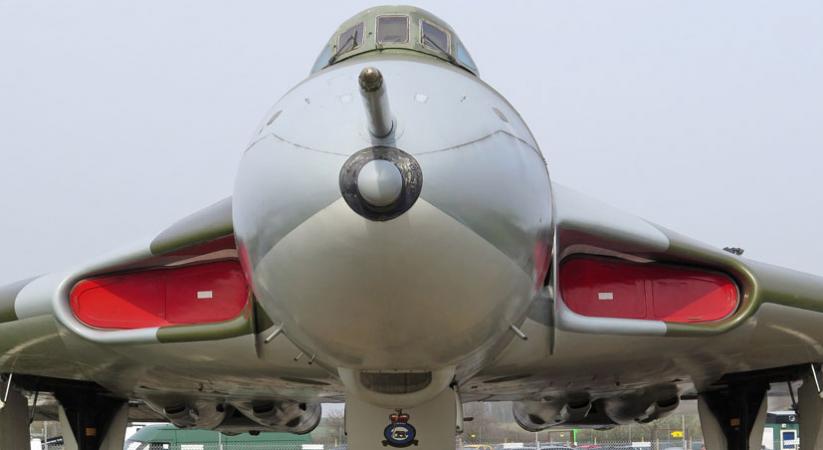
Avro Vulcan B.2 XM594 at the Newark Air Museum
When you first arrive at the NAM and look through the fence, the first thing you notice is the imposing profile of the mighty Avro Vulcan, which dominates the front area of the museum. This particular Vulcan (XM594) was the 58th B.2 version produced by A.V.Roe at Woodford and flew for the first time on 4th June 1963, before joining RAF No.27 Squadron at Scampton. Equipped with the ‘Blue Steel’ nuclear stand-off missile, XM594 formed part of Britain’s independent nuclear strike force, which acted as a potent and highly visible deterrent to any nation that may have contemplated a nuclear strike against the UK.
After conversion back to conventional bomber configuration, this aircraft went on to serve with both No.101 Squadron and No.44 Squadron, both based at RAF Waddington. Its last operational sortie was as part of the last Vulcan scramble on 17th December 1982 – no less than 7 Vulcans took part in this impressive demonstration, as the Vulcan prepared to bow out of RAF service. On the same day, four of the seven Vulcans involved in the scramble (XM594 acted as a reserve) flew in formation over former RAF Vulcan stations, as this unique aircraft made its farewell flight.

Evocative study of Britain’s Cold War nuclear deterrent
The last flight of the NAM Vulcan B.2 took place on 7th February 1983, when she was flown from her home base at RAF Waddington to the Newark Air Museum site at Winthorpe. Not only was this one of the largest aircraft to land at the former RAF Winthorpe site, but for this historic flight, it was captained by decorated Falklands War pilot Squadron Leader Neil McDougal, who was more than happy to recount some of his Vulcan flying exploits to the gathered NAM volunteers.

The Vulcan is one of the museum’s most popular exhibits
Avro Vulcan B.2 XM594 is kept in fine condition by the museum volunteers and is a hugely impressive exhibit – indeed, most British aviation enthusiast visitors will probably tell you that seeing this mighty delta winged bomber is worthy of the modest entrance fee alone. If you are lucky to visit when museum staffing and weather conditions allow, for a modest donation to museum funds, you can actually climb into the cockpit area and sit at the navigator's table, which gives you a clear picture of the operating environment in which RAF Vulcan crews plied their trade. For such a mighty aeroplane, there really isn’t much space available for the crew members and looking at the gap between the pilot and co-pilots seats that would have to be negotiated to take their positions, those chaps would have to have been slight to say the least. A thoroughly enjoyable few minutes, pretending to be Vulcan aircrew.


Avro Ashton fuselage WB491 is now an extremely important aviation artefact
As you walk past the Vulcan at NAM, you see the rather interesting fuselage section of another aircraft, which was also the product of the prolific Avro factory at Woodford, but is even rarer than the Vulcan it sits beside. With just six aircraft built, with each one being slightly different from the other, the Avro 706 Ashton was never intended for commercial airline use, but served as an experimental fleet to explore and perfect the concept of jet powered civil aviation. All six aircraft were converted from Avro Tudor piston engined airliners, which had proved to be something of a failure as an intended transatlantic airliner. The piston engines used on the Tudor were replaced with four Rolls Royce Nene turbojets, which were mounted underneath the wings, one either side of the fuselage. Housed in two sleek paired nacelles, The Ashton had a unique profile and must have been an attractive aircraft to see in flight. Although little known, the Ashton airframes made a significant contribution to the advancement of both jet engine design in the UK and the development of commercial jet transportation across the world.

The unusual looking Avro 706 Ashton prototype jet airliner

The last remaining fuselage section of the Ashton jetliner
The Newark Air Museum is now the only place in the world where you can see part of an Avro 706 Ashton ‘flying laboratory’, which has to be considered as one of the jewels in the crown of this fantastic museum. Donated by managers at BAe Woodford in 2003, this forty-five foot long section of nose and fuselage is all that remains of the six Avro Ashtons, which provided the British aviation industry with such valuable research and engine development data during the 1950s.

The Blackburn Buccaneer is a particularly handsome aeroplane
One of the aircraft I was particularly looking forward to seeing was the museum's beautiful Buccaneer S.1, if for no other reason than the Buccaneer is one of the most attractive jet aircraft to have ever served with the Fleet Air Arm/Royal Air Force and there is something rather enigmatic about the look of naval aeroplanes. This particular aircraft was the 31st constructed from an original batch of 40 Buccaneers ordered by the Ministry of Aviation and went on to serve with Nos. 736, 800, 801 and 803 Naval Air Squadrons during her rather short eight year service career. Seeing service at land based naval stations and on board HMS Victorious, perhaps the most notable chapter in the history of XN964 came in 1967, when it was one of the aircraft used in the bombing of the crippled supertanker ‘Torrey Canyon’, which ran aground on the Seven Stones Reef, off the coast of Cornwall.

Naval aircraft are always popular with the aviation enthusiast

Buccaneer S.1 XN964 photographed in fading light
Following the end of her service career, XN964 returned to where she was first produced by Hawker Siddeley at Brough, North Humberside where she became a ground instructional airframe for the next five years. Thankfully, the affection in which the Buccaneer is held by the aviation enthusiast ensured that she would not end up in the hands of the scrap man, but instead was bought by the Loughborough and Leicestershire Air Museum and transported to Bruntingthorpe airfield. It was from here that the Newark Air Museum managed to acquire the aircraft in early 1988 and arranged for a police escorted road transfer to the RAF Winthorpe site on Sunday 13th March 1988. It is somehow fitting that these photographs were taken one day short of the 28th anniversary of the Buccaneer arriving at the Newark Air Museum. As one of the most attractive exhibits, XN964 occupies a prominent position at the museum, so she can be enjoyed by all who visit her.

My personal favourite at Newark – the imposing Handley Page Hastings
Of all the superb aircraft on display at the Newark Air Museum, I have to admit that my personal favourite is Handley Page Hastings T.5 TG517, a huge RAF freight and troop carrying load-lugger which entered service in the late 1940s. Built as a replacement for the rather limited Avro York, which was in itself a freight carrying adaptation of the Lancaster, the Hastings was the largest transport plane ever designed for the RAF when it entered service in 1948. Powered by four Bristol Hercules 101 14-cylinder sleeve valve engines, the Hastings must have been a noisy beast and I can only imagine how fantastic they must have sounded.

The Hastings was powered by four mighty Bristol Hercules engines
Initially rushed into service to take part in the Berlin Airlift, the Hastings made its first Berlin sortie on 11th November 1948, with the aircraft usually carrying coal as its main cargo. By the end of the operation in October 1949, 32 RAF Hastings transports from Nos. 47, 53 and 297 had taken part in delivering more than 55,000 tons of supplies in ensuring the Allied sectors of Berlin survived the blockade. Tragically, two aircraft were lost during this hectic period of flying activity, resulting in the deaths of five RAF aircrew.
The museums Hastings TG517 was the 19th C.1 machine built for the RAF and was initially delivered to No.5 Maintenance Unit at RAF Kemble in July 1948. Serving with Nos. 47 and 53 Squadrons, TG517 served with distinction during the Berlin Airlift, before being converted to MET.1 standard in 1950 and equipped with specialised weather reconnaissance equipment. In this specialist role TG517 served with No.202 Squadron at RAF Aldergrove, Northern Ireland until 1958, when she was again required to undergo further conversion – this time, she was the first of eight Hastings C.1 airframes to be converted to T.5 standard. For this new role, she was equipped with a large ventral dome, which contained radar bomb sight equipment and was assigned to the RAF Bombing School at RAF Lindholme, in Lincolnshire, where she remained until 1968.

Hastings TG517 is complete with some rather fishy mission markings
By the late 1960s, RAF transport Hastings were being withdrawn from service, following the arrival of Argosy and Hercules replacements and with no interest from civilian operators, most of these beautiful aircraft were simply scrapped. The last four T.5 aircraft, including TG517 were operating with the radar flight of No.230 Operational Conversion Unit from RAF Scampton, who unofficially christened themselves ‘1066 Squadron’ in recognition of their aircraft’s name. TG517 saw active service during the third Icelandic ‘Cod War’ and flew four long fishery protection sorties – as you can see from the pictures above, TG517 has the fishy mission markings to prove it. As the aircraft were finally withdrawn from RAF service and an uncertain fate awaited the remaining airframes, TG517 was purchased by former Lincs Lancaster Association Chairman Stuart Stephenson and after just four hours notice, the aircraft was flown into the former RAF Winthorpe site on 22nd June 1977. Hastings TG517 has recently been gifted to the museum and is most definitely one of the most impressive aircraft on display.
I don’t suppose that many people would include a transport aircraft amongst their favourites, but I challenge anyone to stand underneath the beautifully imposing frame of the Handley Page Hastings at Newark and not to form a little aviation infatuation. With the four massive Hercules engines and a nose that simply towers above you, everything about the Hastings is power and proportions, but despite this, it really is a good looking aeroplane. She is also now quite a rare bird and of the 151 aircraft built, she is one of only four complete aircraft preserved today – two other T.5 examples at Cosford’s Cold War Museum and at the Allied Museum in Berlin, with the sole surviving C.1A Hastings on display at The Imperial War Museum Duxford.

I wonder if any Aerodrome readers were lucky enough to see a Hastings in flight? If you did, please do let us know.
There is so much more to tell you about the Newark Air Museum, but for this edition of Aerodrome, we are going to leave it there. As promised earlier, we will look at some of the other exhibits in a future edition, especially the Avro Shackleton Mk.3 WR977, which is just about to embark on a major repainting programme, which will be a significant and costly undertaking for the museum. I have the ‘before’ pictures and intend to bring you updates throughout this ambitious project, right up until the completed aircraft is unveiled – I am sure that you will join me in wishing the NAM volunteers every success.
To bring this first Newark Air Museum feature to a close, I would like to say that I thoroughly enjoyed my day at this fantastic museum and some of the volunteer members that I managed to speak to on the day. Everyone was enthusiastic and friendly and really did help to create a very pleasant atmosphere for enthusiasts and members of the general public to enjoy their visit – if you do decide to discover this little aviation gem for yourself, you will certainly be assured of an extremely warm welcome.
Even though this was my first visit to the NAM, it will most certainly not be my last. I will be hoping to make regular visits in the future, to show support for the fantastic work this committed group of volunteers are doing for aviation history in the UK. As possibly the most accessible aviation museum in the country by nature of its central location and close proximity to the A1, the Newark Air Museum is definitely well worth a visit and even though we have only looked at some of the aircraft displayed outside, there are numerous exhibits displayed within two extremely well stocked hangars to be discovered as well.
I am afraid that’s all we have for you in this latest edition of Aerodrome, but I hope that you have enjoyed the first part of our visit to Newark. As promised earlier, we will have more for you in a future edition, but if this has whetted your aviation appetite, I can thoroughly recommend a visit to this excellent museum. As usual, if you would like to discuss our latest blog, you can head for either the Airfix Aerodrome Forum or our Corgi Aerodrome Forum and join the chat. If you have any specific comments, questions or suggestions for future editions of Aerodrome, please do feel free to let us know by using either the Airfix Facebook or Corgi Facebook pages, our Airfix Twitter or Corgi Twitter accounts, using #aerodrome.
Please spread the Aerodrome word! If you have any friends or acquaintances who you feel would enjoy reading our aviation related blog, please let them know that they can find us at either http://www.airfix.com/uk-en/news/aerodrome or http://www.corgi.co.uk/news/aerodrome. You can also pick up Aerodrome on both the Corgi and Airfix Facebook pages.
Thank you very much for reading our latest blog and I look forward to posting the next edition of Aerodrome in two weeks’ time.
Michael
© Hornby Hobbies Ltd. All rights reserved

