

Welcome to the first edition of an exciting new development for the aviation enthusiast on the Corgi website – Aerodrome.
Like the intrepid early aviation pioneers, we are at the start of a journey here and although I certainly know what I am looking to achieve with this new weekly aviation blog, I am sure that there will be some turbulence along the way – time to get airborne now though!
My name is Michael Clegg and some of you may know me from my previous position as owner of the Flying Tigers website. I am passionate about all things aviation and have been an avid modeller, collector, supplier and photographer of aviation subjects for most of my life. I hope that the Aerodrome blog will be an opportunity for like-minded enthusiasts and collectors alike, to indulge in the subject they love and share ideas and information on an aviation theme. I will work tirelessly to make this new area of the Corgi website as informative and enjoyable as I possibly can - this is a significant new challenge for me and I am very much looking forward to earning my wings.
I think that people who have a hobby in their lives are extremely fortunate. A pastime, or interest where you can completely escape into your own little world, even for just a short while, allows you to shed the stresses of a busy life and provide a welcome opportunity to re-charge your batteries. I sincerely hope that Aerodrome will become a little part of your escape.
With so many ideas for Aerodrome flying around in my head, it was difficult to know which subject to begin our very first edition with. Unfortunately, a rather sad and significant aviation anniversary dictates that there really can only be one aircraft to take this honour – the beautifully enigmatic British Aircraft Corporation TSR.2.
Few aircraft in the history of the British aviation industry raise as much debate amongst enthusiasts and historians alike as the BAC TSR.2 – an aviation acronym that provokes more strong feeling than almost any other in aviation. Illustrating everything that was wrong with British aviation manufacturing in the late 1950s and 1960s, the TSR.2 project perversely also illustrated that Britain was capable of being the world leader in aviation technology and could produce aircraft that were significantly ahead of the competition. Like many high profile government projects, cost was to be the defining factor in the TSR.2 story, but not before this magnificent aircraft had left an indelible impression on the world of aviation.

Development of the TSR.2 (Tactical Strike and Reconnaissance, Mach 2) project was to begin as the RAF searched for a successor to their English Electric Canberra bombers. Operating at high altitude, these subsonic bombers, which relied on their speed for protection, were becoming increasingly vulnerable to the latest Soviet surface to air missile technology. In order to keep pace with the Eastern Block, a new aircraft would be needed to provide the Royal Air Force with a high-speed tactical strike and reconnaissance capability and preserve Britain’s deterrent threat.
The new aircraft would need to have a significantly enhanced operational range capability, be able to achieve speeds in excess of Mach 1.5 at altitude and also possess the ability to deliver a variety of weapons at high speed and at low level. Add to this the requirement to gather airborne reconnaissance information more effectively than any aircraft that had gone before it and you have the design brief for the new aircraft.
Anyone who has been lucky enough to see one of the remaining TSR.2 airframes at either the Imperial War Museum Duxford, or the RAF Museum Cosford, will have marvelled at the impressive size and futuristic profile of this magnificent aircraft. There is no doubting that the aircraft would not look out of place on any modern airfield and you can’t help thinking what might have been, had the TSR.2 actually made it in to service.
It would have surely been a huge success for the British aviation industry, had all the technological advances actually made it on to a service aircraft and it would have undoubtedly also been a significant export success for our government. Unfortunately, we will never know the answer to this, or indeed the politics behind the decision to cancel the project, but admiring XR220 at Cosford, you can’t help but wonder what might have been.

The design brief for the team behind the TSR.2 project was obviously an extremely demanding one. It was clear that the aircraft they were working on would be a significant leap forward in aviation manufacture, with almost every aspect of its design utilising new and ground-breaking technologies. In the end, this was to prove to be the Achilles heel of TSR.2, as the manufacturing companies, sub-contractors and the government, failed to establish a coherent management process, to drive this monumental aviation project.
The development process was becoming ponderous, with constant delays and setbacks, due to the advanced nature of the technologies being employed, inter-service disagreements and numerous design ‘tweaks’, as the TSR.2 neared its flight-testing programme. Rather than producing a combat aircraft that would be the envy of every air force in the world, they were managing to produce something of a bureaucratic monster.
The constant delays and disruptions were to result in serious cost escalations, which were eventually to prove far too excessive for this ambitious project to support and was the main reason why the TSR.2 project was doomed before the aircraft had even flown. With Britain suffering a period of financial austerity and a change of government expected soon, BAC were desperate to get their new aircraft in to the air, so that they could show government ministers what they would be getting for their money. Despite some lingering technical issues remaining unresolved, particularly around engine management and performance, the decision to fly was confirmed – TSR.2 was to be unleashed on the aviation world.
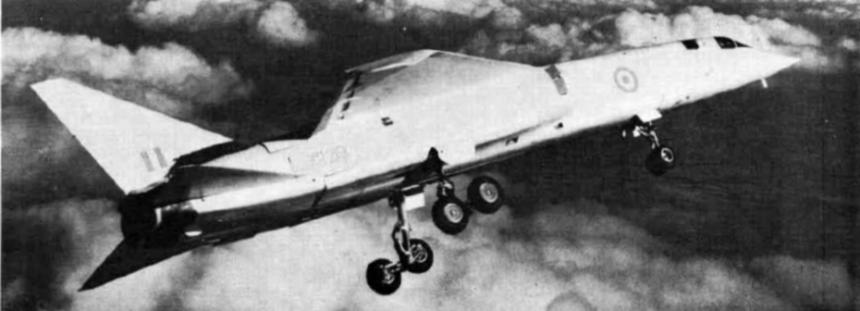
On 27th September 1964, with BAC chief test pilot Roland Beamont at the controls, TSR.2 XR219 blasted off the runway at Boscombe Down and into the aviation history books.
She looked every bit the cutting edge combat aircraft she was designed to be and on the surface, it looked as if Britain had a real winner on their hands. Add to this the fact that XR219 simply looked so spectacular and you can see why the British public were so excited by this stunning new aircraft.

On the early flights, engine and stability issues continued to challenge the design team, even though these test flights were completed at lower speeds, with the undercarriage remaining lowered. More problems occurred when the highly complex undercarriage sequencing system was tested – this almost resulted in the prototype aircraft being lost, as the undercarriage failed to deploy correctly and the crew were actually cleared to abandon their aircraft. It was only down to the determination, professionalism and bravery of the test crew that XR219 made it back to Boscombe Down in one piece.
History will show that the only TSR.2 airframe to take to the skies was XR219, but during her flight-testing programme, enough data was extracted to prove that this was an exceptional aircraft in every respect. Describing the aircraft as the most advanced combat aircraft in the world was not an exaggeration and TSR.2 had the potential to be everything the project team had hoped she would be. Unfortunately though, the spiralling cost overruns proved just too painful for the incoming government to bear and the budget of April 1965 announced the immediate termination of the TSR.2 project, despite previous government assurances to the contrary.
What followed next gave rise to the numerous conspiracy theories that continue to surround the enigma that was the TSR.2 project. With what seemed like undue haste, the government ordered the destruction of not only the TSR.2 airframes that were already in various stages of construction, but also the manufacturing jigs used to build them. Was the end of the TSR.2 dream all simply about a lack of cash, or were there more sinister forces at play?
In the end, only one TSR.2 was to take to the skies – XR219. She was to end her days on a Ministry of Defence firing range at Shoeburyness, where she was used to assess the vulnerability of modern aircraft systems to gunfire and shrapnel damage – such an ignominious end for this most famous British aircraft.
We do still have two almost complete TSR.2 airframes for us to marvel at and to wonder what might have been, had the aircraft been fully developed. If you have been lucky enough to see one of them, you will know what I mean when I say that this is one spectacular looking aeroplane. XR220 can be found in the Research and Development hangar at the RAF Museum Cosford and is the most complete example of a TSR.2 still remaining. The second aircraft XR222 resides at the Imperial War Museum Duxford and even though neither of these aircraft actually took to the skies, they do serve to mark one of the most significant aircraft in the history of the British aircraft industry.
The famous aeronautical engineer Sir Sydney Camm said of the TSR.2 ‘All modern aircraft have four dimensions: span, length, height and politics. TSR.2 simply got the first three right”.

It was obvious that an aircraft with the high profile history of the TSR.2 would be of interest to the die-cast aviation collector and the Corgi Aviation Archive range gave us something of a classic model in 1/72nd scale. It could be argued that this is one model that only Corgi could have produced, which can also be said about their highly successful 1/72nd scale Avro Lancaster and new Avro Vulcan models. One thing that is certain, a display featuring these three models is definitely going to turn heads!
The first model in the Corgi TSR.2 series was AA38601, which was released back in July 2009. It presented the most famous aircraft in the TSR.2 story, XR219, which was the only aircraft to take to the skies, during the test programme of 1964/65. The model was incredibly well received by the die-cast collector and sold out extremely quickly – this model is now an incredibly difficult one to obtain.

The second release in this series presented the collector with XR222. This aircraft was the fourth prototype to be produced and has been finished as it looked when the restored aircraft was rolled out at the Imperial War Museum, Duxford, in 2010. Again, this model has now sold out and is a difficult one for the collector to come by.

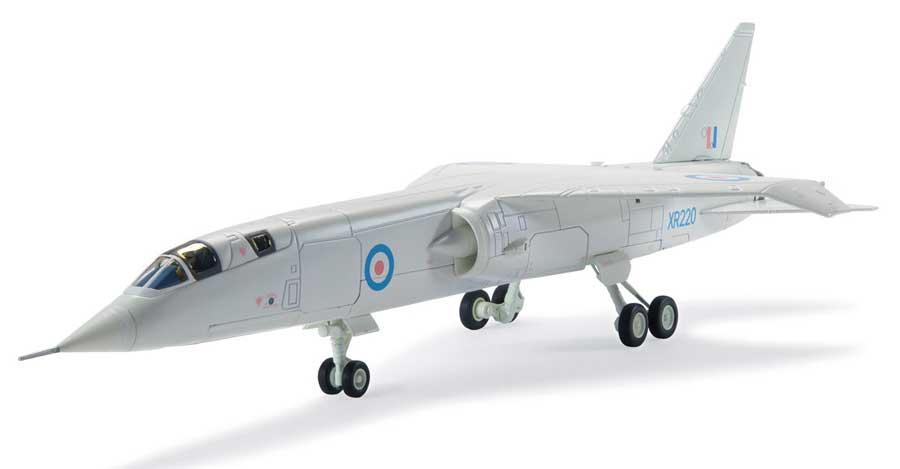
The third and latest release in the series is AA38603, which is the only Corgi TSR.2 model that can still be obtained by the collector. Indeed, we have recently seen this magnificent model offered at a significant discount on the Corgi website, even though numbers are dwindling dramatically now and this could be your final opportunity to secure one. This release presents the collector with XR220, which is the magnificent aircraft displayed in the Research and Development hangar at Cosford and is the most complete TSR.2 airframe still surviving.
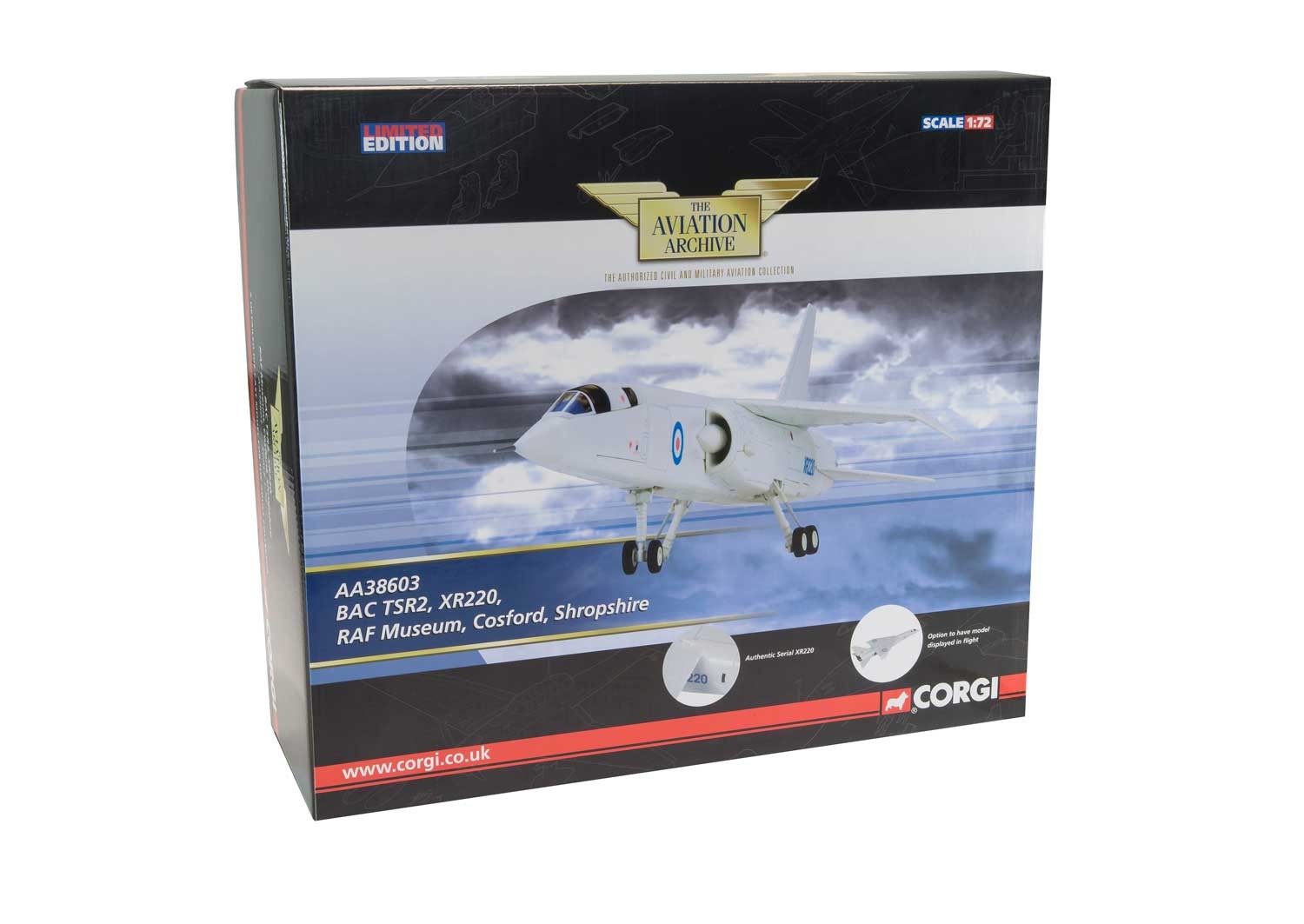
This model also benefits from some tooling modifications, which did not appear on the previous two model releases. The test programme highlighted problems with the operation of undercarriage sequencing system and XR220 added some strengthening to the oleo legs. It also featured a pair of rear facing cameras, mounted in fairings on each side of the fuselage, which enabled technicians to view the operation of the undercarriage system and these additional developments are included on this latest model. Although XR220 was not the famous, flying TSR.2 airframe, the fact that it is displayed in all its glory at RAF Cosford, for all to see, makes AA38603 an incredibly desirable model to collect in its own right.
For an aircraft that never actually saw service, the British Aircraft Corporation TSR.2 is one of the most famous aircraft ever produced in Britain. It is a story of success and failure in equal measure and one which still captivates the aviation enthusiast the world over.
Well, that is our first Aerodrome done and dusted. I really hope that you find this first an enjoyable read and that you will join us again next week and for future editions. Why not tell me what you think, and what you'd like to see in future editions on the new Aerodrome Forum, or on the Corgi Twitter feed using #corgiaerodrome.
Thank you very much for reading.
Michael

